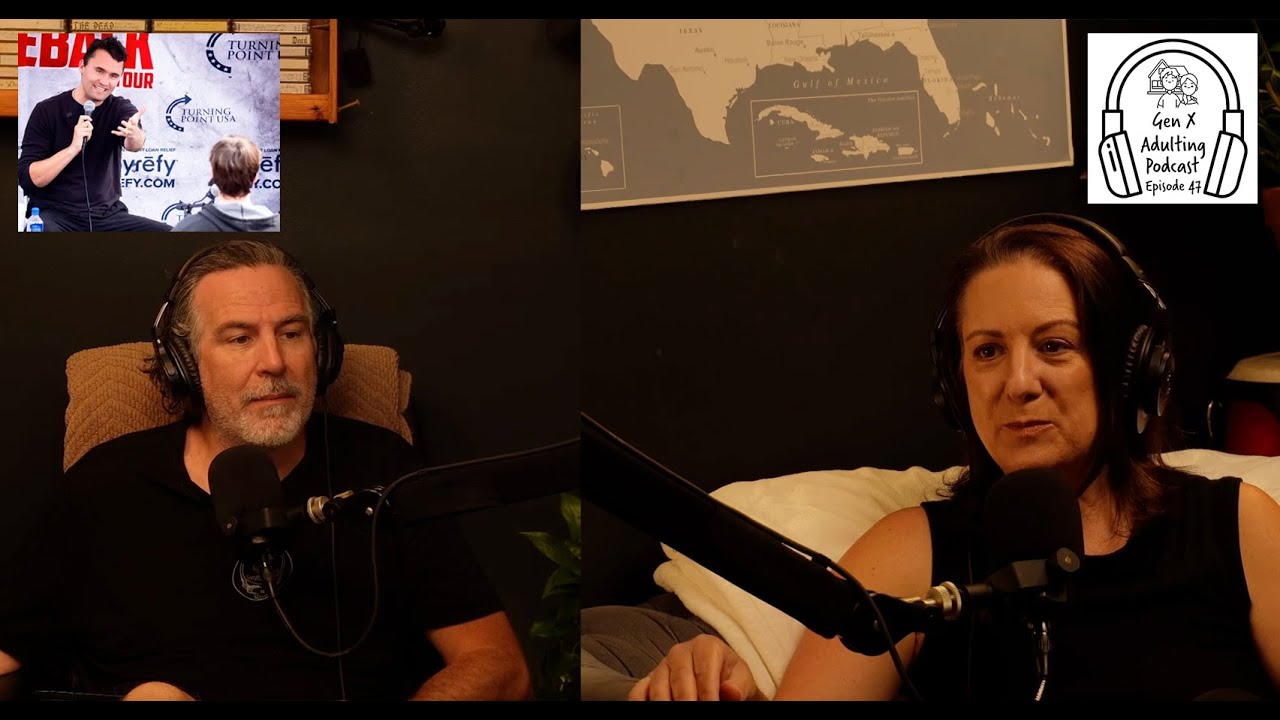
In Episode 47 of GenX Adulting, the hosts discuss the recent assassination of Charlie Kirk, a prominent conservative figure known for his debates on college campuses. They reflect on his impact on political discourse, the reactions to his death, and the broader implications for free speech and societal division.
[Music] Welcome to GenX Adulting. It's been a week here in America. We've had quite a week and I'm sure it's touched some people around the world. So we are going to do an episode on the assassination of Charlie Kirk. When we first started this podcast, our motivation, in addition to having guests on to share their life stories, that would resonate with people around the world and help people feel seen and heard and maybe not so crazy sometimes. But it was also to tell our story, our stories and our individual stories and then our story together as a married couple for almost 32 years, 31 years. I don't know, I've lost track now. Raising children and sharing our opinions and wisdom and thoughts through the from what we've learned through the years. But also in the hopes that our grandchildren, great-grandchildren, great-great-grandchildren and future generations could look back and see what their great-great-grandparents thought about different things that were going on in the world in addition to listening to our story. And this week we experienced a historical moment in history, no question. Something that I'm sure future generations will be interested in and read about and maybe even learn about. So I think it's worth covering and I think you agreed as well, Brian, that it was worth covering. Yeah, I think it's worth covering. It's covering it's, you know, a lot of folks are calling it a watershed moment. Yeah. Comparing it to Kennedy or comparing it to MLK or Malcolm X or any number of other political assassinations or, you know, well-known figureheads who've been assassinated or killed. Right. So again, yeah, the historical significance I don't think can even be realized right now. I don't think we even know. So I think it's important that we do an
assassinated or killed. Right. So again, yeah, the historical significance I don't think can even be realized right now. I don't think we even know. So I think it's important that we do an episode on it for that reason alone as well as other reasons for sure. So for those who don't know who Charlie Kirk was, Charlie Kirk. So do you think that's even possible at this point? Well, I don't know. Everyone knows Charlie Kirk. Yeah. Charlie Kirk. You know, the interesting thing about Charlie Kirk is that he was a very young man. Yeah. He was 31. I believe his birthday is next month. He would have been 32. I've learned. I knew of Charlie. I listened to Charlie at different times. He would pop up in social media and I would stop to listen to what he had to say or to listen to his back and forth on college campuses. So I certainly knew of Charlie, but I've learned a lot about a lot more about Charlie just in the last few days. And one of them is that his birthday is next month. He started turning point USA, I believe, when he was 19, some reports, 18, some reports say 19. We can go with 18. Did you know he was a really good, I guess, football player like he could. He was at a football camp. I saw on social media a video of him throwing footballs with some kid that became a professional. I just saw that today. And he threw like this 45 yard pass like it was nothing. Yeah. Yeah. I didn't know that. You know, he's a, he was a big tall guy. Six, four. Yeah. Six, four. That's pretty good height. So that's a NFL quarterback, you know, height type of guy. Yeah. I did see a video short of his or, you know, I think people were talking shit like, Oh, you can't throw football. And he put up a short showing him doing that. It was at some college
guy. Yeah. I did see a video short of his or, you know, I think people were talking shit like, Oh, you can't throw football. And he put up a short showing him doing that. It was at some college campus in a, in a stadium. And yeah, he launched it. Yeah. Nice pass you through. Yeah. It's a, it's a aspect again, I didn't know about him. So, but he started turning point. I want to say this was in 2012, very young, if the math, math's and with just a folding table and a chair, he would go to college campuses with a sign that would say prove me wrong and really promote discussion conversation. You know, the concept of going into a college campus, I was thinking back to myself and how old, you know, when I was on a college campus and I was, and if somebody like Charlie Kirk would have come to my college campus, I was in college from 1989 to 1993. If somebody would have, he was born in 1993. No, it's a trick. He was wow. Yeah. So if somebody would have come to our college campus, because we went to school together. Um, do you, do you remember who did come to our college campus? Jerry Brown came to our college campus, the previous governor of California, but do you know who else came? Nothing. Not that I could think of Jesse Jackson. Oh, maybe. Do you remember that? Jesse Jackson came. He's from the, the SCU, the Stevenson union. Yeah. And it, what's remarkable is there was no security. Maybe there was, right? There might've been security. Yeah. The way that all that campus laid out is it was kind of in a bowl in a sense, right? He walked down the hill. Yeah. He was right there at the, the, the, the student union. Um, I remember going and listening to him. It was a trip and I'm no Jesse Jackson fan, but I know I'm skipping
down the hill. Yeah. He was right there at the, the, the, the student union. Um, I remember going and listening to him. It was a trip and I'm no Jesse Jackson fan, but I know I'm skipping ahead in some ways, but I never thought I'd do anything bad. Right. No, no. It was when he was Jesse Jackson, part of the rainbow coalition. And he was just getting into like official politics. I think he ran right when Clinton was president. Yes. Jesse Jackson was one of the candidates and he, he was going to colleges and he swung through Ashland. And I remember seeing him there. Yeah. Because we went to, again, um, at the time it was called Southern Oregon state college in Ashland, Oregon, this beautiful Shakespearean artsy community, still gorgeous. Um, in a Valley, 20 miles north of the California border, very small school, small community. So when anyone would come to our campus, I totally forgot about Jesse Jackson. I went to Jerry Brown. You know, who else came that was famous? Who fish? Yes. So we, yes. Side track. We saw fish in a very small, like gymnasium type. And there was like a hundred of us. It was when fish just started out totally off topic. So if somebody like Charlie Kirk had come to our campus, I look back at the person I was then young, uh, really didn't know anything, but I thought I did. I don't know if I would have, I certainly wouldn't have stopped to have a conversation with him. I probably would have, I would have completely totally judged him and completely scoffed and probably stood there and laughed along with people. Some of the things I would have been immature. I wouldn't have had the maturity to realize the impact of what he was doing. It doesn't matter what his views were. I wouldn't have
Some of the things I would have been immature. I wouldn't have had the maturity to realize the impact of what he was doing. It doesn't matter what his views were. I wouldn't have had the maturity to realize that he was coming into the lion's den of idealistic thought and welcoming altering views, altering opinions. I wouldn't, I wouldn't have, I'm saying for myself personally, the person I was then, I would not have recognized the importance of that of just what he was trying to do. You maybe would have, I don't think I would have. What I mean by that is I'm not claiming any intellectual or foresight authority or superiority. I don't, I'm not saying I would have recognized the impact or the power of him coming because quite frankly, times are different. Him coming would have been not that big a deal because there was discourse. People would have conversations and disagree and agree and it never led, it didn't lead to violence at that time. I think back in the sixties, it did probably, right? With Vietnam and a lot of civil rights movement and stuff like that, there was something very tense and it's tense now. Back in the late eighties, early nineties, you could have a conversation and it would not have led to violence. And it didn't need to be this big, wonderful, impactful thing. You didn't need a national tour to go and spread the word to deprogram or change the thinking, right? The mass thinking that I think is happening right now. Um, a quick sidebar. I remember my first time going through Berkeley, Berkeley, California, and we hit UC Berkeley. I remember walking through there and there was like a person there on the megaphone just preaching to people. And I don't know what the hell he was saying. He was spouting some crap. And it was
remember walking through there and there was like a person there on the megaphone just preaching to people. And I don't know what the hell he was saying. He was spouting some crap. And it was like, I remember stopping and listening and thinking, this is fucking amazing. Cause where I grew up, that didn't happen, right? Small town, Northwest Jersey. And there wasn't that going on. Um, so these are like leftover, you know, old hippies sitting there on a, with a little, somehow he had a megaphone that was, you know, back before plugging USB and battery. Somehow he had this powered megaphone and not a megaphone, but an amplifier. Yeah. Just spewing stuff. And I thought it was great. You know, that's an interesting point. Um, when we were going to school, it was a fairly, even though the Gulf war was going on, it was a fairly low conflict time on campuses, I think. Now where we went to school was very liberal. First of all, it's Oregon and I'm from Oregon. So I know what I'm talking about. It's Oregon. It's Southern Oregon. Well, you know, even though Southern Oregon, um, you know, when you get into Eastern Oregon and parts of Southern Oregon, it isn't as liberal, Portland's liberal, Eugene's liberal. Um, and then Ashland, of course, is liberal, but Medford wasn't liberal, which is right. So, um, but then, right. But then the school, um, itself was of course, very liberal, very liberal. And, and that was fine. You know, that was especially, um, at that point in my life, that completely was perfect for me. Um, but to, to understand what you just said, I mean, that's a really good point is it wouldn't have been as quite a big a deal to have that back and forth because people had that back and forth. Because even if you
I mean, that's a really good point is it wouldn't have been as quite a big a deal to have that back and forth because people had that back and forth. Because even if you disagreed with someone, we were kind of in an echo chamber though, but even if you disagreed with someone, you still could have that conversation. And there wasn't like you said, a concern of violence or concern of someone just screaming in your face or a concern of someone calling you, you know, horrendous names or, um, accusing you of things or trying to ruin your life. You know, all these different things, these threat, there wasn't a threat to it. I don't think you would have been called a misogynistic fascist racist Nazi. Correct. Right. Yes. It might've been called an asshole, a conservative, or I don't even know. Right. But you wouldn't have been called these, these horrendous things that really have historical context and are very, pretty aggressive. Yeah. Because I mean, I think it is a really good point is when we were in college, yet, even if you disagreed with someone, you didn't, and I disagreed with a lot of politicians and I, I went to downtown Portland and protested the Gulf war, um, when it first broke out. So I, you know, again, we've been over in Portland. You didn't, you didn't do the, were you in Ashland when there was like that walk through Siski you Boulevard or whatever it was? I went up to the main protest in Portland. That was in January, I think, um, you know, we've been over a hundred grateful dead shows. So we've been in the Mecca of the world that would have called Charlie Kirk those names back then we were in the Mecca, but that wouldn't have happened. I have a whole theory on this. We'll get to it, but that wouldn't have happened. So there
have called Charlie Kirk those names back then we were in the Mecca, but that wouldn't have happened. I have a whole theory on this. We'll get to it, but that wouldn't have happened. So there would have been discourse. You could agree to disagree, argue, whatever. So I think when you think about now you fast forward to 2012 and what he started and his, uh, I think motivations behind why he started it, his concept of just sit down and prove me wrong. So gutsy, right? Um, so I think very courageous. And I'm just saying that as a person to just sit down at a table and say, have a subject and say, let's debate, prove me wrong. And I know there's a ton, a ton, thousands of amazing debaters in our country and in the world and they enjoy it. They get off on it. I'm sure it's a huge adrenaline rush. I don't even know cause I'm a horrendous debater and I've never been put in that position, but I've always admired people who can debate and who just have so much knowledge to just pull out so many facts. Have you ever, have you ever watched the debate, like a high school debate or a college debate? I have, but it's been years. Yeah, it's been years, but it's really impressive. It's incredibly impressive. And I think, um, and I think you have to be, you have to read a lot in order to be a decent debater. You have to be smart and you have to educate yourself constantly because to be able to just come back, I think it's amazing. That's super impressive is he did it all just standing there with his head, with the, with the head on his shoulders and would talk about any topic. It's really remarkable. Cause he doesn't, he's not a college educated kid. He's obviously was a, what a prodigy of sorts, right? To be able to do that. I would assume so. You know,
about any topic. It's really remarkable. Cause he doesn't, he's not a college educated kid. He's obviously was a, what a prodigy of sorts, right? To be able to do that. I would assume so. You know, he had his own outlook on college too. And, and the death that people go in, you know, he had his outlook, name a subject he could speak to it. Um, so what he did was create this movement and he would go in and he would say, if you disagree with me, come to the front row, the people that disagree with me, he platforms what they would consider, they, they would consider themselves his opposition. He platformed his quote unquote opposition. I don't think he viewed them as his opposition. I think he welcomed discourse and open discussion and communication and persuasion and really enjoyed hearing the aspect of people's thoughts and opinions and motivations behind why they feel the way they feel. And then enjoyed, you know, trying to persuade them as to why he's right. I think he enjoyed the whole exercise of it. Whereas I think a lot of the people that came up to the podium to debate him, not everyone, but a lot viewed him as an enemy. Not realizing, viewed him as the opposition, not realizing he, he's actually the opposite because he was sitting here with an open, openness of, Hey, let's talk. Yeah. Hey, that's dangerous. You know, obviously. Yeah. I don't know. I don't know. I mean, I, it's a, it's an interesting one because he's obviously a conservative guy, you know, standard tall, short-haired, good looking white dude with conservative beliefs, very religious. Um, I don't know if, you know, maybe he was considered the opposition, but a lot of you look at a lot of the videos, if you binge watch a bit, it's a lot of people that come on with,
religious. Um, I don't know if, you know, maybe he was considered the opposition, but a lot of you look at a lot of the videos, if you binge watch a bit, it's a lot of people that come on with, you know, you know, purple hair, blue hair, earrings, tattoos, right? The polar opposite of him. And into your point, he was, it was, tell me what you got type of thing. Let's talk about it. Yeah. But I think those people, as you watch them go up to the mic to talk to him, they view it as they're, they're ready to take him on, you know, and that's fine. I think in debate, that's part of it. But I think, I think he was viewed by so many as the enemy. And I think so much of that was from misinformation. Um, I think I just, I think there's was a lot of clips, quotes of his that were taken out of context, out of context, and, um, put out there that people bought into and didn't understand that, you know, it's really an amazing thing because he would, he would have a great, uh, response to someone and have facts and reasons, and it would make perfect sense. But within there, there was maybe one sentence, and then somebody would take that sentence and say, Charlie Kirk said this, and then use it towards, um, just use it to dehumanize him. Yeah. But it's happened to us as well, right? So we've had people, we've said something and people jump on little sound bite. It's the danger. We're not Charlie Kirk here with the user base or anything or the following, but it happens. Happens at all levels. It does happen. So, but I think the dehumanization of him. So one of, I think his most powerful, one of the reasons I think that, um, his opposition was trying to stop him was because he was so influential and he was so influential on the youth.
So one of, I think his most powerful, one of the reasons I think that, um, his opposition was trying to stop him was because he was so influential and he was so influential on the youth. He was the first person to go into colleges to listen to the youth and to, um, actually have an impact in changing their minds on certain subjects. And as a result, that has a political effect, right? Because a lot of people say he was instrumental in getting the youth vote for Trump. So his influence over the youth, that's really the age demographic that companies want, that so many people want to attract, right? 18 to 18 to 30 or whatever. Um, he got him. He got them. Well, but you know, that's one of my, I've got a couple of observations since he was killed. And one of them is the media's response to it, mass media. And I'll throw in like the main, the mainstream media, right? The Fox is the CNN, the MSNBC is the Atlantic, um, daily mail or whatever it read all these different outlets. And then there's the political spectrum of this here. Here's my theory. If you listen to the commentary from, um, and you can do a comparative contrast on this when Trump was the attempted assassination of Trump over the summer, MSNBC, CNBC, the left, let's call it the left side of the left leaning media. They were like, took a pause and then just got back into mud, slinging, shitting on him, right? And inflammatory language. Um, what I've noticed this time is, is, and it's partly, I think it's because there's a demographic they just don't care about. When it comes to Trump, it's probably 50, 50, right? Half the country's flying with them. Half the country hates them. And, but with Charlie, what I, what I think I've noticed is that I didn't
When it comes to Trump, it's probably 50, 50, right? Half the country's flying with them. Half the country hates them. And, but with Charlie, what I, what I think I've noticed is that I didn't realize he was such a force. Like I've listened to him. Like you were saying earlier, I've seen him. I've listened to him. Um, I can't sit here and say I'm the biggest fan of his or whatever. Cause I just, I've semi tuned out, right? I'm involved. I'm interested in politics, but at the same time, there's always, it's just these two sides and it's just constantly going at it. Um, but what I've noticed is the media, the media wants Charlie's followers. They do not want to alienate Charlie's followers. So they've handled the reporting of him somewhat fairly, right? Fox for sure has because he was family to them. Charlie was on Fox quite a bit. Charlie's in with the Trump family, the JD Vance, Marco Rubio, the Trump kids, right? Everybody. So Charlie's in on the right and they're of course going to treat him fairly, hold him with, with great reverence. And they're sad because they hung out with the guy. They were friends with him. They've lost one of their own. But when you go to CNN and MSNBC, especially, cause that's what's on TV, right? If you want to watch, if you want to sit and not have to go scour the internet, which I do as well. But for those few outlets, they don't want to piss off this youth, right? This, there's a massive, even the kids, I don't think kids are as divided left and right. They are actually, they are obviously, or, or, but at least I think the kids all knew him. If you're 15 or 12 or even younger up through our age, but especially that, that, that, that segment, I'm failing to say the right word, but if you're in that,
knew him. If you're 15 or 12 or even younger up through our age, but especially that, that, that, that segment, I'm failing to say the right word, but if you're in that, that bracket where the marketers want you CNN and MSNBC are playing very nicely. They don't care about us anymore, right? We're, we're, we're, we're aging out of the demographic. They don't totally care about us anymore, but they want kids that are younger than us. So anybody say 40 and younger or whatever, whoever's got the money, it's, it's fascinating because they've handled Charlie so much differently. They've actually, MSNBC fired a guy and I've read his rebuttal to it. He might be right. He made a comment that he's saying the timing of it is, was there were shots fired. And what he said was when nobody even know if it, that Charlie got shot. Does that true? No clue. Do I care to follow out? I don't care. I could give a shit, but even MSNBC fired someone for saying something in this case, those commentators have said absolutely horrendous inflammatory comments about Trump and other politicians on the right. Look at the view. The view is even handled Charlie with kid gloves. Have they? I haven't seen anything. Yeah. What have they said? That you shouldn't kill people. Right. If Trump was killed, they would have said, oh, your words have meaning. Your words matter. And they would have written it off and then celebrated. And there's no doubt in my mind, right? But this is a business component here. I believe it. You know, what's interesting is that TMZ, when they announced that he died, some of their staffers in the background right before they announced it were cheering and laughing. And then the guy Harvey on TMZ announced it. And now they've been trying to backtrack saying,
some of their staffers in the background right before they announced it were cheering and laughing. And then the guy Harvey on TMZ announced it. And now they've been trying to backtrack saying, oh no, there was a car chase going on and they were cheering on the car chase. But then people on social media are showing the actual video of the car chase. Nothing's happening. Like there's no reason to be cheering. Like, and first of all, who cheers like that for a car chase, but either way, there's nothing happening within the car chase in that time that Charlie died. There was nothing exciting happening in the car chase for people to cheer and laugh. And then right when it was announced was when they cheered and laughed, they're trying to backtrack because like you said, like they want that demographic. Yeah. That's the right word. Demograph. Here's the thing is his influence on that demographic cannot be overstated enough. Like it's amazing the hold he had because like you said, even if you disagreed with him and these youth that disagree with him knew about him, obviously because the one who killed him was 22. Right. Yeah. So, um, the, he was a powerful man, but the way he became powerful was through talking words, thoughts, ideas, and words, ideas, opinions, words, and being willing to talk to anyone, anyone with respect, when he always was respectful and gave them the respect and platformed the people that came up to talk to him. That's what I don't think was understood is he was giving a microphone and a voice to the people that opposed him and saying, let's talk it out. Yeah. And that's what's been extinguished here is he never fought. He wasn't a soldier. He wasn't a politician. He wasn't making any laws. He wasn't lobbying for, he was,
saying, let's talk it out. Yeah. And that's what's been extinguished here is he never fought. He wasn't a soldier. He wasn't a politician. He wasn't making any laws. He wasn't lobbying for, he was, he was a guy who went into college campuses and said, let's talk about these things. You disagree with me. Let's talk about it. I don't think, I don't think I would say he didn't lobby for anything because he definitely did. He lobbied for the antithesis of everything on the extreme left. He lobbied for a Christian faith. You could argue that. I'm not a Christian faith advocate outselling it, but I don't care. It's always, it is what it is, right? He advocated for marriage and nuclear family. He advocated for peace and talking over violence. He advocated for things like everybody should be treated equally. There should be no discrimination against anybody, whether it's a say a person of a minority group or a person in a majority group. Right. So it was more, he's a very egalitarian type of person. So he did, but that's his platform. So he, you could argue he lobbied for that. Sure. I meant more as a true lobbyist on Capitol Hill. But he had a profound influence on that school of thought. And when you go to the belly of the beast, the belly of the beast is college campuses. It's changed since we were there. When we were there, we went to a liberal arts college, extremely liberal, right? Extremely liberal, but it was liberal, not fanatic. It was still a place where you could share ideas and have ideas. It wasn't this fanatical thing where you had to be a certain way to progress. You had to play a game, right? That's just life, but it wasn't completely over the top fanatical, you know, dogma. Right. And that's, so he's, he
had to be a certain way to progress. You had to play a game, right? That's just life, but it wasn't completely over the top fanatical, you know, dogma. Right. And that's, so he's, he shook that. He shook that foundation. He did. And I think he, uh, opened the minds of a lot of youth. He countered what is on those campuses, the fanaticism that exists on a lot, a lot of those campuses and with a lot of those professors. Um, he was, he was the counterpoint, right? He was the turning point for that. Yeah. So like he was so, he was so powerful in what he did. And I, you know, why though, I think, not to interrupt you, sorry, I think he was so powerful because he, people, he had people thinking and you sure as hell cannot have people thinking in this society. Right. You need people doing well, you need people doing what they're told. You cannot have them thinking. Well, if they start thinking the, the, the power, uh, the paradigm, it's not the power, well, it's all power, right? But the paradigms could shift. And if the paradigm shifts, that's not necessarily good for power brokers. That's what happened though. Yeah. He got, he got the youth thinking and it did shift things. One of the quotes that's really circulating around, there's a few, um, that is circulating around social media to help dehumanize him, uh, from the opposition side that, you know, if you don't call it the left liberal, whatever is to dehumanize him is, um, was about empathy and that he didn't believe in empathy. Uh, he viewed it as a new age term. So I was going to read you the actual quote. Okay. Okay. From what he said, put on my glasses for this. I wonder, um, by chance, because I'd be curious of this, if you look up the word empathy, right? I don't know if the dictionary
said, put on my glasses for this. I wonder, um, by chance, because I'd be curious of this, if you look up the word empathy, right? I don't know if the dictionary still do this. Maybe if you went to an actual dictionary, it tells you the origin of a word and the date, I think it used to. Yeah. Right. I didn't look that up for this. I'd be curious. Okay. So one of the quotes, I'm going to read you one small snippet of a quote that people are using to justify why they hate Charlie Kirk. Okay. He says, I can't stand the word empathy. Actually, I think empathy is a made up new age term. So people are saying, we're not going to give him empathy or his family empathy for being shot and dying because he didn't even believe in empathy. So we're going to give a right back to him. This is obviously people that hate him. Now I'm going to read the full quote, because that was just one little sentence in the full quote to give some context. This is the full quote. The new communication strategy is not to do what Bill Clinton used to do where he would say, I feel your pain. Instead, it is to say you're actually not in pain. So let's just a little, so let's just say a little very short clip. Bill Clinton in the 1990s, it was all about empathy and sympathy. I can't stand the word empathy. Actually, I think empathy is a made up new age term that it does a lot of damage, but it is very effective when it comes to politics. Sympathy, I prefer more than empathy. That's a separate topic for a different time. So where the quote came from that people are holding on to, he was discussing politics. He was discussing how empathy is used as a tool by politicians. He wasn't discussing it on a personal level, how you would relate to someone if they were shot
he was discussing politics. He was discussing how empathy is used as a tool by politicians. He wasn't discussing it on a personal level, how you would relate to someone if they were shot and killed in front of their family. He was discussing it as it relates to how politicians use it. And that's one example of how you take one little piece of what someone says out of context and you use it to dehumanize them. So in a lot of ways, I do agree with what Charlie Kirk was referring to about empathy. I do because he was talking about it with politics. And I actually typed it out because so much has happened this week and I have so many thoughts in my head that I sat down and just really thought, how do I put this into words to explain how I agree with what he was saying when it came to empathy in that quote. And I had just read you the full quote. And when you say your thoughts, are you comparing empathy versus sympathy or just how it plays out here? No, I'm first going to discuss how empathy, what Charlie was saying about empathy and politics. Okay. So let me read the quote, and then I'm going to read my thoughts on it. Okay. Okay. So the quote, the Charlie's full quote, "The new communication strategy is not to do what Bill Clinton used to do, where he would say, I feel your pain. Instead, it is to say, you're actually not in pain." So let's just a little very short clip. Bill Clinton in the 1990s, it was all about empathy and sympathy. I can't stand the word empathy. Actually, I think empathy is a made up new age term that does a lot of damage, but is very effective when it comes to politics. Sympathy, I prefer more than empathy. That's a separate topic for a different time. So then I sat down and wrote down my thoughts on empathy because I do agree
effective when it comes to politics. Sympathy, I prefer more than empathy. That's a separate topic for a different time. So then I sat down and wrote down my thoughts on empathy because I do agree with Charlie Kirk on this. The context of the empathy quote was politics. He was discussing how empathy is very effective when it comes to politics. Empathy is when you almost enmesh yourself into another person's experience. You're diving into it. Your mind has gone so far into the experience that your body is almost carrying a form of the other person's trauma. You are letting their traumatic experience into your body, mind and soul with no boundaries. This can be a very dangerous space to reside in. We all have our own life we're living and within that life we have our own joys and sorrows and many of us are still carrying trauma from the past. So if we're already dealing with our own stuff as we go through our day, if we come from a place of empathy without personal protective boundaries when interacting with our family, friends, acquaintances, parasocial relationships on social media and strangers both in real life and online, it is the equivalent, in my opinion, of absorbing someone else's experience into the fiber of your being while simultaneously being a faucet of energy that constantly pours into others. When people function in a constant state of empathy, there is no end. There is no peace because there will always be tragedy, sadness, stress and upheaval in life for ourselves and for others. It is our responsibility to maintain emotional and mental boundaries, not only for our own self-care mentally, emotionally and physically, but so we aren't an open and vulnerable vessel for those who would target us to use for
maintain emotional and mental boundaries, not only for our own self-care mentally, emotionally and physically, but so we aren't an open and vulnerable vessel for those who would target us to use for nefarious purpose. So when it comes to the Charlie Kirk quote, he was referencing Bill Clinton and how he used empathy as a political tool. With empathy, you can end up diving so deep into someone's experience that you begin to identify with their truth and lose sight of your own. Even if your truth is similar to theirs, it's still your truth, not theirs. With empathy, abandonment of your own truth may happen without you even realizing it. I can see how empathy can be one of the most effective tools for politicians and now it can be massively effective when it comes to creating identity politics and groupthink. And that's what he was trying to say, is that empathy is a dangerous tool when it comes to politics. Yeah, no, that's a lot. So what is this? Yeah, no, you know, it's a lot because I, you know, it's a semantical difference. Maybe it's important, maybe it's not, maybe it's life or death. It feels like maybe it is if, you know, based on that, what you're saying is if you empathize too much and take on other people's plight and existence at too personal of a level that's actually different than your own, then you can start to lose concept of yourself, your own plight, your own frame of reference, and then now be opened up to pure manipulation. Yes. Is that what you're saying? Yes. And that's what he was trying to say, but then he said he prefers sympathy. Right? So let me ask you, well, go ahead and you're going to talk about sympathy because I do have a question to differentiate. So then he talks about he prefers sympathy. So then I thought about that
So let me ask you, well, go ahead and you're going to talk about sympathy because I do have a question to differentiate. So then he talks about he prefers sympathy. So then I thought about that and I wrote down my thoughts on that. Sympathy is when you are able to experience someone else's suffering with them and show them compassion, but you still have enough emotional and mental distance to maintain your own experience and truth. You don't get lost in the other person's experience. Sympathy and compassion are essential to the human experience and our emotions we should use and show our fellow humans when needed. Empathy, in my opinion, is used for more selective circumstances, not as an overall brush reaction to most things. For example, when our children go through hard situations or sad experiences, I can say for myself, empathy is immediately triggered in me. It's my go-to with my children. That said, there were definitely instances where I should have learned more, leaned more into sympathy. Empathy is the mama bear. I'll do anything for my children reaction. And as a mother, there were many times I felt those emotions ride along with them. I think that's a very normal experience for a parent and it never really ends. The challenge for a parent is to have the self-awareness to rein in our empathy if diving in isn't required in the situation. I'm not saying to abandon what your child is going through. Absolutely not. But sympathy and compassion may be enough of a reaction and empathy, if overused, could actually make things seem worse because the parent's overall perspective could be lost in that moment. And that's how I view sympathy. Yeah, interesting. Does that make sense? Yeah, no, it does. I think I'm more of a
because the parent's overall perspective could be lost in that moment. And that's how I view sympathy. Yeah, interesting. Does that make sense? Yeah, no, it does. I think I'm more of a sympathizer probably than an empathizer, especially when it comes to the kids because, yeah, it sucks you got a bad grade, but that's your problem. You should have studied harder. My first is empathetic, right? And so, and in times, that's appropriate, but there are times I should have been more sympathetic instead of empathetic. And I will say as a person, I know I have spent a good part of my life being way too empathetic and I did not have personal boundaries and I would absorb people's experiences and I would dive too deep and I would lose perspective and I would lose my truth. And it became where you almost want to help them solve their problems so badly that you ignore any of your own issues. You immediately are just there and in it and that's dangerous and not good for yourself. So imagine if you have an entire group that is empathetic to a cause and it couldn't even be a cause that's not even real. It's a made up cause or whatever, who knows, but whatever politicians might do, however they may use, people who are so vulnerable that they're so easily manipulated. And I'm not saying it's a left or right thing. I'm talking about a human experience. So when it comes to politics, empathy should not be a factor here and that's what he was saying. I'm semi blown away. I don't know if I can articulate this, but in some ways you've just described the foundation of persistent racism to constantly say you need to empathize with, I say black people, right? I'm of the mindset a hundred percent. I view black people as equals. I truly do a hundred
foundation of persistent racism to constantly say you need to empathize with, I say black people, right? I'm of the mindset a hundred percent. I view black people as equals. I truly do a hundred percent intellectual, physically, emotionally equals. And I find that so many people feel like, oh, we need to, they need to be, they need our help. If we don't help them, then we're being racist or if we don't help them, they're never going to make it. And I'm sitting back kind of like, no, I don't think so. I know, no, they're capable. Stop, stop doing that. What you're doing is racist because you think they're not equal. You do not believe that they are equal. And I truly believe all people are equal. They're circumstantial things that happen in all of our lives that separate us. Right. It's very well known. If you're born in a certain zip code, you have a better shot at life than people born in other zip codes, right? It's really that simple. It's down to a zip code level. That's fucked up, but that's just the world we live in. And I can sympathize with that. Using your definition and logic, you can't empathize with it because there's not a goddamn thing you can do about it. And you can, I mean, I shouldn't say that. It's not a lost cause, but very interesting. You can sympathize with it and have compassion. And if there's ways that you can help change it, you can take action. But if you drown in empathy, it becomes just a virtue, virtue signaling. And it becomes this, it becomes virtue signaling, honestly. And nothing ever happens. And it's almost like it's an acceptance of, well, this is just how it is. And so we're just going to keep, and it's like, no, it's almost like when you want to believe in your, you need to believe in your
almost like it's an acceptance of, well, this is just how it is. And so we're just going to keep, and it's like, no, it's almost like when you want to believe in your, you need to believe in your child enough to do great things so that they will do great things. You have to, you have to believe in other people and not, and they not, you're almost treating like you would be treating a group of people. So let's say black people, like they, you don't believe in them enough to accomplish things without your help. That is the predominant belief that a lot of people have. And I will, I say I misspoke in some ways. I do think on the empathy front, you know, there's a, you can solve for the zip code stuff. And we, you know, there's just different opportunities. There's programs there. You can do a few tax incentives. You know, this zip code's not doing great. Let's give a tax incentive to somebody set up job, whatever it is. There's economic. Yes. But I do think the empathy part of this is emotional, which is what is, which is clouds, any type of systematic or fact-driven approach to solving any problems. So locked in, in empathy and emotions. And that's why I say it never ends. That's why I say if, if you are constantly feeding that everything's so sad and wrong and bad, and, and you're only focusing on all the wrongs and all the sads and that, and that here's the villains, these are the villains. And the reason that everything is so wrong and sad is because of them, them, them. Okay. So it's a pressure cooker, right? And if you have a bunch of people that are vulnerable and manipulated and, and are just functioning on empathy, they're almost like little soldiers. Right? Yeah. Yeah. No. Oh, like for sure. They become mobilized. And then we see what
vulnerable and manipulated and, and are just functioning on empathy, they're almost like little soldiers. Right? Yeah. Yeah. No. Oh, like for sure. They become mobilized. And then we see what happened this week. Right. Yeah. So instead of having discourse and conversation and talking it out, it went to violence. Did you, I'm going to switch topics or just switch terms in some ways. Did you see the quotes about diversity versus unity and how Charlie used to say, I don't believe in diversity. I believe in unity. And I was like, huh, so that got me thinking because living in South Florida, we are the epitome of diversity. And I feel like it works. It's great. I love the diversity of South Florida. Yep. I love the diversity of even like where I grew up in New Jersey, right? New York, New Jersey area. There's a lot of diversity there, but his take was, I don't like diversity because that means we're different. And whereas I like unity, I think it's when you have unity, you have strength. And I thought it was like, man, that's kind of interesting because I really am. I'm in the dogma of I think diversity is okay, you know, and I love it. And but his unity concept was like, look, and I'm going to piece it together. I didn't totally dive down the rabbit hole on it, but kind of makes sense. I think it's what makes South Florida work well, because there's so much diversity that we all unify around it in some ways. We are unified amongst our diversity. And I think that's what he's talking about. Yeah, I think he was saying, let's instead of seeing each other differently, we're just together. Yeah, we're all together. It's really interesting you said that because we live in a very diverse area. And you don't, I think if people came here from other parts of
together. Yeah, we're all together. It's really interesting you said that because we live in a very diverse area. And you don't, I think if people came here from other parts of the country, they would notice it. And oh, yeah, you don't even notice it when you live in a diverse area. It's just how it is like, you're saying people up at an individual level, rather than by the color of their skin, the ethnic background, you know what I mean? Yes, you size them up. All right, is this good? Or bad? Yes, by safe or not type of thing that you know, it's not based on any of anything except like whatever, however, you would normally size someone up. It's not based. So what's interesting, though, is I think, like where I'm from Oregon, there's not a lot of diversity, let's be real. I mean, I'm sure there's more than when I live there. But come on. So I do think, you know, it's up from like maybe 90 percent, no diversity. It might be it might be at 88 percent or something like that. But it's still pretty it's still not a whole big diverse area. No, it's not. And I think I think out in places like that, where some of the there are some of the people that spout, you know, you're racist, you're racist, when they're actually more racist than the people that live within diversity, if that makes sense, because they're seeing everyone by their skin color and they're not living in that unity that Charlie Kirk was talking about, because it is unity through diversity down here. And so I I do think that that's we're living it. And we had another another controversial front or statement, maybe in that same short I saw video I saw, but he was talking about how he prefers unity over diversity. And he prefers he does want a single language. His
controversial front or statement, maybe in that same short I saw video I saw, but he was talking about how he prefers unity over diversity. And he prefers he does want a single language. His concept was I want a single language because everyone speak in the same language we can actually communicate. Right. But if you don't understand each other, then you can't communicate and then you have problems. Right. I was you know, it's interesting thought provoking. I'm not that doesn't piss me off. It's thought provoking. I don't know if I agree with it. I think it makes sense. I think it makes sense. You know, I think people should absolutely I think it's amazing if you're bilingual or trialing or whatever. You know, I think that's phenomenal. I wish I was. Yeah. But I do think when you go out into the world in America, I'm just speaking about America, if everyone spoke the same language, that would only aid in unity, unifying us more. And I do witness that I will say in South Florida is you are amongst a lot of people that are speaking a lot of different languages. And sometimes that is isolating. You know, like I could be at Costco and I'm walking around and I'm hearing, of course, Spanish, but then sometimes French and different. And so you would do kind of getting a little mental bubble because we had a guest on where when she was in China, she called it kind of white noise because everyone. And you do. So it does affect that connection with people in real life because, well, they're speaking different language. No big deal. I'm not offended by it, but I'm not going to engage with them in any way because I don't know if they speak English. What's interesting in a small example, but I think it's salient. To your point down here, you go to
to engage with them in any way because I don't know if they speak English. What's interesting in a small example, but I think it's salient. To your point down here, you go to Orlando or in a hotel here, most of the cleaning folks are going to be Spanish, right? Right. It's just the way the world is right now in this country. When we were up in D.C., the first night, I forget where the place we stayed at, but I was going on the elevator a couple of times and I engaged with the staff, but they didn't. I don't know if they were in the shadows or if they didn't speak English, but they didn't engage. And it was interesting. And it was just like, you know, we get we've pressed the button and I'm like, you know, go ahead. Type of thing. And I don't know what it just there wasn't an engagement and I don't think they spoke English is what it was. So it was very interesting because they didn't have any English tools. They couldn't totally make it comfortable for them in some ways. But I do find down here, like you said, a lot of the staff is Spanish, but they will engage. 100 percent. And you do. I mean, we engage with everybody, but yeah, they'll reciprocate back. And it's great. So there isn't, but they do speak enough English to engage 100 percent. So they've they've learned enough. Hello. How are you? Yeah. All that. Thank you. Yeah. So I think I have a nice day. Yeah. That's basic conversation. Honestly, I think if there's anything that Charlie Kirk really symbolized, it was talking face to face with people in real life, getting off of phones, getting off of social media, going and having an old fashioned conversation face to face. We may not agree. There may we may be in complete opposite ends in many areas, but let's talk about it.
social media, going and having an old fashioned conversation face to face. We may not agree. There may we may be in complete opposite ends in many areas, but let's talk about it. And we used to do that at the dinner table. We used to do that when we'd go out to restaurants. It used to be feel safe saying almost any talking about anything in public. And everyone got so quieted down with political correctness and and social media and everything. So I think what he was symbolizing is really old school in a lot of ways. If you think about it and just let's just talk. You know, it's funny. It makes I just thought of this as you were saying that. But when I worked at the nursery in Portland, I spoke English and everybody else spoke Spanish. But we all communicated. I got to be pretty friendly with those guys. Yeah. And, you know, even helped one of them passes his American citizenship test. Yeah. And we would at lunch, I would, you know, we'd sit in the little lunchroom there and we'd talk and teach each other words. They taught me all the bad words. Right. I've told you about. Yeah. I knew all the Spanish swear words, but I would teach them things. And it was good. But they probably wanted to learn English. 100 percent wanted to learn. There was a pride in coming here and learning English. And that has flipped a little bit too, as far as I think there's some situations where it's almost like maybe some groups have come here and they're prideful about not acclimating into society and holding on to their own culture, which you 100 percent should hold on to your culture. You know, but there has to be a natural acclimation when you if you're going to live in another country for the unity of the country, for the unity of society. I do think,
your culture. You know, but there has to be a natural acclimation when you if you're going to live in another country for the unity of the country, for the unity of society. I do think, though, they're living in the shadows now more so than probably ever. Yeah. What I'm describing was 30 something years ago. And it was a common known thing that there's seasonal workers and they'll send their money home and then they'll probably go home when it's whatever out of season and then they'll be back. Yeah. And it was accepted. And it was just a different time. Now there's, you know, there's human trafficking. No one talks about it. In very stark, simple terms, but people are trafficked now. So they're like, I'm just laying low. I'm just here because I don't want to, you know, whatever that is, whatever that story is, they're staying low there. And that could be in play when we're in D.C., right? Down here, as crazy as this sounds, right? Florida's got a bad rap. DeSantis is, we've got alligator Alcatraz. We've got DeSantis, right? He said very bold statements about illegal immigration and stuff, but people are still, there's a, there's a flow. There's communications when we're on walks and we see people, you know, we'll engage people. They engage us, right? I just felt like up in that D.C. area, it just wasn't like that for whatever reason. It was a different culture. Yeah. Yeah. It was a different vibe. For sure. I wanted to read his quote about Second Amendment rights. That one is also going around to dehumanize him and to justify maybe why he should have been killed. Yeah. This one's silly. I don't know which one you're going to read, but I know I'm familiar with it. So I'm going to read the quote that's going around to help dehumanize him, right?
Yeah. This one's silly. I don't know which one you're going to read, but I know I'm familiar with it. So I'm going to read the quote that's going around to help dehumanize him, right? Yeah. But I think it's worth it. I think it's worth to have a cost of, unfortunately, some gun deaths every single year so that we can have the Second Amendment to protect our other God-given rights. So that's what's going around saying that he felt gun deaths are worth having the Second Amendment. I'm going to now read the entire quote in context. An attendee asked Charlie what his thoughts were on Second Amendment rights. He responded, "I'm a big Second Amendment fan, but I think most politicians are cowards when it comes to defending why we have a Second Amendment. This is why I would not be a good politician, or maybe I would, I don't know, because I actually speak my mind. The Second Amendment is not about hunting. I love hunting. The Second Amendment is not even about personal defense. That is important. The Second Amendment is there, God forbid, so that you can defend yourself against a tyrannical government." And if that scares you, quote, "Wow, that's radical, Charlie. I don't know about that," unquote, well, then you have not really read any of the literature of our founding fathers. Number two, you've not read any 20th century history. You're just living in Narnia. By the way, if you were actually living in Narnia, you would be wiser than where we are living because C.S. Lewis was really smart. So I don't know what alternative universe you're living in. You just don't want to face reality that governments tend to get tyrannical and that the people need an ability to protect themselves and their communities and their families.
in. You just don't want to face reality that governments tend to get tyrannical and that the people need an ability to protect themselves and their communities and their families. Now we must also be real. We must be honest with the population. Having an armed citizenry comes with a price and that is part of liberty. Driving comes with a price. 50,000, 50,000, 50,000 people die on the road every year. That's a price. You get rid of driving, you'd have 50,000 less auto fatalities. But we have decided that the benefit of driving, speed, accessibility, mobility, having products, services, is worth the cost of 50,000 people dying on the road. So we need to be very clear that you're not going to get gun deaths to zero. It will not happen. You can significantly reduce them through having more fathers in the home, by having more armed guards in front of schools. We should have an honest and clear reductionist view of gun violence, but we should not have a utopian one. You will never live in a society when you have an armed citizenry and you won't have a single gun death. That is nonsense. It's drivel. But I think it's worth it. I think it's worth to have a cost of unfortunately some gun deaths every single year so that we can have the second amendment to protect our other God-given rights. That is a prudent deal. It is rational. Nobody talks like this. They live in a complete alternate universe. So then how do you reduce? Very simple. People say, "Oh, Charlie, how do you stop school shootings? I don't know. How did we stop shootings at baseball games? Because we had armed guards outside of baseball games. That's why. How do we stop all the shootings at airports? We have armed guards outside of airports. How do we
shootings at baseball games? Because we had armed guards outside of baseball games. That's why. How do we stop all the shootings at airports? We have armed guards outside of airports. How do we stop all the shootings at banks? We have armed guards outside of banks. How do we stop all the shootings at gun shows? Notice there's not a lot of mass shootings at gun shows. There's all these guns because everyone's armed. If our money and our sporting events and our airplanes have armed guards, why don't our children?" And that's the whole quote. Yeah, interesting. It's not, he wasn't saying, "Ah, yeah, it's whatever. Who cares? Some deaths. I don't care." He was making a very valid point. And I will say, I do agree with him as far as arming our schools. I think all schools should have metal detectors. Our youngest son's high school has a metal detector at every entrance. And we do have a couple, I think maybe at least two, resource officers, and they're armed. They are armed. And we have a police car outside of our school sitting there. In addition to a nice man when you drive up on a golf cart that you have to give him your name and stuff, but I don't think he's armed. I don't know. He might be. But I 100% think our schools should not be soft targets. So I do agree with that. I think that's rational and that makes common sense. And I don't understand any pushback on that. You know what's fascinating actually, as I think about it, because why would you, don't you think the immediate counter to that would be with, you know how much that would cost to arm and guard every school? But they do it for all those things you mentioned, right? Gun shows, baseball games, the banks, airports, nothing's free. As a consumer, nothing's free.
to arm and guard every school? But they do it for all those things you mentioned, right? Gun shows, baseball games, the banks, airports, nothing's free. As a consumer, nothing's free. So if you go to a baseball game, part of the ticket price is security. So it's passed down to the consumer. If you go to the bank, I don't know, I don't go to the bank anymore. Are there armed guards? I have no idea. Yeah. There's sometimes there's a guy, someone standing right when you walk in. Yeah. But there's so anywhere there's security that's getting passed to the consumer as the parent of a kid, we're the consumer. You're going to charge us more in taxes or it's don't, don't charge us more. I'm an anti-tax guy, but spend the money differently and bolster the security. I always say mismanagement of funds. The money's there. Use it for that. Or, you know, I know that at least the administration we have now would be very pro-army in our schools and would give federal funds, I'm sure to that. But think about the jobs you would create. It could be a jobs program because you could take on more deputies, you know, so that could be a full jobs program. So that's just my personal opinion. Some listeners may disagree with me, but I'm 100% about metal detectors and about armed guards, resource officers at schools. And I love seeing a police car right in front of a school. I love it. Well, you know what got lost in the shadows and I don't know anything about it. I don't, I'm not prepared to talk about it, but it it's a shame. I don't know if it's a shame. It's just another fucked up thing that happens in the world. But there was a shooting at a Colorado high school the same day, right? Completely overshadowed, but some kid died. I didn't think any of them had died. I
up thing that happens in the world. But there was a shooting at a Colorado high school the same day, right? Completely overshadowed, but some kid died. I didn't think any of them had died. I think the shooter either he killed himself or they shot him. So, but I think the shooter died, but I believe so. Okay. The shooter. Yeah, I haven't. So we are going to, Brian and I have talked about, we are going to be doing an episode on school shootings because that's another thing that would, the what about ism is pretty rampant right now. Absolutely. School shootings are so important to talk about. We are doing research on that right now because we want to come at it from as educated places we can through our research. So we are going to do an episode on that. And there's a couple other things going on that we want to talk about too. So it's not just a episode about Charlie Kirk and then we're not going to discuss any of these other things that are going on. That's been in the works for a little bit. It's just this Charlie Kirk thing happens. Obviously suddenly was unexpected and we just felt compelled to discuss it for this week. But I agree with you. That one kind of got lost and also the immigrant from Ukraine who was brutally murdered by a felon that had been arrested 14 times. Yeah. Monster. Unbelievable. You know, I think she was two years, two and a half years into living the American dream, which she had was had fallen in love with. So devastating. So do we sympathize or empathize with that one? So for my own personal mental health, I'm sympathizing with that one because I have learned that when it comes to the things that go on in the world, I have to sympathize because if I empathize, it affects my mental health
with that one because I have learned that when it comes to the things that go on in the world, I have to sympathize because if I empathize, it affects my mental health because we have 24 seven news, 24 seven news cycle going on and 24 seven access to social media through our phones. So we know every single horrible thing that's going on in the world. And 10 years ago, 15 years ago, um, my go-to was always empathy, empathy, empathy, and it would destroy my mental health. And I would feel hopeless and that, um, there's nothing that can go positive in the world and what's going on. And I would have been easily manipulated by a politician for sure. I've learned sympathy. Sympathy is, um, allows me personal boundaries where I obviously have compassion and feel sad and I feel all the things and I cry and, uh, depending on the situation, but it does not, um, completely destroy my mental health and I can continue on with my life and I can be there for my family and for myself. Because if you, again, if you empathize too much, you lose yourself. So with the Ukrainian young woman, my sympathy runs very deep, but I, I, if I empathize too much, it's going to put me in a, I'm going to be so destroyed over it, you know? And not that she doesn't deserve that, but that's not going to solve anything. I need to function. Right. So, because again, this is all also about reclaiming your energy and holding onto your energy and deciding where to put it. So, I mean, I think it's, I, listen, if there's something I can do to make sure that someone doesn't get out after being arrested 14 times so he can murder someone, I would put my energy towards that. Yeah. That's much more effective. Yeah. But as far as, um, that quote, I, I agree with what Charlie
being arrested 14 times so he can murder someone, I would put my energy towards that. Yeah. That's much more effective. Yeah. But as far as, um, that quote, I, I agree with what Charlie said as far as the reductionist attitude, because the second amendment isn't going anywhere. And I do, you know, I do think that we need to not have our schools be soft targets anymore. Yeah. So, but unfortunately out of that quote, there's the one quote that's being put around and, and that, but that adds to the propaganda, right? And that adds the dehumanization. Well, what it adds to is the stupid comments, like, Oh, he got what he deserved because he was, he's just one of the casualties. And so it's fine. Right. He was, he was okay with this. Yes. He was okay with it. Cause that's what he espoused. Right. Yeah. And that's just, I think, I think one of the most disturbing things about all this for me, obviously, other than Charlie Kirk being murdered for using words and speaking, um, is the celebrations of his death. But I, I do attribute people that are online celebrating his death are mentally ill. I believe that because I don't think anyone that doesn't have a mental illness would celebrate someone else's death. I certainly wouldn't. There's a lot of people I disagree with in my personal life. There's a lot of people I disagree with online and there's a lot of people I disagree with on an entertainment and in politics, I would never wish death on anyone else ever, ever. And so if you're of sound mind, I don't think you would ever celebrate the death of someone and the people that are doing this have a mental illness. Yeah. That's my opinion on that. I'm not as strongly opinion, opinionated as you are on this. I'm not saying it's okay, but I,
are doing this have a mental illness. Yeah. That's my opinion on that. I'm not as strongly opinion, opinionated as you are on this. I'm not saying it's okay, but I, I'm also, I believe in free speech and you have the right to expose yourself to be a fucking idiot. Right. You really do. Oh, for sure. Yeah. You have the right to expose yourself for someone who hates and is stupid and all of that. So maybe maybe I'm just, I'm, I'm fascinated by it. To be honest with you, it doesn't get me as viscerally angry as the act itself. I think like I'm really, it bothers me that, that somehow this kid thought it was okay to go shoot someone because of the shit he saw online or read and his belief system. That bothers me. It's not okay. It's not okay to go kill people randomly, especially that you don't know that they didn't weren't trying to harm you. And now I get it. Someone's Charlie, Charlie was breaking into that kid's house and middle of the night or whatever. Go for it. You have all go for it. I protect yourself, but to go out and hunt somebody, because that's what he did. He hunted this person. He plotted and schemed. He scoped it out. He figured out how do I get up on top of that roof? What's my angle? What's the best roof? You know, I'm hunting and there's a calculated risk to hunting, right? When you set up a deer blind, if you go hunting, you try to get a good line of sight and put it in a strategic spot. His tent, there was, he hunted because none of this was guaranteed. His tent could have been lower. Might not have had a line of all those things. Right. So he truly hunted him and he got him and assassinated him and assassinated him. So I'm, that bothers me more because I can't help but think what happened in this kid's life at
things. Right. So he truly hunted him and he got him and assassinated him and assassinated him. So I'm, that bothers me more because I can't help but think what happened in this kid's life at such a young age that led him to believe I'm going to go kill somebody that I don't know. I've never met. And I've seen cut up snippets of that's how, what happened? What's the, what's the trigger there from all, for all indications, he came from, you know, a nuclear family that seemed to care about him. He admitted to killing this guy, you know, to Charlie to his dad. So they were close enough for him to, to, to, to communicate that too. So what happened? Nobody knows quite yet. And maybe we will. I, I'm gonna, if I had to bet money right now, I'm gonna, I'm gonna blame the pharmaceuticals in, in the drugs he was taking that were probably prescribed to him. And then you couple that with a lot of the stuff we've been talking about, a social media influence. So I'm gonna, I'm gonna wager that it's pharmaceutical driven. It usually always is. But that's, that's what bothers me. People's reaction, because think about it this way. A reaction is an, is an emotional event that's driven by some cause or it's an emotional response to an event. And words, sticks and stones may break my bones, right? But words won't hurt me, whatever it is. I might've jumbled that, but you're, if you're laughing because somebody died, what if it's nervous laughter? I don't, I'm not defending it. You know what I'm saying? But it's, it's an uncalculated thing. I don't know. See, and I have a totally different opinion on that because I think there's actually a Charlie Kurt, Kurt quote that said, you can tell a lot about someone
uncalculated thing. I don't know. See, and I have a totally different opinion on that because I think there's actually a Charlie Kurt, Kurt quote that said, you can tell a lot about someone by how they react when a person dies. Yeah. I think, I think you can have all kinds of reactions and, but then I think to take the next step and to thoughtfully make a video, watch the video back and think, yeah, that's right. And then like put it up or a meme or whatever to actually type something out and hit publish the intent behind that in my mind is evil, but I think it comes from mental illness. So I, I, I don't think people that respond that way are in the right state of mind. I really agree with that. That's what I'm saying though. That to me is the emotional side. And they, they have this emotional void or, or a disconnect, a disconnect, a coping disconnect to think that, Oh, I'm going to go and throw gas on this fire to make it bigger and somehow get attention. Well, because in so many ways it's, it's absolutely cruel, right? I don't know if you've seen a lot of what I've seen, but some of it is just so blatantly cruel and heartless. And it doesn't matter who you'd be talking about. It's, it goes so deep that they're just projecting the ugliness that's inside of them. And that's so true. And in a lot of instances when people, whatever people are putting out there, it's really, they're telling you who they are. And so they are exposing themselves. And I believe in free speech. Obviously they can put out whatever they want and say whatever they want. I don't think they should listen. That was what, what Charlie Kirk was all about. So, but I think it's unfortunate and it's sad when you see that. And at first it did make me angry because
they want. I don't think they should listen. That was what, what Charlie Kirk was all about. So, but I think it's unfortunate and it's sad when you see that. And at first it did make me angry because I thought it was just being cruel for cruel's sake. And I don't like that at all. There's just so much negativity in the world. Why are we, why are we going that low? But then I realized, you know, these are just people that are mentally ill and are probably chronically online and have lost perspective of life in general. And it really doesn't have anything to do with any of us. It's their own thing. And you got to put it in perspective. And see, I had an emotional reaction at first and that was my own, but I didn't go online and express it or I just had my own process. Yeah. It's been a processing. It's very shocking. When you, I go to anger first. I did not watch the video of Charlie. Yeah. I know a huge majority of people, including our children did. Um, now it's really honestly, that part, that pisses me off. Now two of our kids are in their 20, we have a 28 and a 24 year old, but our 15 year old saw it. Um, that generation is very desensitized to that type of stuff that have kids younger than our 15 year old who saw it. And now they have to talk about it. And you know, let me, let's be real. Us having to talk about sensitive topics with our kids shouldn't piss us off, but it's one that we don't want to have to have because of something so stupid. And it's so graphic. That's what I mean. Well, not even that it's just so unacceptable to go and hunt another human being and kill them for some ideological belief. So you're what you said about pharmaceuticals. And I think we're going to cover this with the school shooting to the
and hunt another human being and kill them for some ideological belief. So you're what you said about pharmaceuticals. And I think we're going to cover this with the school shooting to the school shootings. Um, I would wager you could be right there. Maybe, um, combined with the propaganda that's put online to feed the minds, to create the empathy, to make everyone vulnerable, to manipulate that vulnerability and to use them as a tool and to create their little soldiers. Right. Um, so I do think that the take, taking the quotes out of context is a huge part of dehumanizing him and the whole racist, fascist, that whole tired, tired argument magga. Yeah. It's like after a while it's like, it's lost its luster. Yeah. It doesn't have an effect anymore because it's just been so overused that apparently it does well on certain people, but like you call someone racist, fascist, magga, all this stuff over and over again. It's like, people start to ignore that or blow it off because you've used it for everything. You dropped an apple. All your racist, you know, like it's used for everything. Um, one of the areas that was being put around is that he hates gay people. He hates homosexual people. So I'm going to read you a back and forth he had with a young man who from his own admission, the young man is a conservative Christian and they had a back and forth. So a conservative Christian, young man, gay man. No, no, just a conservative Christian white man. Him and Charlie had a back and forth. So Charlie said, this is in the middle of the conversation. Charlie says, so I'm going to ask a very respectful question as respectfully as I can. What does what they do in their private life concern you so much that you have to go up in front of a crowd and, and then the young
respectful question as respectfully as I can. What does what they do in their private life concern you so much that you have to go up in front of a crowd and, and then the young man, inner, inner raps him and says, it is against God. That is why we're talking about homosexuality. Are you a Christian or not? Charlie says, do we live in a theocracy? Yes or no. No. That's a, do we live in a theocracy? And then the young man inner, interrupts again and says, you said you're a Christian. Charlie says, I am a Christian. And you know what? And guess what? I will say this part of being a Christian is appropriately interpreting what the theological says for the individual, but also means to be long suffering and patient and loving and kind. Jesus Christ talked to all people. Jesus Christ went and did his ministry through Judea and Samaria and he had dinner with tax collectors and he had dinner with prostitutes and he did his ministry in every part of the Mediterranean. What it means to be a Christian, my friend, is to be open-minded, but firm in your beliefs. So you can have that belief. But if you say there's something inherently wrong with communicating or associating, just because they make different personal decisions than you, then you, sir, are not a conservative. And that is how Charlie felt about homosexuality. But that's not what's been fed. And that's the dangerous part of this. That's the dangerous part of this, right? Is that it's lies. It's lies that have been fed, but no one's going and fact-checking this. They're believing and that's part of that being vulnerable and easily manipulated because they're running on high emotions and maybe they're on some pharmaceuticals. I don't know. So what's your
They're believing and that's part of that being vulnerable and easily manipulated because they're running on high emotions and maybe they're on some pharmaceuticals. I don't know. So what's your theory? I don't know if it's a theory as much as it's an observation and something that, again, I just can't help but think of how did this 22 year old white kid from a family go out and decide to go hunting humans? And because I was once a 22 year old white kid from a family and I never decided to go hunt humans. And we see this, right? There's a profile. It's white kids, white kids now. Historically, the mass shooters have been white men. And then now we're seeing white kids and kids in their twenties. And there's been, so I'm thinking why, what's going on here? And I think back to when I was that age and I grew up in a, with a nuclear family we've talked about, I don't really have huge issues. Maybe, you know, maybe I do and I don't know about them, but you know, when I hit, I was in, when I got out of, you know, you get into high school, you know, you're, go to school and you get into high school and high school starts to open your mind a little bit, right? And then you survive high school and then you get into college and then college is, is a time where it's expand your mind, right? You're away from your parents and, and it's time to figure out who you are. You're in the world now operating on your own. You know how to, you got to figure out how to do your own laundry or pay someone to do it, right? How to cook your own food or pay someone to go do it type of thing. And so you're out there figuring out the world. And I think back to for me, I grew up very athletically minded, playing sports and had a lot of attention on me that way. And it
of thing. And so you're out there figuring out the world. And I think back to for me, I grew up very athletically minded, playing sports and had a lot of attention on me that way. And it was the very much, you had to kind of sort of dress a certain way. You had to have shorter hair, be conservative type of thing is where I grew up, right? And, and I, when I got to college, I grew my hair up doing it again, right? Grew my hair out, found the grateful dead, found music. And, and I think, I think there's a void for 22 year old kids to have some peaceful, non-violent outlet nowadays. There, there are, for if you're conservative, Charlie represented something that was non-violent and it was conservative. And he talked about getting married and having a family. And, and he had opinions, right? He, he had strong opinions. He's very faith-based. That would not have worked for me then. It doesn't work for me now. I think Charlie's a remarkable guy. I do not identify with his faith-based stuff, but I also, I'm curious. It worked for him, works for a lot of people. Just not my cup of tea. And maybe it will be someday, but I'm a non-violent person. I'm an extremely peaceful person. But I think for kids in their twenties, college age kids, you either kind of go the route of Charlie or you go the route of this kind of this left interpretation, the other, the counterbalance to Charlie, which is very different. And I don't know how much is in the middle. There might be something in the middle, but what I think, here, my theory, long story short is I don't think there's a non-violent alternative to a turning point on the left. I think it's all very violent. I think it's very confrontational. I think it's, you know, we got to get out in the
don't think there's a non-violent alternative to a turning point on the left. I think it's all very violent. I think it's very confrontational. I think it's, you know, we got to get out in the street and get in people's faces and be loud and scream at people. No, you don't. No, there's another alternative. And, and it, and it can just be, accept people for who they are and not try to change them. You don't have to go change the world or, or convince people of, of your beliefs. But I think back to when I was that age, I tried. I got into environmentalism, very much into environmentalism. I got into thinking that everybody was racist. I did get into thinking all these oppressive thoughts, right? And part of that's because it's college and it's also this new way of thinking and colleges, we went to a very liberal liberal arts college. So that was fine there. For me, I very much got into the Grateful Dead and that type of music scene. And if you think about it, the sixties were strife with political chaos, right? Vietnam war, there were the, I can't even remember the people's names, the key things or whatever at the, the people were blowing up government buildings. I remember moving to Oregon, I think earth first had just blown up some like timber trucks and stuff. This is the late nineties or late eighties, early nineties. There was shit going on, but you go to a dead show and it's like, okay, whatever you're, you know, it's all about the music. And even back then Crosby stills in Nashville, Neil Young, uh, those guys were all, it was very somewhat activists, but they were still about peace and getting along. Think about it. There's no country, Joe McDonald. Remember that's a name, right? Remember country, Joe one, two, three, four, what are we
were still about peace and getting along. Think about it. There's no country, Joe McDonald. Remember that's a name, right? Remember country, Joe one, two, three, four, what are we fighting for? I don't give a damn, you know, that whole song there. That's not happening today that I'm aware of. Maybe it is. And we're, I just don't know, but there's no one espousing peace and getting along. There's no John Lennon, Lennon singing. All we're saying is give peace, peace of chance, right? That that's an Anthem. And there's no one doing that today on the left, on the right. I don't think Charlie, Charlie was not a pro war activist. I don't believe he was saying we need to go to war. We need to be fighting quite the opposite. I think he was more, he was a conservative. I also think he was more of a libertarian, which is something I can identify more with on that front. But on the left, it's, it's very, it's, it's very aggressive. And I think that's part of what's happening is there, there, these kids are trying to figure it out. I just, again, I put myself back to then there was an outlet. There was the Grateful Dead. There was be weird, be in type of thing. It's okay. Wave your freak flag, right? That was sort of an Anthem. Wave your freak flag. It's cool. It wasn't wave your freak flag and make sure that everybody saw your freak flag and that if they weren't as weird as you, or as freaky as you, you need to get in their face and tell them that they needed to be. And that's what I think has happened is we've lost that it's fine. If you want blue hair, nose rings, earrings, and you want to tattoo your whole body. I'm telling you as a Gen Xer, you're cool. We are good. You're good. Truly are right. That's acceptable today. And it's awesome.
hair, nose rings, earrings, and you want to tattoo your whole body. I'm telling you as a Gen Xer, you're cool. We are good. You're good. Truly are right. That's acceptable today. And it's awesome. It's amazing to think that all these, I don't have any tattoos. And I don't care that people do. I think it's cool. It's just not for me. Maybe I'm chicken shit just to not get one, but I just don't have something. The only thing I would ever get would be a peace sign on my body. But I don't have multiple earrings. I don't have a nose ring, but you know, so all that shit is okay. But you don't have to do it and then get in people's faces and make them accept it. Yeah. Does that all make sense? It does. I think that there's, I'm obviously, I'm obviously fairly passionate about it. Right. Yeah. No, I think it's interesting that I feel like there's almost this made up paranoia that's been fed to young adults and kids, kids that everyone has an issue with them or that they have something they need to fight against. I think that's real. I remember being the kid and thinking we need to fight for the environment that I remember that book, 32 ways to save the environment. And one of them was like, turn the water off while you're shaving. And if you don't turn the water off while you're shaving, we're going to run out of water. Yeah. No, no, no. I understand that, that natural rebellious spirit. I get that. But I, to your point, I feel like now the younger generation in a certain group has been fed to do like what you said, that it needs to be shoved down people's throats instead of just doing your thing, flying your freak flag. What is it? Think globally, act locally, work for whatever you believe in, put in the work, volunteer, try to
people's throats instead of just doing your thing, flying your freak flag. What is it? Think globally, act locally, work for whatever you believe in, put in the work, volunteer, try to make change, all those things. But instead there is the, it seems like there's this aggression just to anyone who is, if you're not like them, you're the opposition. Yeah. And, but then they need to act on it or treat you a certain way or do something like, like, I don't know, it is interesting though. There, and there isn't a outlet. There's not an outlet. Like you said, there isn't a peaceful outlet. It's all very aggressive. And I can respect the, you know, the hustle of wanting to change the world. And I think there's a lot of wonderful things that come from every new generation. And, you know, if it, I, I actually think that there's a lot of things that the younger people who had issues with Charlie Kirk, I think if they really would have talked with him, they would have found they have a lot more common ground. But I think that is the case. And that's why we go back to my other theory on the media. His support was broad based. When I saw the video where a girl came up, she had like a nose ring and almost like the bull ring blue hair. And, and she was trying to define to define to him what it meant to be queer. And he's like, you saw that one. Very respectful. And she didn't know how to articulate it. And, but I think for her, she's seeking something out. She went and talked to him, which took a lot of courage and a lot of curiosity. And so there was something about him that was disarming for someone like her. They're obviously very different. She is a unique person, right? And, and probably very sensitive and very, you know, insecure and has wild
disarming for someone like her. They're obviously very different. She is a unique person, right? And, and probably very sensitive and very, you know, insecure and has wild thoughts. And, and he made it okay to talk to her. So his appeal was broad based. And that was the real threat is that he connected with more than just, you know, short haired, fratty looking conservative kids. He had appeal from the broad base. And even if he didn't, because I think some of the kids that went up to talk to him were already prepared at adversarial with him. You're a fascism. Right. Right. But then I think through the conversation, sometimes I saw some stuff where by the end they were like, Oh, okay. You know, I, you know, or, and some would get mad and call him names or whatever and stomp off, but some were like, okay, yeah. Okay. I can respect that. I can see that. Like he went on a, um, a show that had only, only fans, girls or girls that were involved with pornography. And he just, he was just talked to them, you know, he was just like talking about how, you know, I hope that you can find to use your talents in other ways. And, you know, I'll pray. He came in, I'll pray for you because I think you have so much more to offer in the world than this. And he was so respectful. And even at the end, one of the girls said, you're the most respectful one who's ever been, you've been the most respectful than anyone. So like, I know you talked about his faith and something, if you listen to our podcast regularly, we've acknowledged this before as I am have a very strong faith and, um, Catholic and have a strong belief in God and Jesus Christ. And he is my savior and all that. And Brian does not. And, but we work, we work, right? That makes me uncomfortable.
and, um, Catholic and have a strong belief in God and Jesus Christ. And he is my savior and all that. And Brian does not. And, but we work, we work, right? That makes me uncomfortable. I'd say Brian is, I like to say Brian is agnostic, not an atheist, but, um, I do have a strong face. So when it comes to where Charlie Kirk's coming from, I can see that perspective. Um, and I do think he approached, if I were to guess, he approached every single thing he did from his faith. And he believed he had said this, that every person is in the form of God and deserves all the rights and all those things, right? He respected everyone. So because he was coming from it from that place, what resulted was what you were talking about where he appealed to the masses. Even if they were coming in to be adversarial, they still were coming in. He was still triggering conversation. And I do give the kids that would go up to talk to him, I give them so much credit because the courage it must have taken to eat well. And for some, they may be so blind with rage that they don't care, but, um, I still give them props for going up and talking to him because that man was smart. He was smart and quick and knew what he was doing. So I think it's awesome. Even if he totally disagreed with him, I think it's awesome. They went up and talked to him. Yeah. That's what we needed. Whether you're from the left, the right, the center, whatever that conversation it's when, and I think there's another quote he said, it's when you stop talking that violence results and, and, and, and, and so what will be interesting in all of this, but well, before I go on, I think, um, your, your point about that there isn't an outlet for we'll call it the left side, right? Okay. So Charlie, um, kids
what will be interesting in all of this, but well, before I go on, I think, um, your, your point about that there isn't an outlet for we'll call it the left side, right? Okay. So Charlie, um, kids are on the more conservative side identified with him and lean towards him or kids that maybe were on the left or center and they talked to him and he persuaded them. And then they started leaning towards him. Right. And then you have maybe just this liberal group that maybe could go either way. And then you have this far left, which is more radicalized. They're out of fairness. There's a far right. Oh, absolutely. Absolutely. Yeah. 100%. There's a far right with the younger groups, like on the campuses. I have yet, I haven't seen a far right. I'm not saying it's not there. I've seen a conservative for sure. I haven't seen the far right, um, represented, but they could be there just may not be as obvious. Cause when I think of far right, to be honest with you, I think of, um, like, uh, race, really racist, like skinheads, that could be our generation and, and being from the West coast. I mean, there are though, like I've seen some, like I don't, it was a headline. So take it with a grain of salt. It was like a headline around people saying you better treat, you better celebrate Charlie's death, right? Or there's going to be problems, something to that effect. And it's like, you know, I mean, there's absolutely a far right in this country. They're absolutely, they're fucking crazy. Right. They're total racist and bigots. Yes. They hate black people. They hate Jewish people. They hate anybody. Right. Absolutely. Absolutely. All I'm saying on the college campuses, I think the far left kids are, well, they're very
people. They hate Jewish people. They hate anybody. Right. Absolutely. Absolutely. All I'm saying on the college campuses, I think the far left kids are, well, they're very comfortable, right? That's kind of their Mecca. It's their home. So they're easily identifiable usually. And they're more outspoken. So they will, like we talked before, they tell you what's going on. They, whether you want to know or not, you know, they're going to, uh, so, um, you know, confront you or scream at you or whatever. Like they're not quiet about it. I don't see skinheads walk around campuses. It doesn't mean that some of these conservative kids are racist. Yeah. So, so for the sake of my own experience and what I've seen, I can tell you that I've seen like a far left, I've seen a left C, but even like, like, okay, so I view the shooter as a radicalized far left, but I don't view these kids that go up and talk to Charlie that way. They're just on the left. They're liberal. I don't see them as radicalized, you know, where they're going to get a gun and go shoot someone. And I think that's the difference there too is like, there's liberal left young adults and teenagers and people, obviously we're talking about college days right now. Then there's radicalized far left, but I, I don't, I, you know, it's funny. Yes. You're trying to split hairs here. I think this kid's mentally ill. I don't know if it's almost an insult to the far left possibly. And I'm not here to defend them by any means or the far right, or I'm not defending anybody. This kid, I think he took, it was given he's been on prescription drugs or something at some point in his life, fucked up his brain chemistry. And he went out and hunted a human for things he thought were real that he
was given he's been on prescription drugs or something at some point in his life, fucked up his brain chemistry. And he went out and hunted a human for things he thought were real that he was imagining. And the reason I say it that way is because the kid who shot up those kids at the Catholic school in Minnesota, total fucking whack job, the kid down here in Parkland years and years ago, right? That kid was a total whack job. So these aren't radicalized people. I think that's almost too simple. They're, they're crazy. And they've been, their brain chemistry has been altered through something within their life, whether it's pharmaceuticals or the food, most likely pharmaceuticals, right? I'm not going down the RFK route here, but there's, they've been more than radicalized. They've been, I don't know what the right word would be there, but they're insane. To, to they're, they're not connecting the dots around what's reasonable versus what's not what's permanent. What's verse verse what's temporary, right? They don't, there's no, there's just a cerebral lapse of connectivity that's letting these people think this is the right course of action. Well, and those, and they're ripe for manipulation for propaganda and all that stuff. Yeah. So you can have one type of left, um, young adult that just believes one way, you know, maybe we're, we're just, I'm so like, um, what's the word? You know, speculating. Yeah. But also, you know, like, um, like, say pink hair, piercings, all that, they don't all have that, right? We're just saying that. Yeah. So, but let's say, and they, and they believe one way and then they go on with their life, right? They just live the normal life. And then you have, what I'm saying is you have the ones that are
So, but let's say, and they, and they believe one way and then they go on with their life, right? They just live the normal life. And then you have, what I'm saying is you have the ones that are radicalized, but I would say it more often than not, the ones that are radicalized are like what you're describing. They have the mental illness. They probably have been, um, influenced with some sort of pharmaceutical prescriptions in their lives that has altered their brain chemistry. That's the dangerous part, right? And you could, and you could say that might be on the right too. What's interesting, I'm not saying it's not, but what's interesting is that, um, what Charlie Kirk was talking about when he would touch on all these different topics overall was positive. It was a positive vision, right? And it was strife with, with hope. If, if, if, if you can listen to him with an open mind and you can rationalize his words, you'll see that he was, uh, he was open-minded. He did have a faith. He had a strong opinion about God. And in my younger days, I may have discounted him once he started saying God, I've matured, I've evolved, right? I'm a, I'm an adult. Um, but if you're 22 years old and someone starts saying God and you're, don't believe in that stuff or whatever, then you stop listening. And actually, the one thing, um, one thing that this kid was brought up in a Mormon family. And it sounds like he's probably no longer has that belief system, right? So, you know, in some ways if, and I'm not blaming Mormons, but if you're brought up in, in a, on, in a construct, a religious construct, and you start to move away from that construct and then someone's talking about it, you could get enraged. And you see that with me,
in, in a, on, in a construct, a religious construct, and you start to move away from that construct and then someone's talking about it, you could get enraged. And you see that with me, right? I, I'm, uh, I shut down when I hear certain keywords, right? I, I start to move away a little bit and I would say it, I'm guilty of that with Charlie. And being such a faith-based guy, it's like, okay, that's cool. It's not for my, not my cup of tea. I don't, you know, it is what it is. Don't dislike them, whatever. Don't judge them. Um, but you can start to shut down or again, I'm a rational person. I don't, it's like, he's talking about God, I'm going to go kill him, right? That's not happening. Yeah. But for some people, I think different constructs, enraged people and take it really over the top. It's a trigger. It's a trigger. And again, that goes to the mental illness. What's interesting is that I do think that this boy or this, whatever young man came from a conservative family, I think the father is in law enforcement and they are Mormon. So there's a religious support system. Correct. Um, but I think a lot of young adults that end up so far left, um, if you, you go, some of them have come from conservative families, right? And maybe they've gone so far left in rebellion to whatever had they been taught in their family or whatever structure they've been raised in, or it, the left, the left things they've learned are so different than what they learned growing up that there's just this break. It's just a complete break. And there isn't any middle ground. Yeah. Because there is middle ground. I think that's so much of what our country is missing now. There is middle ground. So many people want to say you're on the right or you're on the left
Yeah. Because there is middle ground. I think that's so much of what our country is missing now. There is middle ground. So many people want to say you're on the right or you're on the left and they want to make everything, everything political, everything they want it. Everything's a binary choice these days when the world's everything's got a touch of gray. Yes. Right. Yeah. And it's just the middle ground and what people don't realize is Charlie was a moderate and he was middle ground. He was a bridge between the two sides. Well, it's, you know, and that's what people don't realize. And that's, that's what makes me sad because as a moderate myself, you know, we, we don't make this a political podcast because this is a place for everyone and we don't judge anyone based on their political beliefs, their sexuality, anything. Like we are, we are open to everyone. And, but we don't like to talk, like get political political because we want everyone to feel comfortable to come on here and, and not make a decision not to, or not to listen to us because they think we're leaning one way or another. But I will say, you know, I am a moderate, but, and I view Charlie as a moderate and see some listeners may say, Oh, well then you're far right if you like Charlie, but I have no control over how someone's going to interpret that. I just know me and my heart, how I feel. And, and when you listen to what Charlie Kirk said, if you really listened, it was very open-minded. It was very accepting. It was very loving. And it was coming from a good place and it was fairly moderate. Now, yes, there were things that I didn't align with completely, but you're not going to agree with everybody on everything. But he was that,
from a good place and it was fairly moderate. Now, yes, there were things that I didn't align with completely, but you're not going to agree with everybody on everything. But he was that, that bridge between the two sides were, okay, hey, can we meet in the middle and can we just like have a conversation? And to be killed over that is it's an American tragedy. It's an American. He's not the first. I think I actually think it's a world tragedy because he was exercising his right to free, openly speak free speech, right? And a lot of countries don't have that. Uh, most were one of the few, even in Britain, I was listening to something recently, how some comedian just got arrested at the airport. Five, uh, British police officers arrested him. I think when he got into like Heathrow or something, he's a comedian because he made some jokes. Yeah. Words. No, no, you can be arrested now for putting things on Facebook, on social media over in Britain. Britain's gone crazy. Even here, I think people coming into this country, there's complaints of people landing that get their phones reviewed and are getting maybe kicked out or sent back type of thing. Was that tied to illegal immigration? I think it's the, no, you know what it is. I don't totally disagree with this by the way, which is crazy that I'm don't totally disagree with it because I do fundamentally, but I think what it is, it's like, look, we're, our cup is full right now here in the U S a people talking shit about the country and trying to radicalize people. So we're, we're going to put a stop to it for now. Cause we're going to deal with what we have. Right. And that's sort of what this kid's an indication of is we're, we're killing each other over words that why let more people in
for now. Cause we're going to deal with what we have. Right. And that's sort of what this kid's an indication of is we're, we're killing each other over words that why let more people in that are, that are in that same boat, which is really crazy. I don't know how I feel about it, but it's, it's fundamentally wrong. But then you can also see that. Yeah, that's a, it's a weird one. Honestly, weird one. But what's interesting is when, when we're in finding is obviously when our enemies are from outside of our country are watching us and that's the less unified we are, let's face it, the more vulnerable we are too. Yeah. But let's face it. Most of this is probably from outside influences. Anyways, there'd be no greater victory for a lot of the world to see the U S implode. Yeah. There are right. Yeah. A hundred percent. We've allowed, we have people in Congress who want to see our country implode that have come here from other places that are just espoused hate and, and, and red violent rhetoric, right? We all know who they are. They're pieces of shit. And it's, but it's, it's something that you have to deal with. And in a civil society, you should be able to do it. And, and I think those are words it's voting, you know, it's, it's all of that. It's not going out and shooting some, no, no, not at all. It is, it's voting. It's conversation. We should all, we've gotten to the point now where we stopped talking because if you say anything, you're there's going to be some, someone's going to get in your face, scream at you, yell at you, whatever. But I think what's interesting with Charlie Kirk being assassinated is I think there's going to be a shift. I do think it's a watershed moment, a turning point. I don't think people are going to be
interesting with Charlie Kirk being assassinated is I think there's going to be a shift. I do think it's a watershed moment, a turning point. I don't think people are going to be scared anymore of speaking their mind. And I think it'll be interesting to see how things are, start to change a little bit in society. You know, I don't know. I know you're not sure, but I do think there'll be a change. I'll, I'll be slightly more convinced if in two weeks he's still being talked about because the girl from Ukraine who got stabbed, she'll probably be out of the news soon. If she's not already the kids that got killed up at that Catholic school in Minnesota, they're probably, they're kind of out of the news cycle. Those democratic politicians up in Minnesota that got killed by the cop impersonator, right? They're out of the news cycle. No, I know. Yeah. But I think that he represents, he has such, he represents so much. So I don't know. I don't know if I don't. I think he'll still be in the conversation for the fucked up reason I said earlier. And it's because he represents a demographic that the mainstream media wants as their audience so they can still advertising. And right now, I don't know, Fox probably has them because Charlie's one of their guys, but CNN and MSNBC, I think even the Atlantic, the Atlantic magazine, read articles from them. Even I think they're somewhat moderated at the moment. What about Drudge? Drudge? Drudge is, they're so anti-Trump at this point. And you know, it's sort of a hodgepodge. Drudge is somewhat irrelevant. You know, how did they treat, have they been pretty neutral about the assassination or? I actually, let me say that I think Drudge is somewhat more fact there. It's a, it's a, it's a,
irrelevant. You know, how did they treat, have they been pretty neutral about the assassination or? I actually, let me say that I think Drudge is somewhat more fact there. It's a, it's a, it's a, what's the right word? They put up posts of from other people, right? They're, they're, there's like a vehicle, an aggregator, there's, there's a news aggregator. So there's Drudge himself or them as an entity. They don't put up any stories. They don't write it. They don't have a staff. It's all just put up links to different things, right? Which is also very manipulative in many ways, right? Cause it's all about clicks and Drudge is all about clicks. I don't say that. Like I don't, it's just a fact. I'm not, that's not an opinion. It is all just pure facts. And, and it's a model that, let me go back a second. Cause Drudge years and years ago was the only news aggregator, right? So he had a corner of the market and would put up whatever probably was more representative of his political beliefs at the time. But now it's just to get clicks because now he's competing with Apple news, CNN, or just Google, right? Google search, duck, duck, go to everybody, everybody's AI, whatever. So there's no longer the single game in town. So now it's really just putting stuff out there that'll drive clicks. That's a more emotionally based. Um, so long story short, it's kind of all over the place. Yeah. Cause they're, so I saw time put something up that was like, it said like enough. And it was talking about ending political, violent talk, right? They, and so it wasn't, it wasn't leaning either way. I would say for time, it wasn't leaning. I didn't read the article, so I could be speaking. I know it's disingenuous and that, but then rolling stone, of course.
it wasn't leaning either way. I would say for time, it wasn't leaning. I didn't read the article, so I could be speaking. I know it's disingenuous and that, but then rolling stone, of course. Um, so well they talked about how people are getting, um, outed and for what, how they reacted rolling stone out of all this, that's what they decided. No, that's a warning. Hey guys, temper it down temporarily. They were anti, they were focused more on how people who celebrated Charlie Kirk's death are getting exposed and they were, they were presenting that as how that's not right, not fair. Yeah. And that's a whole nother topic is cause we've talked about this. Um, and I know you, I think you and I have a little bit different views on this. So I think it's fine to expose the people who are celebrating the death of someone else in a gleeful sick way. Um, and I, but I think they have their freedom of speech to say what they said, but I think it's okay to expose them and then let their employer decide what they want to do with it. And some employers may stand by them and some employers may not, but I, but again, initially I just am so disgusted by it, but then again, they're mentally ill. But then again, I don't want to be like, if these are the people there are, you're interacting with when you're out and about in society, it's like, it's a tough one, right? Cause I don't know if it's tough. I mean, what you're describing is the mob rules. And I don't know if the mob shouldn't rule, meaning the mob of people, right? Not the, not the historical Tony Soprano mob, but the mob rules, right? So if it's part of civil society is that we as civilians and participants in this game of life, that's where the rules should be set. And that's probably the fundamental
but the mob rules, right? So if it's part of civil society is that we as civilians and participants in this game of life, that's where the rules should be set. And that's probably the fundamental problem I have with a lot of stuff is I don't think it should be regulated at a federal level. And what I mean by that is I don't, you know, I'm a simple government guy defense, you know, enforcement, those types of things, safety infrastructure, you know, that kind of stuff. We shouldn't be legislating anything social and we are right. That's the problem. And that's why this temperature has risen so much. It should come down to people with the, there should be basic constructs. There should be roads we all drive on. There should be stop signs, green lights, red lights, on-ramps, off-ramps, all that shit, right? We shouldn't be able to go to sleep knowing that some foreign government's not going to attack us. That's the role of the government. When we have a fire in your kitchen, you should be able to call the fire department and it should be, they should come in, right? There's schools, all that. But what's happening is this is the problem. The fundamental problem is people are looking for government to decide what civil society versus what isn't. So long story short, if you, if someone puts something up that is stupid, then it's, they're probably fair game with words, but not violence. No, of course not. Yeah, no, absolutely. It's been very interesting because a lot of people have lost their jobs, but as far as you saying the federal government, but then civil rights, I mean, those, that was a turning point in the city. Yeah, but that was correcting a wrong. We had very discriminatory policies. No, we should fix things. Everybody should be treated
I mean, those, that was a turning point in the city. Yeah, but that was correcting a wrong. We had very discriminatory policies. No, we should fix things. Everybody should be treated equal. You cannot discriminate against people because of the color of their skin, their sexual orientation, quite frankly, even how they look. Who gives a shit? They're people. So the civil rights was the absolute right thing to do. You can't tell black people. You can't go to school with white people. Fuck you. Who are you to make that call? Right? Yeah. So that's crazy. But now we've gone to this completely opposite side of the spectrum. Right. It's almost like gay marriage versus traditional marriage. Why can't a two men get married or two women get married? Right. That's crazy. And here, that's the interesting thing. As far as like, let's take it back to Charlie Kirk. He was the first to say, that's not my beliefs. I believe a traditional marriage is between a man and a woman. But what you're, how you're living your life, I'm not going to, I'm going to still talk to you and I can be friends with you or whatever. That doesn't bother me. That's your choice. Well, what I think is interesting, which is how, although I don't care if it's man and woman, woman, woman, man, man. But if I did care if it was just man and woman, I would feel like him, like this is how I believe, but I still think you deserve respect and everything else. And I'm not going to treat you any different. I just don't believe in that. Even though that's not how I believe it. I'm saying if I, so that's where he was coming from. Like, what's the deal? I think you said it earlier and I didn't know he had this thought that it was his view on this, but he, his perspective that we
was coming from. Like, what's the deal? I think you said it earlier and I didn't know he had this thought that it was his view on this, but he, his perspective that we don't live in a theocracy. We live in a democracy. That's a huge difference. If you live in a theocracy, guaranteed it's oppressive because everyone's got to think the same, look the same, act the same, dress the same. That's not what we all signed up for. That's what we left. Yes. And he wasn't trying to convince anyone that the world should be like that. But I think, again, to go back, he was trying to be the antithesis to what existed on college campuses. He was trying to be another option because there are kids on college campuses that do are conservative or that aren't liberal. Maybe they're middle, right? Or they're far right, but they didn't have a place and they still were, they deserved a place too. They just, and they, I don't think they felt comfortable anymore because so many professors were liberal and I think you would get downgraded on your papers and stuff if they found out. So it was almost like they were targets. Well, you know, and so I think Charlie also gave them a place to come to feel comfortable and accepted and they have just as much right to feel accepted and comfortable just because they're conservative does not mean they're racist or fascist. And that's the problem. They're people too. They just may feel differently about certain subjects, topics or whatever, but they're not going out and trying to hurt anybody. Not his supporters per se. There probably were, right? There's probably people who took Charlie's words the wrong way to the conservative side. We haven't talked about it. And if someone's made it this far and not thinking
There probably were, right? There's probably people who took Charlie's words the wrong way to the conservative side. We haven't talked about it. And if someone's made it this far and not thinking we're total conservative, you know, whatever, whatever. But there's people within Charlie's orbit that would go to his things that would take it to the another extreme to the right. There has to be, it's just a law of averages. I think you should be able to talk about the, that kind of pisses me off that you just did that. I think you should be able to talk about the conservative group of young adults without what about ism. I don't give a shit. We already established there's far right and there's far left. And then we talk all nicely about the liberal young adults without saying, oh, but now there's these young conservatives deserve just as much of a space to feel comfortable and accepted as young liberals. And that's what's been lost. And that's what he gave. He gave them a place to come and feel accepted and for who they are. And then he gave liberal young liberal people place to come to use their voice, to speak their mind and express their beliefs. What a beautiful fucking thing that is. That is a beautiful fucking thing. And that's what they killed. Yeah. And that's why I'm pissed. Because he was trying to give the youth both sides a platform and a space. And he did successfully. And to your point earlier, he drew both sides in for two totally different reasons, but he brought them together. And sure, sometimes there was strife and animosity, but there was dialogue and there was voice and it was America. That's America. He was bringing it back. That is what America is about. And that's what was destroyed. And that is a heartbreak and a
dialogue and there was voice and it was America. That's America. He was bringing it back. That is what America is about. And that's what was destroyed. And that is a heartbreak and a tragedy for America. It is a historical moment. It's a big fucking deal. Yeah. And that's what pisses me off the most about this. Other than it being an utter tragedy that a human life was lost, who has a wife and two young children for what? You know what's fascinating is I do think the void will be filled, but it won't be an organic void. And he brought it as an organic thing. And so there might be, let's have open debate and let's have people come and talk and debate and shit, but that's manufactured. This was organic driven by one man who's very brilliant made it happen. Right. It's his idea. It was his idea. He started with a folding table and a chair and a sign that he wrote, prove me wrong. Just like the banner I made for Kaya at her marathon yesterday, he wrote it, prove me wrong. And he sat there. Yeah. And I do think that there will be a rise up and I do think people will go, you know, I mean, his wife, Erica said they're going to continue the campus tours. I know that other conservative personalities are saying that they're going to pick up the mic and, and, and keep everything going, but you're right. There won't be another Charlie Kirk. I hope there will be. I hope there is. I hope I'm wrong. I don't know. I mean, has there been another MLK or Malcolm X or JFK or, or RFK or what it Bobby? Right. You got a Charlie. Yeah. I don't know. You know what I mean? It's, I don't know. And that's, that's also what's sad is there's not, there's not been another Jerry Garcia. There's no John Lennon, right? Those, they were fairly pivotal voices of,
It's, I don't know. And that's, that's also what's sad is there's not, there's not been another Jerry Garcia. There's no John Lennon, right? Those, they were fairly pivotal voices of, you know, not so much Jerry, right? Jerry was just very much a pacifist, but that alone is a statement. I don't know. I mean, I just think we witnessed Bob Marley, someone great get assassinated. And I am saying is speaking for anyone that listens to this in a hundred years or whatever, if the technology can keep up, we're here to say we were here during it. And it, it was, it was very sad and disturbing and upsetting. And it makes you question so many things, but being a Gen Xer and being someone older, it really hits different because he was so young. And so you know how much life he still had ahead of him and all the things he might've accomplished. You'll never know. He would have been president one day. I think there's no doubt. I think so. I think so. And he might've been a decent one as a, as a uniter possibly. I don't know. I think so. Yeah. So I think just the possibility that not knowing, and this is not coming from a political place. That's what I'm trying to say. And there's going to be people who no matter what only view Charlie Kirk as political and only view him as conservative or only view him as Trump. There's some people that hate Trump so much that if you're associated with him at all, they're blind and they blind to it. They can't see anything beyond that, but that it almost, that doesn't matter. It's like that. Again, that's another form of you can't get beyond your blinders to look, be open-minded enough to see the big picture. You know, like I try to look at each person, whether it's a political figure or anyone, the entertainment
get beyond your blinders to look, be open-minded enough to see the big picture. You know, like I try to look at each person, whether it's a political figure or anyone, the entertainment world, I feel has gone down. It's hard to find anyone in the entertainment world anymore, but I think I try to look at the whole picture. I really try hard to look at the whole picture and really take it all in, whether they're left or right. And I just don't know if, when it comes to anyone on the, if anyone that's on the left, if they're looking at anyone on the right politically, if they can do that. I think the only person that comes to mind might be Bernie Sanders. And right. He seems to, yeah, he can, whether you agree with him or you totally disagree with him, he is consistent in his beliefs, consistent in his messaging. And he is a politician, but he is a human and his rise, his ascendancy has been on a consistent message. And again, whether you hear him or not, but then you get into like, you know, him and AOC are buddy, buddy, right? But Bernie's genuine. I find her to be completely just full of shit. And Bernie polls from both sides. He has. He does. He does. Like there's been Republicans, independents and Democrats that he's polled. So no, yeah. So there's, you know, it exists. It's just everything has been so polarizing. And I think that, I think it got lost that Charlie was actually not there to be polarizing. He was there to, to, to kind of counterbalance counterbalance things. Think about this. I think you, you know this, but, and it's something I've always, I've told the kids as they got into college is you've got to figure out your profession, your professor's political leanings. Because if you don't know your professor's political leanings,
I've told the kids as they got into college is you've got to figure out your profession, your professor's political leanings. Because if you don't know your professor's political leanings, you're going to fail that class. Because it's not about what you know, related to the material, as much as it is how you interact with that person. And cause there's always little, right? It's so, I'll give you an example. I remember taking this, I had, I needed a filler class in my senior year to get to graduate college. And I took this social sciences women's studies class. This lady was super, super, everything was, women were victimized and, and it was, it was like, holy shit. Wow. I don't, I don't believe this. Cause I have a strong mom. I have a strong grandmother. I have strong aunt. So, you know, I've grown up around women that are strong. They're not, they don't espouse this victimism stuff, this victimism stuff. And so I just learned, I had to write that. That's what I wrote. And I got a straight A in that class. Right? So I've always told the kids, know your professor's political leanings, because if you sidestep them, you're fucked. God, you just came at that from such a male perspective. That's so interesting. That's such a male perspective. What you just said, why not the, um, no, the professors, like you should play the game. Like you should figure out of your professors, like leading a right and play the game for sure. But the whole, what you just said about the whole class, it's like that you were shocked. Women have been victimized. No, it's, I'm not, I'm not saying that because they were talking about the patriarchy. No, they weren't. It was, it was just, it was over the top. Even now in a more enlightened
No, it's, I'm not, I'm not saying that because they were talking about the patriarchy. No, they weren't. It was, it was just, it was over the top. Even now in a more enlightened frame of mind that I'm at at this age, it was over the top. It was men are the pure evil men are the Wabam. Right. That's what it was all about. Yeah. But that's what, um, like taking down the patriarchy, that's that movement a hundred percent. Yeah. So that's what, that's what you were, you were in there with it like that. Yeah. A hundred percent. But, but a lot, so I had to write that there's a lot of validity though, with that movement, there's a, there's a lot of historical references you could go to. And there's a lot of ability, but I, but I understand what you're saying is, was coming from, you know, I'm sure she, were you the only guy in there? Uh, there's probably a few of us had to have been a few of us. I agree with you. I'm not saying women haven't been short changed. I think that the history of the world and how women fit into it is crazy. Honestly, it is definitely a male dominated world. Right. Yeah, for sure. We haven't done the patriarchy, but I'm, I don't think I don't remember the contents, but I just remember thinking, holy shit. All right. So I have to blame men for everything to get, I want an A. Okay. So, but that brings me back to, um, I think, especially for kids in the last 10 years on college campuses that are conservative. If you're going, waking up, going to school, going to your classes and you're surrounded by people, people who are liberal, your professors are liberal. It can become very isolating feeling and you feel alone. And again, I think Charlie became just a comforting space for them, you know, where they could
liberal, your professors are liberal. It can become very isolating feeling and you feel alone. And again, I think Charlie became just a comforting space for them, you know, where they could show up and all be together and almost like probably discover, okay, who's conservative on my campus? You know, like, okay. You know, so they deserve that too. I think we've catered and that's fine. Whatever. We've catered to one side now long enough where the other side's been demonized and you have young people who have been demonized simply for what they believe in. And they, they haven't been given a space to feel comfortable. So I think Charlie did give that to them. But again, I go back to, I think he's a real threat because he gave it to both sides. Right. And if you're, you're right. He gave a voice to conservatives on campus by having dialogue with anybody, right? And, and espousing conservative dogma. So he absolutely gave that space. I think you're right. I think it's a shame it's lost. The reason he has such broad appeal, the reason the media wants his market segment is because people who were in that dogma were hearing something from someone else with actual facts and data and reasoning for why they should question their own left leanings. Right. So that, that was a real, that, that extended the spectrum. So he didn't just have people on the far right. He started to creep into that left zone, that left side, a little further and further. Yes. And once you get there, that's a problem, which, but then if I put my tinfoil hat on, who is this kid who killed him? Wow. And why, who, who, who got to him and, and, and made that happen. Right. Yeah. How? And so I saw something today, and I don't even know if this is,
who is this kid who killed him? Wow. And why, who, who, who got to him and, and, and made that happen. Right. Yeah. How? And so I saw something today, and I don't even know if this is, has been verified, but a neighbor said that she saw cars coming and going from his house a few days before the assassination with different license plates from different States. That'll be interesting to see if that is a falsehood or that's verified. Cause that's weird. I know the mother, I've seen reports that she's been just wiping out everything on her Facebook, basically. So, cause there's stuff of him shooting guns and things like that. Who knows? I mean, we know nothing still about the guy who tried to assassinate Trump in Butler. You know, it's how like there's no extended information about him. So tinfoil hat, I'm right there with you. You know, it, was it a hit? Was this kid just manipulated and radicalized to be used as a hitman by a larger group or was this just a lone wolf, you know, what a mental illness. Here's what I would like is if someone's made it this far, who has interest and experience in studying these, I'd love to have you on as a guest to talk about this. If you have some data driven approach that can shed light on this, even anything from the Benzo epidemic to the Adderall epidemic to just prescribing our kids psychotropic drugs that fucks with their brain chemistry, that stops them from connecting the dots. Yeah. And also anyone that maybe has some experience and this could be redundant because they may have experience of what you just talked about, but with school shootings in general or something has studied school shootings, because that is going to be a topic we're going to cover and we'd love to do a deeper dive.
but with school shootings in general or something has studied school shootings, because that is going to be a topic we're going to cover and we'd love to do a deeper dive. Yeah. I, I feel like as more information comes out, we may do a mint, another mini episode on this depending on what happens. But again, we felt this is a moment in history and it deserved this time, this moment in time deserved its own episode for his, for history's sake. I think we felt that Charlie deserved an episode. We, you know, I personally felt compelled to speak about, I respected Charlie Kirk and we may lose listeners and followers for that. I hope not, but I'm also not going to be scared to say that. Um, cause I know who I am and I am a good person and have a good heart and I love people and I'm not hateful or racist. Um, but I did, I like Charlie Kirk a lot. I had a lot of respect for him and I enjoyed listening to him. I think he was a very bright young man, incredibly smart, smarter than most people I will ever know. And I think he had an amazing future ahead of him. And I think what happened to him was tragic. And my heart breaks for his wife, his two young children who will never know him and his parents and his family and friends. Um, you know, I am heartbroken all of over all of it. I, I really truly am. I've been very, it's been very upsetting this week to go through this whole experience. And I assume this is probably how a lot of people felt when JFK Jr was shot, when MLK was shot, when Malcolm X was shot. Um, you just, you mourn it's someone you never knew, but it was someone that was important. John Lennon, you know, yeah, it was important to in society in America, the world. Um, at least that's how I feel. Not everyone feels that way. And
but it was someone that was important. John Lennon, you know, yeah, it was important to in society in America, the world. Um, at least that's how I feel. Not everyone feels that way. And I understand and respect that, but that's how I feel about it. I know Brian, I think you also felt similar feelings about it. You know, I went through the anger. I hate seeing these things where people are just getting killed from for no reason, right? I found the stabbing very upsetting. I found the, the killing of the kids at that school in Minnesota upsetting. I found killing those politicians that the Democrats, politicians in Minnesota, very, you know, unfortunate and just terrible. It makes no sense. I think when it comes to Charlie, I do think it's, I don't want to belittle those what I just said, but he had such a large platform. I do think he's in that same, that same category of a, of an, of an MLK, of a Malcolm X, of a John Lennon of someone who had a pulse for what's going on and what's important and gave people a voice and gave people something to look forward to. He's larger than life. What he was doing became bigger than him. And to be hunted like that, it's just, it makes no sense. It's got to stop. I know that's so cliche. It's got to stop. We got to turn the water down or the temperature down a bull size, right? It's so cliche, but it's, that's up to us. That's up to us as people, not, not the government, not the media outlets. It's up to people engaging with other people. If you feel so inclined, don't, you know, the one thing that comes to mind is we all have a confirmation bias, right? We all look at things to confirm our predisposed position of whatever that event is. So to your point about Charlie and you know, you don't want people to
all have a confirmation bias, right? We all look at things to confirm our predisposed position of whatever that event is. So to your point about Charlie and you know, you don't want people to be upset or, or, you know, think something differently about us, we're, we're just open-minded people. And I think if you drop your confirmation bias and dig into the, dig into Charlie, if this, you know, you know, gets you motivated to do it, you'll find that he was speaking pretty relative. You know, nothing was bad. None of it's bad. None of it should be inflammatory. No, it, none of it was bad or negative, but I think we lost the art of, art of communication, art of discourse, art of the back and forth face to face. COVID could have had a lot to do with that. And so, and then we went so politically correct where we almost went mute about talking about almost anything. So then when Charlie came on the scene and talked about everything openly and loudly, it might've, it triggered people and could have been very jarring for people because it was almost like going from nothing to talking about everything. That could have been too much of a, there was no transition for, it was just too jarring to them or something. I don't know, but I do encourage people to go listen to Charlie and really listen to him, not just listen to snippets, but really go and listen to what he has to say about different topics and watch the prove me wrong snippets because I find them, I think some of them are hilarious actually, but they're very entertaining and informative and, and it's, it is, it's very, it's very sad. It's very sad that he's no longer a part of our society and, and that we'll never know what could have been with him. And I think that's also just
it's, it is, it's very, it's very sad. It's very sad that he's no longer a part of our society and, and that we'll never know what could have been with him. And I think that's also just such a sadness. And he was so young. So, you know, and his wife, you know, she's watch her cause I think she's gonna, she's coming out strong, you know, one of the, and I think we should wrap this up somewhat soon here, but one of the best ones is when he goes to Cambridge, he dresses up and have you seen that where he's in like a tux and he's talking to kids in Cambridge. No, I never went to university and at an intellectual level, he eviscerates them because he, he's smart. Like this dude, he's smart. Yeah. Very, I don't, I'm curious. How the hell did he get so well read and smart at such a young age? Just read. I guess so. But he says he just read, he re he never stopped reading. That's that what it is. Yeah. People he, and he would tell people, read, read, read everything, read everything, read everything you can. And I think that's great advice, sage advice, is to read more and scroll and doom scroll less. Yes. Right. There's so much about, you could take away from what he has to say. That's what I'm saying. Like he was an asset to our culture and, and that's, that's what's just so shocking. I think about some of the reactions about him. So, but again, I think his wife is going to carry the torch and she seems to be an incredibly strong woman. And you know, she's got those two babies to raise. And I think turning points going to take off strong. This is going to become bigger than Charlie. Like that. I think when Charlie was assassinated, I think there's going to be thousands and thousands of Charlies from this. I really do. It'll be
going to become bigger than Charlie. Like that. I think when Charlie was assassinated, I think there's going to be thousands and thousands of Charlies from this. I really do. It'll be interesting to see the, the only thing there would be, I was reading, they have what, like 1600 or 18. Let's make up a number less than 2000 chapters across the US of which 1100 and something are in high schools. I didn't know that I found that. That's interesting. Yeah. The thing that you can't have happen is for those people that get into and start turning point chapters and start speaking the dogma. And I don't know what the right word is, but putting Charlie on that pedestal, don't you can't misinterpret where he was at and make it something that it wasn't. He wasn't about hate. He wasn't about this or that or racism. So you got to be careful, right? Is that interpretive, yes. A morphing of ideas. Yes. From young minds to becoming something negative and not altruistic and not open-minded and not accepting and not a dialogue of equals. Yeah. Right. And cause that's the, that's the other side of the pendulum. Yeah. Well, and I think that's where the faith balanced out. Cause he, he, it came from a source of faith. It was a faith base for him, which, you know, for him was love and open-mindedness and acceptance. Yeah. And that's where he was not far right. People are like, that's the people that have an issue with him. He was a moderate. He was accepting of everyone. But, but to, to the example you brought up earlier with the Christian, talking about the, you know, gay people and he had to kind of moderate them. Yeah. That's the danger in all of this. Yeah. Right. Yeah. Is that people could take his words and run with them. Yeah. But I think that's,
you know, gay people and he had to kind of moderate them. Yeah. That's the danger in all of this. Yeah. Right. Yeah. Is that people could take his words and run with them. Yeah. But I think that's, I think that's happened on the left all the time. All the, oh, they're at the worst of it. Yeah. Obviously. So, um, anyways, again, this just want to reiterate, this was not a political episode. I would love to talk about politics, but we can't because it's so polarizing. Yeah. You can't talk openly about both sides of the same coin because someone is going to, you know, it just doesn't work, which is a shame. I love politics. I know. Maybe, maybe that'll change. I don't know. It would be nice to be able to just talk about everything, not talk about both sides. And maybe, and maybe we can figure out a way to do that without polarizing. We just don't want to alienate people because we want, we want this to be a place where everyone can come to and enjoy and, um, and not worry about any of that stuff. It's supposed to be kind of a refuge or at least a place where you can connect and resonate or you feel seen, you feel, you know, that, um, what your life experience is going through. Other people are going through it too. We don't want to take that away from anyone. So again, this was not a political post, but this was a moment in history. And also we felt Charlie Kirk deserved an episode for all of his accomplishments, especially as a 31 year old man. And what he has the legacy that he most assuredly has left behind. So, um, thank you listeners for listening. You can leave any comments, um, good or bad, you know, feel free to leave them. Uh, we, we can handle it, I think. And, uh, we will see you next time. Bye.