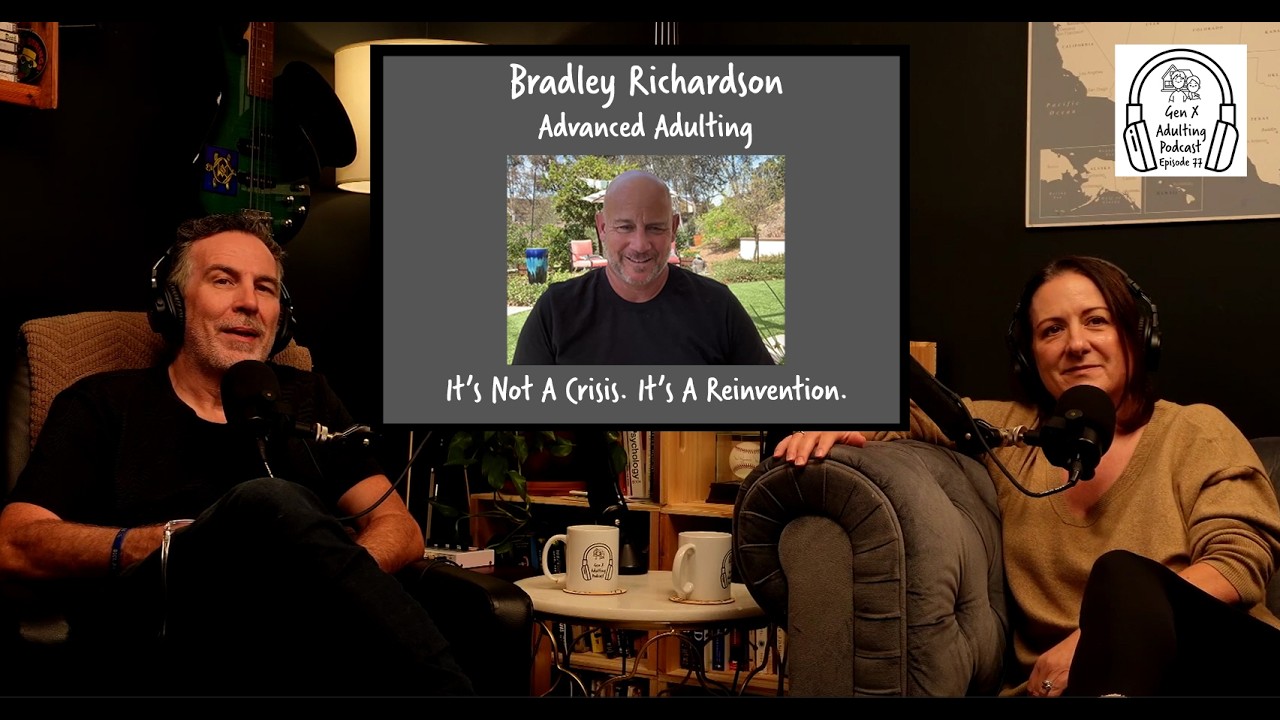
In this episode of the GenX Adulting Podcast, hosts Brian and Nicole interview Bradley Richardson, creator of Advanced Adulting. They discuss Bradley's experiences growing up as a Gen Xer, his journey through tennis, and the impact of family dynamics on his life, particularly focusing on his father's infidelity and its repercussions.
Welcome to Gen X Adulting, and today we have Bradley Richardson, creator of Advanced Adulting, with us. Welcome, Bradley. Thank you for having me. This is exciting. We're so happy to have you. And our first question is always, what year were you born? Nineteen sixty six. So you are gen you are what the second youngest Gen X? You're old second oldest, second oldest Gen X, right? Wow. wow. I'm almost OG. Yep. Exactly. Yep. So I turned sixty here in a few weeks. So it's kinda weird to think that. Yeah. And you do not look you do not look like you're about to turn 60, I have to tell you that right now. No, no, don't do it. man, I need Botox so hard right now. Telling him You'll you it it'll you look great. Don't do anything 'cause you look great. But Thank you. 'cause sixty five is I don't know, have we had someone sixty five on? No. No, we've had boomers. Yes, but not a Gen Xer. So you're our oldest Gen Xer. well, no, we had Gen X Gina on and she's sixty six as well. okay. And you have a connection to her, which we'll get to. But Yeah. Yeah, exactly. yeah. So and I think you're also considered considered Jen Jones. But do you identify with that at all? No, I no, it's funny you mentioned that. So I understand th the nature behind Jen Jones. You know, there is a there's a gap, okay? Just like you've got with you know, with younger Xers who are probably have something in common with millennials, I guess. But the Jen Jones things, no, I don't identify with that at at all. I understand that certain do.
Yeah. I've never heard of that. Yeah, yeah. We I actually hadn't heard of that until we started doing this podcast and people commented, you know, they're Jen Jones or that's Jen Jones. And I actually had to look up Jen Jones because I just knew Boomers and Gen X. So and then Xennials, but I had never heard of Jen Jones. So no, you're you definitely I was expecting you to say like more seventy one, seventy two, seventy three, to be honest. Yeah. Well, I'll take it. Thank you. but no, no, it's funny. Yeah, it is sixty six and Yeah. it's it's funny. I mean yeah, it there's so much about Gen X and I know we're gonna get into all of that, but whether it's culturally, emotionally, how we were raised, all of that, yeah, I just kinda always identified with all of that. And it was fun it kinda funny back in in the nineties when they started to attach a name to it. There had never been a name for it. We'd never really thought about anything like that. No. But But yeah, I understand how you can have some sensibilities across generations, you know, but and you can you Yes. Yes. can identify with things and enjoy different things. Yeah, yeah. but yeah, I mean it's it's funny. I don't I think it's fluid. You know, I really do. I think it's all pretty fluid. It is. It is. But you're definitely Gen X. We're gonna claim you. yeah. Yeah, I'm there. Okay, so where were you born? I was born in Plainview, Texas. So way up that was up in Panhandle. So and I grew up in Lubbock, Texas. So it was Okay. I know that you mentioned mentioned, you know, Gina, we went we grew up, you know, in the the same town there. But Yeah.
Okay. I know that you mentioned mentioned, you know, Gina, we went we grew up, you know, in the the same town there. But Yeah. Lubbock's an interesting place. So it's you know, people think Texas and there's so many different aspects to it. But you know, if you watch the show Landman, you know, there's parts of it that are that part of the world is that's the real deal. That's so spot on I can't even see straight. And Yeah. that's a that's a show with Billy I haven't seen that show. What's what is that show? Have you? I haven't. that's that Taylor Sheridan show with Billy Bob Thornton. And anyway, they Okay, okay, okay. they have a lot of it in like Midland, Odessa, Lubbock and Dallas. Okay. And so I grew up in Lubbock. I lived in I lived a lot you know, several places, but grew up in in Lubbock, school in Oklahoma, lived in New York City and then went back to Dallas. So yeah. But you were born, did you say Plainview? Plainview's a tea tiny little town, you know, up between Lubbock and Amarillo. Yeah. Okay. And so were your parents in it did they live in Plainview or did they live in Lubbock? Okay. At the time. At the time. But they they grew up in and around Lubbock as well. So my parents were together since eighth grade and all grew up in that, you know, together. And yeah. wow. Okay. Do you know do you know how far your generations go back, like why you and your family ended up in that part of Texas? Yeah, I'm a fifth generation Texan, so going back to the eighteen fifties. And Wow. I that I I know is has been documented, but why they went, I don't know. I have no idea. Yeah, yeah.
Yeah, I'm a fifth generation Texan, so going back to the eighteen fifties. And Wow. I that I I know is has been documented, but why they went, I don't know. I have no idea. Yeah, yeah. But yeah, I mean, yeah, it's I don't I haven't done the twenty three in me and all that, but I know that my my background is, you know, I used to say Texan 'cause it wasn't you know, I've you know, like Shannon's Greek, you know, I have you know, other people can identify things. yeah, I know there's American Indian in there and Mm. Yeah, taxing. Otherwise that's about it. And all in that same area of Texas since Yeah. the eighteen fifties? yeah. I mean it's all all West Texas. Yeah. So from Wow. that whole Abilene, Lubbock, you know, central West Texas bit. Okay, and so your parents grew up in the same town basically? Was it in Plainview? Yeah. Now I love it. Lubbock, okay. Am I saying it right? Lubbock? Love I Lubbock, I think. What university's there again? Texas Tech, okay. Yeah, yeah, yeah. Lubbock, U B B O C K. Yep. Tech, Texas Tech. They're also, they're also known. The other one of the other great claims to fame of Lubbock, outside of dust storms and you know stuff like that, is Buddy Holly. So, Hmm. and my mom's claim to fame was she turned Buddy Holly down in high school because someone No way. someone wanted to set her up and she goes, Nope, nope, little, little, little geeky for me. And I'm like, Well, okay. Kind of. So w how old was she? she was in high school, yeah. So No way. And somebody wanted to set her up with so did she know him? She had met him, so yeah, and then someone Okay. wanted to you need to go out with him. She's like, Nope. So my gosh. I wonder when he got famous. Had to have been after high school, right?
She had met him, so yeah, and then someone Okay. wanted to you need to go out with him. She's like, Nope. So my gosh. I wonder when he got famous. Had to have been after high school, right? I d I don't know I should know all the lineage, but no, I I don't. So no. Yeah. Yeah. I don't know enough about Buddy Hawley to to quote anything about that. Yeah. okay, so they grew up together. They started dating in eighth grade. Well, was she dating your dad when they wanted to set her up with Buddy Holly I think, you know, I from what I gather about their whole tumultuous togetherness, Yeah. it was c you know, like anything. I mean, come on, you you you start off in a middle school romance, you're together, you're not together. One week, you know, one week on, one week off, you Okay. Yeah. know. I I think that was kind of their thing. It was like an we're together but they're you know, this week we're off and next week it's something else. So you know. Okay. Okay. And then did they like did your dad go to college? Did your mom go to college? Like what did they do after high school? no, my mom never went to s went to college. I think my dad tried a year or so, but he I was the first person in my family to to graduate from college. But my dad at the time was a drag racer, was a professional drag racer. And that's what he was doing. So trying to make money racing cars. And So wait, he he graduates from high school and was he drag racing in high school as well? Okay.
So wait, he he graduates from high school and was he drag racing in high school as well? Okay. I don't I don't know. I don't know about that. But I mean he got into like big time drag racing and was doing that. And then as the story goes, which you know, you hear your parents fight bitch and moan and all that about things. You know, I I heard too many times that my d you know it's not to sound like, you know, sad sack, you know you know, show, but dad was upset when he found out that mom was pregnant because he was gonna buy a new dragster and instead Mm. got got a son. And so He after I was born he stopped racing but was still in the race world and business and I think did PR for a lot of the big race teams and that was kinda how Okay. my my you know, when I was very young, that was my upbringing. That was your weight to carry is that your dr dad's dream died with your birth, basically. That's nice. You're like let's unpack that. So he he made sure you there's yeah, there you know, that's that's a therapist dream right there. There's so much behind that. Yeah. thanks. Thanks, Mel Robins. Yeah. knew. Yeah, I mean that's so Gen X that you even knew that, that they told you that. Well, I mean come on, look, we're the generation where people you know, cars a car seat was you slept on top behind the the back seat, you know? I mean, so you know, of course, Yeah. Yeah. Yeah. I mean they're they're telling you all kinds of crap you would that would that would send today's kids into a tailspin. Yeah. yeah. Absolutely. Let me project all of my shit onto you and just so you know, okay, so he so they they graduate high school. He gets into drag racing and he's making money in competitions, I guess, or racing.
Yeah. Yep. Yeah, yeah, yeah. But then then it was shortly after after I I was born that he then went to they were like you i in racing or in in sports or what you auto sports and In that world. yeah, I mean they're like the the big parts manufacturers and things like that. You if you got Firestone or any of the the the things Mm-hmm. that supply them. And he went to work in PR for some of the big suppliers who you know supply the race teams. And Okay. so You know, that's you know, we moved to North Carolina for a bit. That's where my sister was born. And I remember Okay. as a kid, I mean, getting to meet a lot of the big racers and, you know, i both NASCAR at the time and drag racing and things like that. And then we moved back to Texas when I was seven. Yeah. So how old were they when they got married, do you know? Twenty three, I believe. Twenty two, twenty three. Young. And were you born shortly after? I was born you know, about a year or so afterwards. Yeah. Okay. And was your mom a stay at home mom? Yeah. A hundred percent. Always. Yeah. Always. Okay. So you're in Texas. He's he's he's racing. and then you guys moved to North Carolina. You're still young when that happened. yeah, yeah, I was very young. I was like I was like, you know, I'd say moved like around two and was there from like two to seven. And then moved back. Yeah, Okay, and your sister's born. so she was born and then we moved back to Texas. So How how many years between you guys? seven okay, seven. So seven years. okay. And then any more siblings? Nope. That's it. All right. So then when you guys moved back to Texas, were you in Lubbock then?
seven. So seven years. okay. And then any more siblings? Nope. That's it. All right. So then when you guys moved back to Texas, were you in Lubbock then? Yeah, we went back and forth between Lubbock and Abilene, so but ended up Abilene for a couple of years and then 'cause that was her family, you know, it's all like Yes. two and a half hours apart. But yeah, then ended up in Lubbock. And that's where I was really raised in high school and formative years and all that. Now so your mom was a stay at home mom. Did you still have the latch key kid experience, would you say? You know, i i it's in a weird way. Yeah. my mom was very traditional and I loved that. I love everything about that. she was Southern, she, you know, d did did all the things, you know, for you and it was great, and I loved that. But I did have this weird independence as well. I mean, I gr I grew up you know, I I think I I mentioned to y'all, you know, earlier, I'm kind of a study and contrast in that I grew up in this, you know, West Texas area. But I played tennis. Okay. So yeah, I did all the sports and all that, but I gravitated to tennis of all weird things in West Texas. And I got really good. And I started playing all over the country and getting ranked and was very good at it. And I ended up I was still pretty young moving away. I started playing when I was ten, but got really good fast. And so I'm traveling with, you know, other families and traveling with coaches and things like that. And then at 14 I moved away and lived off at one of these academies. And so I was I've been independent since, you know, a way early age. So I wouldn't say latch key in the traditional sense, but it was Mm-hmm.
Mm-hmm. like, yep, you know, you do your own laundry, take care of stuff. You know, I I figured out how to get shit done. I think that was pretty much it, you know. So it Right. Right. Right. Right. that's that's that's the the lesson is you figure out how to be capable real fast. Yes, absolutely. So for your early formative years, your elementary school years, did you get into tennis? Like what were you doing during those elementary years? Were you involved in like any music or clubs or athletics or tennis then or was that just kind of academics? Yeah, well tentacle Yeah, no, I was never an academic. I mean, I I I've I've realized later in life I was smart and I wish I'd have studied. But no, it was I I did all the typical sports. You know, you're doing baseball, you know, you you try, you know, you you try basketball, you do football, you're in Texas, of course, you're doing that stuff. but you're still little. But I had a mother who and it was weird 'cause my dad was is is kind of cowboy as you could be, you know, I mean the starch Wranglers and the hat and all that. And but my mom, despite never going to to college and growing up where she did, she raised my sister and I having an appreciation for the arts, which I I absolutely loved, you know? And Yeah. so, you know, I did art and, you know, classes and things like that. And like I say it was just this weird, you know, yin and yang of of things. And I loved her for that. That was amazing of being able to do that. And so it was you know, I was trying to find what my my real you know niche was. And Yeah. it ended up being tennis is which I'd never planned. No, you they didn't do tennis for shit. So it was like, okay. Yeah. Right?
Yeah. it ended up being tennis is which I'd never planned. No, you they didn't do tennis for shit. So it was like, okay. Yeah. Right? That No, no, no. No, that's a trip. What a dichotomy, right? 'Cause Texas is Texas at steer or cowboys, cows, yeah. oil. You're in the arts and tennis. Tennis is not a thing in Texas, right? Especially back then. N not back then. Now what was funny is is where I grew up. So you know, I started playing and and got got good fast, but there was a in where I grew up in particular, there was a weird thing of there were lots of of kids that were good. And the year that I graduated high school, I ended up playing at the University of Oklahoma. I got recruited by a number of big D one schools, you know, and ended up at OU. But within two years of me graduating my my year and the year ahead of me. We had five five guys that went on to play Division I tennis. you know, at everywhere from Texas to Brigham Young to Air Force Academy to all over. and Texas Tech didn't look at a single one of us. They brought in all foreigners. They brought in all foreign interesting. kids. And we thought you could have stacked the deck with kids that went on Yeah. to play for kids schools that were bigger and better than you and didn't didn't talk to a single one of us. I thought that was really interesting, but for that part Was there was there like a tennis academy there? Like 'cause that's weird, right? South Florida we have Yeah.
Was there was there like a tennis academy there? Like 'cause that's weird, right? South Florida we have Yeah. No, no. I I yeah, I went off to Academy and then came back for to to finish up high school. in like the academy I went to, it it was, it was sixteen of us from around the world. And it was like the number one kid in France, number one kid in Canada, number one kid in Mexico, and me getting my ass kicked for a year. And you know, that was incredible. You go to school for like four hours a day, you get up in the morning, you play from five to seven, go to school for four hours, come back and play another six. Where was that? Where was the academy? that that was where I went was down near San Antonio. So they Okay. Okay. they well where you all are in Florida, they got a they got a couple down there. It's like it Yeah. was kinda like when you you've heard of this Nick Bolateris or now it's the IMG Academy. It was kind yeah. of one of the very first versions of that type of thing that that I went to and then went back. But yeah, it's interesting. Yeah. Okay. Cool. Yeah, I IMG's huge here. It's huge and it's big. And they keep adding on. I like for Lacro our youngest is into lacrosse and even four years ago there was only so many lacrosse teams at IMG. They keep creating new levels because so many parents are willing to spend the money. Yeah yeah. So they keep they have like now the Well the facilities too are beautiful. They are. But it's it's interesting how they're expanding the opportunities because there's so many people that are willing to invest, you know. I mean, th that's a whole nother topic. is how travel sports has changed.
Right. And you couldn't you know, look, I mean you couldn't do sports as a k normal kid anymore. I and and I didn't do sports as a normal kid. I mean, but yeah, the the IMG type thing, I mean, I did probably one of the first couple of years that those types of things existed. But Yeah. yeah. Yeah, that makes sense. So during those those first years before you got into tennis at 10, or during those elementary and let's say middle school years, and your dad's involved in racing, your mom's a stay-at-home mom. how were because so for so many Gen Xers, there was a lot of strife in the home that and there was whether it was mental, emotional, physical abuse, but you wouldn't know that from appearances. Would you say that your Family life aligned with that that yeah. Hundred percent. Thou a thousand percent. And take you you gave a laundry list of things. Yes, which is it? Is it you know, take your pick per day? Is it mental, physical, emotional, financial, you know, whatever. I mean, yeah. I and and I I love how you said that and it's accurate. Is I think there's some families, you know, then and now that you just know it's a shit show. You just know. I mean, yeah, Yeah. and and you know, people don't hide in anything. I think it was common for our generation and very common at least in my family. well, everybody's about the show. You know, how do things look? How is it perceived? On the outside looking in, it's great. You know, look at those nice church going people. look at that family. look at them, they're so put together. You know, behind closed doors, it's sh i it's, you know, it's a train wreck. And Yeah.
Yeah. for any number of reasons. And mine was no different at all. And it's funny, my my sister's seven years d you know, younger than I. we had very, very different upbringings, you know, and we've talked about that. We've had rob I mean, we were raised by two dr you know, neither were great, you know, but my experiences were very different than hers and a lot harder, you know. I'm not you know it's not a competition, Yeah. but yeah, the the shit that I saw and witnessed and dealt with very different than than what she did. And I think that's not uncommon. with a lot of Gen Xers as well. Definitely. Would you now was the strife mainly between your parents or was it displaced onto you as well? Well, you know, it was totally between my parents. You know, i always with them. I mean again, they they've known each other since eighth grade. I mean, it was you know, y two people who'd never matured, you know? Two people that known each other forever, two people that didn't have the tools or communication to to be able to do anything. And you have, you know, shit, people have been married for, you know, ten, fifteen, twenty years and when they got married as an adults and they s you know, still have problems with it. it was a lot of that. And with their whole relationship too, I mean it was you know, I I learned later in life that both parents are fallible. But you know, the fact of the matter is, my my dad, my dad was big time womanizer and I, you know, again, your your parents that generation's parents tell you shit. I heard I knew everything. Yeah.
Yeah. I I I met girlfriends, I knew all kinds of crazy shit. And you know, I I had pictures, okay. You know, and i this just weird. And you don't think about that but you know, when you're little, but you start understanding later what the fights are about. And Yes. what I found myself in situations, I mean there are a couple of you know in particular, where it was the they're fighting and it's like, pick one, choose right now, who you're gonna go with. We're out. And I mean, i that you don't think about that. You you you don't know what to think about that. But you know, for No. me, I mean, that became again therapist's dream here. But I mean that that was that's how I became a people pleaser. That's how I became a, you know, We have a little a little, you know, ambassador of the United Nations here of like I have to make shit work out between these two here. Yeah. Because, you know, you know, if if I'm doing everything right, you'll be happy. And that just became part of my personality and my MO and you know it that affects you for a long time. A long long time. And affects your choice. Yeah, well no, it's ingrained. Yeah. It's ingrained. It's funny because I think about what you said. My dad also was a womanizer and had girlfriends and stuff. And they're and I my parents were divorced. He was in Michigan and I grew up in Oregon. But when I was visit would visit him, yeah, we would spend the half the day with him and his girlfriend. And then as we're driving to my see my stepmom, who he's still married to, or they're in one they got married and divorced twice. So maybe they're not married at that time, but he's still dating her. Right.
Right. he would be having a talk with me in the car. Now don't tell you. know so and so that we just saw so and so and I'll never forget we were at lunch with my stepmom and I accidentally I was seven and I accidentally said something and he took me she got mad he took me out and ripped me a new one outside the restaurant for saying something and I was seven At seven. at seven and so the so I can my point is and I have pictures and all that. I have photo I have pictures and photo albums of me and his girlfriend. yeah. y yeah. Yeah. And it's crazy. It's crazy. And the you don't realize just how F'd up it is until later. And, you know, I'm sure we'll talk about it at some point, but I mean what what kind of blew my family apart was something like that. But it was the, you know, putting a child in a situation of don't tell your mother. There's a difference between don't tell your Yes. mom, you know, I I ran a red light versus by the way, I took Yeah. you out with Tits McGee over here and you know Yes. No. I mean, that's just wrong. Yeah. Yeah. Yeah, no, it is. And it does create such people pleasing and such fight or flight and walking on eggshells and hypervigilance and all that crap. But it becomes so ingrained that it becomes who you are. And then you carry that through your high school years, through your twenties, through your thir it's really I feel, at least I can speak personally, it wasn't until I hit midlife where I actually started figuring out who I am and not all of these symptoms of the dysfunction I was raised in. Well, I mean, look, I I really wish to God that I were you know more evolved and had figured it out earlier, you know. Yeah.
Well, I mean, look, I I really wish to God that I were you know more evolved and had figured it out earlier, you know. Yeah. And for me it just ended up being one of those things that 'cause it you know, i it just it just bec it exacerbated. It just became more and more and more. And that whole idea of perfectionism, I became an incre I mean, even to this day. I mean people who know me or or or Shannon other go the the standard I hold myself to is so insane. And that's not Yeah. that's not like the typical midlife bullshit of I'm such a high performer. No, I'm like I'm scared to death of I have to be perfect or it's better work and it better do this, you know, or you know, someone's not gonna love me or like me or whatever. That's horrible. But that's how my brain Yeah. Yeah. has worked for 60 plus years. And only in the past, you know, five have I probably become comfortable or let go of it or gotten a realistic Yeah. perspective of it. And that impacted everything, impacted who I chose to marry, you know. That was a huge one, you know. And I remember after, you know, after I got divorced, because I you know who I married, then you get divorced and you go through the typical, you know, because anybody's been divorced out there at midlife, it's what you do. You go and you date everything in town and who looks just the you it's the same. You look better looking versions of the same person. And Yeah. and it ended up being my sister going, Yeah, you do. You get you end up basically you married dad and then you date similar versions of it. And she pointed it out exactly. I'm like, damn, okay, here's two hundred bucks for therapy. But it's true. Mm-hmm.
Mm-hmm. I mean I I th I think we do. We make a lot of choices like that and we try and justify it and rationalize it. And yeah, that's one thing. Maybe, you know, look, there's a lot of things that, you know, Gen Z and all gets wrong and the therapy speak and other bullshit. But I tell you what, I do think they probably are approaching relationships a little differently and a little better than probably we did. One hundred percent. One hundred percent. Are you and your sister close? We are, but we are polar opposites, you know? she is she has a barometer for me. She is my bullshit detector. Meaning I can go, am I smoking crack? Am I just am I way off on Mm. this? Okay. And she'll tell me. But we view the we view the world very differently. Yeah. our personalities are very different. How we view things are very different. she I'm not politically, but when I use this word, she's infinitely more conservative and reserved than I am. She's a hell of a lot tougher than I am. I'm much more demonstrative, Mm-hmm. but it's like she got a long fuse, but when you get there, you know, hold on. Okay. And so we're close, but close but not, you know? Yeah. I was just thinking of the dynamics 'cause you had your parents and you, so there's the three of you. Then seven years later she shows up. Maybe you know, you were probably still a baby, but by the time she shows up, you guys have your thing going on. So you've developed some patterns that probably influenced her. Yeah, I I I I s I see that. I see what you're saying on that. I don't know how much I influenced her on that because the other thing is, remember, you know, I started playing tennis at ten, okay, so she'd have been three. So yeah, you'd be And and then I'm tra I'm traveling. I mean, I literally was
So yeah, you'd be And and then I'm tra I'm traveling. I mean, I literally was out pretty soon. Yeah. Yeah. you know, you know, I mean it was back then it was like the travel sports thing. You're gone all Yeah. the time, you're at practice, you moved away from school at fourteen, and then I go to college. So I think that was pro that that's one reason we probably Yeah. and we had very different experiences because of that. Yeah. Yeah, that makes sense. So as far as like you were talking about performance equals love for so many Gen Xers, Mm-hmm. when you up until you found tennis, how was your relationship with your dad? Because I'm assuming once you found tennis, that was a commonality, a bridge for you guys where he could participate and show his love through your performance. Would would you say that's accurate? No. Here's why. Here's Yes. Here's It was tennis. It was tennis in Texas. Is that why? here's here well okay, here's the deal. and this'll this will come full circle because my wife did the same thing. Okay. It's do you like do you like the person or do you like what they represent? Okay. So here's the deal. He loved having a little winner. He loved having someone who did something unique and different and interesting and could point to. But it's didn't but you're just not doing it right. I'm like, dude, you don't know. Mm. Mm. shit about this. But here I am, you know. And that was the thing. And it was just always the again, you the the never good enough. Okay. It was like, you know, it was kind of the backhanded compliment of everything. It was like, yeah, but. Okay. Yeah, but. And I remember it I mean everything from how you wear your hat, okay. Is there a proper weird way wear way to wear a baseball hat? Okay. I mean Mm.
Okay. Yeah, but. And I remember it I mean everything from how you wear your hat, okay. Is there a proper weird way wear way to wear a baseball hat? Okay. I mean Mm. it just shit like that. And it was just like always something, you know, rather than just the Right, right. Hey, I'm proud of you for you. I mean, again, I'm you know, look, I am so anti, you know, the participation ribbon at all, but I do believe heavily in the, you know what, if you suck, I'll tell you. And if you're kicking ass, I will tell you. And I will shout Mm-hmm. from the rooftops. Okay. And, you know, it was just always the kind of, yeah, but, you know, it was like the Right. look at look at look at my boy over here. Yeah, but meanwhile, you're just beating the hell out of me on this, you know? And it Right, right. one of those where I you know, I would he I would think I'm doing well, you know. And again, that's something you carry forward this day of like, you know, my god, you're kicking ass on this, yeah, but are you really? Come on. That's the little that's the little voice, you know, in there. Yeah, yeah. And that's d haunting. I mean, it really is, you know. Yeah, yeah. It c it's completely undermining. It's one hundred percent undermining of your experience, you know, overall. Mm-hmm.
Yeah, yeah. And that's d haunting. I mean, it really is, you know. Yeah, yeah. It c it's completely undermining. It's one hundred percent undermining of your experience, you know, overall. Mm-hmm. And it I have found I think I don't know if your dad was a boomer, but I the boomers in my family, I've noticed they I have my I actually ended up having a long conversation with my mom once about it. And I was like, you do this because you're I saw your mom and your aunts do this. You have to stop doing that. You have to just give a compliment and let it be and not bring out the other that she was always the devil's advocate, always look at it from the other person's point of view. That type of crap. And I think some of that's that Generational. It's generational. They have the they don't just stop that the sentence. There's the next but they can't however they can't just they don't want you getting too big for your britches. They can't just celebrate you. It's like it it's that constant catch twenty-two. Yeah. I mean just y the the celebrating. Gran granted, I think the pendulum has swung so far on the opposite end, you know, as well. But you Yes, yes. know, but I remember my I remember my kids when they when they were doing sports, you know, I mean I had one that was just like, you know, you didn't like losing and I and I did, you know, some people are gonna hate me on this one. I said, if you don't like losing, get better. That's real simple. You know, I mean Yeah. g get better, you know, and there will always be someone out there who's probably a little better, and that's okay. But Yeah.
Yeah. g get better, you know, and there will always be someone out there who's probably a little better, and that's okay. But Yeah. if you don't like the situation, you can fix that. that, you know? but there is the I I think that was just it. It was just nothing was ever good enough. And then, you know, I guess daughters and mothers have their own dynamic. Fathers and and and sons have a have a a dynamic as well. And for me, I I just started rebelling, you know, and I don't I'm I have always been the really hold my beer. Watch me. Okay. If you don't think I'm good enough now, Mm. watch it. I'm gonna triple down. In a lot of ways in life that was awesome, you know, that was really good. You know, from an outcomes perspective, from a mental perspective, it was a train wreck. Yeah. Yeah, yeah, of course. Well go ahead. Well, just tennis is I assume you played singles, maybe some doubles too, but you're playing singles, man, that's that's intense. Total no never never never played doubles. And here's why. It's a gr interesting point. Okay. One of the things I loved about I was never a team sport guy. Okay. I just didn't dig it. But you know, i this is probably the the ultimate Gen X th thinking on this. I played singles because you know why? Because if I'm gonna win or lose, it's on me. I it's all me. Meaning Mm-hmm. if I'm gonna lose, I'm gonna own it, but I know, that's on me. I'm not gonna count on somebody else to screw it up, you know. And that's not healthy at all. I get that. But that was a that was a mindset. Yeah.
Yeah. And I love singles because of that. You know, it is you out there, there's no coaching, there's nothing. It is you out there trying to figure it out. And what that particular game taught me. Sports t sports, all kinds of things, teach kids amazing things. But for for that, I will say tennis. taught me you're out and and you're out there trying to find a way. And what I love about it is there is no shot clock. There is no the clock ran out. It's fourth quarter. It is like you're out there until the last point. And until they've won the last point, you're in it. And you still are in it. And you gotta figure a way. And you know another weird thing again, people probably go, well that's pretty psychotic. But the way that I looked at it was I believe there's a big difference between losing and getting beaten. Meaning Mm. People get beaten. You can you can get beaten and that's okay. Someone was just better than you that day, and that's okay. Mm-hmm. That's gonna happen. Whether they're more talented or not, you're gonna get beaten. It happens to everybody. Losing though, losing, in my weird opinion, is that had something you had some control over. Meaning you didn't do something right, you made an error unforced error, didn't think, didn't concentrate, you know, didn't didn't remember your training, didn't pro didn't train properly, whatever it is, you know. And so, yeah, like I said, not healthy, but that was kind of the mindset growing up. And that was kind of perpetuated throughout everything else. So how d I love the I love the whole getting beaten versus losing. I'm rap trying to wrap my head around that. Yeah, I like it'll come to me, but no, I really I can picture that exactly. I'm Yeah.
So how d I love the I love the whole getting beaten versus losing. I'm rap trying to wrap my head around that. Yeah, I like it'll come to me, but no, I really I can picture that exactly. I'm Yeah. I'm gonna talk to our son who plays lacrosse. So you think it's losing more of your own fault. You didn't you didn't try hard enough, you didn't go at it. You just you just didn't you didn't you didn't give it your best. If you give it your best Yeah. and they and you do everything right and give it your best and someone and and then then then someone's better than you that day. They just beat you and that happens. That's okay. Yeah. That that's kind of that's how I interpret it. Yeah. I just got beat. Yeah. Yeah. Yeah. Yeah. No, I like that. Yeah. Yeah, I'm gonna t I'm gonna definitely share that with our son. so when you discovered how did you discover tennis? You said you were ten, was there a team in your 'cause that would have been what, No. fourth, fifth grade? Yeah, around there, round yeah, around fourth grade, close to it. 'Cause I was young. I was a young kid. Yeah. in West Texas. So that's elementary school. So how does a Gen Xer in West Texas at ten in ten years old discover tennis?
So that's elementary school. So how does a Gen Xer in West Texas at ten in ten years old discover tennis? So back back to dad's weird obsession about image. I was a small kid too. I mean, y you know, people can't tell me on screen whatever. I'm big dude, okay? I'm I'm yeah, but I was a late bloomer. And small kid growing up, but it was about, you know, nine or so. My my dad was like, You're gonna need to learn to play tennis or golf, you know, because one of those you need to pick one because they're gonna help you later in life. And again, I didn't understand anything. I thought, no, not gonna do that. You know, tennis is a sissy sport, and you know, that's what you said at the time. And golf, I mean, no. I didn't think anything about it. And I blew him off and fought him on it. And but we had an old racket around the house. And I remember on my own, getting a tennis ball, and our house backed up to another, an older gentleman who's a World War II veteran named Mr. Harris. Mm. I remember. 'Cause he always wore like the the the the dick the Dickies type of unit unitard, the whole overall cover all suit. He wore that Okay. every time, Mr. Harris, and he'd wear that and a cowboy hat and he had a hook. Okay. I remember that vividly. Yeah, he had a hook for For a hand? A Captain Hook hook? Yep, like a cap like one of those claw hooks, okay? And it was gro Yes. that's fucking awesome. Did he lose his hand in the war? And so I and he was the nicest man and he was our neighbor and he had a he had a a Model T as well. They kept he had a Model T and a C Wow. and El Camino. that he kept in the driveway. And, Very cool.
Wow. and El Camino. that he kept in the driveway. And, Very cool. you know, I just thought that was so cool. So anyway, they had this big, you know, long cement driveway and it backed up to his garage, which is just a brick wall. And I went out there one day and I got the the racket and and a ball and just started hitting against it, you know, not knowing what the hell I'm doing, just hitting against it. And Mr. Harris would let me do that, you know, and I, you know, hit one, you know, I broke a garage window one time and all that. I Mm-hmm. just I did that. I kept hitting on it. And then I went and I asked my parents You know, and we growing up, we had, you know, there were moments of affluence. So yeah, I played tennis and all, but don't don't think, my God, it's, you know, you know, hit Mr. Trust Fun baby. We had moments of affluence and moments of in the shitter. Okay. So it was like all up and down, okay? And we were we were in the valley, you know, at that time. And money was tight, but I'm hitting it hitting against that wall. And I asked my mom, I said, Well, I think I'm ready I think I'm gonna play get some lessons. I wanna play. And there were some other kids who had played at school, but they were the rich kids playing at the country club and the racket club and all that. And they were at they were just little a-holes. And, you know, this little, you know, poor kids wanting to go and get tennis lessons. And mom said, you know, I'm not gonna pay for something that you're not gonna stick to. So tell you what, in three months, you go keep hitting against the wall for three months, and if you're still doing it and you still want to, we'll do it. And I did. I kept at it every day I'm hitting against that damn wall of Mr. Harris's house. And she said And for three months I said ready. She goes, okay. And she took me to the public tennis center, to Rose Park Tennis Center, and to the public place. Couldn't afford the main pro, got the assistant pro, three-fingered, you know, Jay Myers. I remember this vividly. He had three fingers. And apparently people are missing digits around me. But he right, right? but he
I know, I was just thinking that what's going on there? You got Captain Hook and then the that's funny. he He was my first coach and I went out there and my mom took me to my first tennis lesson. I think it cost like ten bucks at the time, which at the time was a lot of money. And I hit and I kept going and kept going and kept going and I got really good really fast and won my first travel tournament at eleven and you know, got r ranked big time in Texas at me at that age and it just kinda took off from there and It was interesting 'cause all like I said, all the little rich kids playing at the racquet club. you know, Yeah. I I got I was given a hard time about the whole thing. And you know, like I said, the way to solve a lot way to solve a lot of problems and shut a lot of people up is get good. So that's it. Yeah. Yeah, that's true. It is interesting your dad chose country club sports for you, pushing you to either golf or tennis, right? Yeah. Yeah. So did you Image. How's it look? How's it look? You know? Yeah. did you compete alongside or against any of those country club kids? later I did and I smoked I mean it was just a no no question. Yeah. I mean at the beginning yeah. it tore up. Yeah. That ha Like karate kids. Yeah, but that had to have been amazing to just sm like beat them. That had to have been so validating. It was great. Well, cause so w at the time I told you we kinda bounced between Abilene and Lubbock a bit. So I I mean, Yeah.
It was great. Well, cause so w at the time I told you we kinda bounced between Abilene and Lubbock a bit. So I I mean, Yeah. we had lived in Abilene for a short period of time. When there was no money we lived in Abilene. So I lived in Abilene just for a little bit of time and that's when I started playing, okay. And we quickly moved to Lubbock. And then I remember there was some, you know, tournament or something and I see those kids out, you know, that I I knew when I first started playing. Yeah, I just beat the hell out of them. You know, it was easy. You know, 'cause they're always mouthing off. Yeah, I love that. And and then and then That's awesome. Yeah. and then, you know, it was really about thirteen and fourteen that I got that I just I mean, exponentially it just took off. And that's when I w you know, moved away and went off. And, you know, that whole getting your ass kicked for a year, that's a whole other valuable lesson. I mean, like I said, I mean of the sixteen kids, three went on to be top ten in the world. Okay. And so, in the when you're in the mix, you know, Mm-hmm. you don't know, okay. And I remember vividly, you know, doing that and I thought, man, you know, this is tough. Okay, this is just tough. You know, and you don't Yeah. think you don't think you're getting any better. And I remember, you know, after I left, first tournament I played in was a big, big tournament. And I drew this guy. he was the number two guy in Texas, you know, and I had always kind of been in awe of the guy. And you know, he two in Texas, but I mean he's like top twenty in the country. And I drew him first round. And I went out and I think I beat him, you know, two and one in like forty five minutes. Just nothing. Just be a walkover Wow.
Wow. and I like, so yeah, it's just funny. you you train, you do things, and whether it's business, whether it's, you know, anything, you just kinda realize once you're around you know, once once you're kind of, you know, in the fire, you don't realize what that does to you, you know, until you you step out. Well there's matchups too, right? There were probably guys you could beat that you probably shouldn't have, but then there's guys maybe that beat you that you shouldn't have lost to. 'Cause it's not the biggest world, right? Well yeah, it's not it's not. It's not a big world, but I guess the other thing it's interesting, i it's a lot with sports, but I mean I guess golf antennas would have this in comparison. Maybe being a pitcher, maybe. Mm-hmm. I mean, it's so mental. I mean, there's a lot of physical Totally. differences, okay? But I mean, you know, you you look at it's interesting. There's a sh there's a show on Prime now and I think it's called Twenty Nine or Ace's Twenty Nine. And it's a documentary about apparently in the open era Okay. There's only been like twenty nine men ranked number one in the world. And so they went and they ran that from everybody from you know, Connors to Mackin, everybody. And so they went and they interviewed each one of them, okay? Up until the current current day. And it was interesting, because I forget which one said it, but it was like, look, beyond really the top three or five guys in the world, you know, there's no real big market difference in talent. Okay. It's just not. You can go all Mm-hmm.
Mm-hmm. the way to the you know, through a hundred plus. Everybody's pretty everybody's good, okay. It's mental. It's all here. It's a hundred percent here any day. And it goes back to what I said earlier. I mean, it's you're out there solving problems just for you. And there are no more mental athletes on the planet, I think, than probably golfers or tennis or anything like that, where you're like, Okay, I have to make this happen, you know, and I've got nobody else to depend on or rely on. And yeah, it's just a different mindset. Yeah. How much would you or would you say your upbringing, let's just call a blue collar compared to the white collar kids, right? If I were to just sum it up. Right. Yeah. How much would you say the adversity you went through both, you know, not being as affluent and also what was going on within your home helped you be scrappy enough to get so good and have that mental strength, maybe over the kids who are more affluent who didn't have as much adversity as you. Would you say that went into play? 100%. Yeah. I mean, there there are tons of people that are more talented than me. There are tons of people this day in anything we do. There are tons of people who are better writers than me, better speakers than me, have cooler content than me, antenna, whatever. Yeah, you know, but there are two things to it. And as as a kid with athletics, as an adult with anything you do, one, I knew how hard I worked, and I knew how hard I had to work, and I knew how hard I I knew that it wasn't just showing up. You know, I wasn't that naturally talented. Okay. So I think knowing, you know, hey, I've got to put some work in on this. Okay. You can't just half ask this. And, you know, the the kid who's more talented, I've got to figure out I I have to figure out a way to do it harder and better than you somehow. And the other is knowing what your lane is. And I think that is applicable to damn near anything in life. Is just knowing what your strengths are, you know, and you've heard a lot of people talk about this. Gary V talks a lot about this. You know, you're Yeah, you know, coaches talk about it, of don't focus on your weaknesses, focus on your strengths. Sounds stupid at first, okay?
That's not to say completely ignore your weaknesses, but I totally understand the value now of go look, I know who I am and I know who I'm not. I know what I'm good at, I know what I'm not, and I can't be somebody else. And I think too much of too many people, and myself included for too many years and too many things, tried to look at someone who is doing it, doing it well but differently. Or looking at a trend or looking at the shiny object or looking at something else and go, well, I can do that. Maybe, maybe that's what I need to do. Or if you're having you're in a different timeline, you're just working hard, you're in a growth spurt, or you're just learning or or or trying to a a acquire skill or something, and it's not going fast enough, it's easy to to take your eye off. It's it's easy to go off track and go, well, we'll do this. And, you know, later in life I found out, you know, boy, that that's a shitty strategy because you end up never really getting any traction and finding out how good you are. And then finally when you you realize, no, this is who I am. I'm comfortable in my skin. I know what I am and what I'm not, that's I think when things start happening and start moving. Yeah, absolutely. And I think consistency is key here, right? Wouldn't you say consistency is is like you kind of just Yeah. said, don't get distracted by the shiny object. You know, know y who you are and the foundation of your path and stay consistent on that and try not to get diverted off of all these well, maybe I should try this, maybe I should try that. So much of that is consistency. Yeah, consistency sucks. It does. I mean it's it's so necessary,
Yeah, consistency sucks. It does. I mean it's it's so necessary, But I mean it's that's one of those hey, it sounds great, doing it's a lot harder. You know, I think that's that's the challenge. Yes. Yeah. you know, I mean consistency and it it's that way with dieting, working out, your career, anything. I mean consistency solves everything. But yeah, yeah, I'd lo I'd love to have figured that one out. Still haven't. It's it's it's boring. You don't know until you're in your fifties. I know, but it's boring. That's one thing I've been trying to teach my kids is it the success is actually not the ex the it's not always this excitement stuff. It's that consistency, that holding the line the whole way, but it's so boring and you don't get that dopamine hit from consistency Yeah. until you until you accomplish the big thing. Yeah, and there's two things with that. Number one, you know, make sure you you that applies to relationships as well. Okay. You know? Hey, bor boring, Yes, yes. you know, boring's healthy, okay? Drama, not necessarily Yep. healthy. Fun, exciting, awesome, but not healthy. And you know, the for for a kid, yeah. I mean learning that early, I'd be that that's the stuff right there. It is. I always also say contentment. Contentment is is more than people like what's the meaning of life and finding that happiness? It's that contentment and that peace, you know, is the best.
It is. I always also say contentment. Contentment is is more than people like what's the meaning of life and finding that happiness? It's that contentment and that peace, you know, is the best. Yeah, i and and yes and again, you know part of it you part of it's my own personal approach. I'm not saying it's healthy or great, but I also know that I'm not alone on this and I think this is a very common Gen X type of thing, okay? From the people that I've talked to for thirty plus years. Reaching the pinnacle sounds great and it is wonderful and it is awesome, but there is a letdown afterwards, you know? And I think that not enough people underst nobody tells you that. Okay. There's two two important lessons that we had to learn as an adult that nobody tells you. Hockey stick growth looks great, doesn't really happen that way. Because at some point you're gonna plateau. At some point, you know, this is not realistic in anything. This is more realistic. This is what we hope for, it doesn't always happen. But I think that That's a big thing and then once you achieve it, that's great, but there's kind of a huh Okay, now what? You know? And sometimes it's a what's next, and sometimes it's a Yeah. okay. And you know, for a lot of people, I mean it's not uncommon for depression to pop in after something like that. After you've reached a well, Yeah. I'm talking about like the big milestone or something like that. Consistency in your life every day, you bet. Get up, do your thing, work out, walk, take your vitamins, you know, you know, tell your person you that you love them. I mean, whatever it is, those little those little consistent wins I think are more valuable sometimes than the big Big home run.
Well those build the foundation. So I think when that letdown happens, you have that solid place to land. I think for so many people they're chasing that big hit and they don't have the foundation to land on. And so the hit's so hard and then they're trying to get that that pinnacle again and they spend up and down, up and down and never having that solid place to land. yeah. Yeah. And yeah, we don't think about the landing, do we? You know, we you know No. When did that hit you in your tennis career? I'm saying when, Wait. maybe it didn't, but I'm assuming it probably Yeah, the in and t tennis it tennis it didn't, you know I wouldn't say that hit as much. That that really wasn't as impactful for me, you know. I mean I I at some point you realize hey you're not gonna be, you know, the the best of the best. for me that was in college, you know, and and you know, later. I mean I did you know. But I think the the the big you I I think it was Well, you I say later in life, but you y we start off this conversation talking about childhood. I think you start to realize a lot about overcoming or disappointment or hitting something, you know, as you're kind of matriculating along the way. You know, I don't I don't think for some people it it's one. It's one identifiable thing. I believe, at least with my experience, it was it's been a a series of several different things that are related to different aspects of your life, whether it's business or, you know, relationships or, you know, anything like that. Yeah. Yeah. So what you you left at fourteen. so I'm assuming through junior high or did you call it junior high or middle school? Junior Junior High. Yeah.
Yeah. Yeah. So what you you left at fourteen. so I'm assuming through junior high or did you call it junior high or middle school? Junior Junior High. Yeah. high, you were still playing tennis. Were you approached by the school or did your parents seek out that school or did your coach seek out that school? Like how did you end up leaving home to go play tennis? It was a it was a mix of being approached. You know, I got approached, you know, and then my parents were like, Okay, let's find out more of what this is this is about so they they'd approach me. So was it were you offered like a scholarship? So I'm assuming something like that's very expensive. That was way expensive. So no, I you know no, the number one kid in France gets a scholarship. I did not. So I but Okay. it was it was the the exclusivity of hey you get to come work with you know basically I was coached by a guy who won Wimbledon's coach. So I did that for a year. So Okay. three time Wimbledon winner I got to be coached by his coach for you know, that's what you did. So And your parents were supportive then of you leaving? Yeah. yeah. That was And how how was how was that like for your mom? 'Cause you were gone, right? It's like going to prep school. You only would come home on holidays? It was. It was very it was exactly like going to prep school. It was you know, they were supportive but I mean you gotta remember at the time, I mean, geez, that that's, you know, early eighties, way early eighties. There's no cell phones, okay? There's no FaceTime and Mom. Yeah. There I mean, Yeah. Yeah. it was it was about as analog as you get. And so Yeah. you are truly on on your own, you know. You can call long distance, yeah. Yeah. And Yeah.
Yeah. Yeah. it was it was about as analog as you get. And so Yeah. you are truly on on your own, you know. You can call long distance, yeah. Yeah. And Yeah. but other than that, no, it was very, very on your own. And you learn, Yeah, y again, we talk about latchkey or, you know, the the dynamics there, but it was everything from, you know, I say doing your laundry, but the bigger lessons were I'm there with kids who were also a hell of a lot older than me, okay, who were upwards of, you know, eighteen years old, who Mm. had done things all over the world, who were already used to being on their own doing this, Mm-hmm. who were a lot of were getting big notoriety. who, you know, you're talking about a ultra competitive environment. And dealing with that that you know dealing with that as a kid when you sit there. I mean you know, look, I'm not gonna you know be shy about it. There are a couple of times, yeah, you're losing your shit. You're 14 years old and you go, I'm homesick. Yeah. You know what? I'm getting my ass kicked all the time. Yeah. Down here I'm alone and getting you know, I'm just getting beaten like a drum. Yeah, this sucks. And Mm-hmm. I remember that a couple of times and it was like, I wanna come home and they're like They they were not easy to say come home 'cause I mean it was a big deal. But and I'm glad they didn't. You know, I'm glad it wasn't Mm-hmm. Yeah. come on baby. No, it was like, All right, you you need to really think real hard about this. And I did, but again, that was just kind of the way I was wired. It was like and and again, like I said, not the healthiest thing, but all right, I'll power through this. Yeah. And I did. Were you the youngest? There? second youngest. Yeah.
Were you the youngest? There? second youngest. Yeah. Okay. Did you bond with the other young one that was there? No, I bond it with the older ones. Yeah. you did? Did did you guys get to party? Like were you exposed to early partying because you were with such older kids or because you were with athletes? Okay. Of course. There were kids that got thrown out. One kid got thrown out for sneaking a girl in into his room. Okay. Okay. And yeah, one of the girls, because I told you we went we went school for four hours a day. So Yeah. he brought one of the one of the locals in, okay. You know, he and I remember her Yeah. name was Debbie. She showed in like wearing it wearing a bandana, that's what she wore. And I remember that. I was a young boy. And yeah, and he he got caught with her and got sent home. And then yeah, there was drinking, you had a like you said, the latchkey thing, you almost had a college experience before the rest I guess. of us. Well you did. Yeah. Yeah. That's what that's him calling and saying, I want to come home, and they're No, no, stick it out. That's freshman college freshman shit. Yes, absolutely. So that's different than what we all went through. Yeah. Yeah, the lat the latch key thing never really applied. I mean, 'cause it just didn't you know. The like I said, the independence, yes, but the the latch key of hey mom's working also No, mom didn't. Mom mom had to work later in life. Mom mom had to work after dad left, but you know, not up until then. And I and I'm thankful for that. I mean it wasn't you know, look my my home life sure sure wasn't the the cleavers, but you know, mom, you know Yeah, to this day. I mean, yeah, I got some home cooked stuff. Yeah, it was pretty great. I liked it, you know. So that was good.
But then but then you were out on your o I'm picturing like the movie Class. Remember Class with Rob Lowe? Do you remember that movie? is that the one where he's a ho is that the one where he's a hockey player? I don't no. He and Andrew McCart yeah, yeah, I think I know what you Yep, I know what you're talking about. Yep. No. No, I don't think so. Andrew McCarth it's like a prep school. And I'm not saying it's like that, but I'm picturing the eighties and kind of like that. But you had that experience so young. Were you did you graduate from that school? No, no. So 'cause it was it was so insanely expensive. I can't even tell you. I mean it was like college. So how many years were you there? I was there for a year and a half. Okay. But yeah, it was okay. like it was like college. I mean it was as expensive as college, you know. then I went back to Lubbock and it was easy. It's just easy. I mean Okay. I'm sure, right? yeah, high school high school was super easy for me. i I don't mean a academically, it was just the rest of it was just you know, I kinda figured out a little bit how the world works and I I I enjoyed that. I got along with everybody. you know, I was never the you know I I was never the the the cool, super popular A A class, you know, A kid, you know, whichever breakfast club member you wanna, you know, pull on that. But Yes. but, you know, I y look it was it was a it's not a small town, but it's a smallish town. So look, I you know, people Yeah. in town people in town knew me because of of what I did. Or people in school, you know, whether I knew them or not, here's what I you're the tennis player. Yeah. Okay. So I had that going for me, you know. 'Cause when you came back, what that had like mid sophomore year?
'Cause when you came back, what that had like mid sophomore year? Junior. Yeah, I came back I came back yeah, I came back Junior year. Okay. junior Yeah. And so I assume you were on the tennis team. Were you like the star tennis player on the tennis team? Yeah. I mean I played number one, yeah. So but it was just it And was di here's here's the thing. I it was different because Yeah, the way the way tennis worked, you can play on the high school team and I played on the high school team, but the bigger thing is I was playing ne I was playing other tournaments. You know? So like they have they have there's the school route and then they've got like the US T A route. And I was just okay, I'll I'll Right. do I'll do the school thing just because I'm in school and you know, you don't wanna you don't wanna be a total dick and you know, you're just gonna go and participate and it's fun and all that. But my focus was on the other. So traveling and doing the other. was your plan always to play tennis in college? Hundred percent. Hundred percent. That was it. Yeah. Yep. Were you being scouted early? Like as soon as you came back junior year, were you being scouted when you were away at the academy? At the time they didn't do it that young, now they do it that young, but at the time no. They do it later when you're a little closer to like junior senior year. So yeah, but junior senior year, yeah, it was all over. Yeah. It was it was going around so I think USTA's Yeah, I think USTA's like US swimming. Right. Where they know your time when you're five and they track Yeah. it. USTA, they they know who's who. Yeah, it's all ranked. Yeah. Ranked. Yeah, you get you got rankings that you're twelve years old. Yeah. So like so were you an early commit?
Yeah. it. USTA, they they know who's who. Yeah, it's all ranked. Yeah. Ranked. Yeah, you get you got rankings that you're twelve years old. Yeah. So like so were you an early commit? I don't even know if we called it that then. I know I just I saw I mean, I did my whole you know, flying to different schools and it was weird. So remember it's the eighties, okay? So Yeah. again, you know there was so much stuff that went on. I mean, it was like, you know, you you you go and you f you go on your trip and for me it was you play. Okay. So, I remember that. Hey, you know, here you go, go play this kid over here. You know? Hey, we this this kid's you know, number three in the team or this kid just won as I tell you how old it was. Hey, this kid just won the big eights, go play him. All right. And you do that and so they're watching Wow. you do it. Yeah. That was kinda my deal. And I ended up signing signing a letter for with the Sooners and got a deal with them and went there. That's a big deal from Texas, right? You're like a traitor. Yeah. Yeah. Huge huge total trader. Total gerator. But they paid. It was cool. Even for like even in Lubbock, they're like they probably is Lubbock back then did they support Texas Tech or they U T? it's tech. It's always been tech. Yeah. Hundred percent. Okay. Yeah. But everybody hates Oklahoma. Everybody hates Oklahoma, yeah. So that's where I went. Yeah. Yeah. That's awesome. Well, Yeah. so how many schools did you visit? Like what s other schools did you visit?
Everybody hates Oklahoma, yeah. So that's where I went. Yeah. Yeah. That's awesome. Well, Yeah. so how many schools did you visit? Like what s other schools did you visit? I there was like Texas A and Cal University Colorado, Baylor. So and then here's the thing, this this is the biggest regret with all of that is my parents now there's so much information out there. But my parents, you know, they didn't know schools from anything. They knew the ones that I got recruited by, because they they're big ass schools and they play football on the w on the weekends and you see who they are, okay? You know, AM Yeah. wants to talk to you, you're gonna talk to AM, of course you are. But if that badass little liberal arts school that cost a quarter of million to go to calls and I could go there and get a free ride and play number one and do all that, I've never heard of them. What are they? You know, you don't want to go to Philadelphia, do you? You don't want to go to Boston, do you? I don't I've never heard of them. I passed looking back on it, because I didn't I didn't know what I didn't know. Looking back on Yeah. I'm like, you're a fool. Because I could have had the best education totally for free. It would have been a totally different life, totally different experience. But because my parents didn't know any better of what these things were, I mean, you know, yeah, I would have done that in a heartbeat. Total heartbeat. Yeah. No, that makes sense. I think in general for all of us, I mean yours is a very sp special situation, but our parents had no no knowledge of college and didn't guide us anyway. Mine didn't, yours didn't. Yeah, I think it w we were all so independent. You had guidance because it was an athletic situation and you had coaches
Yeah, only a reasonable. and Yeah, but for like we were all kind of like, I don't know, where now it's there's so much information, everyone is so involved. And if somebody's getting recruited, at at least in the world We're in, like people will take that liberal arts offer, you know, because at least in lacrosse, there's so few offers to big schools in general. Whereas and so many small schools are becoming D1 now for lacrosse. So, you know, you might end up in this tiny little school no one's ever heard of, but everyone's stoked because it's a D1. It doesn't matter, right? You're playing D one lacrosse. Kids today, too, they'll use the sports to get into the schools they could never get. into a Lafayette, a Harvard, a Bucknell. Right. So that's kind of what you're alluding to there. Genius. I w I wish I would have done that. Yeah. Yeah. Yeah, that that's a hundred percent. That that's the whole thing. Had I known better or my my parents had known differently and they just didn't. It's no fault on theirs. But you look at Right. it goes because I remember, you know, we get letters and I Who the hell's that? You know, I'd never heard of them, you know. And now I'm looking at it go, damn, that would have been nice. You know? And you're right. You'd get you know, schools that wouldn't have touched me other now. The funny thing is too, again, you're talking about the the eighties. I mean, like I remember there were schools, I'm not gonna name them, but there were two schools in particular. I go up, I play I go up on the trip, I play, okay, and by the time I got home, I had not even applied yet. And they had somehow rigged it, where, okay, you're already in. You're in. Now, we normally have to you remember the the the ACT? You took the SAT and the ACT. I never took the ACT. So yeah you're in. Okay, you're in admissions, here's the packet and I Okay. And they're not going there. But I mean stuff
Yeah. like that, you're like, okay. I just th the whole education piece, I you know, again, kids today, even my own kids, I mean, there's a lot that there's a lot that's screwed up about it all. but there's some things I think from the education part that that they do or well or is different that I wish that I would have had access to. You know. Yeah, yeah, definitely. And I think there there is so much more guidance now, almost hyper focused guidance, but it's so much better. But I wanted to ask you, since you know, you you did play D one, a D one sport and you you know, you even went away to prep school for a while for sports. What is your opinion and perspective on travel sports looking at it now and what's happened to even recreation sports? I think it's horrible. I think it sucks. I think it absolutely sucks. And the the the reason is I think like a lot of things, you know, y look, and Grant, you're talking to a kid who played a country club sport, okay, but was not I was never the wealthiest kid, okay. I know how much money it takes to get good at something. There's natural talent, okay, and you can still do that, but it's becoming harder and harder. And I think the sad thing about it is it effectively boxes out kids who are just naturally talented, okay, who may not other otherwise have an opportunity. And it also totally boxes out the kid that just wants to play for fun. You know what? You know Yeah.
Yeah. y you know, you wanna go play soccer, but you know what? You don't give two shits about making the MLS. You don't gonna play in college, you know, you don't have the dreams of playing for some sub team in Europe. Okay. You just wanna go kick the ball, okay? You're eleven years old and you just wanna kick the damn ball. That kid does not have an opportunity now. And that I watched that with with my kids. you know, sidebar my kid my middle child, my oldest son, I I remember when we were he was They had a group of kids that all play T-ball together, okay? Little boys that start T-ball and then the other they go over about three years. And I think they're maybe like seven or eight at this point. And one of the dads, you know, is always I'm gonna sound like an ass on this, but it's always the dads that never really did anything in school. It's always the guys that were always like, you know, the same people that play pickleball. It's it's the the folks that, you know, well now I'm an athlete, okay? Well, dude, you were you were picked last, you were JV, okay, and now you're living vicariously through your kid. And this Yeah. guy, this guy called called me up and these boys just played together and they were playing baseball for fun. He goes, well, you know, I think I'm gonna he we was coaching the team. Well I think I think I'm gonna have some of the boys some of the boys try out again. I go, what do you mean try out? Are you mad everybody try out? He goes, no, I think I I'd like for for Skyler, my child, and you know a couple others to try out for the team again. I go, wait a minute, you're having him try out for the same team these boys have been doing this just for the past few years and they're seven. Well yeah I just really want to elevate it and I I wanna I'm looking out for Daniel's baseball career and I lost my shit. And I'm like, really? Daniel's baseball career? Because this guy was super Chicago Cub fan, you know, moved to Texas from Chicago. And he and I'm like, Daniel's baseball career. Yeah, well I just really need, you I want to elevate it and, you know, bring some kids in and all that. So Skylar can try. Skyler sucked at baseball. And I just lost my shit with him. I go, Tom, I said, I said, this is great. I said, you do that. This guy's not gonna be trying out for your team, but you know, and but I hope Daniel's baseball career make it. I wanna check back with you in about tenth grade when he's when he's discovered beer, weed, and girls, okay? So let me know how that works out, okay?
Yeah. I just think that's you know, sometimes I I I think it's sad, and that's my soapbox on it. I think it's sad that the kids just who want to go play for fun, just wanna go they suck at basketball, but God let them go play, you know, just let them do it. And Yeah. Yeah. Yeah. I don't think that exists anymore. We've just watched it 'cause again, we have a twenty nine a sixteen to twenty nine year old and just since our twenty nine year old played rec all the way through till now, we've watched the whole recreation concept be destroyed because you have travel kids that are wanting to also play rec on their off time and then the coaches are only playing those travel kids to win. So even if you have kids on those teams that are just rec, they're not getting playing time 'cause the travel kids are there. Well, it's also we move from a cold climate to a warm climate and you're in a warm climate. Texas is pretty warm. Florida's warm, so you play sports year round. Mm-hmm. And what's happened to us, it's a thing in Florida, California, all the all the warm states. The kids have to pick a sport way too early. They have to say, I'm gonna play baseball or I'm gonna play football or I'm gonna play lacrosse and then they play it year round and they don't they're not multi sport athletes anymore. And it's they're dialed in. No, and what about the party what about the kid you're right what about the kid though that let's say he's played soccer since five years old and he played and he's he's now, you know, twelve, okay? And he discovers he likes baseball. And what if he's really awesome at baseball? Okay? He's behind. That kid will unless you spend thousands Yeah.
Yeah. upon thousands of dollars, those kids have already been tagged, identified. No. You that kid's got no chance. That's hard. Yeah. No, it's unfortunate. I'm I'm hoping that over as the generations as the years go on, rec becomes celebrated again. And there's like Yeah, I agree. parents will start to protect it and it'll will kind of go back to that. grassroots, amateur Just for fun, sand lot vibe. I think that's gonna become the new like niche or whatever. I think it's gonna get way worse though with NIL. Look at what's happening in college sports, right? College football, they're talking there's a lawsuit that's getting sorted out where pro players are coming back. Right. So they get out of college, they go try out for the team, they're in the the training camp, they don't get make it, now they're coming back. That's crazy. I think they should get crucified for that. I th I mean there are two things with that. They're trying. No, i I mean, look, I get it. If you if you think you've got the goods and you go and you can go you're a it was register for the draft and you don't get picked, okay? I'm sorry, you shot your shot. You shot your mouth off and you can't go back now. Okay? I mean if Yeah. you if you're I'm badass, I'm gonna go get turn pro, then go turn pro. you can't get picked? I'm sorry. You can't go backwards now. I think that's a tough one. The other thing I have a big issue with is is that yeah is it name and likeness, the NIL thing, okay? About getting paid. Have you seen any that? Okay, where these kids Yeah.
Yeah. now look do I think you yes, you if you're a college athlete, I understand. It is truly a full-time job. You're not getting a scholarship. You should get, you know, they're making money off of you. I get it. You should get something. Okay. But there are kids now. I mean, signing multi-million dollar sponsorship deals. You got some college freshman or sophomore who signs a deal with a name with a big name brand for two million dollars. I mean, you what? I mean, no, I I that that's absolutely ridiculous, you know. Yeah. It's getting pushed into the high schools though. I've seen high school kids athletes that are sponsored by some of the bigger brands. It's crazy. Yeah. It's crazy. That's crazy. Yeah, I mean if you're a coach, how can how can you if you're the coach, how can you tell them, hey, you know what? sit down, run laps. No, not going to. Yeah. Yeah. Yeah. It'll be really interesting to see how this all goes. Okay, so you're at University of Oklahoma. you're a D one athlete. So did you have time to do anything? Because so many times with D one athletes, it's like they live and breathe the sport. They don't really have that typical college experience of joining a fraternity or sorority or partying. But were you able to as a tennis player? Would you say playing tennis? Was would be different than on a team sport as a D one athlete and you had more space for that? Yeah, i it was Oklahoma in the eighties. I had time to do anything. You know? I mean we Okay. Okay. could do anything. Okay. I was there when Switzer Bosworth were, if that tells you anything. That's what I was about to ask you, yeah.
Okay. Okay. could do anything. Okay. I was there when Switzer Bosworth were, if that tells you anything. That's what I was about to ask you, yeah. yes. I lived in you know, for part of my time I lived in the athletic dorms. We had a totally separate life. It was it was everything everything you think and imagine and can hear about that period and that at that place. True and then some. so yes. Okay. And I also joined a fraternity. I had ti you know, I I I On the surface, I had a great college experience. Okay. Educationally, it was dog shit. It was awful. I mean, because Yeah, yeah. Mm-hmm. Mm-hmm. of some of the having some of those perks and benefits, I didn't really get the full academic experience, nor did I know what to do with the full academic experience either. Okay. Mm-hmm. but I think the bigger thing was you know, it was just kind of some personal things that had happened in while I was in college that really kind of soured the latter part of it, you know, of you know, life and growing up and figuring out what to do to do next and you know, li life got life got turned on its head pretty quickly in in college. Was it something that happened within the your tennis world or was it in your family? No, it's it it was totally family. It was totally with my family. it was probably you know towards the end of my sophomore year, you know. So things were starting to go sideways with my family, back home. And again, you're talking the yeah, the mid eighties there, you know, so you didn't you you weren't on the cell phone all the time. You didn't you're emailing, you didn't know really know what was going on. But Yeah.
Yeah. You know, I know that my family had had some some hard times financially. My told you my parents had not really gotten along, but it had just gotten worse. And you know, I ended up going home during Thanksgiving. And you know, the just the tension, you know, anybody has, you know, parents that don't get along, I mean, you know, knows that and Yeah. I come home and I felt that and then it was just weird. My dad said, Hey, you know, come on, we're gonna go for a ride And I'm not I was never close to him you know, him saying, Hey, let's go for a ride, you know, I dunno if he was gonna go bury me in a field or what. But yeah. Yeah, right. So I was like, Okay, fine and you know, my mom's there, you know, she's there, you know, in the you know, the you know, living room or whatever and we left left her there, my sister there and he and I are going, you know, going driving and I said, Where are we going? He goes, it's a surprise. And I'm like and I c I I was, you know, a college age, you know, smart ass at that point. I'm going, What you know, what's up? You know, you know, I I didn't just sit there and take it. So I'm pushing him. And he goes, There's somebody I want you to meet. I'm like, what? Okay. So we go to this this restaurant there in Lubbock and we walk in and he goes, There's somebody I want you to meet, and he introduces me to this girl. And I say girl intentionally because she was about my age. And you god.
god. know, just kind of you know, tacky looking blonde. And he goes, This is so-and-so, and he was just so happy and proud, and it's like, you know, she's a big part of my life, and we're together, and you know, I just wanted you to meet her because you know, she's gonna be a big big part of my life, and you know, it's important to me. I'm just like sitting there going, I'm like, you MF. I'm like, are you kidding me? And we're at a bar, okay. We're at a nice, you know, restaurant bar. And I said, I'm gonna need a couple of these, okay? So I ordered a couple of drinks and he goes, I'm gonna leave you two alone for a minute just to let you guys get to know each other. What? And bad move, horrific move. Because I just looked at her and I just said, Honey, I don't know what who the hell you are or what you're doing, okay? But this is jacked up. I said, How old are you? Well, I'm old enough to be with your father and I care about him. I go, No, no, no, no, no. This I mean, we're contemporaries and she was, she's about a year older than me. And I was just beside myself, okay? And 'Cause you were only wait, weren't wouldn't you been like twenty, maybe? Twenty. Uh-huh. Yep. Yeah. And Yeah.
'Cause you were only wait, weren't wouldn't you been like twenty, maybe? Twenty. Uh-huh. Yep. Yeah. And Yeah. and I, you know, and I I wasn't polite. Okay. I wasn't nice or kind. And I'm like, done, going to the car, you know. And he wouldn't he wouldn't say anything, you know, on the way back. And here we are driving home, okay, to you know, where my mom is, okay, waiting for us. And he goes, you know, just what you and I talked about. Well, don't say anything to your mom. And I'm like, wow. Okay. and it I you know, in retrospect, I probably should have just you know blown the whole thing up then. But I didn't. I'm just like, I was in such shock, okay, that I didn't know what to think. Okay. So I'm sitting there looking at my mom, hey did you boys have fun? I'm like, I just felt like dirt. And so, my gosh. it gets better. And then I I go back to school, okay. And I'm still just kind of reeling from all this and not knowing what's going on. So between Thanksgiving and Christmas, you know, he says, well, you know what, guys, we're moving. I I I got a new house. Okay. I bought us a new house. You know, here's it's in this part of town. We're gonna go over there and we're gonna move right at right after Christmas. Okay. And we're like, Okay, okay, you know, great. Things are going well. You got a new house. So we have Christmas, okay. And he had scheduled the movers to come, okay. And meanwhile, I knew all this was going on. I was cold, okay. and I'm still holding on to this, freaking out. And we have Christmas, the day the movers to come the day after Christmas, and they start moving everything and packing everything. And somehow, like my mom starts to notice and then says, Well, hey, hey, Tom, your stuff's not in there. You want to get your stuff in the closet and have I'll get it later. I'll get it later. I'll have them get it.
my gosh. And I'm watching this go down and they move everything and they move it to the n you know, they the truck leaves and he's I'm gonna follow the truck over there. And we're still in the other house, okay, in the old house. And it kind of clicks, you know, 'cause she couldn't reach him. And she my mom looked at me and my sister there. My sister's younger than me, she was thirteen, and she's like, Where is he? You I go, well, and I'm trying to hold it. And she my mom got mad. She goes, You know something's up. You know what's up. You gotta tell me. And I'm like, she goes, he's not coming, is he? I go, No, he's not. And he ended up not ever coming and moved to Arkansas with that girl. And No way, and ended up about so you know, I get to spend the rest of the Christmas break consoling my mom in this new house with shit everywhere. And you know, I go back to school, okay? And ended up that three months later, because he hadn't done anything because he'd run off to, you know, that, lost the house because he never did anything on it. And my mom and sister were kicked out and I had to go live in a hotel. And I'm off at school still. I'm off at school trying to do school, everything else, you know, all of this. And I called him. at one point because, you know, you there was certain you know, th I needed some money for something 'cause I'm a kid in college. And I call I call him 'cause he gave me his number in this new place he'd moved to with this girl. And he answered the phone. I could hear her in the background. And he acted like I was someone else, you know? And it was, you know, well, hey, yeah. Hey Dan, thanks for calling. Really appreciate that. That's great. Thanks for calling, you know. Can't talk right now. Hangs up on me. Okay. And sent me a hot check and there you go.
Was that the first time you had spoken to him since that day after Christmas? I talked to him like one time previously, okay. But I mean that's the Mexican novella shit, but always crazy. That's crazy. I'm blown away. Well, and also I'm sorry to do this during the holidays. I No. you it'll it it'll explain a lot of other great interesting stuff later. funny how one thing is a domino for others, but I yeah, I it it just destroyed me. Okay. Just absolutely destroyed Yeah. me. Okay, for any number of reasons. And again, you got no cell phones, you got everything, and I'm sitting there thinking, what do I do? Do I I had a choice, you know? Do I do I leave? Do I leave school? Do I go home? Do I, you know, try and take care of my mom? What yeah, I'm a 20 year old kid. What type of job can I get? You know? you know, and I'd had another fraternity person in my fraternity there who had done the same thing, you know, and he was there working as Sonic, you know, 20 years old and after leaving school. And I remember driving around Norman and I'm crying my eyes out. And I'm beating on the steering wheel and I'm thinking, you got a big choice. I said, You get a big choice right now, okay, whether to go home or to stay and make this thing work. and really do something with your life. And ended up staying. And it was really hard because I mean, look, money had dried up, family had dried up, again, no cell phones. I you know, my mom and I I still have Yeah. them to this day, I'm trading letters with my mom, you know. And Yeah, that was the hardest thing. You know, I ended up you know, I left the fraternity, okay, 'cause I learned a lot about people. I learned a lot about how people view you with money and view you without money. And really hard. And I ended up graduating and Wow.
Wow. yeah. I you know, I talked to him several times, you know, after that. But after I ended up getting married and all that, I didn't talk to him for twenty two years. And yeah, I've talked to him several times since then and you know It's a different thing now that I'm in my fifties, but that that really shaped how I how I did everything moving forward. Very good and very bad. Yeah, my choices. Yeah. Did your tennis community rally around you at all or No nobody did. No, nobody did. Yeah? Yeah. I mean, you know not like you'd think. Did Did anyone rally around your mom? Like did she have family, a support system that she could lean on? That almost doesn't sound like it if they're in the hotel, but Well yeah, for a little while. Yeah. But then, you know, some family came in and, you know, the church and things like that. But I mean, with Mm-hmm. things like that happening so fast that you don't know. I think that was the thing. And Yeah. it was just this whole thing of when things are going down that you don't know, you don't know what's going on, you don't know what's behind the scenes and then boom, then boom, then boom, then one other thing. You know, what's gonna hit me next? Okay. You can't you can't plan, you can't prepare, you Yeah. know? And you're just dealing in the moment. And your your poor sister was thirteen, so she's like eighth grade, and this is go the worst time for anything to happen, Yeah. yeah. but I mean that it's insanity. That's what I'm saying. We have very different experiences. Did your mom Yeah. Did your mom very know he was a womanizer through their marriage? Or was this truly she knew? Totally. She f th w before they got married. I'd h I'd heard that before he got married. I'd heard the stories when I was Okay.
Totally. She f th w before they got married. I'd h I'd heard that before he got married. I'd heard the stories when I was Okay. a child. I'd heard the stories of of when I was a child and again, I don't know how much is truth or not, but tra Right. it tracks. But I mean, I heard everything from, you know, the excuses of well there's a guy that looks like me. there's you know, I hit a couch. yeah, I mean whatever. I mean you you hear the She knew. Yeah. Yeah, yeah, yeah. So she she knew and it was probably kind of like one of those things, just those situations where sh you know Well yeah, you know, I mean, come on, that that's look, it's funny. You look on social media now, you look at people now, okay? Men and women, whatever, especially women. I mean, you know, look, there's a there's a degree of independence now that's just like, F you, I'm not putting up with that. I'm taking myself and I'm out, okay? That that Yes. Yes. Yes. Yes. didn't really exist in the mid eighties, okay. It's the Yep. Yeah. it's the, you know, what did I do? You know, what what did I Yeah. do? What went wrong? I'll suck it up, you know? And that Yeah, yeah. was very common. And it was very common for I'm I d not just my parents, I'm sure, you know, but a lot of people. No, you're yeah. Absolutely. And also she'd been a stay at home mom. So then yeah. she'd have to think, what am I gonna do? You know, as far as the job and starting her life over. And no, Yeah. Yep. yeah. I mean it's completely different now. I mean the Gen Z women have been raised by Gen X women. You know? Yeah.
Yeah. Yep. yeah. I mean it's completely different now. I mean the Gen Z women have been raised by Gen X women. You know? Yeah. Well, no, th they've been raised to I don't need a damn man. Okay. And for reasons like that, I understand. But yeah, I mean that was that was just something that I had never saw coming. Well, you know, I I'll I'll leave back. I Yeah. say that, you know, I knew it wasn't great, but I think the point is, for me anyway, and it really impacted a lot of a lot of decisions. And I say that why I'm comfortable sharing this is because I know I'm not the only one. Yeah. Okay, I know I'm not, you know. This isn't like, look at me and I had it so bad. You know what a lot of people do, they just don't talk about it, you know? But when you get at Yeah. the barbecue and they're like, let me tell you what happened. I mean, and that's that's one the things I I respect that a lot about, you know, someone who will open up with that. because everybody's got something. Yeah. but I think it made me it made me even more self reliant than anything, you know? And yeah. I'm sure. I'm sure. And it made me I you know I dealt with all this of the performative nature, you know, because it was just kind of like to keep h I I I felt if I was better it I'd make him happy, you know. You know, we use the word narcissist, okay, now is like a throwaway word, but that was kind of a real deal, you know? It was like, you're reflec you know, you reflect on me. And Yeah. yeah, just the the lack of accountability in the show. And I think the show was what got me, the fake piss. You know, I was like, I can take anything, I can take bad news. But just be tell me. Just be real with me and tell me. And I think that Yeah.
Yeah. was the hard part. And you know, when that happened, you know, college became no fun. College became work, college became let's get out of here as fast as you can and get on with life and get to doing something, get to making money and all. Yeah. Did you graduate in four years? Five. Yeah, took me longer. Did did he come to your graduation? yes. And that was the last time I'd seen them together and it was an ugly, ugly situation and you know it was just yeah, it was bad. I mean, even physically bad. Yeah. No. No Did he bring the new girl? no no no no no. No. He she dumped him about six months later. okay. I'm still blown away on the whole I d am not telling you in but we're gonna pretend to follow the moving truck thing. That's just that's next level. It is. That's really the that w that that was that was the yeah. That. Yeah, you're just like Yeah. Over the top, yeah. It well it's psychopa it's psych it's psychopathic to do that Mm-hmm. to your family. Like that's insane. And n the narcissism is off the charts there, right? 'Cause he's absolutely not thinking of anyone else but himself in that moment to a crazy degree. Yeah, and I can under s you know, look, later in life I can understand. There's so much that we don't know as adults or as kids about our parents. There's so many things now as an adult, you know, that I just kinda go, wow. That is an under a decision I do not understand. I will never understand. But yeah, I think it was just kind of the whole you know, being caught off guard with that. But that that Yeah. sh that shaped a lot. And like I said, after that it was a matter of, okay, let's get the hell out of here and get limited.
Yeah. sh that shaped a lot. And like I said, after that it was a matter of, okay, let's get the hell out of here and get limited. So then after graduation, what was your move? Like did you have a plan of what you were gonna do after graduation? Yeah, it was funny 'cause it ended up I was gonna go it I was gonna go to work, okay, and I looked at a lot of different industries. I was gonna work in I thought I thought sports marketing, you know, but that was you know, that really wasn't as realistic. I I looked at finance and then I ended up getting a job in sales for one of the early internet companies, very early legit, you know, internet companies. And Which one? it was call it was called Data Times, which was part of I don't know if you'll have enough you you've heard of the Gaylord Hotels, right? Okay, or Gaylord Okay. Yeah, yeah, yeah, yeah. Well people don't know, they know the hotels, but they don't know that Gaylord, Ed Gaylord, was one of the oldest and wealthiest families in Oklahoma. Okay. He owned the o he owned a Mm. PUBCO, which is the big newspaper there since the state started, okay. He also was one of the the third largest shareholder at Dow Jones at the time and for being in Oklahoma they had were at the cutting edge of gathering digital information. Okay? So like prior to this, a lot of people don't know even Gen X don't know this shit. So used to with newspapers or magazines or anything like that, they had morgues, okay? Which they'd have a bunch of little old ladies out there cutting things, okay? Cutting the actual newspaper and keeping them in a book or turning them into microfish. He had digitized these. So at the time there were only three companies on Earth, okay? there were us, okay, because he had the relationship with Dow Jones. So we had the Wall Street Journal digitized, we had several other newspapers digitized. There was Knight Knight Ritter, who owned a bunch of newspapers, and then Lexus Nexus, which is still, you know, to this day a big legal deal. Only three companies on Earth. So we had digital information, shit that we get now for free. We were charging thousands of dollars an hour to have access to. People couldn't do that, but companies did. And so cutting edge.
And I was one of their, you know, early salespeople and they sent me to New York. And I'm twenty-three years old, and I am getting to deal with, you know, senior and EVP level folks and execs at, you know, some Pepsi. Texaco, some of the biggest ad agencies on earth, all the TV networks, I became friendly with people in the media at all the big magazines like Fortune and Forbes and CBS and things like that. And while I was there and I was really good at it. And I also can, you know, schmooze and network. And so while I'm there, this kid from Lubbock who'd done all this, I'm in way over my head because I'm dealing with people who are, you know, my parents' age. And they didn't Mm-hmm. know this is so new they didn't know shit about it, you know. If I can handle Yeah. myself. and I made great connections, but at the same time I was keeping a journal. You know, I go home that night and I'm like, okay, you met this particular senior VP of such and such. I'm okay, you know, Fox News, okay, love or hate But when they started, you know, one of my contacts was Roger Ales business partner. Okay. So that's the level of people I'm getting to deal with here. And like I'm Wow. Yeah. meeting I'm meeting people. And I'm like, this person's amazing. You know, here's how you negotiate. Write this down. This person's an asshole. Don't do this. Don't treat people this way. don't sleep with your coworkers. I mean, everything, okay? All the stuff that you wish that school had taught you about starting off in work. I'm learning baptism by fire and I'm writing it all down. And I kept this journal and I'm doing well there. I was in New York for, you know, ultimately over five years. But about the time I'm writing this journal and I'm loving life up there. having a great time, but learning so much and making all these great connections like ESPM was a client, other other things like that. it's about when well Doug Copeland's book, Gen X, came out. the book Thirteenth Gen came out as well, How and Strauss. And I'd read
The I haven't read that book. it's good. It's really interesting. It's it's it's under it's it's It's a seminal work in Gen X, but people don't it's understated because they were sociologists. And what they did is they they played back about how Gen X is actually the thirteenth generation since the signing of the Declaration of Independence. And they have a lot of great data that went into why we are the way we are, and the birth, dearth, and everything else. It's fascinating. Okay. Really? What's the book? The thirteenth gen, okay? And so those two things happened. I remember reading Thirteenth Gen. I'd already read Doug Copeland's book, you know, the the original Gen X. And it was when you know people were starting to call us slackers, huh? And Time Mag Right. Yeah. Time magazine had done you know, grunge was having all that. And Time Magazine did Right. a big cover story, said the 20-something story, you know, it's a very famous cover, and it was when they really were launching that term and talking about Gen X, you know, we're slackers, we have no ambition, we're coming into all of this and basically just shitting all over us. And I'm reading this and I'm thinking, okay, there are those people, yeah. But you know what? There's also a hell of a lot of people like me. There's a whole lot of people here in New York City, there's a lot of people back in Texas and Oklahoma and all these friends who are actually hooking their ass off, who are working, who are professional, who are trying things
And I'm I'm living it. You know, I'm I'm you know twenty three, twenty-four years old. And I I look at this and I go, well, okay, yeah, part of that's true. But that doesn't apply to me and it doesn't apply to a lot of people who I'm working with every day who I see. It doesn't apply to my friends back in Texas or other people who are in their twenties. Yeah. Who are just working their ass off and just trying to get started. We're not all, you know, wearing flannel and you know living in Seattle. Yeah. And which I thought was funny. And it's you know, the media jumps all over that. And I thought about this and I thought about it personally, and I thought, you know, there's so there's a whole other side to this, you know, and while some of that's true, no one's representing the other side. And I started to think about it in my own career. I thought about the journal that I'd put together. I thought about what I needed as a young person starting out. And yeah, we you know, we didn't know what to call ourselves. We were just young people starting out in our twenties. Yeah. And that given it the Gen X name or twenty something. And that's why I started thinking about it. And because of of what I was doing in my career, and here I am, you know, twenty four, that I'm dealing with a lot of a lot of significant people who were older. and in business. And you know, it's things that now we take for granted. But at the time no one did, no one thought of, no one had access to. And Yeah.
Yeah. you know, I looked at my journal and I thought there, you know, there needs to be a different voice for this. And to to really, you know, put it out there about this other side of Gen X, of people who are young. And because of my connections, I remember there are two people in particular. There was a gentleman who was an executive with CNBC. And another one who is a what is a senior writer for Fortune magazine who were friends of mine, both older gentlemen, they were in their fifties. And I had talked to them and they, you know, they said, Hey, Brett, you know, we were at lunch one day, and they said, Hey, you're too smart for what you're doing. You're never gonna own this company. Look, it's owned by a, you know, a a billionaire in the eighties. You know, huh. what do you really want to do? And, you know, at the time, you know, it would be real easy for me. And I think people in, you know, our age starting out would have been easy. Well, I'd hope to Find a job and work my way up to vice president one day or, you know, regional, whatever. And I thought, Yeah. screw that. And I said, I got a crazy idea. I said, Let me tell you guys about this. And I laid out for them what was going on culturally with Gen X, with the book, with 13 Gen, with the 20-something article, with everything's in culture and business and what the where the gap was. And I said, I think companies are missing this. I think people are missing it. I think companies are missing this whole group, the subset of young people right now, Gen X. And I said, ultimately, I said, I'd love I I think there's a book there. I've been keeping this journal and here's a book. And I fully expected them to go, okay, well, that's cute. Good idea. You know, get the check. And they didn't. And in particular, one goes, you know, okay, he goes, I get it. He goes, Are you serious? And I go, what do you mean? He goes, Are you serious about this? Do you really want to do this? I'm a suit I'm a C student tennis player frat boy who'd never written anything, okay? Wasn't like, I'm an author.
Right. And you know, he asked me again after lunch, I said, Yeah, I'm serious. And a couple days later I talked to him and he goes, I really want to know if you're serious, because if you are, I think I know some people that might could make this happen. And I Wow. go, I said, Yeah. And he goes, but if I open this door, he goes, I can open the door, but you have to walk through it. And you better be damn sure you can't quit this. I'm like, all right. Didn't know what I didn't know. He introduced me to a woman named Pam Bernstein, who at the time had just left and opened her own literary agency. And the job before that was she had started the literary department at William Morris. And she had just finished doing a big book with Pat Riley, Ivanka Trump, Sha'done a Movie, all this. I had no idea. I didn't know what the hell this was. And she also had three boys, all about my age, who had Ivy League educations, who were, you know, meanwhile, having a hard time getting jobs. And she took a meeting with me and believed in what I did and said, I can help you. So I got her as an agent and we spent three months and I worked on my journal. I had my friend from Fortune kind of help me massage some stuff and figure out how to actually write. I had some of my friends from the networks, hey, record me speaking and make a video. Shit that you do now with a phone. No one did it, you know, it Right.
Right. the early mid and mid nineties. And I put together a marketing plan for it. And she helped me do that and put together a book proposal and basically laying out why we were a market that was worth listening to. And I had it together and we basically took 13 pages from my journal, was it. And put it into a that 13 pages of writing a journal, 40 pages of marketing proposal. And I remember vividly, I'm there in New York and she said, All right, I'm sending it out, I'm sending it out to five publishers, Random House, Simon Schuster and these others. I'd no guarantees on what's gonna happen. It was a Monday. Wednesday, she calls me and she said, r editor at Random House, l read it, loves it, and wants to meet with you. Can you go in and meet with him? I'm like, You're damn right I can. And and I was twenty s Wow. That's crazy. That's crazy. yeah, and I I went in to meet with him, him and the gentleman who was the actual editor for Tir Thirteenth Gen. And Wow. and a publicist. I'm sitting there, you know, I I'd played hooky from work, okay? In between sales calls. I'd gone to go meet these people at random house. I'm sitting there, and I remember they're quizzing me about the everything. And I said, look, and I, you know, I said something that probably could have just sunk it. I said, look, I gotta be honest with you guys. I said, I am not a writer, I'm not an author. I said, I am a sales guy who knows how to write. And I said, I've got a message that I believe in. A lot of people need to see. And I know that if you want to sell a lot of books, I know how to do that. And a week later I got a book deal and audio deal with the biggest publisher on the planet for more money I'd ever seen in my life. And I was like, That's amazing. holy shit. So so I yeah. Yeah,
That's amazing. holy shit. So so I yeah. Yeah, That's awesome. You sold yourself. Living the dream. You sold yourself though. That sales came in right there, you know. that that couldn't happen today. I mean, it it No. couldn't happen now. fast forward, you know, I got that and I had a year to write the book. I'd not even written the book, by the way. That's important to note. I didn't sell them a book. I sold them thirteen pages of a journal and in a very the most unbelievably detailed outline ever of here's how this is gonna look. And that's what they bought, pay me the money, and I promptly freaked out for about two months. And I remember asking my you know, I asked my agent this, but I asked my friend Jerry this too, the the gentleman with fortune. I said, 'cause the first stuff I wrote was shit. Okay. The first stuff after they paid me was garbage. And I'm like, this just doesn't sound like me. And I said know, what do I need to do? What does a writer do? And they and I'll never forget it. They said, Did they pay you? Yeah. You're a professional writer. Figure it out. Okay. Figure it out Mm-hmm. now. There's no right one. There's no not one right way to do this. It's what's right for you. They paid you for your voice. Use your voice. Don't be someone else. Yeah.
Mm-hmm. now. There's no right one. There's no not one right way to do this. It's what's right for you. They paid you for your voice. Use your voice. Don't be someone else. Yeah. Super advice. So I did that was end, so I started working on it more. At that time I had met my you know who would become my my you know first wife and I got married. I mean just a whirlwind, fast thing, got married, and I had 90 days before my deadline of writing the of getting the book done. And so I cranked it and I wrote a four hundred plus page book in ninety days from scratch not and not knowing what I was doing. I turned it in and when it was released. it ended up hitting number five on the Wall Street Journal's list and you know, best selling career books. Like a legit bestseller, not the Amazon bullshit that happens now. And That's cool. Wow. That's cool, man. you know, that set so yeah, so it it did that and that led to that that really led me down a path and a career of what I'd really wanted. And so I started, you know, I started speaking. I mean like big time speaking and you know, on colleges for companies, you know, things like Southwest Airlines, you know, I I got a call from ATT. And you know, this is when you know you used to get the phone calls from ATT or MCI or whatever. Hey, can you change your long distance service? I got a phone call from yeah, I Yeah. got a phone call from someone at ATT and I I was kind of rude at first and and was about to blow them off because I thought it was one of those calls. And ended being someone from corporate ATT who had seen the book and seen what I'd done. I've been on Good Morning America, I'd been, you know, they did a piece in Rolling Stone about Gen X, and I was in that. And it was just interesting Wow.
Wow. because the people from ATT called and said, you know. No, no, no. We're we're legit and we actually like you and we want to build a campaign around you reaching Gen X. And so ATT hired me for a year to to be a sponsor thing, you know, to basically buy a boatload of books and travel around and talk about Gen X and talk about you know the careers and opportunities for for Gen X. And that, you know, Southwest Airlines, like I said, they brought me in to work with them for over a year to work with their Gen X employees. And so it was just an interesting thing that took a whole opposite side of the slacker dom of it. And you know, I I joke around about it. I guess I was an O I was an OG influencer before social media because, yeah. Yeah, I was just about to say that, yeah. You were way before our yeah time. Yeah. but doing all the things that people, you know, you know, the media, I, you know, I was doing the media, I was doing the speaking, I was writing, I was all over the place with it. And talking about just that idea of as we as 20 somethings, early 30 somethings, were matriculating life. And I ended up writing another follow-up book to that, another job book that we did with HarperCollins. And then then I had kids and I thought the sa kind of the same type thing. I thought, you know what, all the baby books at the time, there are tons of d great dad books now, but at the time it was what to expect when you're not expecting. Yeah.
Yeah. And, you know, a couple of the dad books were like really wuss books. And I thought, this is not the conversation I'm having. And so I, you know, ripped my own title off and, you know, wrote a book called Daddy Smarts and wrote two of those about being a young dad. So a first time Gen X dad, what it's like doing that. So we did a couple of those. And I was, you know, I was doing great, living life, loving it, having kids. you know, and I was in I I was enjoying it. I l I felt in the zone and I was starting to get a lot of traction with it and a lot of bigger things. Or doing some big things, but I was really making a name and starting to get even bigger. you know, side, you know, an off ramp. But the wife, you know, I should not have gotten married, let's just put it that way. But the wife li you know, kinda like my dad, she liked the showy part of my husband's an author. She just didn't like a lot of what went with it. Or me doing it, or the limelight Right. being on me or such. And so things at home weren't great. And I remember starting to get a lot of attention. I remember in particular, you know, I I'd had I'd had producers from Oprah at the time reach out and were starting to kind of do the prep work on bringing me on there and Wow. and the wife just threw a freaking fit and was like and you know, my I defaulted back to my kind of weak nature of childhood and all that. Well, I gotta keep peace in the kingdom. well and started tapping the brakes on it, you know, and it was a lot of Wait, the yeah. why why did she have an issue with you doing Oprah?
Wait, the yeah. why why did she have an issue with you doing Oprah? Because I'd I had married a narcissist and it was a lot of the, you know, well, you know, everybody's looking at you, not me. you're getting a little too big for your britches on this. You know, and liked liked a l my gosh. yeah, I mean, it was kind of the behind the scenes thing, just like I had grown up with. And yeah. What did she work? Yeah. Yeah, she worked. she was in academia. Yeah. So it was kind of another sidebar to that. But yeah, she worked. Okay, so it sh so she had her own career. Yes. Yeah, Okay. she had she had her had her own career. But it was Did you guys how did you guys meet? Like you met in the city? No? So okay, more more interesting. Yeah, we're gonna go back two step. We're gonna go back a few years. So and I I want to finish up at the job smarts piece and where that went because that was pivotal. But Okay. Okay. but when my dad after my dad left, okay, back in college, after my dad left, the the girl that I was dating at the time, my college girlfriend, was from Midland. And her parents were very well connected and you know, just lovely people. And they knew this guy. Okay, I'm gonna say the name and p some people are gonna go, ow, but love him or hate him. Okay. They knew this guy who was a psychologist getting started in Wichita Falls. And they had me go talk and spend some time with Dr. Phil. And and so he this is before his whole courtroom science thing and the Oprah thing, and he was, you know, working with people. And so I spent some time working with Doctor Phil and you know, going trying to get my head right. You know, this is when I was tw twenty one.
So wait. Yeah, pause for one second. Wait. You went go ahead. Well my question is, why did they send you there? Was it like we've got we're well connected, we've got cash, we're gonna help you out. Yeah, okay. We know this guy, Bradley, you're yeah, Bradley, you're such a nice young man, you know, I know you're having a wrong ri yeah, I know you're having a hard time, you know, you know, we'd we'd love for you to go talk to somebody about this. Okay? So this was just straight up therapy, going to see Dr. Phil for therapy. Okay. Okay. Okay. Just altruistic deal. So yeah. So anyway, so did that long you know, why that has references because fast forward a few years later, I had just got the book deal and they, you know, he he was doing you know, I didn't think with Doctor Phil, but he was doing some things with his sister and his dad and another another person as well, and they had some sort of alumni type of thing for people who had worked with him. And it was an event in Dallas and I just went and, you know, I thought, Well, okay, you know, I'm gonna go and and you know flying through Dallas, stop, see what that's about. And I get in and I looked and it was people probably twenty years older than me and I just thought, you know, I just don't f I'm not feeling it right now. I don't wanna do this, but I thought, well, I'm here for a reason. I'm gonna stuck suck it up and, you know, stay. And I did and I met again, I grew up in I grew up in Lubbock, Texas, okay, Bible Belt. You know, it's not not the hotbed of diversity, let's just put it that way. Okay. Right.
Right. So I ended up meeting a a woman there and meeting a Jewish woman there. And I that's important because you know, she was nice and we got along and all, but I thought, okay, you know, she's cute, she's really cute. But you know, I I remember I remember one of my friends' fathers telling me before I went up to college, hey, you know what? Jewish girls they'll never they'll never marry you. So, you know, you can date them, but they'll never marry you. Okay, great. Didn't th didn't Right. think anything about it. So I met her and ended up ended up connecting and that's how we met and kind of a whirlwind romance and engagement and got married, you know, several months after that. You know, just just connected. I met her at that I met her at that kind of alumni thing. So you met her at this at this talk at the alumni thing. 'Cause she had also gone to Doctor Phil. Okay. Okay. Yeah, she she yeah, she had done so yeah, she had done something previously as well. You know, which I guess I guess there's a thing there if you're you know, two people two people who've kind of screwed up a little bit, you know, get together. So Yeah. you know. but anyway, the point being, and why I say that and that's relevant, is because, you know, she East Coast, you know, about as opposite as can be. Totally opposite. Every every way you view life, you know. you know, introvert, ultra academic, you know, we viewed life very differently and everything. Came from a very wealthy family. which, you know, I yeah, I'm I'm made my own I'd made my own bones and my career and all. And it was just interesting. So, fast forward back you know, go ahead. And so we were you living in just so I have the time, were you living in the city when you met her and you just happen In New York, yeah.
And so we were you living in just so I have the time, were you living in the city when you met her and you just happen In New York, yeah. to read okay. And so you were working your sales job and you had Yeah. Yeah. gotten this offer for the book and then met her after that. You guys get Yep. Correct. married, you guys are living in the city together. No, it no, 'cause I I I had moved back to Dallas. Yeah. She was in Dallas. I'm like, I'm in love. Let's go to Dallas. Yeah. Okay, so you move to Dallas. Okay, okay. So you move back to Texas. To write and so you're writing this book in Texas. Okay, okay, okay. All right. So that would Okay. I moved back to Texas, okay? So Yep, I wrote the book in Texas and back in Dallas, living in Dallas and doing that. Okay, so then all right. So then you and so now to go back. So then you guys start a family and you write these Yep. other books. Yeah. And now you're on to this book you were just about to talk about, which say Job Smarts. Well actually it's about to go on Oprah. Well yeah, you're about to go on Oprah and you put the brakes on. Yeah, well Yeah, I just put the brakes on everything. I was like, you know, because I guess and this maybe maybe Gen X, I think it's a Gen X thing. You know, people I talk to who are now divorced, why did you stay married so long? Why'd you get married? Well, because it's what you should do. You know? It's what you should do. You know, I Yep. Right.
Yep. Right. knit I knew, I mean, there were some behaviors and some things early on that I was like, wow, that's not right. That shit doesn't feel good. That's not you know, that that doesn't I'm not aligned with that. Even my mom and and I'm sure on her side too. So I'm I mean I'm not I'm not a saint here. I'm sure on her side, yeah but no, you know, well gosh, you know, we're expected to do this, what you should do. Let's go through with it. You know, and Yeah. I think that's the reason p lot of people our generation stay too long too. You know? Well, I c Yeah. Yeah. you know, God I should have turned tailed early, but no. I mean I think a lot of people are like, well, you know, you know, I was, you know. And I Yeah. I talked to I talked to especially talk to a lot of women, you know? well, honey, just try harder, Yeah. you know. And I was Yeah. that mindset of, well, just try harder to be better, do something, you'll make it work. No, it's doom from the start. But Yeah, yeah. you know, I I think, you know, look, it only takes me a lot of people, I'm thank God I did, you know, they they say that and I about being a cliche or not, of one of the most important choices you can make is choosing your partner. Okay. And I support that a thousand percent. That that i I think can help determine Your happiness, your success, your financial success, everything is happening. So don't agree with you. You don't need a sycophant, you don't need to suck up. But someone who's just got your back and you're in Yeah. the same you're in the same boat rowing the same direction. I think is huge. Your team. Yeah. Yeah. Hundred percent.
Yeah. the same you're in the same boat rowing the same direction. I think is huge. Your team. Yeah. Yeah. Hundred percent. You're a team. You're a team. And you're best friends. I think that's very important. You know, also, we didn't have the word red flag wasn't a thing for us. Like that's so defined now, right? But that didn't exist. We didn't Right. know how like you just said, you knew something was off, but you d couldn't define it. And our society didn't define it. So we wouldn't have known. No. Yeah. No. No, we wouldn't have known. And so, you know, that that was that was tough. I mean, and like I said, my I ended up marrying a a female version of my dad. And it was hard because I mean I'm thriving and succeeding and doing this. And you know, the the expectations were the expectations were insane. so I again just a family is different. growing up than how I grew up. And I remember I remember I said and again, I, you know, I adored her family. You know, they were love wonderful people and great to me. But it was funny because I I remember one of the right after we got married, I remember her dad sent me down and said, you know what? Hey, it just kind of the expectations. Kind of the fatherly expectation of what you can do for my daughter. Mm-hmm. And it was, well, you know, if you you start making I think if you start making about four hundred a year, that's a good start. I'm twenty Wow. seven F and years old, okay, in in the mid nineties, all right? And I just Right. Right. I just hit the bestseller list on the the journals list, okay. Right. And I'm like, Huh. Wow, okay, that's the bar. Okay. Yeah. Well because because back then four hundred would have he might as well have said a million. You know, I did of course. Of course.
Right. And I'm like, Huh. Wow, okay, that's the bar. Okay. Yeah. Well because because back then four hundred would have he might as well have said a million. You know, I did of course. Of course. like to anyone listening, any young people, that that sounds like a lot still, but not that was so much more. Homes still used to cost 150 back then. Or less. Or less. Yeah. So that Absolutely. Yeah. That was just that was kind of the that was kind of the the pot that I had swam into. And Right. it was it was rough and you know, I I had good times and bad times and you know, but I think that was the hardest part is just, you know, here I am making this and succeeding and doing these things that I was proud of. To Yeah. the outside would go, you know, to to nine out of ten people go, Pretty cool, it's awesome, it's good. You Yeah. know, and I Yeah, did what I thought was right for my family, okay, which is just how I what I believed. But you know, it definitely wasn't true to myself. And well, it was it was destructive, you know, very very bad. You know. And it it definitely paralleled also how your like you said, how your father treated you. You could continue to do well, but there's always gonna be that but, but, not enough, not enough, not enough. Yeah, yeah. And I Always a butt. Someone's big butt's getting in the way. Absolutely. Yep. still find it interesting though that she wanted the brakes put on for Oprah, because monetarily that would have benefited you significantly. Yeah. It was just i some of the look, I'm not saying it made sense. There's a lot that didn't make sense. Okay. Yeah, yeah, yeah. Yeah.
Yeah. It was just i some of the look, I'm not saying it made sense. There's a lot that didn't make sense. Okay. Yeah, yeah, yeah. Yeah. And anybody's been in a situation like that knows. When, you know, look, I'm a I'm a reasonably intelligent guy and you know, you start doubting yourself, you know, and I think the hardest part, and if you've been there, you know, any anybody watching who's been there, they will I know they'll give me a a virtual high five there, is, you know, when the people who you love the most and you are there for and think have your back. you know, are are kind of chipping away at you like that, man. I mean that that's one of the toughest things going, you know, and Absolut yeah. that that's a real hard thing to get through. And I think the thing is too, it happens to men also, you know. I'm a strong dude and I'm still was Yeah. but 'cause I thought, well, you just give for your family and that's what you do. It's what you do. And yeah, so it was it was hard. But I ended up I was still speaking, I was still doing stuff, but I ended up I I did that for several years, you know. So about the time when things were really getting momentum though, I thought, well, I'll start a company, you know, I'll get a real job and, you know, start something, you know, like a business that was kind of related to the books. It was two thousand. you know, like everybody in two thousand, didn't go well. And so I then went to get a real job, as everyone had instructed me to. And here I am, you know, Mr. Job Smart's risk you're written all these books and done all these things, and I had to go get a job. And I ended up I ended up working
I gave it up. I mean, I was just I I I gave it up. I mean I really did. I mean I I was was so beaten down and you know, felt like I had to keep peace in the valley that I ended up going to get a real job and I worked for a couple of years in i for Dow Jones and the Wall Street Journal and I hated every single minute of it. Hated it, okay. What did you do for them? I you know, I I because I'd done a lot of job and career type books, I ran one of their I was a director and ran one of their big divisions for their recruitment, advertising and career journal and things like that. I mean, that's a solid corporate position, that's for sure. It is. but you know, this this boy this I think this says everything and you know, but what a what an omen. I flew up, you know, they let me live in Dallas, okay? And I flew up there, to New York and I remember my first day and they're like seven seven of the seven directors. And I'm in a meeting and I look at the guy next to me, wonderful man who's significantly older than me. And he I said, Well so how long have been there? He goes, Thirty seven years. And somehow just some sort of weird visceral reaction, I go, my god, it's longer than I've been alive. And I thought I looked around the room and the person with the shortest tenure there there had been like I think seven or eight years. And I thought, this is this is not where I belong at all. Yeah. And I was in my thirties, you know, I was I was close to like thirty-five, thirty-six. Mm hmm. How old how old were you then? Okay. Okay.
Mm hmm. How old how old were you then? Okay. Okay. And I just I I didn't like it. Didn't like it from day one, you know. And while I'm there, you know, it was funny, I I got another I got an idea for another book while I was there. And meanwhile I'd kinda taken myself out of rotation. And I like everything that I've done, it starts from actually living your life. And I remember, you know, it my wife at the time we had gone to dinner at someone's house and with two other couples and she had pulled me aside in the kitchen. And said, so and so just lost their job today. Don't talk about work. I'm thinking, what kind of bullshit's that? And apparently the other husband had gotten the same talk. And so, you know, we have dinner and you know, the guys are sitting around the table afterwards all looking at each other, you know, like dumbasses. And because, you know, what do you what do you talk about after sports and whatever? 'Cause none of these guys none of us are really friends, okay? Right, right. And I and I looked at it and I'm I'm doing it in my head and I think, okay, two years earlier, I had just tried a company and failed. you know, this guy over here had been a big exec for another tech company in town and got laid off. You know, and this guy, and I'm thinking, this is just real life that everybody's avoiding, you know, what's real. Everybody's avoiding what's real. And so I thought about that and I thought about Okay.
Okay. how much you know we put of our identity, especially Gen X and everybody, we put of our identity in our careers and what we do and achievement and all this. And yet real life happens. You know, and doesn't matter who you are, what you do, how much money you make, how many educated you are, people are gonna have career hiccups and they're gonna lose their job and they're gonna start over. And they're it's not always gonna be that hockey stick, everything's awesome. And I thought about it and I thought, okay. And so I, you know, again, no one had written a book about the emotional side of losing a job or failing before, that I had seen. And so I took my notes and journal and everything and I went back out and I got another deal with I know myself, I got another deal with Random House. For a book called Career Comeback. And Wow. it was kind of and dealing with the emotional side of losing a job and starting over. Because I think for a lot of us, you know, we'd been achievement oriented, we'd done things, and for a lot of us, sometimes it's the first time you you swing and you miss, you know, and what Yeah. does that do to you? And whether it's your own doing or whether it's a layoff or whatever. And I wrote that while I was working. And when that came out, they didn't like it, you know. And you know I just thought, you what, this is who I need to be. Okay. I like that. But I felt good about that. But that did really well. And they published that all over you know, all kinds of languages and you know, it it did very, very well. I was happy with that and felt good about it, but I still needed to get a real job because that's what the the in-laws and the families expected. So people had asked me to go, you know, talk to me for a long time at going into executive search and as a recruiter. And I thought, well, that's you know, either someone who's like in their sixties or seventies who you know, knows a lot of people, but that's not me. Or it's kind of the cheesy, you know, used car salesman type. But I
Yeah. met these guy I met these guys who a lot of them were former college athletes, a lot of them were my age. And it was kind of a nice mix of, you know, type A type A alpha, but but got stuff done but were smart and I liked it. And so I I I joined them and I became managing partner in one of the biggest executive search firms around. pretty quickly and I placed, you know, hospital CEOs and CFOs and and it did very well with that and I enjoyed it. I loved it. I loved every bit of it. the environment was casual to say the least. It was it was fun. It was a lot of fun. making a ton of money, doing great with it. But again, you know, at home it was, you know I say fun it a little it had a little bit of Wolf of Wall Street vibe in the office to it. Yeah. Yeah, and you know, at home just a little pressure. At that time, my wife had started to become even more devout in her religion. I never converted, had no plans to convert, said that day one. And Mm-hmm. she became even more devout and started to becoming you know, a big part, you know, of ultimately, you know, on boards and national boards and such and she was doing that. But meanwhile we're raising three kids and I'm, you know, making the money and doing this. It just became harder and we became further apart and you know, just a there's a lot to it. But yeah, it's just something that probably should never have happened in the first place, but we became, you know, even fur e even more and more distant as time went on. And you know, I ended up wanting to leave, you know, after about sixteen years. So we had three kids. Wow.
Wow. And that was the hardest thing. I stayed long far longer than I should have, you know. again would have done her a better service and me one too, to leave earlier, but you know, damn it I'm Gen X and we'll stick through it and fight through it. I'll I'll make it work. Yeah. You'll grind through it. How how how old are your kids? Like how old how far apart are they? they are Yeah. And so when you guys divorced, how old were they? they were ten, thirteen, fifteen. They were young. Yeah. So they were young. So did how did your co parenting situation work? Did it was it horrifically okay. awful. It was it was awful because it was one of these situations where you know they never thought I'd leave. You know? People would people would watch how she would treat me and the the things that were said. And it was like you know when I finally you know look, it was one of those things there was no I was not leaving so I'd go you know chase women. I was not leaving Yeah. to go party. to go sow my oats. I w I was fully prepared to, I will never date or see a woman again. I will live under a bridge. I don't give two shits about this. This is a I just want something better for myself. And I remember at one time towards the end, I was like, you know, hey look, I, you know I we need to do something here. Okay. I will let you go do your thing. And she was like it was just kind of a a very like I said, similar to how my dad was growing up. It was the I'm gonna stay into this thing until ti until my youngest graduates and then I'm gone. But I'm gonna I'm like, that's that's you know, eight years away. I'm not doing that. I'm not living Yeah.
Yeah. my that and that's not fair, you know. And you know, everybody knows what's going on. I'm not gonna do that. And it was kind of a you know, I had to be the bad guy. And so I did. And I pulled the trigger on that, but no one thought I would. And the moment that I did, you know, that's when it was like okay, shit gets ugly, ugly fast. And It was always ugly and you know, it never is really repaired itself. You know. It's just when you marry a situation like that. And again, I'm no I'm no saint by any stretch, but you know, i it's the people say, we're gonna conscious uncoupling and we're gonna co parent. You know, look, that's great. Yeah. Okay, that's awesome. Okay, I think it's horse shit, you know, but like broken clockers, you abro you know, broken clocks right twice a day. People can do it. But Yeah. Yeah. I think I think the thing is What a lot of people underestimate is, you know, especially been married for any period of time. I mean, you get married in your twenties or even early thirties, you know, and you get married you divorced in late forties, fifties. I mean, you know, you've had that that period of life that, you know, you're a totally different human being. A completely different human being, you know? And it'd be great. Yeah. I wish that you I could grow with someone. You know, it was not my desire to, you know, you know, great, get a first wife and give her half your shit and walk away. No. It Right.
Yeah. I wish that you I could grow with someone. You know, it was not my desire to, you know, you know, great, get a first wife and give her half your shit and walk away. No. It Right. The idea of I I wish that I had had that. but, you know, I didn't. And it set me up. It it was harder leaving was harder than I I'm glad I did. But that whole period, and I like things went better for me professionally for a while, but I hadn't really healed for anything, you know, and that took me a real long time to figure out not get over the divorce, but figure out who the hell I am. Right. While you're still surviving and moving forward and dealing with past. Yeah. Life's happening. Yeah. Yeah. Of course. Yeah. Yeah. Yeah, life's happening. Life's life's going on. And I think that's the thing. You know, and you again 'cause you're you're so many moving parts to it. If you have kids. You know, if you if you don't, I it it's easier, I guess. It's never easy, Mm-hmm. Yeah. but I mean it's easier 'cause you don't have that. But you got kids and you know, look, I mean I I was gonna do a video on this, you know, soon. I mean, you know, i I think part of being a parent is you were gonna guarantee to F up your kids. It's just part and parcel of it. And different, you know, it it just is. Doesn't matter who you are. In some Yeah. Yeah. way, our parents did it to us. We're gonna do it to our kids, and our kids will do it to theirs. In some some level, some way, On some level. Yeah.
Yeah. Yeah. way, our parents did it to us. We're gonna do it to our kids, and our kids will do it to theirs. In some some level, some way, On some level. Yeah. it's just it. And why? Because we don't know what we're doing. And that's okay. You know, some better than others. But, you know, how information is interpreted, you know, everything. I just think, you know, the thing, and that's part of advanced adulting as well, is just man There's so many different things that hit you at as you matriculate life, as you get older, that you have no clue are coming. Or if you do know it's coming, you don't think about it, or you don't know how to deal with it, or you can theoretically understand it, and all the gurus on social media, well, here's my twelve step plan to do this. Okay, great. But here's the deal. You don't you will not fully understand some things until you experience them. And that goes for, you know. being divorced, that goes for losing a parent. It goes for a number of things. You know, Yeah. you just don't know until you're in the mix. And you can and you can intellectually know it, but until you experience it, it's totally different. And we're all doing life for the first time. Like I'm fifty five. This is my first time being fifty five. You know, so Right. there's no and and things still happen at this point in our lives that we're like, God, okay, we gotta learn how to deal with this, especially if you're a parent. because that Mm-hmm.
Right. there's no and and things still happen at this point in our lives that we're like, God, okay, we gotta learn how to deal with this, especially if you're a parent. because that Mm-hmm. whole, you know, it ends at eighteen. It doesn't. Parenting never ends. And you're growing as a parent along with your children and whatever path they're taking, it forces you to have to grow as a person and change. So that's a whole fluid thing. And then as a couple and growing to like you said, growing together, you know, and as much and And for Gen X women, we go through perimenopause, menopause right now, and that's changing our perspective on a lot of things. And then Gen X men are going a lot of them hopefully are going through their own enlightenment moment or their healing journey or their midlife moment. So as a couple, if you're both not communicating and open to growing together, it's not gonna work. It's just not gonna work. No. No. And it's funny. I was thinking about this the other day. It's another topic that I'm I'm gonna gonna tackle. But it's the you know, think of all the bullshit that we learned in school. Okay. They you know, how many times have I used the Pythagorean theorem as an adult? This many, okay? Okay. So does the engineer techie guy. But but but me, no, I haven't. You know, I I those Right. Yeah. I used it once. I did use it once. Yeah, yeah. Same. those things that we know, but you know, they don't teach you about credit. Mortgages, taxes, Yeah. and they sure as hell don't teach you about relationships, conflict resolution, regulating your emotions, anything like that. And the the real stuff that you need, okay? Yes.
Yeah. and they sure as hell don't teach you about relationships, conflict resolution, regulating your emotions, anything like that. And the the real stuff that you need, okay? Yes. No one says, you know, those are things that you get to learn the hard way. You get to learn you know, you get to learn by getting punched in the nose and screwing it up. And you know, real I think relationships and marriages are a huge one right there, you know, of Yeah. just you I I wish someone had sat me down and gone. Okay. Yeah, she's hot. But here's what you really need to think of in who you marry. Okay. Right. Right. Right. and here's what happens when this occurs, or here's what you need to think of. But we don't, you know? And those are the things that we and and unfortunately, and I think for a lot of us, and I I know I did, yeah, I got divorced and I you know, for me it was, you know, okay, let's kind of get your act together. Great. And then I, you know, I I promptly went out and got another relationship. Okay. Another, another, you know, bad relationship. Different. Okay. It looked different, but it the core was the same. Okay. Right. And then that wrecks you. Okay, well, stunted growth more. Okay. Well, then I, you know, I went on like a you know a two-year spree of like, nobody's getting my heart. I'm gonna date everything in town, you know. So I was Yeah.
Yeah. that guy, you know, which is not which is fun. Honestly, it was I'm not no I. I mean, it was fun for a while, and then you just kind of realized. This is kind of vapid. This is kind of empty. And this sucks, you know? And that's not who I want to be. And then you kind of stake a step back and you kind of go, well, this is, you know, wow. Maybe, maybe the problem here is me, not just what I'm doing, but maybe I'm picking, maybe I'm making the wrong choices. Why am I making these choices? Okay. What am I doing with that? And that's a big deal. And those are things that we just don't don't expect. You know, we just think it's all going Well, we to be kumbaya. we weren't taught self awareness, we weren't taught self introspection, you know, and we've talked about this. Like, I don't think Gen X boys were given any emotional development whatsoever besides anger. You guys were not allowed to express any emotions, I don't think. And then and then you grew up to be men in relationships. Well, that and then here here's here's the problem. Not I mean, again, I'm gonna say this and you know people might not like my answers, but they're the answer, okay? Just so you're exactly right about Gen X Men, okay? And I believe now, and it's starting to sort itself out, but I believe for peep for that window of people our age, you know, we were raised a certain way, we were taught and not taught a lot of things. And then we find ourselves in a marriage where women were taught and not taught a lot of things as well. Yes, yes.
Yes, yes. And we, you know, don't know how to handle certain situations. And then it becomes this mixed signal of, you know, stand up, you know, get in touch with your feelings, emote, communicate. But don't emote too much because it's gonna gross me out. So you need to be a man and you need to step Right. it up and you need to do this. So you're like, Okay, what am I doing? And that that's a tough one, okay, that a lot of people, you know, a a lot of men face. It was interesting because I again I s you know, the overwhelming majority of my audience is women and I love I love that. And I I think that I give them a I give them an an opportunity to to hear a voice that that is aware of that, you know, of and and very supportive and in tune. But I think it's funny because I It's about a year or so ago. I was asked by a magazine in the UK, a women's magazine, said, Hey, Bradley, will you write a story for us that talks about what women need to know about their man's midlife crisis? I thought, Okay, you sure? And because I said you know, and I think a lot of people make the default of, it's only men that have a midlife crisis. One, I'm gonna argue no. I think a lot of women do as well. But you know, I think w that's coming to the end well and I say crisis, however you define that, and it can mean different things, but I think a lot of the emotional things that in physical and emotional and mental things that women are dealing with as they kind of hit this age and with menopause and everything else is a form of a crisis in a way, okay, that they're overcoming and dealing with. Right. Right.
Right. Right. But but with men, and I wrote in this story, I said, Hey, me people love to think that it is I'm a man, I'm having a midlife crisis. I'm going to leave my family. I'm going to go get a yellow corvette and start dating 20-year-olds and people my daughter's age. And there's they're there are those dudes, absolutely. But nothing could be further from the truth. I said, what a man's midlife crisis is, is a hell of a lot darker and things that you'll never know because it's beneath the surface and they'll never show you. And it involves things like the amount of financial, the yin and yang, the mixed messages that we deal with. The who do I need to be? I'm expected to be this, but I want to be this, but I should be this, but I was raised to be this. The the depression, okay, the financial pressure, you know, the the suicide rate among men is off the charts, okay? And especially in comparison for midlife men. and I think I think it's almost like 70% of of suicides are midlife men. And I said things like this, you think it's always, well, they're not attracted to me, they want a hot young thing. Well guarantee MT, if Channy Tatum or Zach Afron came knocked on your door, you'd you'd answer it. You're damn right you would, okay? But you know, of course, you know, but it's not that. It's the idea of there's a lot of you know, guess what? May you know, all the the symptoms and and physical things that that women are dealing with menopause. Well, guess what? You know what? The plumbing doesn't quite work like it used to, guys, okay? Maybe sometimes it's not that he's not attracted to you, it's because they don't want To disappoint you. Maybe they're they're scared because they put on some pounds as well. And you know, that's that's it too. It's things like that that I think people are r you know, when you actually pull back the mask and you get real, that's the real shit that goes on. That's the real stuff in people's heads, you know? But but we create other narratives.
And well what what's what I find interesting about what you're saying too, it and it goes back to what you were saying, we're not necessarily equipped to deal with that, right? So that also adds to the whole conflict of it all, the cognitive dissonance in a sense of Mm-hmm. I've got all this shit, I've got all these thoughts, but I can't let that cat out of the bag. I gotta internalize this shit and kind of work through it, I think. And Of course. it's a fascinating There's no space. Yeah. I don't think I Well think about it. No, there's no space. Women are great with it. Women women to women are much better at it, infinitely better than men help that. No. I I I think yeah. Yes. Absolutely. Well, but really quick on that topic. Then they but because they're so good, I think there's a little pressure put on the men to be at least half as good. And we're probably maybe a tenth of it. You know, it's they're You mean with communication? Well yeah. You Yeah, you guys start discover discover things, you start to emote on it, you can discuss it. We are like Yeah, you don't know how to maybe put this is a lot. You like you said, you guys have not been equipped with being able to express what exactly not feeling safe enough to express it because Yeah. you that balance you talked about. Because you have to be you have to be a man. It is. Mhm. You can't be cringe and be like a you like can't be a weak Right. Don't be a pussy. Yeah. man. You can't, especially for Gen X women, right? Like maybe the millennial and Gen Z women like find like they are more maybe open to some certain characteristics of men of young men in their generation, but Gen X women are not. They want a man, right? But then they also do what they want to do. They want emotional intelligence.
I wanna I want a man, but I don't need a man and I'm gonna let you know I don't need a man. And Mm-hmm. But but it it but that's more of a financial thing. Like I think it's that balance of I want a man to put me in my feminine, to be secure enough to put me in my feminine, but but I'm strong enough where I don't need him like financially. Correct. And it's healthy. Do you know what I'm trying to say? Like you need him, but not in that traditional way, I guess. Does that make sense? No, yeah, it's makes total sense. No, I'd agree with that. I just think I think that that's the thing that you know, back to the earlier part of things we aren't taught. Man, Right. that that would save that would save that would have saved me twenty five years right there. That would Yeah, yeah. have saved me a hell of a lot of a lot of, you know, you know, b kissing lady frogs and kicking tires and making mistakes. You know, and I just think the idea of you know that being Knowing who you are. We start off this conversation, you know, talking a lot about knowing who you are and staying in your lane and your strengths. But I think the part is, and it this also goes to another piece, is you know, people now at the whole midlife space love about it's a reinvention story. Well, let me back up. They also like to talk about it's not a crisis, you know, and they give some sort of bullshit euphemism for it, you know. it's an awakening, it's a you know, a rebirth. Yes, it can be. But you know, anybody that's been divorced. not you know okay great anybody that's had to deal with kids you know at any you know l level who are maybe struggling or you know older parent or family member or health issue or a career issue I mean these are these are real things that happen to us just because of the stage of life we're in because everything happens to line up at that. And call
Right. you know I think failing to acknowledge that it is a crisis. Everyone's in different ways. But a crisis, a challenge, whatever you want to call it, that's okay. Because that's how you improve. That's how you get through it. That's how you move through the fire. And that's who you can then that lead you to the next thing as everybody talks about reinvention. Yeah, there does need to be a l s an element of reinvention. But you know, I I think the more and I used to be Mr. Reinvention guy, okay? I w used to be you know singing the those that song. But the more I think about it, I don't know if it's as much reinvention as it is rediscovering who in the hell you were and you wanted to be in the beginning, but you gave it up. You suppressed it. You quieted that voice. You walked away. You gave up a dream, a voice of how you acted, what you really wanted to do. And for a lot of people, now that we hit this stage of life, for us anyway, that's why you're seeing a lot of people who are Gen X, you know, you know, hitting some nostalgia things or getting to do some things that maybe we'd liked in our youth or explore those things. And I think that's super awesome and healthy because you know a lot of us, I think that was the you give up so much of yourself, you know, in that 20-year period. of raising kids and doing all this, that now it is like a a time of freedom to be able to go, Yeah, but you still have the real life to deal with. And that's okay 'cause Yeah. everybody does it. When did you learn to stay in your lane or what your lane was? Were you fifty? Huh? It's that about a week ago. Yeah, yeah. No, that's the why I'm asking that's 'cause I can relate to that, but I'm not sure when I've I don't you know.
Bradley Richardson: About a week ago. About a about a week ago. Yeah. Yeah, here's the thing. Here's what I think. You know, here's what I think for me, but I don't think I'm wrong for a lot of people, because I think I think there's a lot of a lot of people will identify with it. You know, I think there are different parts and elements of my life, different silos. There's I don't think it's it's unilateral. Think there are silos. You've got your career, you've got your financial, you have your parental, you have your relationship, your romantic relationship, your friendships. You have your own self, okay? Your own self-worth and identity. All of those are lanes and silos. And I think that you find that at different times through different events over a period of time. For me, it's taken a good seven, eight years. Okay. My you know, there's another group that I I love. God, Talk fifty to me, okay? Heidi and and Constance. They th you gotta follow them. They're fantastic. They it's it's a women's podcast, but they're they're absolutely fantastic in what they do. And one of the questions they ask is one word to describe your fifties. And I think it's interesting because I thought of that, and you know, there are people saying, dynamic or whatever. Mine were shit show, okay? Because for me, a lot of it was that growing. It was learning, it was making some of these mistakes over again. And I think that, you know, just because you'd proclaim it, there's a lot of the whole, you know. personal development gurus out there. Well, if I'm gonna say this, look, just because you're saying, you know, I'm know it's kinda like this. You know what? Just 'cause I buy bigger pants doesn't mean I'm not fat. Okay. Just cause you call something, you know, you know, you give a word to something doesn't mean it is. I think
Right. that you have to actually experience that. And for me, it was a lot of my early 50s were a lot of those I was making some of the same mistakes and I was picking things up better, but I was made It was looking at that consistency and there can be consistent thing things that are consistently good and things that consistently tough. And for me I was like, Well, I find myself, you know, kind of back full circle. Why is that? And i y it's those tough choices. And it's the tough choices that are the three AM conversations. It's the things when you actually step back and you're not doing it for anybody else, you're not doing it for your kids, you're not doing it for, you know, any you know, you know espouse or to get this or anything. We just kind of go, okay, no one's looking, there's no show. You know, what's going on? Where do you want to be? Who you really feel like, okay? When do you feel best in your skin? Okay. What do you need to be around? What do you need to drop? And those are ugly, difficult conversations that no one needs to hear, but you need to have with yourself. So to your question for me, you know, I think I I I got about half of it locked down. several years ago and you know we moved to California, you know, a little over two years ago. It was about two or three years ago that I really started to feel like, No, you're you have more control over this. I have more control over things because I felt like I was still, you know, chasing bright, shiny objects or grasping for what's gonna work? What's gonna work for me? Well, y you know, you can, you know, keep just trying everything or you can actually go take a hard look of okay, what what am I really good at and what am I not and what feels true and authentic to me. That's really it. And it may not someone else may not like it. Someone else may not understand it or get it, but this feels right for me. And the older that I get, the older I get, the more I realize that I'm the only one that has to get it. You know, that's it.
Mm. It's so true. And I think you nailed it right there as what feels true and authentic to me. And I Mm-hmm. think that, gosh, if we could have found f realized that and discovered that in our twenties and trusted it and been secure enough to accept it, you think how far you could go. But I think at least for our generation. We were so gaslit and undermined by pretty much everyone around us that even if we had the confidence to believe that in ourselves, we would have e quickly been, that would have been shut down immediately. So it's almost like you said, getting to that point where you have the freedom to even like investigate that about yourself. And I think for us it's midlife where we can even give ourselves that opportunity to even question. Maybe I am like this is who I am, or maybe I can go for this. Maybe have the courage to believe in ourselves and know it is authentic, it is real. And then in a way it's bittersweet because you're like, God, I was that person this whole time, but I compartmentalized that part of myself for twenty years of my life or whatever. And it's kinda Well. sad. You know, that's kinda sad. But that's enlightenment too though. Well yeah, yeah. No, it's The Yeah. bittersweet and wisdom. Yeah. Yeah, someone could have told me that, but I would have gone, okay, great, and not understood it. I mean, I guess the example Yeah, yeah. Yeah. Yeah.
The Yeah. bittersweet and wisdom. Yeah. Yeah, someone could have told me that, but I would have gone, okay, great, and not understood it. I mean, I guess the example Yeah, yeah. Yeah. Yeah. that I use I I've used this example before, but it's kinda like a chameleon, you know? And you know, chameleon, you know, it it changed a little goofy lizard, I mean, it changes different colors as an adaptive mechanism to survive, you know? And and not be lunch. And I thought about that. I thought, okay, that's kinda like us. I mean, we become chameleons in some form or fashion because You know, we think, well, to survive. Well, you do in a way, because you change your voice, you change your dreams, you change your desires, you change your approach, your demeanor, everything, your life, you know, oftentimes to get along, to be loved, to make the peace, to be accepted. And we give that up. And I think at some point, and I know for me anyway, you know, there was a point in you know my late forties, fifties, that I look up, you wake up And you kinda go, whether it's a divorce or life event or whatever, and you go, Okay, what color am I? I don't know anymore. I don't remember what my original color is. You know, because I've had to change it so many times to adapt.
And I think that that's the the beauty of it really is for a lot of people is you do get to go, you know, okay, you get to find out what color I am and what color you wanna be, or what color you really are and always were. And nobody gets to judge you on that. And if they're gonna judge you You know, yeah, y it's so funny, you see people, I'm in my effort era. Okay, cool, whatever you want. But for me now, especially I'm I turned sixty here really soon and I'm looking at this, I go, you man, I don't know how long the runway is. I think time has finally started to to I say catch up, but I finally started becoming very cognizant of time now. That, you know, I it could be five years, God willing, it's thirty years. But, you know, you you know It's not just a social media meme or declaration of I don't care what anybody thinks. No, I really don't give two shits on what anybody thinks right now. Because because Yeah, it's yeah. Yeah, yeah, yeah. I know I know it's gonna end. And I know I've wasted and that's hard, you know, and I wrestle with that sometimes. Is did I say wrestle? my god, I hope the accent didn't come out. just hey wrestling. But The Texan the Texan coming out. I I think I I do. I just think, man, you you gave away so much of your time, energy, life force and everything for things that didn't matter, but I also would not be where I am and have learned those lessons had it not been for that. So I think Yeah, that's a big deal.
Yeah, that's a big deal. that's a reckoning, but I think you're right. And I love the way you just summed up discovering your color. I love that. I love that. I I mean that's gonna be a short, just so you know. But and what I and to follow up on that god, I love that. but to follow up on that I don't think I ever knew my color because I think for those of us who had completely complete up upheaval in our childhoods and had trauma and never had the chance to even discover what who we were ever. Like literally from the time we were born. it's for some of us, it's the first time even trying to discover what our color is because we've been c had to be chameleons from the start. So I think that's such a great way you just sum that up. I think people can understand. understand that and resonate with that and it can help define some things for them of where they are now midlife. It makes so Yeah. much sense. And to your other point, you do reach you do reach a realization time is finite. And that does help bolster that fuck it attitude of you know what I I I I can't waste any more time caring anymore what you think about me or prove trying to prove something. It there's not enough time. Fuck it. Fuck it. Yeah. No. Yeah. No, there there's not. You know, and it's it's going it a lot of it is and we we said this about the reinvention piece, and again, sometimes you need to and in different ways. But I Right. Right. think that that so much of it is you know people love the idea of, you know, well if I just throw more stuff on. Well sometimes you're gonna try new things to see what you like and don't like, and that's that you know, or different personalities or lifestyles or whatever. Yeah.
Yeah. Places to live, absolutely important. But I think sometimes they they don't work on the underneath or look at the core. of who they really are and wanna be because i they just throw more shit on top of it. And that's kinda like that's kinda like throwing paint on top of of something without priming it, without a cleaning it. You know, you just it's not gonna stick. It's bad. It's a bad paint job. And I think a lot Yeah. Yeah. of people look at that. And I think that's you know i it's just interesting how we approach who we are now, you know, and you know, awakening, yeah, maybe my eyes are open, but yeah, I wish I wish I had realized that many years earlier. Yeah. And I think one of the really positive things about our generation talking about all these things is hopefully Some of this wisdom will somehow filter down to the younger generations and maybe they can have a little bit more of a head start or if they're looking for resources on certain things they're going through, at least we're putting it out there. So if they're searching for something, they may come across some of this stuff and it may help guide them when they're 30 or 35 instead of waiting until they're 45 or 50, you know. Well, you know, w to be determined. My Yes.
Well, you know, w to be determined. My Yes. youngest child, before he went to to college, I don't know if you know, I'm gonna play the long game on this, so I don't know if this advice is gonna stick or not with him. But before he went to college, he's a little bit he's a little anxious anyway. And we sat down, he was very concerned about where do I go to school and what am I gonna major in and you know, I wanna make the right choice because I don't wanna disappoint you or I don't wanna disappoint mom and I don't wanna disappoint grandma and grandpa. And I sat him down again, you know. Voy voicing the the the quiet parts out loud, the unpopular opinion, I said, I said, buddy, I said, I'm gonna tell you, I'm gonna save you thirty years. Do what you want to do. I said, as sad as it is, your grandparents are gonna die. And as sad as it is, your mom and I are gonna die. And your brother and sister are gonna live their own lives and they're gonna do their own thing. And we all love you and we all want you to succeed, but when we're gone, you know, nobody's gonna matter. Do whatever the hell you wanna do, okay? Do what you wanna do. Nobody's gonna let you fall, nobody's gonna let you fall on your ass and fail. But it really doesn't matter what we want. Just do what you wanna do. Yeah? And I I wish someone had sat me down and and said that. Who knows if he's gonna take it? But we'll see.
I think that's great advice. That's such great advice. But we and I I'm sorry, I'm just gonna think this thought is I do think us Gen Xers, as much as we created helicopter parenting and went way too far in one area, we definitely create the space for our children that we needed. Like you just did that for your child. And so, you know, we we have gone overboard in certain areas, but we we definitely have I think come through in having a finger on the pulse of giving our children what we needed making sure they at least have that. What they do with it, we have no control over, but we're at least giving them those tools. You know, I'm sorry, Right. Yeah. what were you gonna say? No, no, you don't have to apologize. it's a matter of you're playing the long game. I think we've had similar conversations And you don't know if they hear you. And if someone told you that, you know, you're saying, I wish someone told you. You might not have heard it anyways. So we'll just Well yeah. you know we'll find out. The fact that someone told Yeah, yeah, yeah. Given the space is is critical. I think we do that more so than we ever got that space. We didn't we just didn't. Yeah. I agree. You were say okay, so just to go back real quick. So you so you're divorced. And you are are you you worked at this what was it an executive search company you called it?
Bradley Richardson: Yeah, executive search firm. Yeah. I did that I did that for for several years and when I got divorced, I you know, I wanted to blow it all up, you know. So I I started to really dislike the business. I didn't feel good about it anymore. I was trying to find my way. I ended up I ended up leaving. You know, we had a number of partners leave and I left and it's pretty contentious. I ended up starting my own firm and did that for a while, but I wanted to leave the industry but I still kinda held inside of it. And did that for several years. And then I was just I was tired. I was just done with it. The industry had changed. I wasn't enjoying it. I didn't feel, you know, I say aligned with what I was doing. I just didn't like it anymore, you know? And I wanted to get back to what I was doing, but, you know, again the whole you need a real job, you know? And I remember I I ended up going to because I'd had my own, you know, recruiting firm at that point. But I thought, well, and I went to to was talking with a a giant health system and about one of their senior positions and it made it down to the final final people, me and one other person. And they said, We know you're the better person for this, but you know, your your style, you know, we're a very political environment here, like a bureaucratic environment, and we just think your style might might rub a little peop some people the wrong way. I don't disagree with that. But I was just like, screw this. Okay. I'm done. I'm done with this whole industry. I don't want to do this anymore. And I I ended up not knowing what I wanted to do. So I just left. I did about the most opposite thing. You know, here I am dealing with, you know, placing, you know, these you know big CFOs and CEOs and dealing with that every day. And I said, screw it. I would rather want something so mindless. I'm gonna go ten bar for a minute. I'd never tell bar in my life. Okay. I was once somebody where I didn't have to think. I did that for about I did that for probably about maybe three months, four months. Horrible experience. Okay. But it was great because I got to just clear my head, do something that was, you know, you get to see a whole different side of humanity.
Yeah. And it was there though. It was funny because there was one day this girl came in, and I'm not gonna name her, but she's a she's a big fashion influencer, okay? Mm. And we started talking. And it was interesting. You know, I'm watching her do her little you know social media things. And we start talking and you know, it was really interesting 'cause I mean she has hundreds hundreds of thousands, okay, you know, followers. She goes, and she was telling me, you what she's making all this and I knew it was I knew it was legit. But she goes, I have all these people, but I just don't like it because I have a you know, I have a huge following, but all I'm doing is talking about dresses and all these fashion stuff, and I really just want to talk about Jesus. Okay, great. It's awesome. And I'm sitting there thinking, huh. She goes, I don't have a message. I don't have a message, but I'm I'm here I am talking about all this. And I told her, I said, It's interesting. I said, I have a message, but you know, if I had if I had that many people, man, that I'd know what to do. And I thought about that. And I kept thinking about where I'd been and where I'd come from and I'll bring everything that led up to to when I kind of gave up the the books and the speaking and all of that and and the writing. And I thought about it. I went home and again, as most good ideas would be start, I started putting notes together. And I started thinking about you know adulting and about how the term you know the the term is so basic for you know our kids. you know, learn to do your own do your own laundry and you know balance your bank account and stuff like Yeah.
Yeah. that. And I thought, well that's that's great. But you know, meanwhile, here I am an advanced adult and I'm having to deal with some real shit, some real heavy shit. Because when you're 27, they don't tell you what it's gonna be like to be 47 and Divorced. They don't tell you what it's gonna be like to change careers again. They don't tell you what it's gonna be like to all these things that are advanced adulting, the PhD level classes on this. And Yeah. I thought about that and they don't tell you about dating in your fifties. Yeah, all of these things. And so I started to put that together. And at the time, I I I was one of the first men to go through Marie F if you Marie Forlio, some people might. I was one you know, as one of a big social media person, marketing person, but I was one of the first men to go through her her group. And I had this idea. Because I had I had a lot of my my women friends come to me and just go, you know, okay, it was kind of like the, you know, Bradley, tell me straight what you help me help me speak man, okay? Decode what what this guy's saying here. What does this really mean? And I thought about that. I thought, you know what, let me just kind of put this out there of what if I were to do something that kind of helped people our age who were kind of going through this transition? And I put that idea out there to To this group, which is, you know, a huge number of people, and I really expected to get crucified. And they said, No, that's a great idea about advanced adulting, kind of the whole just telling it like it is. and you were a great voice to do that. And so I put some test things out there and quickly just took off. And that really started leading to the building advanced adulting brand and getting back to what I I I wanted to do in the first place. So it was kind of like a a getting back back in, you know, to where I started. Yeah, and you know, it took me a couple of years to ride kinda iron up the kinks with it of figuring out what all that meant, you know, and what the important things were to you know, as as Gen Xers. Huh?
Did you start that did did you start that on social media? Is that where you started t when you say you said set some tests at like some Okay. Yeah, I start I start on social media. I started on social media and putting it out there. And you know, it was interesting. You know, we started just putting the content out there, but then you know, like like a lot, you don't know what you're doing. You don't know what you don't know. You don't know what you're doing and you see other people. I mean, I'd put my toe in the water with like everything. Well, do I need to be coaching? Do I need to make a course? Do I need to do this? I did everything. I did not like that. I did not feel real authentic with that. I just felt, you know, i it it's kind of a dirty business, that whole part of it. You know, I didn't like getting you know, one, I hated coaching. Absolutely hated it. you know, but I felt because a lot of people well I have to have the answers. So it when I started advanced adulting, I thought a lot of it was, well I need to have an answer and tell you what to do. Yeah, I don't know what the hell I'm doing half the time. So how can I tell somebody else here? Okay. And, you know, i Right. Yeah. Yeah. that was a lot of it. And I also felt very slimy after a while of you know, kind of the whole the over marketing with it, the, you know, you know, doors close, here's my launch, all that. And I've done it all, okay. But I didn't like it. And so part of my whole evolution with it was just finding my lane of just saying, Yeah.
Yeah. you know, I'm really good at you know, one, if I'm gonna make a business of this, where do I feel best of dealing with the business? Okay. Well it's not you know, having people who watch me on social media and fans and followers and things getting money from them. You know, I did that for a while and I don't like it. The best is I understand business and I understand marketing, I understand companies and brands. Great. But my biggest thing is just by being that conduit, like I started out with Job Smarts for 20 somethings, of saying, hey, here's what a lot of us are going through right now, you know, and I bet you are too, you know, and that connection And that's really where advanced adulting is taken off is like I don't claim to have all the I know a lot of stuff and I can share a lot of info, but I'm trying to figure this whole thing out just like you are, just like everybody, you know, and you get a lot right and you get lot wrong and sometimes I've I know a little more than someone else and sometimes people know more than I do and we just try and put it out there. But I think for me, where I feel good with it right now is and like everybody's got their lane and I love that, you know. Like your folks, you know, your folks that you got you got like your Sherri and people and Nick and people like that who are and and Gina who are so good at the comedy. They're so good at the comedy and it's awesome and Yes. Comedy. Yeah. Yeah. that's a that's a lane that is necessary and it's awesome. Yes. Yes. you've got other people out there who really do have a lot to offer in terms of the how to. but you know, I just I I I felt like a too many people were you know, I've got to have the six step plan. I'm not your six step plan guy. You know. I I'm I'm Right. Right.
Right. Right. the the I I'm the guy that's gonna say what no what people are kind of afraid to say but but go, yeah, I see you. I get that. I get that. Right. And because I believe, at least for me, maybe I'm doing it for myself, but I I know other people need it, is just knowing, hey, I'm not crazy, I'm not the only one, you know? And that's it. That's that that's Yes. Yeah, and helping people feel seen. That's it. what that's what advanced adulting's about. Yeah. And resonating with people, helping them feel not so alone in what their experience and feel seen. But I think it goes back to the authenticity because you're being honest and you're saying, I don't have it all figured out, but I'm gonna share with you what I do know. And and maybe that will y that might resonate with you and maybe you're going through the same thing, or maybe I'm helping you put words to what the experience you're going through. So I think that's that's why you're resonating with people is the authenticity, because you're not some Thank you. quick fix. You know, do this do these four Well things and you're good. yeah, you know, there are a couple things to it. I appreciate that. You know, it's the you know, look, it seems like there's a lot of people out there, you know, and and look, you got a voice, go for it. But there's a lot of people out there that suddenly the you know, well, I I got a ring light at fifty eight and I've got something to say and so now I'm gonna tell you how to live your life. Inevitably, if you look at it, most of those people, a lot of them are, well, I sold my company for nine figures and I'm sitting on this and I've already got tons in the bank and I'm gonna tell you how to find your purpose. You ever notice a lot of rich people that tell you how to find your purpose? You know? You have that luxury then. I you know,
Right. Right. Yeah. look, I it it I I okay, fine. I don't need another freaking multimillionaire to tell me how to discover things. The ones who I respect. are the ones that that will talk about the real shit. And in some good and bad. It's everything. It's across the it's the gamut, you know? I think that's Yeah, yeah. it. But the the other thing that I really look at and why I like why I'm very happy right now with my lane and with the space is again like I said, this isn't like I just decided, well I've got something to say. I'm gonna do it. No, I've I've been there since day one. I've been there Yeah. since day one and since we since we were wearing flannels and calling slackers. Yes. And I looked at it like Okay, now I get to see it come full circle. And we're still the same group. When we've got less hair, gray hair, and we're asking questions and we always have, and we're challenging things. Now we're just asking different questions and challenging different things. And I think that while this small s you know, brief snippet of time that we all have in common, I like that. And if that's it, you know, I don't need a big purpose. It's just to realize, hey, we're going through this and yeah. We live totally different lives, different locations, education, background, everything. But I see you. I get that, you know? And those are the things that that we talk about.
Well, you're so right in that from the start you've had this talent, this innate talent to step back. Take in what you're witnessing with the generation and then take the next step and write something to help our generation in that moment, during their 20-somethings, during parenting. You know, wrote the parenting book for first-time dads for our generation and what to go through during when you lose your job. And this is what you might be going through. You've been a witness to our generation. in every cycle that we've experienced and then have done something with that insight by writing almost a manual for each phase of our lives. And now with social media being a part of our generation, you're utilizing that almost in that in the exact same way, but way more hands on, way more connection, because you're literally Yeah. Yep. Mm-hmm. right there in people's lives every day. So it's what a beautiful evolution for you. I mean, have Thank you. I'm sure you've taken stock of that, but you really have been along the journey observing us and then doing Yeah. something with that and documenting it. And then and then doing something helpful, saying, Okay, this is what I think might help you. Right now, like job smarts for twenty somethings or you're like all the different things that you you took that information and tried to help us along the way. And I think that is the That's thank you. difference. Is it's you're not just jumping in now saying, Hey, I'm gonna coach you. You've been coaching the whole time. Yeah, and being coached. You know, li life's been coaching Yes.
difference. Is it's you're not just jumping in now saying, Hey, I'm gonna coach you. You've been coaching the whole time. Yeah, and being coached. You know, li life's been coaching Yes. me. I think I think that's that's the thing. I mean, you know, look, I I know a lot of stuff. you know, I've had a I've had a really unique life and have you you know, if I have a strength or been blessed with something, it's a unique perspective and that ability to to communicate that and connect the dots and simplify something. But man, Yeah. I'm still learning. I'm still learning every damn day. And you know what? I just I don't I don't maybe I don't connect with the people that say everything's awesome and it's perfect and it's fantastic and you know awesome, you know, and that's great. I mean good for you. And not life is not always awesome. Life is not always shit. You know, it's just this. Right. Right. And that's okay. And Yeah. I think I I respect more people that will are willing to say, yeah, I'm I'm killing it now. But let me tell you about this. Let me tell you how I really got here. Or you know what? Hey, I'm I'm going through this too. I mean, you know, Yeah. caregiving is a is a huge one right now. When you actually pull back the veil for a lot of people and you find out, hey, what they're going through, I mean, you're not alone. And I think that's the biggest thing is we're the smallest of all these generations and we have more in common than we realize. We are a diverse group, but we have more in common. The way our sense of humor, you know, our Mm-hmm.
Mm-hmm. approach, you know, our viewpoint. And you know, again, we're here for such a freaking short period of time, man. It it's good and no one taught us these things, so let's at least kind of you know, it's it's a self education right now. Yeah, we're continuing to be scrappy and we We we had a shared experience in childhood, but none of us realized that. So many of us felt like we were weird or alone. And then we get to this agency on social media. My God, you did that too. You even on our podcast here. One of the biggest takeaways for both of us, I think, is that shared experience. Shared experience. And then we're continuing to have it now, midlife, you know. And so I think you were gonna say something before though. Do you remember? I think I interrupted you. No, no, I think I mean two things. One, you're a contributing member of society. So kudos to you for being Thank you. a contributor. I do think the fact that you're almost sixty, you're still learning is such a credible statement that people, you know, younger my myself, others, our age, it's like, okay, I we can relate to this. You don't think you've got it all figured out. You're not dictating what people should be doing. There isn't the twelve or six step program, it because it's all bullshit. It it's it's coming at us differently. There's no fucking steps here. It there might be, but you might go from one, two, then to ten and back to three or you know, whatever that is. It's all fluid. And I think the fact that you you capture that, that's just part of who you are makes it an auth authentic thing. You're an authentic message, I guess. It's interesting. Thank you. The the thing I'm and thank I really do. it's nice when other people see it. So thank you. I think for Mm-hmm.
Thank you. The the thing I'm and thank I really do. it's nice when other people see it. So thank you. I think for Mm-hmm. me, I mean, it's one thing that I've wrestled with for years. We talked about childhood, we talked about all that, is man, I have discounted so much of what I've done. You know, you know, it's Yeah. it's been hard. Okay. That's been really hard. And even to this day, I'll tell Shannon stuff and she'll go, Are you kidding me? I mean, like you know, you know, what what you've done or or or anything. And that's you know, 'cause I just I push it down, I've downplayed it. And it's funny because But you were taught that. I mean, I don't care, you know, if you you know, God, Buddha, a tree, whatever you spirit, whatever you Ha ha. think. But I really believe now, I mean, I feel like when we were younger in my twin in our twenties, with with job smarts and you know, Gen X in the beginning and everything, I feel like, you know, the kind of the OG, you know, pre social media, I feel like I got I got asked into a club, I feel like. I feel like I got invited in Hey, we're gonna let you behind the velvet rope and we're gonna let you see how all this works, okay? And you get a taste of it and you get to feel this. But you gotta go for a while. I'm like, what? You know, you gotta leave. You gotta go and you gotta go through some shit for about 20 years, okay? But you'll get to come back, you know. But Yeah.
Yeah. and now finally, I feel like as I approach and as I'm hitting 60, I feel like I'm getting asked back in, but now with experience and more knowledge, and I get it, and I get an opportunity. to share that with social media, with the voice, with people who get it. And it's more like, now you needed some seasoning. You needed a little a little little you know, a little cooking with this. Yeah. I was gonna ask you, when did you meet Shannon in this whole journey? What part of your journey were you on? So hopefully you know after I got my shit together, Yeah. thank God. I would I would have ruined that. I would have ruined that years ago. so you know, it was it was a little over five years ago. So five years ago and I I was still trying to figure, you know, figure out where I wanted to be, and my daughter was getting engaged. And I went back to Dallas because she got engaged in Dallas. I had been living in Atlanta at the time. Okay. So I left Dallas several years earlier because I was just like, I can't be here anymore. I wanna go I wanna go nomadic. I wanna see you know, do what I I wanna do. Okay. So I I lived in a couple of different places to see where I wanna end up. And I went back to to Dallas. And we met actually online. Okay. So on one of the dating apps. And here's the funny thing. Okay. I, you know, I just went to Dallas and I thought, you know what? Let's just see what there is. Be fun. You know, I'm not looking for anybody. That's the last thing I want to do. You know, whatever. And we went for drinks and it was funny. I mean, it's just I have a you know visually I have a certain type. Okay, so she fits very well perfectly. You know, but walk but walked in and I was thinking nothing. Okay. And so walks in, sits down, and she you know she did one thing about dating or anything. But we have drinks and right out of the b out of the out off the bat, she she says, So, I never Google anybody, but I Googled you. And
Mm. I don't know if that was a mistake or not. And I'm like, Okay. And she goes, so I read something. I started to read one of your your blogs, you know, that you did. And about how grown grown ass women, you know, they don't want to hang out, they want to date, okay? And she thought, huh. So I'll read a little more of this 'cause she's she had done some coaching as well, but she's also, you know, masters in clinical psychology, pepperdine, you know, Mensa. I mean, she's a gorgeous genius and she's funny as hell. So Mm-hmm. but she said that and she goes, I so she goes, I then went down the rabbit hole and read some more of your stuff. And I had written something kind of talking about kind of like our conversation today, you know, and it was just like this: hey, look, here's who I am, here's what I've done. I've been a good man, I've been a total dirtbag, I've you know, you know, been up, I've been down, all this. And it's just very real and authentic. She goes, and I read that and she goes. I knew I'm in trouble. She goes, damn, I am in big trouble now. And it was, you know, it it just it's honestly is the best relationship I've ever been in my life. Is what every all the shit show and everything that I had done up to this point prepped me for this one to do it right. You know? And it is, you know, it is just wonderful to it it it's healthy, you know? It is just that's it. And it's fun Mm, mm-hmm, mm-hmm. and it's awesome, but it is none of the drama. It's just, you know, it's dating a grown ass woman. And I Mm.
Mm, mm-hmm, mm-hmm. and it's awesome, but it is none of the drama. It's just, you know, it's dating a grown ass woman. And I Mm. love that, you know, and it's someone who I told her this this morning. I have someone who completely completely supports me. I you know, not a kiss ass by any stretch. It's not a you got it baby. She'll call me on my shit. Okay. you know, but it is it is nice to have someone who you're growing with. And we've been through some big things. We lost parents, you know, pets, but it's just nice to have someone who you feel seen by, heard by, respected by. You know? And That's awesome. You kinda have someone in your corner. I have someone in my corner and you know you know I do you know when I say do anything, you know, i I don't take that lightly. That sounds like a nice throwaway line on a relationship. But when you realize, you know, you got somebody in your corner here, okay? And you realize that, you know, you know, everybody's been through their shit. You know, I mean that what I used to say about relationships is, you know, if you're at this age and you're expecting perfection, you're you're crazy, okay? Because we are all used cars. At this point, we are Yeah. all a set of used cars. You know, you were dinged, you got miles, you got some scrapes, nothing's perfect. That upholstery might be the wrong color, but you know what? If it's eighty percent, ninety percent good, you got a winner. And yeah, you ever got baggage. And Little baggage. Yeah. Yeah, yeah. I think that's it. And I think someone who you know, I just I'm I'm very when I I I am l lucky and blessed and very happy. And it's long Awesome.
Little baggage. Yeah. Yeah, yeah. I think that's it. And I think someone who you know, I just I'm I'm very when I I I am l lucky and blessed and very happy. And it's long Awesome. a long time coming. And it's just funny because it's you know, I I think I'd mentioned this before. You know, I I have no pl we have we've talked about this. I have no plans on getting married. We are we are more married than any I was married for a long time. That you know, that didn't mean shit other than legally, okay? But Right, right. you know, we're gonna, you know, curtain goldie this thing, you know. I mean they're I love that. they're th that and that that works for us, you know, and I love that. Yeah, I'm just I very, very happy. I have a question. Okay. My my question from me for it. Okay. You know, you've been probably from Texas East and now you're in California and SoCal and Yeah. you know, I don't want to pick on California, but there's some wild new age kind of things out there, right? Thinking, it's different. How's that how's that helped you in a sense? Or how have you in like adapted to that or enjoyed it or whatever? Well, you know, I i w I I said a while back, I'm a bit of a study in contrasts, okay? So, you know, yeah, there's y growing up in Lubbock and being from Texas and being a, you know, a a white man in his fifties here in America, yeah, there are some things that probably track and probably you think are right. And there's some that are so opposite of what you would think, you know, that I I don't believe you gotta fit in a box, you know. And and I'm okay with that. Yeah. Mm-hmm. you know, pol I don't talk politics, I don't talk religion. Yeah. Like I said, I don't care if you worship a tree or whatever. Ha ha ha.
Yeah. Mm-hmm. you know, pol I don't talk politics, I don't talk religion. Yeah. Like I said, I don't care if you worship a tree or whatever. Ha ha ha. you know, look, I grew up I grew up on, you know, I grew up on you know Jesus and the Bible belt and all that. And what did I do? I went out and married a Jewish woman and Mm. you know, I then, you know, I I I'm all woo-woo and spiritual, you know, Yeah. but I think the thing is What I have learned is it goes back to what I said earlier. We have more in common than we than we'd think. Okay? And I Mm-hmm. I agree. Yep. I am a big believer in cognitive dissonance, you know? And I I subscribe to that. I don't think enough people do, you know? Yeah. Look, I just you know, I I don't have to like, agree with what someone does, where's who they sleep with or believe or anything. you know, but you know what, I'll respect it. You know? Don't Yeah. Th and that and that's just it. It's funny, you mentioned the Spec California though. When we came out here, we almost went to Florida, okay? But yeah, and that was about you know, it was three years ago. We just said we're done with Dallas, you know. There's Dallas is wonderful. You like to eat, drink, and shop, it is your place. Okay. But if you like the outdoors, there's n it's horrible. And traffic's rough. Traffic's pretty rough, you know. Yeah. But you know, we're both both outdoors people and We thought about like I said, thought about Florida and I just for you know, she had lived out here before, but on a whim I said, you know Let's go. I had some friends who play tennis. Yeah, the big tournament It's
It's out there in Palm Springs. And I said, let's just go to Palm Springs and see what's out there and do that for a while. We'll travel around and then we'll, you know, probably end up back in Florida. We came out there and we spent about a year in Palm Springs and in Joshua Tree. Fell in love with that. It's a little hot. 126 is a a wee bit hot for me. Mm-hmm. Yeah, yeah. and then we came down to San Diego and just fell in love with it. And it felt like home. San Diego is so different. San Diego's not California. Yeah. I'll just say, you know, any anybody out there, because when we left Dallas, we're driving out here, and this we still talk about this. This is this is a line that is frequent around this house. We stop in El Paso and I'm filling up the car. And there's this couple and older couple in an R V and they're, you know, across the tank. And I'm just, you know, I talk to anybody, so I'm just chit-chatting the guy. And ends up they're leaving from California to go to Texas and they're moving there. And he asked us, I said, Well, we're we're moving out to California. He goes, he goes, my God. You know, why would you do that? You know, it's you know, it's high it sucks, the the people are horrible, the politics are horrible, blah, blah, blah, all this. He goes, California sucks and I'm like, Wow. Yeah. All right, man. So we go and here's the thing. Everybody's a different experience, but We've we have loved everybody. We have met the nicest people. We've met every you know, all kinds of great, wonderful people. We're ten minutes from the beach. It's expensive as all hell, okay? I Yeah.
Yeah. get you that. But it's fantastic and it's wonderful and we love it. And I feel like San I feel like San Diego is like where there's Dallas Fort Worth, okay? They're totally different. 30 miles apart, totally different. Okay. I like Fort Worth better because it feels more like home, like in Lubbock, okay? But LA would be Dallas. This is more like Fort Worth. It's just easy and and anytime we do something fun, like we're down we're down at the beach or whatever, you know, we see dolphins or something, or see the seals and we're like, Yep. And you see in the backyard, you see how that yep, California sucks. It sucks. It's awful. Yeah. Yeah. Yeah. Yeah. Yeah. You know what San San Diego's its own special place. You know, it's funny. I love it. He talks to people at the gas station. just I do the same shit. And she gives me a hard time. She's like, you're so weird. Yeah. But Same. You're so you're so peekly. Yeah. but then he's not. That's what's weird, is he's not people y, but then he is in those situations. I was gonna ask you, did your mom ha did she meet Shannon? Like is your mom she passed, right? Unfortunately, my mom my mom passed beforehand. And Okay. you know, loved my mom. My mom, boy, she was wonderful. She was one of the most encouraging, optimistic women and people I've ever met, and was so encouraging to both my sister and myself on honey, you can do everything. You know, you know, it was the anything. Hey, baby, you know, the sun's gonna come up. I know it's a shitty day, you know what, sun's gonna come up. Awesome. But she beat herself up, was very self destructive, you know, and that was hard and you know, a lot of that comes from, you know, she put up with my dad's shit and all. you know, she was a saint, but I also the older I get, the ma I I look at my parents in a very different light as well, you know. and see that their human abilities and things and limitations. she ended up You know, I I talk about some on on my Instagram there 'cause I do a lot in the caregiving space and work with a lot of caregiving companies and I believe heavily in in that 'cause so many of us you know, Gen X and Sam's generation are synonymous now. And
Yeah, yeah. you know, my mom had lived by herself back in Lubbock. My sister was in Atlanta, I was in Dallas and she fell at one point. We couldn't reach her for a couple of days, and she had fallen in the shower, broke her shoulder, and had laid there and we couldn't get to her. And I remember that vividly and I I rushed in, you know, we ended up having to find somebody and pol you know, fire and police and everybody to go in and get her. But after that she moved to Atlanta with my sister and she passed there. But No, that's something we don't think about. We don't think about our parents. We don't think about getting older. We don't think about that relationship. We don't think about seeing them as human. We don't think about the dreams they had or them at prom or them or, you know, any you know, reflecting on any of these things. You know? And Yeah. Yeah. I I i it's just it's changed my perspective greatly about everything. I think it's it what I try to remember when I'm looking at people that are, you know, twenty years older than us, especially when I look at women. But I when I see men too, twenty to thirty years older than us, I think, you know, inside they're just a girl. They're just a boy. And they're just doing it all again, still even if they're eighty, they're doing eighty for the first time. And you know, it's it's now that once we get to this age we can take that perspective but it of course that's almost impossible when you're younger w you look at your parents, you know. Well, it it's in anything, you know, you don't know until you're there. You don't. And Yeah.
Well, it it's in anything, you know, you don't know until you're there. You don't. And Yeah. it's so funny. So one of the the the most successful posts I've done was about ageism. Okay. And I I I went on and I just said you know, I said I I mean, I did it last year. I said, I'm f I'm fifty eight years old and I'll probably never get a job again. You know, I said, I'll work, I'll make money, but I'm not gonna get employed ever again. Okay, because and I didn't go to talk about ageism and how you and and really I think that's true for a lot of people. Ageism is true, it exists. You know, the way that people get hired again is so different. Hell, I was a recruiter forever. I know how this works, okay? The shit that people will say in a closed door will blow your damn mind. Okay? I don't want anybody over forty. I don't want a woman. I don't want this, that, or the other. That goes on. Should it happen? It shouldn't happen, it's illegal. Yep. And people speed too. I mean Mm. and I think the funny thing is, you know, I I don't like LinkedIn. Okay, I just think it's garbage. But y you gotta be on it sometimes and especially since I deal with companies. But what's funny is there are lot of people out there about, you know, we can change ageism. You're not. You're just not. And here's why. Because ageism is the one thing. That you will never fully understand until you get older. Because all of us, probably to the person, there are exceptions. But when you're young, dumb, and bulletproof, and you are looking at, you know, well, that you know, that person at work who's in their forties or fifties, God, they're they're slow, they're dumb, they're old, they get out of the way, they're clogging up the works, they don't get it, whatever, okay? It's it's the law of it's the law of nature. I mean, you're looking at the old you know, the the new the young Impala's looking at the slow old Impala, okay?
Mm-hmm. And I think that You know, I see some of this now and I go, Okay, just wait. Okay, just wait. 'Cause you'll be there, you know, and you'll understand Yeah. it then. And you know, it it's a it's a cliche. I mean, I'm sure your parents probably said it too, just you wait till you have kids, or just you wait till you're my age. Damn it, they were right. You know? Mm-hmm. Yeah. Yeah, there's a there's a lot to Yeah, there's a lot to be said. Well you had said that you had reconnected with your dad after being estranged for what, twenty two years? We were strange for twenty two years. I finally spoke with him after my I spoke with him after my mom passed. And at the time and that was that was shit over ten years ago, but that was rough 'cause it set me into a depression. I opened Pandora's box, you know, I really wasn't prepared for the answers that I didn't get or did get. So that really set me off. I mean, after my mom passed was probably one of the rougher things. And I went on about a a two year run of just I'd never I'd always I'd always won stuff. You know, we talked about that before. I can I can win this. You know, tell me I can't. I'll show you. Until you can't. Okay. Until you just Yeah.
Yeah. can't. And that was hard. And, you know, after I got through that though, I didn't do meds or anything like that. I just, you know, but That w that was a real deal. Since then, he and I have connected. We've spoken, you know, many times. I mean, but like I said, I think it was I had a rough go with my kids, you know, some of mine. And I think that kind of gave me a little different perspective. At first I thought, is this some sort of weird karmic bullshit that's coming my way here? But then I just it didn't change anything or forgive how he did anything, okay, at all. He finally it only took him like 35, you know, almost 40 years to apologize. I wasn't looking for an apology at all, but the awareness of just, hey, I really I really F some stuff up and I really hurt you guys. You know, it doesn't change anything, but I also stepped back as someone who's a man who's gone through a divorce and all of that and just gone. You know, okay, I can understand how you're living your own life too. And you just made the wrong choices. But it it you know, doesn't forgive anything that, but it gave me a little grace to at least open Yeah. my eyes with it. Well, it's amazing you got the apology. I mean, there's just so many people that never get that acknowledgement period. So just to even get it is a huge step for you. That's an a great gift for you for your healing journey and you weren't looking for it. So it's almost like It was. a extra bonus in your healing journey.
It was. a extra bonus in your healing journey. Shannon was a big part of that, to be honest. I mean, cause she was like, I'm not gonna tell you what to do, but you know, let me you're you're better than this, you know? And just offering me different perspectives and different ways to think about it. And you know, yeah, I mean, I'm glad I did. You know, is it ever gonna be buddy you know, i there's part of me that I do regret the years that were lost. I guess the point you know, here's what I think, okay? And this has a lot to do with other kids and estrangement and what all the bullshit that's going on now with Gen Z and all. Everybody The no contact. Yeah, everybody has a right now to be upset, to be angry, to be hurt. no matter what their story or their version or interpretation is. And I I totally respect that. But at some point, and then I guess this is it for me, at some point, barring you know, physical abuse or something like that. I think there comes a time when, like I said, it doesn't make it better, but you hanging on to that becomes your own issue, not someone else. You know, that's on you. That's on you for not letting that go. For you hanging on to something and being all butthurt about something or letting it, you know, torque your mind and be angry or whatever and not even opening anything, or even just d letting it go and not not acknowledging it. I I think at some point it becomes you. More about you than the other person. You know, and for me that was it. I thought, what's this thing about me as a man if I'm gonna hang on to that? That's that's such a big statement though, because you were a a young man in college and and your dad did bail, right? On on the family. That's a pretty big statement for you to yeah, like a country song band, yeah.
like a country song band, yeah. for you to take that on to yourself in a sense. Not that you took it on to yourself, but it's like I'm bigger than this. I'm gonna you almost forgave him. Well, I think for Yeah. forgiving others sometimes is a gift to ourself and it's part of letting it go and f and And allowing that forgiveness is a gift to you and part of your healing journey. It really has nothing Nailed it. to do with the person and then you opened up that maybe the wall of for lack of a better word, but you opened that up and and it's kinda nice. Sounds he jumped in a little bit and did give you the apology and acknowledged he fucked things up and so it's I guess you have to open yourself up to it. Yeah. Yeah. You do. I think that's just it. You know, I mean if I if I do that without ever knowing I mean, I guess the point was, and and and Shannon talked to me a lot about this idea of like, you know, are you how are you gonna sit with this five years after he's gone? You know? How are you gonna sit with with that? Forget him. Forget taking him out of the equation. That Right. Yeah. Yeah, yeah, yeah. was really it. That was more it than anything. Taking him out of the equation You know, look, you you have a choice. You have these pivotal moments as a man or a woman. Whether you're in your twenties, whether you're in your forties, fifties, to four all these things are forks in the road where you have a choice of who you want to be. And we talk about the reinvention thing, and people think, well, I'm gonna learn to shuffle dance. Shuffle dancing don't mean shit. I mean, you want real, you know, reinvention stuff. That's like, hey, you know what, I get to course correct a little bit. You know what?
Maybe I'm off the path of the man that I want to be or could be or need to be or should be or know is in here but have gone way south that's where I want to drive it back to that's the reinvention that's it and that's up to me that's not about anybody else that's not to stick it to an X believe me I spent too many years wanting to stick it to an X okay really or you know someone did you wrong or watch this there's someone you know I used to do some work with some big NASCAR teams and there's one of the guys that really was coach of one of the big NASCAR crew to pit crews it's really interesting. Interesting guy and he he talked about this guy. He'd bring they'd hire former athletes and Navy SEALs to come in and pit the cars. And he he was talking incredible leader. And he was talking about a lot of the guy they wouldn't hire guys that came in was like, Yeah, these guys fired me and I want to stick it to them and show them. Okay? And he said why? He goes, because we wanted the we want wanted to reframe it. And it's this. Imagine that you you've Hit the pinnacle. You've hit your goals. You're happy. Whatever it is. You're at the top of the mountain, the happiest day of your life. Okay? You're surrounded by all the people that got you there, that supported you, that loved you. Do you really want to sit there and invite the person that's like, yeah, F you, I showed you. They don't, they don't belong there. That's not it. It's about you. It's your Right. time. It's your time to enjoy with the people you love who helped you, who belong on that mountain on that spot with you. And that's your time. And I thought about that and that really 'cause I used to be the, you know, well, screw you. Now it's just it's about me. And that's okay. Yeah.
Yeah. Yeah, that's how it should be. It's it's your own personal journey. How would you s sum up what advanced adulting is to someone who wants to know what is that? Yeah. Advanced adulting is all of the the things that we encounter at this stage of life as we're growing older that, you know, y you never expected, that nothing prepared you for, no one taught you about, that we all encounter. And it's the advanced things, like I said, of you know, relationships, finance, life. That's it. That's the that's really what it is. Is is all the things that we encounter, the equalizers, you know, that Mm-hmm. everybody deals with, no matter You know, where in the world they are, you know, how they grew up, the amount of money they make, their education, their color, it doesn't matter. Those are the things that we all are doing as we matriculate life as Gen X is going through this together. Those things. That's advanced adulting. And what is your sixty to sixty? Si I turned 60 in a few weeks. So, and with that, I got to thinking about, you know, look, I'm in my head more than I need to be, okay? And thinking and reflecting like a lot of people. And I started thinking about all these things as I'm leading up to 60, you know, about the past, about the present, about what I want in the future, about time, about regrets, about you know, you know, what I wanna do, all of these things, about the man I wanna be for the next 30 years, okay, God willing. And you know, 60 by 60 is something I started on Instagram a while back about going on there you know almost every day, just talking about, hey, here's what I'm thinking, feeling, observing, and going through as I'm hitting this age. 60's a milestone, 60 is a big thing, 60 is a tipping point. Gen X never thought about being 60, and here we are, the youngest of the old people now. You're leveling up. It's like I'm going from being a senior to being a freshman now in a whole new class.
Yes. And I I look at that and I thought, no, let's take let's take a beat and let's share some of these things that I'm going through. And it's not life lessons. Some are lessons, but it's not like I'm gonna tell you what I've learned. Fuck that. this is just you know, yeah, I'm a cautionary tale. I think a lot of us are. And so sixty by sixty is that is just sharing, hey, here's what I'm thinking, here's what I'm seeing, and maybe you are too. And the I and that's my thing. And you know, I I I say this phrase and it's a it's a a West Texas phrase. Southern deal, but you know, you've heard me say it. It's like, hey, if you if you can relate to this, you know, you know, you just any bit, if you connect with any piece of this, then you're my people. You know, and that's it. And that's what sixty by sixty is. And that's leading up to it. And I, you know, turned sixty in a few weeks. And you know, I think this is a big year. And I'm gonna continue to chronicle this year. Because like I said, it is that leveling up. It is that freshman year, you know, of of your your next third. I think that when people say, you know, it's your second half, you know, okay, really, really mathematician, I'm not gonna live to a hundred. I'd love to. I'd love to live to a hundred and twenty, not gonna happen. Okay. So God willing, I'm gonna get another thirty. Okay, that's it. If I can check out at ninety plus, I'm good. But you look at your first thirty, your childhood to Being a young adult. You're 20 or 30 to 60 is raising kids, midlife, you know. Hopefully, you're doing a lot of administration stuff, but you finally get your shit together. And now 60 to 90, you're like, okay. It's a third. And so, yeah, I really want to, you know, being that kind of older Gen X. I'd kind of like to continue my job or how I started 30 years ago of chronicling. Hey, here's what this looks like for us. Hey, guys behind me? Come on, look ahead. I'll be that upperclassman that kinda shows you the sh helps you along and learns along the way.
That's what I was just gonna say. You're kind of pioneering it and navigating it ahead of us where you can be that example that we're watching as you're the one of the first ones entering into it. And you've also so come full circle. It's really amazing. It and it's Thank you. and looking back at it, I'm sure you see now how all those pieces had to happen to be put together to where you are now and the journey you had to go on to get here. That that is something that nobody tells you and that is one of the best but hardest lessons is when you're in the shit, when you're getting kicked around, everybody, it doesn't matter who it are who it is or how that happens. Everyone deals with that, okay, in some form or fashion. But you don't get it at the time. You know? And Yeah. I and that is one of those things, it's cliche but true, you know, the the gift of time and perspective and looking back. I get it now, you know. Yeah. And I I I I did a video on this the other day, but I think it you know it it it plays, it tracks with this. I mean, there are things that we think would break us. Okay? Losing a parent, getting a divorce, you know, whether it's, you know, a business failure or a bankruptcy or, you know, a child whatever, that you think, my God, this is the worst. I'll never get through this. Yeah, you will. And it's gonna suck. And it may be really Yeah. hard. But you're here. You're here. You got through it, you know? And I think that's that's an important lesson. And then being able to sometimes can take you long time to be able to to being able to look back, you know, and comfortable with looking back, that's a hard thing. And looking back with objectively, I think is the best thing.
That's such a good point, especially if you've gone through a lot of shit, is being able to allow yourself to look back and not judge yourself too harshly and not cringe too harsh at yourself because give yourself gr the your past self grace. And that's That takes a lot because a lot of times you just want to not look back at that and you just want to keep moving forward. But I think to have the full experience and perspective and be a true witness to your own journey, you have Mm-hmm. to be able to look back at that person and say that person had to exist so that the person I am now exists. And I need to give for me be like, I need to give her grace. You know, she didn't know what she didn't know. And Right. and look how far and witness how far you've come and where you're at. But that's not easy to face your. No, no. That's when they when they talk you know, the the woo-woo people talk dark night of the soul or whatever, that's it. That's what they're Yeah. talking about. That that is the you know, or I think Bernay Brown puts it better as well, you know, in a better way. It's like, you know, you know, big change effectively paraphrasing, big change happens when you stop believing your own bullshit. You know? And I Yeah. Yeah. I think that's it. When you actually look in the mirror and go, Okay, stop shitting yourself. W Yeah. what happened? Or what are you gonna do? You know? That's yeah.
Yeah. Yeah. I think that's it. When you actually look in the mirror and go, Okay, stop shitting yourself. W Yeah. what happened? Or what are you gonna do? You know? That's yeah. Yeah. But it's all part of that healing journey. Do you have any questions before I ask my last question? No, the only thing that's I find interesting is I think back to my uncles and the men in my life when I was growing up. They're World War Two vets, Vietnam vets. They had no emotions. I you know, they express no emotions except maybe anger, frustration, maybe happiness, but that was in the form of joking. But I think what you're doing's very interesting. You're you've you are talking about emotions that we deal with at my age and your age and a little bit younger. So it's interesting 'cause they they didn't have the medium, but they would never have even gone there, right? Well, y yeah, and and y you're exactly right. You know, they they cried when the dog died in the movie or at someone's funeral. That's it. Yeah. And you know, I I think Yeah not I think there's definitely the over you can go overboard, the over emoting and you I'm gonna be Mr. Touchy Feely Mm-hmm. with it, okay? I don't I'm very I'm very in touch. But I that's not me is the over emoting, you know, with that. I just like I said, you know, the thing the time some of my some of my favorite times, some of my f because you connect, is with people who I don't like the word vulnerable, but they're just like, Let's take the fucking mask off, dude. Okay? And I don't care if it's a man or a woman or whoever, but just can go All right, you know, me too. I didn't want to say it, you know? But you know, I've I've had so many of those conversations with people who would DM me go, Hey, thank you for saying that, because I'm feeling that too. Or I was thinking that, you know? And like I said, I don't have all the I don't have the answers, but it's just like that say and I use saying the quiet parts out loud. I will I will be the guy that calls it out in the room. And because inevitably there's gonna be somebody at the party. Once you once everybody stops, you know, looking awesome and using the filters and saying, you know, it's you know, look at me, social media. ironic I make my living this way. But but I think that once you get past that, you realize that everybody is beautifully effed up in some
Mm-hmm. way. And when you realize that, it makes them more human, it makes them more relatable, it makes them more trustworthy. And then that's how you can you you just realize you can get through stuff, you know? Yeah. I find I think it's interesting too the whole so and so lost this job, don't say anything. Probably would have enjoyed talking about it as men, like, fuck, dude, that sucks. It's gonna be fine. You'll get you'll find something new. I might know somebody. It could have you know, but I get the whole don't Yeah. bring it up. Yeah. You know, here's the thing. You know, e again, we've heard variations of this, but it's the idea we all are so scared of being judged, and everybody's gonna judge yeah, we're all scared of being judged that someone's gonna say something. What are they gonna think? And the reality of that that cliche or meme of half the people well not half, most of the people judging you don't even have their own shit together. Or Yeah. they're not even thinking about you at all. Yes. And so what does that matter? You know, and I think that's the, you know, I think that's the beauty of almost turning sixty here. And look, Gen X, Gen X, you know, we're anyway. We have that, you know, I don't care filter already, you know, ranked to ten. Yeah. Yeah. But I think, trust me guys, the older you get, the more that's gonna that's gonna go to twelve real fast because yeah. you're just like, I don't have time to deal with this shit at all. Yeah. you're you're telling a menopausal woman, so you don't have to tell me that time went to mine already there. I've before I ask my last question, I have one question. 'cause No, you're right. Yeah.
No, you're right. Yeah. I assume that you've you will have a perspective on this, as a man, or maybe not an opinion, but so many Gen X men are dismissive avoidance attachment style. Do you think that that is because or that goes back to being rooted in not being given any space for emotional development growing up? Yeah. Yeah, I do. I think that's a lot of it. That that and you know, rub some dirt on it. Rub some dirt on it. Don't be a pussy. I mean, is you know That and then when you get older and you grow up and you know you really have something and you wanna tell you sure as hell don't tell your woman. I mean, and your buddies don't wanna hear about it. You know 'cause everybody's at that, especially when you're younger, everybody's, you know, puffing out, you know, you know, measuring, you know, eggplant measuring. And I think Yeah. that you know, I i I think that's why. I think it's just easier to dismiss that. Yeah. And then just to 'cause it that is all what's c that is a big contributor into a lot of the divorces that are happening now is that that lack of connection and intimacy that the women in their lives are wanting and y like you had said and we had talked about, they're going through their own thing and wanting more of that connection. But a lot of men are still stuck in that avoidant space and are ill equipped to connect with them. And what and I mean I personally know women that that was the root of their divorce.
Yeah, I mean I that that's a hard thing for every I mean look i for men and women on the the whole you know the the attachment styles that's a real thing. That's a that's a real legit thing. But I think it's and it it's hard for a lot of because I think a lot of men don't fully they think it's all or nothing, you know? They think it's gotta be this great, I'm suddenly gonna be crying at Hallmark movies and I gotta be that guy. And Mm. and it's not. I mean You you mentioned you met Shannon earlier, you know, about why you know, how and why and all that. And you know, one of the best th you know and I've heard this from a number of peop from her, but also from a number of of of people who like I said, I've got a pretty big female following. And they're like, Okay, here's a here's a guy who's in his masculine. You're not alpha, you know, you're not you're not that guy. But you Right, right. know, you know who you are and you're in your masculine, but you still are at least can communicate and and know what you're feeling and are able to to get there, you know? And I think that's look I'm no you know I don't know took me a hell of a long time to get there. So but I think that's that's a hard thing to do, but I think for anybody, you know, whether it's being in your masculine and being able to communicate and feel that or being in your feminine and being able to do that and being able to vacillate between it all, I think that's well, that that's that's tough stuff. That that's PhD you know, masters level shit right there.
That's the magic. Yeah, that's the dance though, right? And I honestly think for your platform, I know you have a you said you have a large female audience, but as a man, to honestly talking about how men can be both masculine and still communicate That's something. I'm telling you right now, that's a huge thing is to figure out the balance of being able to be both. and I do think the younger generations are communicating more about that. Mm-hmm. but you seem to be going slightly more like away from the masculine. Well that's your as a Gen X guy. That's yeah, yeah. Yeah, yeah. Yeah. Yeah. And no, you you know, you y you and I can do a whole separate podcast on how soft they are right now. But yes. They could use a little World War Two action on that, yes. I know, I think that's something Yeah. Yeah. Yeah. And again, that could go too far. Okay, so thank you for sharing your opinion because We got we got some hard s hot sports opinions on that one. So of course. that's I think that is something that We need more discussion around at least our especially our generation. And I think it would help a lot of we can avoid that completely. Yeah, yeah. I think it would help a lot of people our age feel seen, especially ones that are struggling in relationships Thank you. and not wanting their relationship to end, but also trying to figure out what what to do. So I think that needs to be discussed more. Yeah.
Thank you. and not wanting their relationship to end, but also trying to figure out what what to do. So I think that needs to be discussed more. Yeah. And it it's romantic relationships, it's friendships, it's those those things too. And it's also just kind of, you know, you know, i not not to sound all, you know, Mel Robbins on you, but I mean it's the you know, it's that relationship with yourself. That's a huge one. That's the one that's the one thing, you know, i is is corny and and I guess cliche as it sounds, or or rote, but yeah, the common denominator in every relationship you have is you. You know? If they're not working what the hell's the deal here? You know? And I think Right. Right. that's a thing that it that's a hard one for a lot of us at this age. When you finally recognize that, that's when you start becoming a a much cooler individual. And Yeah. Yeah. One hundred percent. No, I think humility goes into this too. And you're always gonna have the Gen Xers that are like, I didn't have trauma and we're tough and we don't need to talk about anything. And that's you're not gonna get it that that's just that's a whole nother sect of our generation. You know. And and they come in Absolutely. Yeah. Yeah. and drop comments and I'm just like, okay. I don't even say anything. okay, my last Trolls are fun. yeah, ex I'm like, bring the engagement. I've started dropping the Nellie Olson image on Anybody Troll there, so it's hilarious. I love it. I'm like now that you've commented, you're just gonna see more of us. Right. my last question is always, where do you see yourself in five years? Nice job interview question. Yeah.
Right. my last question is always, where do you see yourself in five years? Nice job interview question. Yeah. you know, I it's so funny. I my when I was forty five, right, after I got divorced, I I went out and I sat down and I put together the legit bucket list, okay? Of of all right, you know, I'm free on parole. I can do everything now, okay? Yeah. Let's go. And it was a lot of the tangible shit, you know. I want to motorcycle and I want this and I want to go here and I want to travel this and I want to, you know, all these things, and a lot of them were achievements and a lot of them were notoriety things and all and and I achieved and a lot of things I wanted to learn and do, okay? Like I wanted I wanted to begin painting again and sell a painting. I did, you know, I I checked the box on a lot of shit. But it's so funny because the past couple of years I really have taken stock of a lot of things. And I remade, as part of the whole 60 by 60 thing, you I I remade my bucket list, okay? And it is so dramatically different. It is highly intangible. Okay. It is things like, you know, I want to be able to have a loving relationship. Okay. And continue that. I want to be able to take care of her. I want to be able to travel somewhere and have a good relationship with my kids. Okay. I want to be healthy. I want to be mobile. Okay. It that sounds so weird. I mean, you know, I want to look, my knees hurt like shit. Going upstairs, not fun. And so, you know, I'm starting to understand these things, but you know, i there's also some i the things that are softer, the things that are more personal. So five years, I you know, I hope to God I get five years. I hope to get I get thirty years, thirty five years, great. You know, it at ninety three you can beam me up. I'm good. But
Yeah. until then, I gotta run like hell. And, you know, that's one of the reasons we moved out here to California is you know, look, life's short, you don't know. Okay. I wanna live by the beach. Okay, cool, done. You know, I Check the box. You you're doing that. I have one tangible thing. I want to see myself. You know, see yourself. You know, I want to continue being the voice. Okay? I like that. I have finally, after a 30-year hiatus, finally become comfortable in that spot and owning that spot. And not with the fake bravado of, look at me, I'm such and such. No, I've earned it. I've earned every damn bit of this. Yeah. And and I like that and feel good in that spot of being that in that position. You know, I'm never gonna I'm never gonna be as funny as Gina and Sherri Go do that, okay? I'm never gonna, you know, have it all mastered and figured out. But this lane I like and I wanna continue doing that. And I wanna continue doing that social media great. I love continuing working with companies, and you know, that's a whole other thing, is I think we are an underserved market as well. So getting more companies to Say, hey, you know, we may be old and wrinkled, but we spend a lot of money. Okay. So focus Mm-hmm.
Mm-hmm. on us. But the the two big things, I'd like to speak again, okay, and not for ego. Why is it everybody's a keynote speaker? Okay, I'm a keynote speaker. Dude, you you spoke once two years ago. Now you're a keynote speaker. Okay. I'd really like to do that again. But the biggest thing, the only real tangible thing I I want is or ego achievement. I'm gonna write again. I'm gonna write another book, okay? Where you you said it yourself, you said it several times and you are spot on. It's in my head. This is a full circle deal, okay? And I'm the person to do that. Where did we start in our 20s? Where are we in our 50s and 60s now? Okay. And not, you know, how to, but what do we hear? What do we hear? And that that book, there's an advanced adulting book. And but it's not just the book. What I because I could do a book tomorrow. I could self-publish and go crank out a book tomorrow, okay? But for me, I I wanna be on the New York Times list. That is the that is the one thing I want of anything. Okay. If there's if the anything else, I don't care. You know, named on whatever, you know, top one percent. Don't give a shit. I would like to get a I want one one more big book deal and I want to be on that list. That to Mm.
Mm. me, you know, just only to me. I don't give a shit what anybody else thinks. Okay, they can be the number one and you know, Amazon bestseller at two in the morning. but I, you know, that to me is like, you know, I still hold value in that, even though I know how it works and it's a whole game and such. But to me, that's something I can go, yeah, all right. You know, that's like somebody that says, hey, I made it to the I made it to the big show in the in baseball. I made it to the majors. To me, I look at and go, all right, there you go. You you did something. That's what I want. I think I think How bad do you want that? Pretty that's the only achievement oriented thing I want. I think you'll get there. Yeah, one thing there's a theme in your life that we've heard is you get you achieve. You win. You're achiever. Remember, you figure it out Thank you. and you win. And and it and I think this has been a culmination of a series, right? It started with us as 20 somethings, and you've gone through all the phases of our lives, as I talked about before. So this book is absolutely going to happen in timely because you are ahead of all of us, pretty much. You're kind of leading the charge here. And so you've been With us the whole way, you need to continue documenting us if you think about it and helping us. So, and you're man you manifested it, you're saying it out loud. It I Yeah. agree it's gonna happen. And one so I think that's all everything you just said is awesome. One thing I'm noting though is you had said that your mom exposed you to the arts. She did. And which is writing and you said you painted and you sold a paint. I mean, you've done some some people Yeah.
She did. And which is writing and you said you painted and you sold a paint. I mean, you've done some some people Yeah. have a lot of things you've done are just one thing on someone's bucket list. You know, you you your bucket list that you've accomplished Not a lot. It it's been a lot and but the writing, the painting, the speaking, and the creating content on social media, that's art related. And so your mom started that for you and that's been a part of your path. You know, she's what she gave you has been on your path along this whole way. And I think you've been on your path. It's just with some tangents as we all do. But it's it was it's really nice to hear you say you're ready to. step into that role that you've been building and creating this whole time. It's almost I see like a silhouette and you're just now you're stepping into it and really Thank you. taking it over. So again that it all connects. Thank you. Yeah. And and thank you for saying that and confirming that. Because you know what? I think the thing is, you know, even even if even if you have a spouse or someone else, the the cre the creation thing, the creative arts, anything, especially y you're doing this and you've got this vision in your head or you're doing something, it's a lonely place. 'Cause I mean what I what I mean by that is y sometimes you're thinking, Yeah, am I crazy? Is that work? Mm-hmm. Is that am I just you know, am am I totally, you know, out you know, off my rocker Yeah. on this? And or, you know, am I just wrong? And so it's no one's I'm not no one's seeking validation, but it's nice to go, okay, someone hears me, sees me, and connects with that. So I'm on the right track. So
One hundred percent. And that's again our Gen X shared experience. And what's so beautiful about having this medium now where we can all connect. We can be there for each other. And we can we can tell each other, be too big for your britches. Everyone told us not to be, but we can tell each other, no, it's your time, be too big. It's your time to be too Hitch-toe. big. And we're gonna cheer you on and cheer each other on. Yeah. and we won't be sh I always say Gen X will not be shushed anymore. We're using our voice No. and you can't shush us anymore. No. No. Not at all. So and thank you. Yeah, I've I w nobody's shushing us and they're not shushing me. And it it is my time. And huh. I just want to say thank you to you all. I know when you first came on the scene last year and I started watching you guys, obviously adulting, you know, that hit. Mm-hmm. But but what I like, you know, again, I don't I don't hide my opinions too much. you know, and one thing I highly value and respect is that authenticity. And you all just, you know, you're relatable, you are authentic, you hit real things, and I just th thank you for having me on and sharing this and giving me an opportunity. But I I support what you guys are doing a thousand percent. So
Thank you. Thank you so much. You know, we we did take a leap and didn't really know what to expect. And it's been so beautiful to find that it is resonating and it's helping people feel seen. And and like you said, it is validating, right? And ev that wasn't our intention. I I believe so much about what your intention is behind things and that will kind of navigate what happens. So our intention was we had good intention behind it, but then to know that is being received well, it means so much. And what's cool, we haven't had to change that. No, we are not chasing something. We're not chasing something right. It's just trying to be authentic. So we're not chasing anything. So it keeps it fun and real and and going. Yeah. Well, there's a one of my favorite songs. Okay, outside of Favorite 80s song, okay, which is Level Forty Two. but Mm. i one of my favorite songs, you know, I don't I have no tats, but I I would be happy to get one. And I would get it. There's a Ziggy Marley song called Gotta Be True to Yourself. And I think, I mean, if there's something I want branded on my skin, it would be that. And I think for a lot of Gen X, a lot of us It's that, you know? And we were raised, we've gone off the path, whatever. But with what time we have left, anything. I mean, it really is. It's about being true to yourself. However you see that. That's unique and cool for everybody. One hundred percent. And I think that's a great way to end it. So for listeners, you can find it's at I'm Bradley Richardson, right? On everything. And and is Advanced Adulting is that also in your bio? If people search advanced Adulting will you come up? If you it'll it'll be kind of a backdoor way, but yeah, I mean I'm everything about advanced adulting. But yeah, the handles are the Okay. That's
If you it'll it'll be kind of a backdoor way, but yeah, I mean I'm everything about advanced adulting. But yeah, the handles are the Okay. That's handles are I'm Bradley Richardson, but advanced adulting. and we're about to do a new you I'm about to redo and do a new YouTube channel just for advanced adulting itself. So cool. Cool. Okay. Yeah. And when you write that book, if you would like to come back on to promote it, we would love to have you. That would be very cool. So listeners, Hundred percent. Hundred percent. Yeah. please check out Bradley Richardson. We will also have everywhere you can find him in the show notes. And so please leave any comments or questions. He will see them and we always love to hear from you. And again, thank you, Bradley, for your time. I know we this was long for you and took a lot of your time. So we appreciate you spending so much time with us. Absolutely. Happy to. It was wonderful. And again, listeners, we love to hear from you. So please leave any comments or questions. And we will see you next time. Bye.