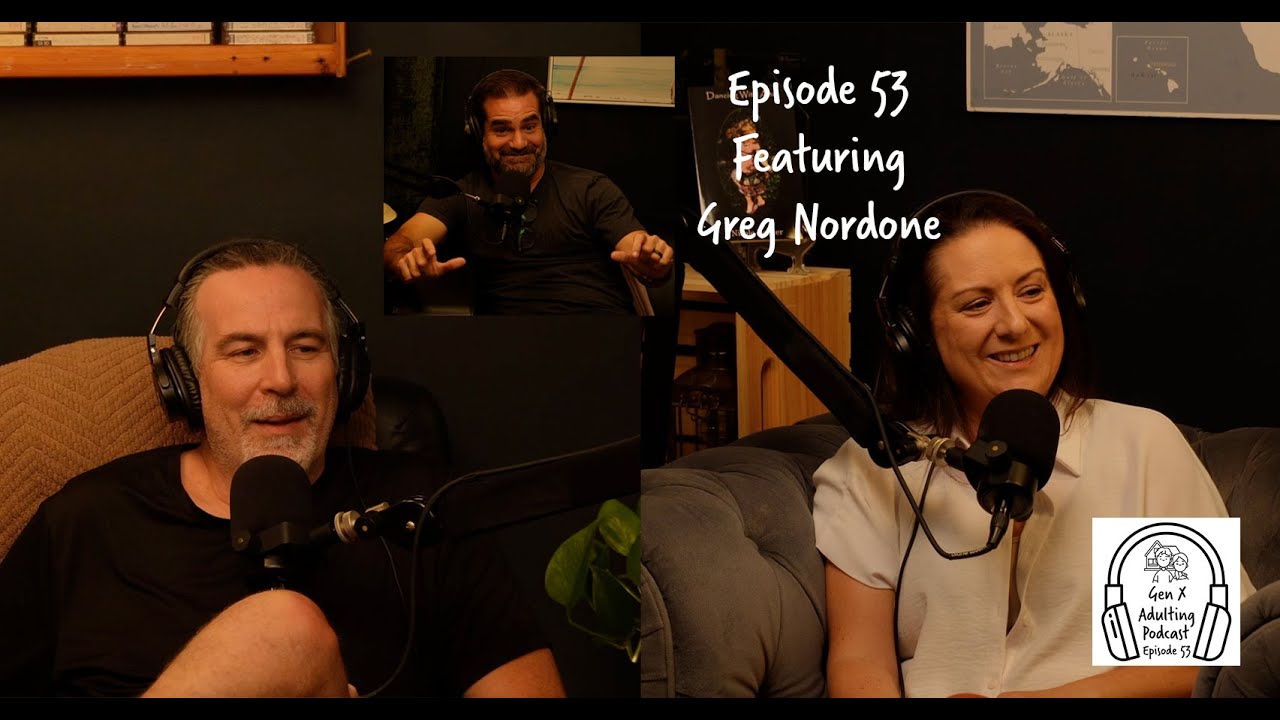
In Episode 53 of the GenX Speaks Series, Greg Nordone, co-founder of Greyson Technologies, shares his journey from growing up in Miami to navigating life as a GenX adult. He discusses his family background, experiences in high school, college life, and the challenges of becoming a father at a young age after the loss of his father.
[Music] Welcome to GenX Adulting and today we have Greg with us. Welcome Greg. Thank you. Thank you for having me. We're thrilled to have you. Our first question is always what year were you born? 76. Okay so you're GenX. Yeah and you're like, you're not young GenX but you're getting there. You're one. I think so. You're edging towards the end but you're still hardcore in that generation. Yeah I would say so. I think I felt a little bit on that like. So I connect with you know. Yeah. Certain side of the GenX. So I think 76 is legit. Yeah of course. Yeah yeah yeah I think that's like they can still, your childhood was probably still very GenX childhood. Yeah I think so. So where were you born? Miami, Florida. Okay and were your parents from there? My dad is from Miami, Florida. Yeah okay. So I'm second generation native. Okay so. Very rare. Yeah you're like a real Floridian, a real guy from Miami. So what about his parents? Where did they come from? New York. Okay. And then my great grandfather. Okay so your dad's Italian? Italian. A hundred? Yeah dad's a hundred. Okay. Yeah. And so they came over from Italy. Yeah. And then they were in New York, his parents, and then came down to Miami. Do you know why they came down to Miami? My guess is work. I think work. But other than that I don't really know a lot. My grandfather passed a couple months before I was born. Do you know what your grandfather did that would have brought him down here? I think it was like steel and I think it was like steel and stuff like that. Okay. Yeah. And then your mom. Where's she from? My mom's from Short Hills, New Jersey. Okay I know where that is. The mall. The mall. New Jersey Sloppy Joe, Milburn Deli. Yeah everyone knows the
your mom. Where's she from? My mom's from Short Hills, New Jersey. Okay I know where that is. The mall. The mall. New Jersey Sloppy Joe, Milburn Deli. Yeah everyone knows the Milburn Deli. So good. Yeah. When we lived there the Short Hills was like the fancy mall we'd go to sometimes. So okay so she's from New Jersey. How did they meet? They met in Columbia. Columbia in school. Okay so they both went to Columbia? Both went to Columbia. Okay and so they're college sweethearts. Yeah I guess they are. Yeah it was my dad's segment. I went to Cornell. Okay. And right guy but then got kicked out like in his freshman year I guess he didn't study or apply himself very much. He played football. Played like a little they had two types of football like under 160 pounds or something like that. No kidding. Yeah and then and then he came back home and yeah and then back to Columbia. So he so he left Cornell because he wasn't focusing and and locking in basically and then he came back to Miami but he was still able to get into Columbia. Well so yeah that's impressive. Yeah smart guy. I know but yeah my dad was real bright. Yeah no kidding. My mom's real bright too actually. I think my mom's smarter than my dad. What did they get their degrees in? My mom's a dental hygienist. Okay. She went from there to Penn. Okay. And finished and got her dental hygienist there too. Yeah and then my dad I think my dad is was general business and then he and then he actually spent a little time at FSU too and then taught himself how to be a CPA and became an accountant then hated it and became a life insurance salesman. Oh no kidding. Okay is that funny? Yeah it is funny. I hated it. Like just just couldn't stand the boringness of it. Yeah. So they met at
then hated it and became a life insurance salesman. Oh no kidding. Okay is that funny? Yeah it is funny. I hated it. Like just just couldn't stand the boringness of it. Yeah. So they met at Columbia but then your mom went to Penn and he went to FSU but they stayed together? Yes well so this is where it's blurry for me and like okay this is funny because I should know these things but I always my dad passed when I was 25 so I don't think I was I don't think I cared. That's not the right word but I guess you know it just wasn't as relevant to me as it is now. Yeah and it's funny thinking about this I was like I should probably talk to my mom and really map that out more clearly. That's because it's interesting because I think yeah I was trying to figure it out. Okay but they obviously stayed together even going to separate schools. Yes. They did long distance. Yes. And then he ended up back in Miami and then when she graduated Penn she probably met him down there I would think right. She's gonna be so mad at me. Okay so if I really think the actual way I worked was he goes Cornell back here military. Oh yes. So he was a marine. Okay. Yeah because like they were a hardcore family so like if he got kicked out he actually went to a boy's boarding school in high school too. My dad like my like me heavy ADD very spazzy. Okay. They sent him to boarding school for high school place called Middlesex in Massachusetts. Okay. And so then this is where it gets fuzzy Cornell back home military. I think FSU then Columbia because I think in Columbia they met got married and came here so my mom actually could be Penn Columbia. Okay that makes more sense. That might make more sense. Okay. She's gonna be so mad. Yeah okay so military. How long was he in the
and came here so my mom actually could be Penn Columbia. Okay that makes more sense. That might make more sense. Okay. She's gonna be so mad. Yeah okay so military. How long was he in the military? Four years. Did he serve? Yeah he did languages and he was in San Diego. Languages meaning translating. For what languages? That's a great question. You never got into it. Okay. Never talked about it. But probably like I would think Italian right. I was actually my dad was really good Spanish. Okay. And he did he did just a lot of translation okay stuff but would never really never really got into what he did. And he was wearing California you said. Yeah that is really interesting. What years would that have been do you think? No. But that would have been like if you were born in 76 that would have been the 60s. For sure. Yeah. Was he in Vietnam? Vietnam. He served during Vietnam but never served. He never went over there. Okay so he served during Vietnam but it was in California translating. Probably like semi intel stuff. Yeah and got really lucky you know to not have to. It is so interesting. Wow for that is really interesting. Okay and then he went to Columbia your mom probably went to Penn that makes sense and then to Columbia. Yeah. And then did they get married before they graduate? Do you know? No. No they got married down here. Okay so then they go down. They got married up there but they moved down here. Okay so they get married up there. They moved down to Miami. And was his parents still here in Miami when they moved in Miami? Of course. Okay and then her parents though were still in Jersey right? Yes. You're at the Grandparents? Yes in Short Hills. They had that home until my until my grandmother passed. Okay and were their uncles
Okay and then her parents though were still in Jersey right? Yes. You're at the Grandparents? Yes in Short Hills. They had that home until my until my grandmother passed. Okay and were their uncles cousins aunts? Yes she has two brothers. Okay. One two younger. She is the oldest and then she had a Jimmy and Doug. My dad is the youngest of four total. One older lived here in Boca. Older brother then older sister then older brother than him. So he's the baby. He's the baby. And then were there aunts and uncles for you that you grew up around in Miami? You know it's funny. Michael Tony his family is probably the closest we were probably closest to them because that's on my dad's side because it felt like Boca to Miami Shores was you know like 100 miles away right? Like that it felt where are we going? Why are we in a car for this long? But we would get together but you know the age difference between my you know the oldest and the youngest in that family was significant. Right right that makes sense. But I'm close to Uncle Tony's daughters now. That's cool. Yeah that it's they're great. That's cool. They're so great. So your parents are married. Your dad you said was an accountant for a while. Yeah KPMG and Pete Morwick like before all that happened and then was like this is terrible and became like a at that at that point life insurance and then financial planner. Okay and your mom was a dental hygienist. I was a dental hygienist for a while until she was like I don't love this at all. Right this is really interesting. And then then she at night studied to become like a librarian or teacher and then she ended up being the media specialist for Killian High School. Okay. And then and then schools up in the Pasco County area. Nice. Cool. Now
a librarian or teacher and then she ended up being the media specialist for Killian High School. Okay. And then and then schools up in the Pasco County area. Nice. Cool. Now when were you or do you have siblings? Yeah I have an older brother and younger brother. Okay so there's three boys. Yeah. Did they start their family pretty quickly after moving down here? That's an excellent question. No I don't I think it was four or five years before okay or my older brother was born. That's kind of unusual for back then. Yeah. You know that's. I think my mom was like 30 when I was born which makes Morgan like 20 or 27 and a half. Okay so she worked for a while and before she had you guys once she you know had your older brother do you know if she was a stay-at-home mom for a while? No she worked. So she worked. Yeah. Well so did you guys so she worked when you guys were little did you guys go to daycare? Yeah and yeah there was a couple of um a couple like church like schools and things like that that we would go to. Okay. In the local area. I remember you know it's all really fuzzy candidly it's kind of weird because they uh so I was eight and they got divorced. My dad really struggled as as an as an accountant he just kind of like didn't want to do this anymore and he knew he didn't want to do it but really struggled to like leave that and go be um go be a financial or planners or life insurance guy and I think that wrecked his ego the struggle. Okay. The inability to provide the struggle and then I think like and I look back and I think that that resulted it might as sweetheart of a guy but but I think he was like tough into the family unit or at least with my mom like you know what I mean like there's conflict there but I think that
resulted it might as sweetheart of a guy but but I think he was like tough into the family unit or at least with my mom like you know what I mean like there's conflict there but I think that conflict was like because he was having struggles dealing with his change. He was kind of in limbo. Yeah and there were no settled. It's not like you talked about things back then. I would assume. No help. Yeah there was no one to consult with. Oh well no mental health was a bad word you know talk totally. None of that he could have had some depression going on. Totally and he's a you know big ADD guy you know me. Yeah all three of us are ADD ADHD if you will. It's working you know and and yeah there's not a lot of help. There was a lot of ritalin take it. Yeah no one no one well was he on meds for his ADD? I don't think so. So I feel like that was pretty pretty. Yeah there were nothing there for the day. Yeah yeah so he's he's kind of he's kind of stuck and that'll come out in different ways and and before he could make his shift you know it sounds like there was a breakdown within the marriage you know and that makes sense and again because there now you can talk about all these things so easily but back then and I think also he was Italian right you probably need to be the man and not talk about your feelings and all that so that probably all went into play. So because it's unusual too back then during the 70s women were women did work obviously and I know that but it really wasn't prevalent it was just starting in the 70s and so to have your mom be working then wasn't necessary usual. My mom did end up working because she was a single mom and I think that was more normal but to have a woman married and still be
and so to have your mom be working then wasn't necessary usual. My mom did end up working because she was a single mom and I think that was more normal but to have a woman married and still be working full time that wasn't totally the norm. She had a tough mom an independent mom as well so even though in New Jersey my grandfather was the town dentist the short-hilled dentist and James Conklin and and it was interesting because she was I think a flight attendant my grandma right but but like anyway it was just like she was a worker versus not stay at home for per se right yeah and and my mom going to college and and two good and those things like yeah like yeah that was always pushed like my mom's tough cookie man. So that that really started with your grandmother then yeah you think that and she was that example and I would love to know where your grandmother got it from because it started somewhere you know and it wasn't the norm it wasn't so somewhere along the line your grandmother made that decision. Right there did your was your grandmother first generation here or were her parents because I think you said your dad's family was first generation right no my dad's uh my dad's let's say my dad's grandfather was first generation so his father was born here in the states okay yeah they were they were tougher I think I think that side of the family was tougher my mom's mom my grandma was Swedish yeah I don't know it's a it's uh it could be that it could be that too yeah I think that's really yeah exactly yeah it could be that too no I think that's really fascinating okay so um when you were in elementary school so that's when the divorce happened yeah I was eight you were eight so that's like what third grade I think that's third grade
really fascinating okay so um when you were in elementary school so that's when the divorce happened yeah I was eight you were eight so that's like what third grade I think that's third grade second third grade third grade and so your older brother would have been how old 10 to 10 and a half and then your younger brother what kindergarten okay so that's there's three in elementary school yeah and now um they're going to get divorced which again was still not very bad at all that would have been what like you were born 76 that's the early 80s it was just starting that whole divorce thing um do you have memories from that period or um anything that stands out during the divorce or how it affected your family sure there you know a couple of fights we observed that we didn't you know weren't great they actually the way they told us was real tough um they were in the middle of a really big fight we had this uh cool house in Miami Shores it was funny I you know it's funny they bought this house three months before I was born and sold it and I moved out after I graduated high school so I lived in the same home for all 18 years that's really awesome that's cool yeah so it was funny I was listening to a song on the way here it was about uh you know going back to your old home you're not allowed to go in but you know but um and I remember we had this playroom downstairs and the kitchen was upstairs the bedrooms in the playroom were downstairs the kitchen living room and all the living space was upstairs and they had this big fight in their bedroom and they came out into the playroom and they're like boys were getting divorced but it was just violent I remember it being violent so it was after me yelling yeah their their energy everything
they came out into the playroom and they're like boys were getting divorced but it was just violent I remember it being violent so it was after me yelling yeah their their energy everything they were coming right off a fight and they told you guys and was that a shock yeah for all you guys yeah for sure and then um so you your mom and the three of you got to stay in the house I assume since you yeah and moved out yeah and then uh was it the type of custody situation where you'd see your dad like every other weekend yeah like Tuesdays Tuesdays Tuesdays and then on the weekends okay and then we would it was interesting because he would take one of us oh interesting uncertain like so my dad and I would uh like you know it was my Wednesday and we thursday thursday because cheers we would sit and watch cheers okay I remember I remember this apartment this this apartment behind a wendy's like near downtown that's all being it's all beautiful condos now right but um yeah and we would sit there and it was great like it was sketch getting it like walking up to it and and then we would sit there and we watched cheers and we watched growing pains and like we watched you know I just kind of those were the fond memories you know what an interesting way to approach that I mean that is really cool actually so the week was it the weekday he would do one on one and then the weekends take all three of you yeah that's so smart because it allowed him to stay really have that quality time with each of you and create that bond yeah in a way and then you still had that time together but also what a difference you're coming from this wonderful home with your mom and then going to this different environment in your dad's apartment so that it's
you still had that time together but also what a difference you're coming from this wonderful home with your mom and then going to this different environment in your dad's apartment so that it's like two different worlds yeah so I think my dad was struggling to figure it out and I think my mom was always like you can have whatever you want days wise and um it was hard for him yeah you know a lot of our a lot of our time spent together was like let's just go to the mall yeah he didn't really know how to spend time with us yeah you know I've got a lot of shirts that you know that you like making them all yeah right like a little choccy yeah right remember that like the little puffy yeah oh my god iron on right in front of you yeah I had one that said el gato because my dad used to call me el gato yeah like run around and called himself el gato so that's what he he had one like that and uh and then um he he loved the sail and he had the sailboat and um he had this line the line was only admirals or assholes sit in uh the stairwell which is why where I stood all the time which is why I heard that so one christmas I get a shirt ironed on whatever said admiral that's awesome yeah so that's like a core memory that's core memory yeah do you still have the shirts I don't I don't have that one I've got a few from growing up actually um I have his polo okay so probably the one thing I have yeah yeah that's cool I can totally picture what you're saying like I can picture them all and I can the Omni mall in downtown Miami which is I don't think still there but but yeah so then there was like a merry-go-round and it was like clockwork you'd go there and eat play it was almost like you weren't even you know I mean it was we overwhelmed yeah
was like a merry-go-round and it was like clockwork you'd go there and eat play it was almost like you weren't even you know I mean it was we overwhelmed yeah you just didn't know what to do with three boys three boys all spazzy as heck yeah yeah you know yeah so did you get to the point where you look forward to that like all right I'm going to see dad we're going to the mall and I'm getting a shirt I liked the uh one-on-ones yeah yeah just to be with him yeah yeah 100 you know what's cool though is like I played a lot of sports he showed up at every game that's what I was going to ask you that was my next question he was present it just I think the parenting part was hard for him yeah yeah our relationships became unbelievable and he was my best friend as soon as we could have a beer together yeah yeah that makes everything change everything changed like when I went to college it was too bad right like you listened to those yeah cat stevens type songs yes and then he passed away when you were 25 so you were just just just finding your groove with him yeah yeah that's so in elementary school you mentioned in elementary school did you do sports through elementary school middle school that time yeah so it's fair to say that uh so we love sports like all three of us really played but um I spent more of my time at the fields and those guys like I have let's say the father figures in my life were coaches along the way and I really believe that those each one of them played roles in my life different ways maybe not all of them but there I could name certain coaches along the way that just had a massive impact on my life that's cool what's right I would live it I would live at the field house Miami Shores is a really cool town that way was it
coaches along the way that just had a massive impact on my life that's cool what's right I would live it I would live at the field house Miami Shores is a really cool town that way was it baseball uh baseball up until the day it turned into soccer soccer until the day you know so it was uh as ago it goes uh football soccer baseball okay and that was like your year like to the day it stopped you start the next one yeah and I mean and I did overlaps like one team was finishing and I would I would go to another I would do two practices a day okay two different sports as they overlapped so you completely immerse yourself in two immersed now uh that obviously was for a love of sports was it also do you think like you said you had father figures there do you think it was a way of coping I think so remember my grandfather wasn't there either yeah my grandfather had passed before so I never got to meet him yeah uh so there really wasn't a father figure my dad was there very present but um yeah I think it was I think it's coaches were you able to have um more intimate conversations with your coaches and you were with your dad meaning sharing emotions feelings any of that nope so it's just more they were solid male figures in your life and people you could look up to and leaders yeah yeah I'm not shy to tell someone what's going on in my head or you know share with folks so I always reach I was always kind of like reach out and whether it be school or sports or whatever always found myself around good adults that yeah you know just kind of said hey I'll help you out and then how about with your teammates was it like with all of your teams was it like a family almost yeah yeah so big parties and you know all the same guys I'm still very close to
how about with your teammates was it like with all of your teams was it like a family almost yeah yeah so big parties and you know all the same guys I'm still very close to so many of them now very close so two of my like two of my best friends I've known since I was eight and nine years old that's awesome were your were your sports where you kind of in football you had the same guys then you go to soccer and you have the same guys then you go to baseball very much season after season yeah that's how Miami Shores is yeah yeah it was it's the best town now that's down to grow up was this right would you say this is the equivalent of like a wreck yeah oh yeah and then did you do any travel was travel thing there at that time um we did some travel there were a couple of players that just kind of decided to focus those guys got put on a unique they would go to other town like go down to kendall and play with some better teams soccer and those guys really escalated those guys played in college they're really good um I did more high school okay that's where I my my journey got more athletic well I think for those of us growing up though travel wasn't like how it is now it wasn't it was like you said it was those few kids and now it's almost it's reversed it is it you know it still takes money no matter what like even back then a couple of my friends that got really good at soccer like their parents were able to afford them having some private lessons on the side yeah yeah I actually I remember this window where I had a chance to play I'm like a tweener birthday and so a couple of my friends were on the older side a couple of my friends on the younger side so I had a choice like do you want to play with the 12s or the 13s
I'm like a tweener birthday and so a couple of my friends were on the older side a couple of my friends on the younger side so I had a choice like do you want to play with the 12s or the 13s I remember that being a really hard choice and going all right I'll play with the 12s because I had a few more friends even though I could play with the 13s if I would have gone to the 13s it my level would have escalated because they had a better coach and they had a better everything when's your birthday February okay is there well I know that they always are changing the the birthdays I was always so I was a tweener too but it was August for so I could I did the same thing yeah yeah so in elementary middle school was it mainly sports were you involved in anything any other extra curriculars like clubs in elementary and elementary and middle school elementary middle theater always my theater okay okay so when did you get involved in theater um fairly young I think my mom took me to go see Phantom of the Opera I love Phantom of the Opera fell in love love it Brian's even been really in Broadway it's the very first one I've seen yeah I saw it down in Miami did I've seen okay so this is a funny story yeah for one of our anniversaries we went over the Phantom of the Opera on Broadway I I drug him to or dragged whatever is to Phantom of the Opera yeah maybe I drove and dragged right so we want we go through the you know the first half or whatever and then there's the intermission right so we get the intermission starts where the lights go on and he gets up to leave and I'm like like leave for good and I said no it's just intermission and very loudly and his very deep voice goes you mean there's more and it echoed through the whole place people turn and it turned
and I'm like like leave for good and I said no it's just intermission and very loudly and his very deep voice goes you mean there's more and it echoed through the whole place people turn and it turned around and looked at us and I was like oh that was the only time I did that with him really but he did see all of Phantom of the Opera I can't believe you don't remember I do now that you say that yeah I remember I I think you blocked it out yeah I wasn't hooked no you weren't as hooked as I was yeah so you saw Phantom of the Opera my mom had me in that stuff well actually it was funny because I remember I mean I was playing football either seventh eighth grade I remember going from football practice to it and I thought I was gonna fall asleep like I was fighting it so that I was fighting it and then I was like yeah yeah yeah yeah yeah yeah yeah yeah it's amazing I had been doing some simple church like theater before that okay whatever okay it wasn't until um until I got in high school that I got really immersed in it okay so what an interesting existence for you oh yeah because you're athletic and the jock quote unquote yeah captain of the football team okay cat okay okay yeah small school don't get me wrong okay okay so you get to high school and you're doing high school sports and high school theater both of those things require a lot of commitment on top of academics yep did you work too no okay so that summers okay okay my dad kind of had that statement that it was always like you're either gonna be in school like you're gonna do these extracurriculars are you gonna work those your choices yeah well those extracurriculars especially doing theater and academics would take up and and athletics would take up
these extracurriculars are you gonna work those your choices yeah well those extracurriculars especially doing theater and academics would take up and and athletics would take up everything if you want to even try to get some sleep in there somewhere it was crazy so that's my question though is I don't know how it was set up but I would have pictured theater practice and athletic practice would have been around the same time after school it was complex and I had some amazing teachers and coaches that worked with me that's amazing that is awesome yeah so cuz was theater year-round practicing no more in some respects but it was more play-based to okay so it's the real work in theater for me at least was at the play you could take it as a class mm-hmm and so I would do that but then but then also when we're in a play yeah a lot of attention so what did you lean into in theater like were you singing were you dancing were you you know in high school it was all straight plays okay I can't sing okay although there's a funny story about that but but I can't so anyway I did all straight plays a really enjoyed it I had a great teacher named Sandy Lewis who was just absolutely spectacular woman and and she was great like so I'd spent so much time even my senior year she created a class for me and called directing and I just got to direct her so I would go to the middle school class then I got to direct a middle school play it was just special it was really cool experience growing up that's awesome those types of teachers and they they they hooked me up so so what kind of plays do you remember what place you did we didn't mash Jekyll and Hyde yeah that one that's cool that's one of Brian's favorite shows yeah well doing the play was yeah yeah just a
what kind of plays do you remember what place you did we didn't mash Jekyll and Hyde yeah that one that's cool that's one of Brian's favorite shows yeah well doing the play was yeah yeah just a lot of like one acts and and shoebucks stuff very cool and that was mainly high school yeah okay and then you were the captain of the football team the soccer team so it sounds like you were a leader on the athletic side were you also leader in the theater side too you know I don't think so I was courageous enough to hop into whatever they wanted to hop into but but I wasn't really a leader per se there were some people that just you could tell loved it I love it yeah but like there's some people I have a feeling there you were probably had some leadership qualities because of crossing over from sports right and you were the captain of those teams so then you had to been somewhat of a novelty in some ways in that we've got this athlete coming over to theater that's not totally common so you probably had a natural leadership maybe not I don't know prescribed I guess yeah I mean I've had some teachers call it that at this school I mean there was a guidance counselor who who had said like there were a couple things she's like you're just a natural born leader yeah remember that and it and it stayed with me you know core memory because I you know it's weird I I was in I was in like a lot of the honors classes so I would spend a lot of time with really tacky yeah nerdy guys which is great you know and I could I could get along with those guys I'm fairly gregarious I can get along with a lot of different people and so I would hang out with them but then I'd go to football practice and hang it out with all my jock buddies and then
get along with a lot of different people and so I would hang out with them but then I'd go to football practice and hang it out with all my jock buddies and then I'd go to theater and hang out with all the theater people and I I just think that's the way I guess for me that was easy because I was like this is great you just yeah who cares they're all different but it doesn't matter yeah and each one of them has something special and fun and enjoyable and I loved my jock friends for who they were yeah and I love the theater people for who they were and just great friends on all sides of it but back then and I think you I don't know about now if it's that way and I don't know if it was like this at your school it wasn't mine it was very clicky yeah and there were groups and it definitely would have taken a special person to float the way you did and be accepted and not ostracized by one of the groups or judge I I think yes and I found myself able to break through that piece of it but I think the deep relationships were a little bit more on the sports side okay you know like where so those people like oh yeah he's like you know he's cool come on in he's fine but then there's a gate do you know what I mean yes so there's a big gate like there's the wall okay and no one's allowed in but you cross through the wall yeah that's okay yeah then there's another private room and I wasn't invited into the private room right I also made a choice in high school I think because of this guidance counselor you know driving me in this in this which was we created an organization called leaders educating about drugs lead so I ran that in high school which is hysterically ironic because I got it once I got out of high school it's like what
called leaders educating about drugs lead so I ran that in high school which is hysterically ironic because I got it once I got out of high school it's like what are these things right well what besides the leadership being inspired by the leadership aspect of it what drew you to focus on drugs I think that was uh you know I think school kind of guided that more than I was like I'm gonna be this guy I just think I was making teachers happy okay you know what I mean I really do I think that's core too it was like hey I love this teacher hey they think this is great okay okay I'll do that and that kept me out of a couple circles right right now of course people who are still like hey man he's cool yeah except we're gonna close the door now right like the narc is here and it wasn't an arc like I was like listen I don't care if you do it like I really wasn't but you know wasn't like I don't care if you do it like I'm cool it's not my thing yeah but I didn't care if you did it however it was really designed like the the whole premise of the thing was just to educate better yeah about there are dangers right and it wasn't this like full-on Nancy Reagan like yeah it was more just about education which I think you know when you go to a small private school uh drug dealers are smart right they're businessmen they they know where the money is so you actually have I think a lot of it comes to the smaller private schools more so than the best drugs are in all private schools 100% if you're good at business you go to where the highest paying customers we didn't establish that so you were in a small private high school yeah small private high school was your scholarship and middle schools private as well no so I went to public school for
establish that so you were in a small private high school yeah small private high school was your scholarship and middle schools private as well no so I went to public school for elementary okay and then Catholic school for for for three years okay and then I jumped to the private school for like seventh through twelve and you said you got a scholarship yeah like the Presbyterian Church helped out and then there was like some scholarship money my mom couldn't afford to send me that so I we we were able to find money through the church and through the school what was the motivation of wanting to go to that school mom did you send mom's like let's get you the best school we can get no just me what what do you why are you why just you do you know um you know I don't uh I don't have a clear answer on it I just think that uh I was I think my mom knew that I I would excel you were the overachiever out of the three yeah maybe that's the way to say it were you people please but my younger brother it got more it got tricky so Miami Shore's got a lot of people in every district and then like what happens your choices were Miami Shore's elementary was great whatever I rode my bike school that's the majority of my life right yeah ride my bike school stop at grandma's Nana's on the way home have a cookie you know like doo doo doo doo my homework yeah it was yeah it was amazing like when you really think about it yeah it's super nice my buddy who lives six streets down would pick me up in his and his prelude I was like late every time he's like dude you're killing me he's still one of my best buds you know it's so beautiful it's like I know so many people from this town who are all still really close in fact my
you're killing me he's still one of my best buds you know it's so beautiful it's like I know so many people from this town who are all still really close in fact my wife's from the town okay yeah and I know friends whose wives are from this town okay so I get okay Miami Shore's has that cool vibe too that's cool yeah really growing up in Miami Shore's there's like a Facebook page what are it's what are the demographics of Miami Shore's is it is the Cuban Italian for the most part it was I mean primarily Irish Catholic Irish Catholic um I think Joe Robbie I don't know this but like Joe Robbie lived in Miami Shores okay and then he helped build when he was building jirabi like a lot of construction guys from the town yeah okay and so and he owned the dolphins okay yeah and so anyway yeah Irish Catholic there some Italian but but definitely the Catholic Church was strong like like the Catholic Church of Miami Shore's pretty strong church so you said though a district for your little brother so and so what happened was like my choice was this new magnet program school mm-hmm and it was tough it was it was a rough place to go so I think that if you really look at it like my mom's like okay let's send him to the Catholic Church let's see then my parents got divorced my dad was Catholic my mom was Presbyterian yeah so it's really funny when the divorce happened I would go to Presbyterian Church on Sunday with my mom and then get in my bike drive to the Catholic Church and put an envelope with money into the giving box to prove I was there to tie it yeah that was a tie yes but to prove I was yeah yeah yeah yeah so it was really funny like that was my Sunday were you were you covering for the whole family the tithing
was a tie yes but to prove I was yeah yeah yeah yeah so it was really funny like that was my Sunday were you were you covering for the whole family the tithing yeah yeah yeah yeah cuz my older brother went there too okay and then he went to North Miami High so he ended up going to the local high school oh wait I think I know what you're saying so you guys were going to school at the time at Catholic school yeah that was oh yeah so we are kids went to Catholic school and yeah you have to prove you were there I see what you're saying yeah church you mean yeah yeah so one way or another you were there you're gonna purchase money in that envelope time you're golden you're good so you would go to church so you went to you were raised Presbyterian it sounds like yeah so I always joke I went from religion by fear to religion by service oh my god so and that was that pretty much every Sunday yeah so you would do that and then get on your bike and go take care of the Catholic Church yeah you're so interesting okay but you also got a lot of good Catholic values at school of course right yeah class yeah yeah and I was so I was I was baptized Catholic I was confirmed Presbyterian interesting okay so you went through the whole your first communion Catholic yes okay so you were baptized Catholic first communion Catholic then reconciliation probably during school time that's around the same yeah you would have if you were first communion you went through reconciliation yeah there's our dogs that was um yeah well see for our kids first first communion was second grade and and reconciliation was I think first grade or third grade so yeah okay so you did the first three sacraments of Catholicism baptism yes reconciliation
first communion was second grade and and reconciliation was I think first grade or third grade so yeah okay so you did the first three sacraments of Catholicism baptism yes reconciliation communion but but then for confirmation you didn't finish it out you went with Presbyterian and I didn't even know they did yeah so what are you because you could it's like dual citizenship I guess the way the way what am I I believe in God yeah I pray yeah I'm not a great churchgoer yes you have dual citizenship and do church in religion yeah you can you kind of dabbled in both I think that's so fascinating okay so um you said you were height your high achiever it's obvious you were high achiever were you also people-pleaser would you say yeah totally and would you say you walked on eggshells no okay so you were a people-pleaser high achiever but you you weren't nervous about being like that if that makes sense you weren't walking on eggshells making sure kind of kind of trying to read the adults before you act to kind of yeah every now and every now and again I would get careful my soap like my mom like five of my mom's good friends worked at the school okay my dad dated the dean of students like it every now it's like one of my like my best friend Mike he'll do this whole time we would be in school and when my dad was dating the Dean of students he'd be like Joe yeah we can do anything like he literally he took advantage of this idea that we walked on water because he was like a fourth son to my dad and he took advantage of the walk on water not that we I mean we're good kids like we didn't really break that many rules yeah so broke simple right you know like nothing kid shit kid shit yeah and and there were you know in Miami stores there were other kids doing
kids like we didn't really break that many rules yeah so broke simple right you know like nothing kid shit kid shit yeah and and there were you know in Miami stores there were other kids doing worship so yeah you know it's easy to stay off the radar when you were in partying no and like even my my you're so funny like my mom used to have this rule in high school she would be like you're allowed to go out but you gotta wake me up when you come home so I know that you were in the house before yeah before curfew and so I would go out and I'd come home late army crawl into her bedroom and set the clock back no way totally wake her up she'd look at the clock got it and then army crawl out and then army crawl back in and reset the clock to the right time yeah was this a digital or like yeah yeah the red ones the brown the brown you know talking about the wood exactly what it was that is so Gen X I do that is so great I remember that so much I used to do that so often that's brilliant yeah that really that I love that that's genius did she know that before now set it on this podcast yes okay I've told her at a like a Thanksgiving dinner we've had some fun fun stories wine yeah okay so high school so you're busy you're busy you're doing all these things great for me okay your world though is it sounds like it's pretty small there oh you're doing all this stuff but it's a small world you're living in super super interesting Brian because you know you you're in Miami yeah I had friends going down to South Beach this is it but my like my I was more of a home and I don't know if you'd call it a homebody but like I stayed in the shores yeah sure is safe to me right I think that I married my wife from the area like
it but my like my I was more of a home and I don't know if you'd call it a homebody but like I stayed in the shores yeah sure is safe to me right I think that I married my wife from the area like I I do believe that one home thing I've thought about this like because you made someone who's been in like six homes in their journey and they've got weird connection issues right like they don't you know like there's something fragile do like I have a friend who's had so many homes yes it just was what it was right and they struggle to connect whereas me I'm like this this is perfect in fact my neighborhood and my wife and I were looking for the place we wanted to live the neighborhood we found is like everyone walks their dog everyone is like in there riding their bike everybody weighs to each other it's a small little microcosm of my shores and that's like it's so hard to come by in yes in this area of the country South Florida yeah well it's the reason we picked the neighborhood we're in yeah I'm not gonna say the name of the neighborhood on the podcast but this neighborhood we're in is the closest you can get to 1950s living as far as walk the neighborhood any time of the day it's very it's very much that Northeast vibe if that Northeast small town vibe sure sure so it is hard to find down here so it sounds like you grew up in a small town in Miami yeah absolutely in a single house very small town and even though though there was the chaos of a divorce and you went through that typical like divorce kid and there's shit that went with that you know but you you had the stability of your town your home your coaches your teachers yeah your activities and it sounds like that helped balance out the trauma that you also would have gone through with the divorce
had the stability of your town your home your coaches your teachers yeah your activities and it sounds like that helped balance out the trauma that you also would have gone through with the divorce because no matter what no matter how good things are that's still traumatic event for I'm a child of divorce I know I'm talking about I'm just out of like three or four divorces I think so it's it's wonderful you had that anchor yeah of the functionality to go with the dysfunction that would have just naturally resulted from divorce yeah my brothers weren't as active and I think it was hard wrong yeah no that makes sense you know by the way that might have just been that might have just been the way I dealt is I surround myself in groups yeah you know and because I either developed that over time you know team sports is to me one of the most wonderful things you can do to your kids like team sports is great and you learn so much by the way acting is team sports absolutely it's incredible yeah I mean if you've ever sat in a green room or gone to the practices and the amount of support practice trial and error things like that that you need in teams in acting is in credit and trust trust trust is real trust yeah yeah I talked about that today with my team yeah that reference yeah acting yeah because in acting you're also being very vulnerable and so it's different than the kind of trust on a sports team because that's trust too yeah but it's very different so it sounds like you were insulated with these activities right that's why I always felt like a book were tone feels like it's 200 miles away yeah I mean I didn't do the South Beach thing yeah much I really didn't like oh did you go to this and this is like I guess I'm kind of
like it's 200 miles away yeah I mean I didn't do the South Beach thing yeah much I really didn't like oh did you go to this and this is like I guess I'm kind of a dork I didn't go to that many of those things and well and you were living a fairly responsible life for a teenager even though you were doing the army crawl and change in the clock but you weren't out there the real trouble I got into is like we egged a car you know turns out it was an undercover cop guard yeah he showed up at that like that kind of stuff and so you know we are fair share of oopses but yeah yeah but mom never really I don't think mom ever worried yeah yeah that's amazing that's amazing so I'm getting towards mid end of high school did you were you already thinking about college and where you wanted to go I'm not where I wanted to go too much but I was definitely thinking about college it was kind of like I qualified for the Florida undergraduate scholars program I think is what it was called at the time so state schools were always an option I applied to Tulane was the only other school I don't even know why really I've never never really thought like how did Tulane end up in my list but at my school they had you know pretty good a really good actually not a pretty good a really good college guidance counselor who helped you through things and maybe that's where we ended up with it and then I got a couple of a couple letters more than anything else of like interest for college football but I was just super burnt out okay it's so weird playing being able to play all three sports which is like the good and the bad is like is like I was pretty good at all of them because I didn't focus wasn't great at any of them okay okay and so I loved soccer but you
play all three sports which is like the good and the bad is like is like I was pretty good at all of them because I didn't focus wasn't great at any of them okay okay and so I loved soccer but you are either born with gifts in your feet or you're not right it's just as that way and I was and I was pretty darn good but you know not necessarily like that next level because you have to play it against people that are just different yeah so football was what I was best at and and I often think like what would happen if I would have gone to a small school in North Carolina on a football scholarship but ultimately I couldn't afford Tulane that was not a there's no happening and it was like had four or five good friends all going to Florida and said sign me up when I have a question on this when today kids playing sports have they have to specialize down here and it drives me crazy because they don't they can't do the three sports they can to a certain point but then the travel team set in the kids who specialize come back and just wreck everybody you know if in rec was it like that when you were grown up was it was it specialized were you forced to pick something earlier doesn't sound like it it's not like you could play but like three sports here's reality even though even though I didn't specialize it was still top 10% of my team yeah so there was half there was half there was yeah I'm just Netflix so there was happy to have good eye hand coordination fast yeah you know those types of things and and in football I love hitting people it was like reckless I I won't use the nickname because it'll be you know whatever but like I had a nickname like it started when I was like seven years old and stuck with me and like it was
it was like reckless I I won't use the nickname because it'll be you know whatever but like I had a nickname like it started when I was like seven years old and stuck with me and like it was just because I was a reckless you know what position did you play in football I played sort of running back receiver you know and then but I love playing more safety and linebacker I was gonna say I could picture you as a safety just coming up and popping someone just mowing like I called like we had a me and this other guy called the stick them and pick them you know and he would go get interceptions I would just read people that's hilarious I don't know why but like growing up playing football my whole life and it's some great coaches like they just said this is how you hit people and this is and and and they said and it's safer to do it that way and that's all I needed to know so for me I was always about applying the force yeah you know yeah like the one time I did it under 85s we had some coaches and I hit this guy on the side as a whole place lit up and I was like that's all that was the only affirmation I needed and ever since then it just you know it was simple to me like that that was the easy like this just go hit people it's great and I felt protected I got pads on yeah yeah yeah and you know it's crazy not one injury that's amazing not even a concussion well I don't know about that yeah I know we don't talk about that so I had my one game I got hit in the back and then hit across the helmet and my jaw dislocated like this and I'm like I come to the sidelines and you know you're a small school we only had like 25 kids on the team I went I played I played receiver or you know receiver or running back except when the quarterback got hurt
to the sidelines and you know you're a small school we only had like 25 kids on the team I went I played I played receiver or you know receiver or running back except when the quarterback got hurt then I played quarterback I played full-time defense I kicked It's a special team. Punted, returned kicks, returned punts, never once left the field. Wow. Never once. Wow. And so I get hit and I come to the sideline, I'm like, oh my God, they're hurting. And they're like, what? Here, sit down. And there was this doctor came down off the bench and he's like, let me look at you. And he just ran right back into place, smacked me on my ass and I went right back out there. That's hilarious. Hilarious, my mom and I went like the next couple of days and I'm like, mom, I'm not really, it's not all together, you know? But that was it. And like, you know? Did you ever go to a doctor and have it checked out? Yeah, we did, yeah, that seems okay. My mom was like, Jen is for God's sakes, my grandfather was a dentist. That's awesome. That is so Gen X too. No one cared, yeah. Oh no. Get back out there. Are you kidding, now they call an ambulance or something. Back then we had the smelling salts too. Yeah, we did. The concussion. You're like, I'm back in. I can't see straight. Yeah. Oh, I'm good. Yeah, I'm good. Yeah. Yeah. So okay. For sure. And I played against some guys that played on Sundays and they were just built bigger. So you could throw your body at someone and exert force until physics wins. And I ran into a knee once that just was like, where am I right now? So there's definitely a few. I was gonna say, that sounds like a little-- There's a few brain cells that are no longer. You would ring your, I got my bell. I got your bell, yeah.
So there's definitely a few. I was gonna say, that sounds like a little-- There's a few brain cells that are no longer. You would ring your, I got my bell. I got your bell, yeah. It's a whole thing, like it's totally different. So our son does travel across and even playing for the school, you have to sign all these things and he has to watch a video about, it's totally different. Well, they do pre-season tests. They do all of it. Did you know about that? That whole protocol for concussion? No. Oh yeah. You do a test in the beginning, you answer questions. And then if you think you've got concuss, you have to answer the same questions. And if your answers deviate or the timing's off too much, it's pretty good actually. Smart. Yeah, it's smart. I like that process. No, no, it's good. Data-driven. Yeah. 100%. Yeah, that's what appeals to me. This is data-driven. Hey, data-driven stuff makes me, right? Okay, so as far as college though, I assume because your grandmother and your mom were so progressive in that thought process, college was discussed in your home, it was assumed you were going to college. Oh, 100%. Okay, so that's cool. So, and you had a great guidance counselor, which is unusual even for that time, so that's awesome. So you ended up going to UF? Yeah. And did your brother and little brother go to college too? Older brother, no. He actually came up to that area and went to, what is the community college, Santa Fe Community College, and then was studying to be a firefighter, that didn't work out. And then my younger brother, no. His journey was just a little different. Yeah. He has since, he says in Saint Pete, went to Saint Pete College and got a degree, but it wasn't like high school and then big break.
His journey was just a little different. Yeah. He has since, he says in Saint Pete, went to Saint Pete College and got a degree, but it wasn't like high school and then big break. Okay, so out of the three, you were the traditional-- Out of the three, for four years in and out, bye-bye. I wondered, it just got me thinking, is the age, and when your parents got divorced, your older brother was a little bit older, little different experience, then you got you, then you got the younger one, little different. Do you think that played in? Totally. Yeah. I think about that, but I, so my younger brother had a weird, weird thing because my mom was like, I don't wanna send him to that. School we were talking about, she sent him to Palm Beach to live with my aunt and uncle, her aunt and uncle, actually, so that was kinda like my brother's, our great aunt and uncle. Okay. They took care of him for like two years and he went to school up there, two, three years. And then, like poor guy, man. The journey was tough, he was so resilient. He was like, he's just got this beautiful way about him. You know, he's like, yeah. But, and then she moved like-- Out of the house. Out of the house and he's, like for his sophomore year, he's gotta move to like middle of nowhere, North Tampa, like country. Fight net. Wow. Fight net, you know, and like that was, I think that was hard, really hard. You talk about like not fitting in at all. It's different over there. Totally, right? And they are immediately like harsh. Yeah. Harsh and pick on and all this and like, you know, anything that he would do that would have been, let's say a cool kind of mannerism or whatever here was just crushed there. He ended up like two years there and then coming back to my dad.
anything that he would do that would have been, let's say a cool kind of mannerism or whatever here was just crushed there. He ended up like two years there and then coming back to my dad. But like, I'm coming back staying with my dad, but I'm like separated from all this because-- You were in college, right? I'm in college. And the weird part is you don't have a home to go home to. Yeah. I don't know, I'm going to like Newport, Ritchie. Oh, true, true. Middle of nowhere, West Florida. When did she sell, was it your freshman year? She sold the, literally, pack the car, pack the house, drive to the new home, which is because she got a job at this school system. Unload the home, love you, college. Okay. Like days. What a transition for you, so-- So I had nowhere to come home to. But also just-- And my dad had a one bedroom. Yeah. So it's not like, my dad had this one bedroom apartment, it was like two twin beds. Well, what's so interesting about that timing is, you had a couple things going on, because graduating from high school is a big deal. And then getting ready, did you do that thing that Florida kids do where you go the summer session? No. Okay. So you had your summer to kind of enjoy work, being in Miami Shores, but knowing that you're gonna be moving. So you're having a transition of leaving your childhood home, your childhood friends, everything you've known. So those are two big things, you're leaving and you're going to college. And then go to the new place, and then continue on to Gainesville. It's a lot going on there. That's a lot. My mom wanted us to come home and visit. There's nothing here. Well, yeah, because a lot of times also that first Thanksgiving or freshman year, when you come home, you get together
That's a lot. My mom wanted us to come home and visit. There's nothing here. Well, yeah, because a lot of times also that first Thanksgiving or freshman year, when you come home, you get together with all your friends from high school. It's all about your friends when you first came home. Yeah. Didn't know a soul. So that was a blow for you, and then your little brother's going through his own thing, and I'm sure your older brother was going through his own thing. Do you think that having, because also that stability that you had insulated yourself with to help you cope with everything you'd been going through with the divorce, that was gone now? So now you have this new experience at UF. Would you say that you then created a whole installation there with friends and a life there? Yeah, totally. I mean, it's crazy, but three of my closest friends at UF were from my high school. That's awesome. Yeah, so I-- So that kind of came with you. Yeah, totally. It kind of came with you, that comfort came with you. So did you live with them in the dorms? I lived with, not my first semester, my second semester, I lived with one of them in the dorms. Oh, so you changed dorms mid-year? No, I did. I literally moved next door, me and my roommate. Okay. We need to get along. We're gonna get along. It was okay. I mean, we ended up being fraternity brothers, but we still didn't get along that well. So you didn't know that. It wasn't a fun living situation. Yeah. You can be friends with someone, but not be able to live with them. Yeah, totally. You don't know it at the time. You don't, you don't. Well, but yeah. So you moved in with someone first semester. Yeah. Didn't work out. Next door to my, to three buds from high school, who did a threesome in there,
You don't, you don't. Well, but yeah. So you moved in with someone first semester. Yeah. Didn't work out. Next door to my, to three buds from high school, who did a threesome in there, and then had it like a loft put in and like did some really cool thing. And then two of them were like, "Hey," and one of them's dad was like, "Hey, I bought you a house. "You'll go there." And so they're like, "Later." And my one buddy's like, "I can't afford to pay rent or anything." Yeah. So he's like, "You wanna move in with me?" And so they had this decked out. Yeah, it was great. That's amazing they could leave. I know- And that was a fun other half of the first year. I'm sure. Like we had a great, me and my buddy, we had a great time. I'm sure. I'm sure. And the fact they could leave though, because I think at FSU, you have to live. Maybe not anymore. I know, I know. There used to be, well, we went to college, you did. No. You had to live in the dorms. I think it was one semester. Yeah, yeah, yeah. I think that was the- You had to at least do something like that. Okay, so you're at UF and second semester's looking good. Yeah, it's enjoyable. Yeah, yeah. And then during the holidays, you'd go home to this new town. Yeah, summers, yeah. And summers. Holidays for the new town. I made one friend that lived generally, but it was still like 40 minute drive from my mom's. It was, it was, it was tough. And then the summers. Who were you staying in Gainesville in the summer? Staying in Gainesville for you. My first, my freshman year summer, I came down and I lived with my dad. And he's like tiny apartment in the middle of nowhere. And that was funny, you know, that place. And we'd play racquetball. That was like what we would, we like,
And he's like tiny apartment in the middle of nowhere. And that was funny, you know, that place. And we'd play racquetball. That was like what we would, we like, we'd go to the racquetball courts, we'd play a lot of racquetball, and then I'd go hang out with a bunch of buddies. We'd play poker, you know, three or four nights a week, go out occasionally, but no one really had any money. Yeah. You know? So you're kind of working, scraping together, what have you. But, you know, we all came from working class families that, you know, there wasn't extra. So you didn't work through high school because of the extracurriculars. What was your first job? A summer job being a camp counselor was my first job. And that was in Miami Shores? Yeah, for the church. Okay, and then when you came back down that summer and lived with your dad, did you work then? Yes, so I got a job at the hospital in admissions. What's funny is my senior year is the funny job. The most interesting job I think was just before my senior year. Okay, so I didn't share this part, it was really interesting. My mom, being a dental hygienist, had realized that she could, excuse me, when she was a teacher, she still was a dental hygienist, and she realized she could, in the summers, go to Juneau, Alaska and get paid a ransom to be a dental hygienist. So she left her boys. How old were you guys? Maybe 18, 16, and then she took the youngest. So your little brother also went to Alaska for a summer? Yeah, to see the best. Where did you stay then? Can we have your house? She left us in the house. Way through parties. So this is your sophomore, your sophomore? I think it was junior and senior. If I try to piece together, remember how we said I can't put the gates to everything?
Way through parties. So this is your sophomore, your sophomore? I think it was junior and senior. If I try to piece together, remember how we said I can't put the gates to everything? It gets me mad, to be honest. Yeah, 16 would be like beginning in junior, your February. Did you stop your anti-drug crusade at that point to have the parties? Well, let's put it this way. I was educating and being educated, but I still really, I still did not smoke until I got to college. Not once, until I got to college. And I was surrounded by people who were like, yeah, totally, and my brother liked to throw the parties. Back then, half the kids from Miami Shores went to one high school, the other went to the other high school, there were fights or fights in my lawn. One of my best friends, his dad came over, he was like, oh, rah, rah, rah, rah, like my dad. My dad was supposed to watch us, but my dad's 20 minutes up, down the road, or 25. You know, it was hysterical. The palace. So my buddy calls it the palace. The palace. You're housekeeping the palace. Who wouldn't wanna hang out there? It wasn't like that scene, you see "16 Candles", the movie, where they have the party at the house, do you know what I'm talking about? They were, I didn't go that bad. Like it was controlled, but there were a couple that were like, wow, there's a lot of people. We had this really cool deck off the second floor, with a little, like what was supposed to be a storage shed, which I'm sure became like the smoker shed, which is really breaks my heart, because like if there's one place I'd like to have smoked, it would have been there. You know, like everyone else did, right? But you know, it was a great party house. And yeah, so here's, this was funny. So I started dating this girl,
like to have smoked, it would have been there. You know, like everyone else did, right? But you know, it was a great party house. And yeah, so here's, this was funny. So I started dating this girl, like my senior year and over the summer. We're in high school still, right? Yeah, so this is like, I guess this is junior to senior. I'm dating this girl, my mom comes home from, this is like a little core memory, and my mom comes home and she's over. Wait, it was the Alaska? Yeah, yeah, so my mom comes home from-- Did you know she was coming? Yeah, yeah, yeah, it wasn't a surprise. I just, for the last month and a half, two months, she was over in my house, in my room. Are you kidding me? At that age to have an empty bedroom, it's like a dream. Yeah. And no sneaking. A dream and you're like, are you out of your mind, lady? Yeah. Right? Oh, well for-- For my mom? Yeah, for sure. Totally. I think she really, I think she trusted I would do the right thing, and I did. Morgan, I have no idea, but like me, it was like-- Why wouldn't she though? You were like this amazing, high achieving kid, you know, so-- That didn't break a lot of rules and all that. Yeah, she didn't know about the army crawl then. Yeah, yeah. She did not. Pre-army crawl. Which still wasn't, like all I was doing was going out and hanging out with buds. I wasn't really doing a ton of bad stuff, right? She wasn't willing to not trust you and supposedly your dad was gonna watch you, quote unquote. Correct. So yeah. He's there for emergencies, right? Yeah, yeah. But I'll never forget this, because the girl's overhanging out and I get this, like, Gregory! Oh, with the full name. What is happening, right? And I go, what's up, mom, what's going on? She's like, you will not have guests
because the girl's overhanging out and I get this, like, Gregory! Oh, with the full name. What is happening, right? And I go, what's up, mom, what's going on? She's like, you will not have guests to the female persuasion in my house. And I was like, oh, so now there's rules? Okay, sorry. Like, you know, like, I always want it. The way I looked at it is my mom had it tough. You know, she's a single mom. Both my brothers struggled in school. And so she worked tirelessly to, she's like, she's doing the Dunlohi-Genis thing to make enough money to make ends meet. My dad at the time, still struggling, right? And she's gotta work so hard with both of them every day on their homework. Yeah. They're both experimenting with Ritalin, you know, like the school, you know what I mean? Like, there's a lot going on, right? You know, and she's just surviving, you know? She's, and I guess I, I don't know, I'm like, I felt like I had to help her. You know, and I wasn't helping. It was just like, because I don't really think I helped. I just wasn't ever gonna be a burden. No, you took that role, right? And typically that happens, especially in those situations when one of the kids is gonna take the compliant role, the people pleasing role and the helping role and that you took it. Yeah, I did not help for the homework. I did homework on my own. Everything was like, it was just... No, but you know, I always say this. Sometimes the compliant kids are the ones you need to watch because everyone assumes they're fine and a lot of times they aren't. And then there's things that don't get dealt with for the compliant kid, that the compliant kid, as they get older, face and deal with, but the compliant kid is bearing shit to be compliant. And so I always tell people
that don't get dealt with for the compliant kid, that the compliant kid, as they get older, face and deal with, but the compliant kid is bearing shit to be compliant. And so I always tell people check on your compliant kids because those are the ones sometimes that are in the most danger mental health wise. Wow. So, and I'm not saying that was your situation. No, it's interesting, because it's certainly been... Well, once mom goes to Alaska, it's party time. Yeah, exactly, exactly. Comes to the palace. But it makes sense. You know what's funny is, is like, I didn't necessarily wanna throw parties. I just wanted to have little get togethers. My brother wanted to throw parties. You know what I mean? I was just kinda like, we can do anything we want. Come hang out here. But I just wasn't really into drugs, barely into drinking. I mean, I was a total idiot drinking wise. I'd be like, yeah, shot, shot, shot, shot, yeah. Throw up. Like, how cool is that? And then I'm laying on the ground, like you're cool. And then I'm wrecked for the entire next day. So like, I wasn't very cool that way. I just couldn't handle my alcohol. I didn't know how to just, my dad would be like, dude, it's not a race, you idiot. You know? He's like, what are we doing? Right, and it was like, right to the cliff, fall off. So anyway, I was just mellow. But for you, it was also access to have girls, or a girl over. Totally. So that was probably the biggest highlight of that whole song. I mean, sure, the little bit of exposure to the drinking or whatever, the people around, but... 100%. For a teenage boy who has a consistent girlfriend, like having access to a bed is like, it. That's it, right there. So that's funny though, but you know, listen,
100%. For a teenage boy who has a consistent girlfriend, like having access to a bed is like, it. That's it, right there. So that's funny though, but you know, listen, you went to church every Sunday. I'm not surprised she came. Not when she wasn't there. Not when she was in Alaska. But when she showed up, that was probably on her mind. Like, you're going against some things there. What's interesting, just the sidebars, you were more of the compliant people pleaser for your mom, but once it sounds like when you were in school and sports, you didn't have to play that role. So it's more at the home, it seems like. That's interesting. And because at the school, my mom was dialed in, there was still some not gonna be disruptive, right? No, he was, yeah. There was like a senior prank, I'm like, I don't need to be part of that. Yeah, I think he was still doing that at school. Very much, I think very much. And high achieving, captain, and doing all the things. And yeah, no, I think that went into school too. Oh man, I had some coaches that, you know, that like, because they played that father figure role, like all I wanted to do is make them happy and proud and this and that, and you know what? And then when it comes full circle, so there's one coach, a defensive coach in my high school and he and I got to know each other really well. And unfortunately, recently passed. And man, we would sit there, cause I was a senior, I kind of knew, like I was cerebral enough that I understood how the game was going. So I'm like, why don't we do this? Why don't we do this? So we would sit and talk about it, right? And he'd be like, why is that guy a wuss? I'm like, I don't know. Like, what do you want me to do? Coaches, they're a bunch of private school kids.
So we would sit and talk about it, right? And he'd be like, why is that guy a wuss? I'm like, I don't know. Like, what do you want me to do? Coaches, they're a bunch of private school kids. Like, you know what I mean? Because he drives a Porsche to school, like what are we gonna do? Like, you want me to hit him? I'll hit him, but it's gonna cry and walk off the field. And we would laugh about it and we'd have a great time. And then, you know, he gave a speech, you know, like sort of the awards banquet and these things I remember. And, you know, it impacted me. He goes, if you gave me 11 players, if you gave me 11 players that were all like one, I would take him. And then he also said, you know, he goes, it's not the size of the line and the size of the fight and the line. And yeah, I mean that, you know, just people believing in me, like someone believing in me meant a lot. Yeah. Especially in high school. Yeah, no, it makes sense. Do you know what I mean? Yeah, yeah. How did you balance navigating that path through high school in a private school where there was probably a lot of wealth? Yeah, a lot of wealth. By the way, it might have given me some drive. Okay, to kind of prove yourself? No, like, holy shit. I can live like this. You want that? This is what's possible. Okay. Yeah. Okay. So were you ever viewed, did you ever deal with any stigma after-- The Broke Kid, Scholarship Kid? Yes. Yeah, there was once, I remember, and I don't think it had to do with Scholarship Kid, but it kind of did, in that you had a lot of kids who had maids and nannies and all that. My mom went through this phase, she's like, "You boys will now do your own laundry." It was one of those. We had like, she was cool about certain rules, but if she did the
and nannies and all that. My mom went through this phase, she's like, "You boys will now do your own laundry." It was one of those. We had like, she was cool about certain rules, but if she did the laundry, you had to fold it, and we didn't fold it, she's like, "Now you do your own laundry." Well, what you learn as a kid is that if you leave your laundry wet, for a long time, it stinks. Yeah. And I went through a phase where my clothes reaped, and I remember like, the abuse I took. I mean, I had hand-me-downs. Yeah. You know, all that stuff, and so I definitely took some abuse, but there were also some other kids in the school that didn't have money too, and it was okay, but by the way, I also had some great friends who had money. Yeah. And I just learned to get along with them. Right. You know, but I went to, went to sleepovers on Indian Creek, which is where Tom Brady and Jeff Bezos and all those guys live now, right? And you're like, "Okay." So this is interesting. This is a level. This is a level. Sometimes, and I really do believe this, I think some people are limited by what they see. In fact, like, you know, it's like your imagination can't create it. Even if you see it on Instagram, whatever, like in social. Like you can't see it, but if you've gone into a home that looks that beautiful, you can go, "How do I get this?" Yeah. Right? Now I was always gonna do it ethically and this, that, and the next, but it was always like, "How do I get the house on the hill?" Yeah. And you see it, right? And you're like, "Wow, okay, so I need to work hard." It's exposure. Yeah, and it was always like, once I hit a limit in anything I was doing, I was like, "Well, what's next?" Like, "How do I?" So I do think it added some drive, for sure.
It's exposure. Yeah, and it was always like, once I hit a limit in anything I was doing, I was like, "Well, what's next?" Like, "How do I?" So I do think it added some drive, for sure. It rooted into, it rooted. Yeah, yeah, yeah, I wanted it, if you will. Yeah, yeah, yeah, so there were pros and cons that you dealt with some shit for being the quote unquote poor kid or scholarship kid, but it also gave you that drive and stayed with you the rest of your life, probably. Helps to be the captain of the football team. Well, yeah, that too. Yeah, like I'm not complaining. Like I had big friends. Like, "You wanna mess with me?" I'm like, "That's a really big friend, "they're gonna beat you up." And then at the same time, at a small school like that, you're a captain of the football team and you help the team be, do great, people wanna be your friend. Right. So... Yeah, you had a lot of balance in there. Yeah, it's crazy. A lot of different worlds. Very blessed. Do you ever reflect on this besides now? Yeah, in different ways. Most of it is just kinda like, "Man, I'm pretty lucky." Yeah. You know? More than anything else, just kinda blessed. Like, "Oh, I was pretty blessed "to be able to do some of that." Without realizing that, had I not had those things, how hard it could have been, that part, maybe it's making me think more about right now. But, you know, I was a decent athlete. I think the thing is, is there's plenty of people who are decent athletes, but they don't work hard. Just think about it, like, when you go from football practice to soccer practice, to homework, to theater, you know, and rinse, repeat, and oh, by the way, you gotta, you know, you can't go mess around at break because you gotta go do this. Like, I was overworked.
to homework, to theater, you know, and rinse, repeat, and oh, by the way, you gotta, you know, you can't go mess around at break because you gotta go do this. Like, I was overworked. But I had no, but it also said, like, you know, if you want all these things, like, by the way, like, the more, it's funny, the harder you work, the more opportunities present themselves. That's a blessing and a curse, because then all of a sudden you're like, "And I still have that blessing and curse now," because it's this conflict between your values wanting something, and it, like, let's say, like, you wanna volunteer, but it costs you time away from your family. And that conflict messes with me as I've gotten older. Yeah, that makes sense, yeah. You wanna do these things, but like, having a child second time around, I don't wanna miss those years, like, I miss them with me first. You see the trade-off, and it creates that conflict. That conflict, what are my values, in a sense? Yeah, are they, you know, like, making, it's like, just choices. You know, like, funny thing is, is in high school it never felt like there was a negative choice. It was just, do this, do this, do this. By the way, because it kept me from partying, and because I wasn't partying, I didn't feel like I didn't have FOMO on that side of the house. Right? Yeah. Because I was busy. Yes, and in some ways also, like we had discussed probably also your way of coping with what had been going on. So you've been busy, you've been doing, you've been, you've had this childhood, and all this, this installation, this little small town in Miami, your mom sells the house, you're now at UF. You had kind of always had adults around you helping form who you are. Now you're on your own,
this little small town in Miami, your mom sells the house, you're now at UF. You had kind of always had adults around you helping form who you are. Now you're on your own, in college, in a town. There's no, your mom's not working at the school. She doesn't have, no, none of your mom's friends are working at UF. You're kind of free, maybe for the first time. No eyes are on you. It's just your experience. How did that experience compare to where you came from? Big man on campus. Big fish, small, big fish, small pond to little fish, enormous pond was a lot. Joined a fraternity, helped. Gave me a sense of that, you know, group. I mean, having a couple friends from my high school, and it's really funny, like my, so if you go to Florida and it's rush week, so you're just kind of walking around, and my roommate happened to know this dude, and he comes over, and they're like, "Hey, let's smoke," right? And I smoked once, maybe, like, "Okay!" Like I was yes to everything at that point, right? Not everything, that's a stupid statement. So we smoke, this dude becomes my best friend in all of college. Like we lived together, we joined the same fraternity, and he was like, "My guy," right? So we became the best friends. So it was really funny, that happened like day one. You know? That's awesome. Yeah. And I do truly like being around people. Like I just like people, I have this friend now, he's like, he looked at me one day, he's like, "You like people?" I'm like, "Yeah," he's like, "You don't?" He's like, "No, I don't like being around people at all." I just never even like, it's so funny to hear someone verbalize it, right? That's me. Okay. Right, but what's funny is, Brian, is because I like being around people, I'm very good with introverts.
I just never even like, it's so funny to hear someone verbalize it, right? That's me. Okay. Right, but what's funny is, Brian, is because I like being around people, I'm very good with introverts. Yeah, yeah. Right? Yeah. Because they're like, "I can, I make it easy on you to hang out with me." Yeah, yeah, yeah. And right, like, because, you know, some people can do it, like it's just adapting very much so to my surroundings. So I would, you know, so it was, it wasn't as hard as you think for me. I went to school, I drank a little bit, partied too much, missed a bunch of classes, lost my scholarship, that pissed my parents off. Yeah, yeah. But guess what, the response to that was, was, "Now you're gonna take a loan out in your name." Okay, back then a loan was a little easier. It was like, "Here's an interest-free loan, you don't start paying back until after you graduate." Yeah. Okay, so it started paying for schools and books and stuff like that. When did that happen? Freshman year. Okay, so was that second semester when you got with your friend? I got to see, I got to see in theater appreciation and lost my scholarship. Oh no. Shit, you know. Wow. This is hysterical. Theater appreciation. Because I didn't go, and I didn't know there was, theater appreciation, forget the, I love this. Yes. And it was an 800 person class, which is the worst thing in the world. Yeah. Because no one cares. And then there's eight plus notes. So you kind of read the notes, and the guy basically made it tricky on people. He kind of made it very much this. I get my classes a joke, but I'll put Easter eggs in showing up. I hate that. If you didn't show up, Yeah. You were screwed. In attendance class. Basically in attendance class, it's all was.
I get my classes a joke, but I'll put Easter eggs in showing up. I hate that. If you didn't show up, Yeah. You were screwed. In attendance class. Basically in attendance class, it's all was. I made the mistake also of like, I signed up for like English at 8 a.m. Oh, jeez. But I didn't know any better. Yeah. That's the interesting thing. The interesting thing about all of this was, because I had never really needed my mom to help, or my dad to help, no one helped me pick classes. No, like we didn't go through that. Like she was like, "You good?" I'm like, "I'm good." But it wasn't making wise decisions such as an 8 a.m. class in college or freshman year. English? Yeah. I'm gonna make that a lot. So that's one I had to drop that way. So I went through that process. And yeah, I mean, I paid for it by paying it back, with interest and the modern way of lending money to students and then ripping them off in the meanest interest rate you can, that makes tons of sense to me. So I paid it all back and all that, but that was the trade off, that was the consequence. There's this whole debate around, should you go to college or not? And I'm still there. But I think what you're describing is part of that experience in college. It's not all academic, it's learning. Don't schedule a class at eight. That'll help you later in life. Do you ever have 8 a.m. meetings today? Yeah, right? I try not to. Yeah, you try not to. Unless it's, yeah. Brian, here's interesting. I went back to my school to talk to seniors. And the number one thing I talk to them about is invest in relationships when you're in college. Business world or professional world is a lot about who you know always, right? But opening doors. Who you know opens doors.
is invest in relationships when you're in college. Business world or professional world is a lot about who you know always, right? But opening doors. Who you know opens doors. I don't necessarily think that who I know has helped me massively. There's people I do know where that's worked out. But my message to the kids was, you're not there necessarily to really learn and apply the book smarts. You'll learn some. There's some things I've learned. However, my favorite classes had nothing to do with my major. But I had said to the kids, I was like, "Look, first and foremost, "get outside of your comfort zone." And I wish I would have done that. So that's the negative of being this people person like to be surrounded by people. I don't like going to a bar by myself. Whereas you know people are like, "I go to a bar by myself all day long." That's not comfortable for me, which is weird. And I used to, when I lived in Boca, I remember Gatsby's was right down the street. And I would be like, "Hey, I couldn't go there by myself." And so I didn't break out of my circle. And I was challenging them. I said, "You know, if you break out of your circle "and you get outside of it, "you're gonna meet people from all walks of life. "And these will open massive trees for you." Tributaries of crazy relationships you never knew. That I wish I did more. And so that's what I encouraged them to do. Because that's where I think, college has that opportunity. Really, like a massive opportunity for them to do that. And then the other thing is like, "Man, your best opportunity to explore topics "you'd never thought to explore." And I don't think you don't like, we're like, "Hey, I'll do theater appreciation in golf "to get my credits." Because everything was about
"you'd never thought to explore." And I don't think you don't like, we're like, "Hey, I'll do theater appreciation in golf "to get my credits." Because everything was about sort of achieving your credits to get to graduate. And I was four in, four out. And I really wish I wouldn't have been. By the way, I don't think I coached my daughter as well as I could have through her college journey. Which is funny, because I know this. But I really don't think I pushed her as hard. I got her out of her comfort zone for sure. She went way out of Florida. But not necessarily the way I'm talking. Which is interesting. So, go ahead. Well, the question, so you went back to your, you spoke to seniors at your high school. It's a very interesting thing. Because I know you are a giving person. And you do volunteer, you do some things like that. How did they receive that? Did they? So I really was so grateful for being invited. It was like I was three years into my company and my entrepreneurial journey. And got invited back. And it was a really neat experience. It was all seniors. We were at some gazillionaires house on Fisher Island. I think the guy invented the barcode. Oh, my goodness. Literally, right? Someone invented that? Right, I see. Oh, by the way, this was a lesson for me. I got to talking to him for 30 minutes and realized, I know exactly why you invented the barcode. There was no way you were gonna survive in corporate America. That wasn't an option. And he and I reflected on that to the students. I go, you know, everyone wants to be an entrepreneur. Everyone wants to own a company and blah, blah, blah. Yeah, the reality is, is I'm not, I mean, I was college, the workforce, big corporate. I just, my journey into entrepreneurship
Everyone wants to own a company and blah, blah, blah. Yeah, the reality is, is I'm not, I mean, I was college, the workforce, big corporate. I just, my journey into entrepreneurship is different than a lot of other people. But there are some people who do it out of desperation because there's nothing else. And that's a really core driver, right? No other options. Or I've done a self-assessment and I can't live in that world. And that opens really cool things. Talk about getting out of your comfort zone. 100%, right. And that's, you know, it's funny. Getting out of your comfort zone is like, I feel like I'm a risk taker, but I don't feel like I'm a risk taker. It's so, because of this circle of comfort that we've talked about building. Yes. And when you were college, and we talked about how a lot of that fell away, but you still had some of it, because you had friends there, and then you created with your fraternity. So it sounds like you kind of approached college a little bit similarly in high school. You were driven. You had an end goal. Maybe you focused on the end is more than the process of getting there. It was like, I'm graduate. Like I got four years graduate. This is what I need to do. And as you're saying, instead of getting out of your comfort zone, having some different life experiences during those four years, not be so goal focused on what you're supposed to be doing. Yeah. I've often reflected that, had I decided to go, I was burnt out of sports. I had said that. But I love football. Love it. And should I have even explored that's going to a small school, staying the same path, I'd probably be coaching football right now, in some respect. I may still, in my older days, like high school and what have you,
that's going to a small school, staying the same path, I'd probably be coaching football right now, in some respect. I may still, in my older days, like high school and what have you, but if I would apply the same level of passion drive and intelligence to that, I would have done it in a high level. And so sometimes I've, I keep asking myself, you don't always have to do the straight line. My life's been very straight line, I think, until it gets disrupted. And a lot of actually my risks have been forced upon me. Yeah. But it's, yeah. Yeah. But when did that, so you graduate from college, did you then do the next kind of safe choice, like as far as what was your first job? Yeah, so my first job was a buddy of mine got me an interview. Okay. In Atlanta. My best bud, one of my best buds who picked me up every day from school, his older brother, who had come down to college and blah, blah, blah. And like we became friends and we're great friends now. He got me a job, ended up being more of a mentor. And he gets me his job at this company, he just left. And I go on this interview and one of the guys I'm interviewing with gets up in the middle, starts stretching, like literally, weird. It's my first job interview ever. That's awesome. Wait, the guy that is interviewing you? Two guys are interviewing me. The friend who got me the job is in the, or got me the interview was in the, excuse me, my best friend's brother's buddy, who made the connection, he's in the room. But he starts doing all this weird shit. And he works for them. And he works for them. Like some time she or something. And the other guy goes, and the other guy's like, so I do this whole interview, I think I did okay. Yeah. They say no. My buddy calls him up.
Like some time she or something. And the other guy goes, and the other guy's like, so I do this whole interview, I think I did okay. Yeah. They say no. My buddy calls him up. You're gonna be idiots, don't you do this. And they end up hiring me. Oh, wow. Yeah, calls him up, you guys are idiots. It's like a training ground of inside sales reps, right? Okay. Top of my class, blah, blah, blah, first to get promoted. Let's put it this way. If someone bets on me, I'm gonna do a lot to make sure. And by the way, this has driven me. This is how I think I've been. Even at the client level, if the client says, I'll go with these guys, I'm gonna give the small guy a chance, I will do everything in my power to make sure that they're rewarded for that decision. So did great there, straight arrow. First interview at a college. Got the job, went to that place. How long did you work there? Yeah, all in all it was about five, four, five years. Five years? Oh, that's a long time. Oh, I see stuck around. That's the same job. So inside sales, and then I got promoted and I moved to Louisville, Kentucky. So you lived in Atlanta? I was in Atlanta for two years, roughly. And then went to Louisville? Went to Louisville. Okay. And did two years there. And that's where my girlfriend and I got pregnant. Okay, so you're working there. You have your own place? Yeah. And you had your own place in Atlanta, right? No, I had a roommate. Okay, so. Yeah, that was great. Like Atlanta was great, a bunch of young professionals. Okay. A couple guys, I ended up meeting a guy who I knew at Florida, but didn't know really well. And someone said, hey, that guy's looking, you're looking. Why don't you guys be roommates? Perfect. War besties now, it's amazing. That's awesome. Yeah, I love him.
but didn't know really well. And someone said, hey, that guy's looking, you're looking. Why don't you guys be roommates? Perfect. War besties now, it's amazing. That's awesome. Yeah, I love him. That's awesome. And he's strange, I'm strange, it's great. And we're having the time of our lives. We're both doing these stupid jobs. He's making fun of what I'm doing. I'm making fun of what he's doing. We're both just trying to figure it out, go out, barely spend every, and I made three or four friends who I am really close with. That's great. That's great. And then my buddy's older brother is now one of my best buds. Because now four year differences and four, five year differences is nothing, right? Yeah, yeah, yeah. And so, yeah, the friendships I made in Atlanta, I mean, I'm very blessed. I have a great circle of just super cool people that have been in my life. And then when you get to Kentucky, so that's your first time ever living on your own. Oh yeah. And how old were you? 23. So that's cool. Just getting your own place, right? Kentucky's interesting. Louisville's interesting, right? Like at one point I joke, I go out to a bar, I'm one of the only guys who doesn't have his name on it, sure. Why did they have their name on their shirt? Like, you know, like you're like a uniform. Oh, like a? Yeah, like your name-cac, like a uniform. Like, wait, you don't-- Like a blue collar job versus a white collar job. Oh, okay, okay, okay. Which isn't even fair, but it was like mentally, I'm young and I'm stupid. It's not fair. Okay. By the way, Louisville's an amazing town. It's one of our favorite cities, yeah. We've been there, we loved it. We loved it. Loved it. Okay. Big small town. Great whiskey scene, right?
By the way, Louisville's an amazing town. It's one of our favorite cities, yeah. We've been there, we loved it. We loved it. Loved it. Okay. Big small town. Great whiskey scene, right? Yeah, yeah, very cool town. Great whiskey scene, great bar scene. Yes. Great music scene. Great music scene. Their blue scene is fantastic. They had like Sunday concerts. They are Catholic churches, a new carnival every summer. Summers in Louisville are amazing. Winners, woo, cold. Were you in downtown? I lived in the St. Matthew's area, which is kind of a little suburbia. The downtown wasn't as good as it is now. Yeah. Right? It wasn't as-- And it's still kind of a small downtown now. It's a little dodgy. Yeah, it's a little dodgy. But it's like a small downtown. By the way, I met a guy there who is a lifelong friend now. Yeah, he's amazing. I'm not surprised. It's just kind of my journey. So you're living in your own place for the first time. That's a big move. And you work, you got this promotion. You're working and you meet this woman. My girlfriend from high school. Oh, so had you guys been dating this whole time? No, no. Wait, is this the one that your mom yelled about? No. Okay. That was the Hooters waitress. There's nothing special about that at all. You have that interesting part out. It's part of myself. But yeah, you know, my kids are gonna listen to this one. Oh, that's a good one. They're gonna listen to this one. Yeah, so. So when did you start dating her in high school? Sophomore year. She was a year younger than I was. So I guess I was a junior, she was a sophomore. You guys were like off and on through high school? Well, she ended up moving back to Columbia, the country. Oh. So like they, her family moved back there
junior, she was a sophomore. You guys were like off and on through high school? Well, she ended up moving back to Columbia, the country. Oh. So like they, her family moved back there and then we reconnected. In Kentucky of all places? We were connected remotely. Okay. And so then even in Atlanta. So we reconnected remotely in Atlanta. And then we started doing the remote dating. It was always long distance. Okay. She would fly, she moved to Miami. No, she was living in Miami working. So when she graduated college, she moved to Miami and started working. Okay. And then we were doing the long distance thing for a while. And then we were talking about marriage. So it wasn't like, we weren't talking about it. And so. Did she move to Kentucky to live with you? She moved to Kentucky, but she like moved in. We're like, I said, well, why don't you move? Like she's like, I want to be closer. So she moves with some roommates or gets an apartment with some roommates, but that doesn't work. So she's in my house 24 seven, which when you're young, yeah. So you had your own place, but not. Yeah, so I had my own place for like a year. Okay, and then you had your girlfriend there. Correct. Okay, and she's working there too, I assume. Yes. In Kentucky. Okay. And so you guys are dating. We're dating. And you're talking about marriage. Yeah, we're like, hey, and maybe this is the kind of ring I would like. Okay. That kind of stuff. Yeah. More like that. I'm still 23. Right. Right, 24. And then she gets pregnant. Okay. And, you know, so I immediately say, well, let's go, I gotta do the right thing. Let's went to the, got the justice of the peace, come to my house and my mom flew up. My dad was like, should I? And, you know, like,
well, let's go, I gotta do the right thing. Let's went to the, got the justice of the peace, come to my house and my mom flew up. My dad was like, should I? And, you know, like, nah, it's no big deal. Don't worry about it. We'll connect. So then, so then he, so it was like, no, it's my mom's there and we do a little baby altar in my apartment, if you will. And justice to the peace comes, he's like an ordained minister and he does that. And so we get married. What about her family? Were they there? Family was in Columbia. We had him like on, like, what was it at the time? Aim or ICQ? Yeah, something like that. It's crazy, like something, you know, to get it. Yeah, and it's me, my mom, her, my uncle, because my uncle lived in Louisville. Okay. And then my cousin, and those were like our witnesses. And we did a little cute little thing and, you know, had some wine, whatever, it was nice. And then a couple of weeks later, we went down to Orlando and did the parks and we did the parks. And so everyone, like a couple of my buddies came, my dad came and everyone got to spend time with her and get to know her or whatever. She spent some time with my dad and my dad was like, yeah, yeah, that's great. Like, he's like, I'm not feeling great, but everything's good. And my dad died 30 days later. So how old were you? I was 24. And she was still pregnant? Mm-hmm. How did he pass away? Heart attack. So my grandfather died at 58, a couple months before I was born of a heart attack. And so he, my dad died of a heart attack at 58. A couple months before-- A couple months before my daughter was born. Your daughter was born? Yeah. Wow. So it was in the family. Yeah, hereditary for sure. Young though. Very. And he was in Miami? Yeah, my little,
before-- A couple months before my daughter was born. Your daughter was born? Yeah. Wow. So it was in the family. Yeah, hereditary for sure. Young though. Very. And he was in Miami? Yeah, my little, I'm at a work thing and I get a phone call from a police officer and he was in the shower and he had a heart attack in the shower. And my poor little brother woke up. Was he living with him? He was living with him and he woke up. He went into his shower. Just kind of moseying around. Yeah, yeah, yeah. Just walked in on my father passed away. Your poor brother, just to add on to all the other shit you were talking about. Which is amazing, because he just, his heart is so big. He's just such a good, floats through life with this, you would think he'd be like, "Rrr, rrr, rrr, no, no, he's not. "He doesn't walk around with this dark cloud, "woe is me vibe at all." I'm always like, "Dude." Not only was your dad young, you were young. Extreme young. Very young. And about to become a father. Yeah. Yeah. So that's a whole nother thing. So that was-- So that had to have been like a grenade for your family. Just massive. We were gonna move from Louisville to Atlanta. We changed our minds when we said, "Let's go move down to South Florida." Which I think my wife never wanted to be in Atlanta anyway. So she used that as an opportunity. Hey, let's get to Miami. So that's August 1st, September 11th happens. Oh, geez. We said September, we moved. I changed jobs. Same company? Same company. Wonderful, wonderful manager. Was an important man in my life. Because they worked with you, right? Because of everything going on, they kind of set all that up for you, that job in Miami? They weren't that great. Okay. Yeah, they weren't that great. One man was good.
Because of everything going on, they kind of set all that up for you, that job in Miami? They weren't that great. Okay. Yeah, they weren't that great. One man was good. I was gonna say, you got one guy. He had a role, he's like, "You can come here." I was leaving the company, by the way. I was interviewing for a role at a different company because I was like, "I'm gonna move on." Okay. Big corporate, 250,000 person company. So he had a role, I knew the guy. He's like, "Hey, I got a role in Fort Lauderdale. You can come down here." So that's great. So I got to move. We buy a house, change jobs. My daughter's born all within six months. And you're 24. Turned 25. 25. Yeah. 25, I guess that was 25. 25. And your mom's not there because she's living. And mom was super, like she's trying to do everything. But all the familiar stuff. Yes, there's no familiar, there's nothing. It's just such a contrast from when you left, graduated high school, and this life you had had, and then you come back, and it's like nothing is the same. And we move out to the middle of nowhere suburbia. West, west, west Broward County. And your dad's not there. So you're having to live down here in South Florida without your father for the first time. That's a whole new normal. Was your little brother still here? No, he was in Tampa. He was in Tampa. But you had the uncle, right? And the cousins? Yeah. Who lived in Boca, but too far away. I mean, now you've got your new wife, and the daughter's born. The baby. The baby's born. You've got a new job. You're back to a familiar geographical area, but it's completely different. Yeah, that's what I mean. It's almost like-- Broward, like I don't know anyone. Yeah, I don't think. So, well, and she's still, we haven't even gotten to
but it's completely different. Yeah, that's what I mean. It's almost like-- Broward, like I don't know anyone. Yeah, I don't think. So, well, and she's still, we haven't even gotten to the birth of your daughter. So she's still pregnant. You've started this new job, you've bought a house. I mean, I bought that house and she was born like. And then she was born, and now you're a father. Yeah. So how did becoming a father change your life? You know, I take it very seriously, but then it was, I took it as a responsibility. And I think my wife was struggling with a little postpartum. That's my diagnosis, no one else's. So it was really tough. It was really tough. I was opening a territory that had been neglected for a very long time. And if anyone's tried to build a business from start, it's really hard. It's a ton of no's. Well, actually we didn't even touch on that. Huge expectations professionally now, right? Now I gotta earn. You gotta earn and you're building a territory, starting it from scratch or fixing a neglected one. And it's the type, back then sales jobs were low base. You make your money and you're variable. Now they've new world of, there's more balance to it, which is different. And so it was really hard. I had a good manager, he was cool dude. He had a lot of pressure on you because now you're a father and a husband. And I couldn't make the ends meet. And it was funny because I inherited just a little money from my dad from life insurance. The irony of my father being a financial planner, but his, the cobbler's children have no shoes kind of thing. Like his world. By the way, I was the executor of the will because there was no executor of the will. So everyone's like, you're the guy who's organized. I'm like, I'm not organized.
Like his world. By the way, I was the executor of the will because there was no executor of the will. So everyone's like, you're the guy who's organized. I'm like, I'm not organized. You're the high achiever. You're the high achiever. Correct, so it's not always fun to be the high achiever. And for some reason in our family, we like to say, please be the high achiever and then judge you as you do it. Lovely, and that happened to my dad when my mom, when my grandma passed too. He was judged as he did it, which is funny. Yeah, I think that happens. Heavy as the crown, they say, right? Yeah. Yeah, and I remember so distinctively walking the dog once because the marriage was hard. It wasn't working. It was just, you know, unfortunately, it was just nothing but stress all along the way. And there wasn't a ton of support. And I remember looking at the sky, like, dude, where are you? Not God, dad, dad. Where, like, I need you now. You know? Yeah. You're dealing with a lot there. You're dealing with not having a father at 25, which no one expects. Hello? Like, never in your wildest dreams. He was so excited to be a granddad. Like, he was out all over the moon. And he was gonna have granddaughter, you had three boys. And just to go back, you had finally, once you hit an old enough age to drink, you know, hang out. That's when your relationship really started. For 30 days, it was a really cool window. Was it only that long? It was only that long to talk about what was gonna be possible. Yeah. 30 days. What a tease, man. What a terrible joke, tease. So. And our last, one of our last, I'm pretty sure our last conversation was he was telling me I should buy life insurance. And I go, dad, I don't wanna talk about death right now. Yeah. Like, dude.
So. And our last, one of our last, I'm pretty sure our last conversation was he was telling me I should buy life insurance. And I go, dad, I don't wanna talk about death right now. Yeah. Like, dude. I'll figure it out. But I don't wanna deal with this now. He's like, you need to do this. You know, my dad was always sort of, he's not trying to sell me anything. He's like, this is responsible. What is something that happens to you? You know? Yeah, yeah, yeah. I remember buying life insurance, like, right after he passed. Because I was like, I need it. Yeah. You know? It's such a cruel joke, right? You're giving a window into what could be, and then it's snatched from you. And you're so young, and at the same time, and you're still a child, you're still your father's child at that time. We're always our parents' child. So you're your father's child, and you lose him, but now you're someone's father, and have to be that to that child. And also a husband. That is an insane tornado of everything. What would you say your biggest coping mechanism was during that time? That's funny. I mean, you know, work was part of it, you know? Because I had no choice. I mean, yes. Ultimately, I don't ever run from a fight. That's never been me. So unfortunately, that leads you to deal with things later. Yeah. Right? So just push it down. Denial. Maybe that's a little nice Gen X, or just push those feelings down. You're not allowed to have those. Oh yeah. So there was a lot of that. Buddy of mine got me involved in a softball team. Just a way to take my mind off of it. Yeah, I don't know that I coped as much as I just dealt. Avoided. Avoided, yeah, just operated, right? Like I put blinders on and said, you know, execute, you know, like
Yeah, I don't know that I coped as much as I just dealt. Avoided. Avoided, yeah, just operated, right? Like I put blinders on and said, you know, execute, you know, like you can't not make ends meet. I think it got real, then there was a divorce. So how long were you guys together? Like 18 months. It almost was destined to not, to fail. It started with just so much. And anyone in a normal situation would struggle, but you guys were so young. And even though you'd been talking about marriage, it kind of happened so quickly. There wasn't a lot of preparation. Wasn't natural per se. Correct, for it. It was for the reaction too. Right, and then. But it's a testament to you being a good person too, though. You're trying to do the right thing. And doing the right thing isn't always easy. And then you get more curve balls thrown at you, and it's like, this is really not easy. Under such extenuating circumstances. I mean, it's, and even though, you know, your mom was there being supportive, she's not living close to you. So it's not like she's the grandma that could just come over and help. You know what I mean? You guys didn't have that, even that person that comes in, I'll take the baby, you guys take a break. I think I've learned a little bit of that. My mom's really good at dealing with the situation without emotion, just operating. Like she, when my dad passed, like, even though, I mean, to give you an idea of like, you know, they really loved each other. They just had a really tough time, and they got divorced, but like, like we did thanks, we did a, just before he passed, the year before he passed, we all did Thanksgiving and Christmas together. They were still friends. Yeah, like, you know, there was a respect that got developed,
just before he passed, the year before he passed, we all did Thanksgiving and Christmas together. They were still friends. Yeah, like, you know, there was a respect that got developed, redeveloped over time. And that was really beautiful to see. And when my dad passed, like, she was really a rock for the three of us. Like she moved it, but then she talked to me about how like, then it came crashing down on her. My dad's passing didn't come crashing down on me until, like really like to deal with it, it was funny, like one, honestly, it was years later and my buddies about, my buddy had to write a eulogy for his grandma's passing. And he goes, you know, can I see yours? Cause I spoke at my dad's and I like got three sentences into it, ran out the house for about an hour and just basically sat on a, outside of the back of my house crying for, It finally hit you. Yeah, I just couldn't, couldn't not cry. How long from the time your dad had passed to that? Four years, maybe. Okay, so you had buried and, Buried, yeah. Avoided and was in, and were in denial. I've reflected on a lot of the harder things that have happened in my life. And I feel like, I feel like, God does that to certain people who can handle it so that they can help others through it. And like even when my friends got divorced, buddy of mine was going through it, I was there to help him through it, like, hey dude, this is how this goes, you know? And it was tough. Not long after my dad passed a couple of years later, you know, one of my good buds, his dad passed. And like, you know, to be there for him, you know, that makes me feel really good, you know? Yeah, you're giving back from your own experience and your own agony. What's the point of it if you can't help others?
you know, that makes me feel really good, you know? Yeah, you're giving back from your own experience and your own agony. What's the point of it if you can't help others? Yeah, you're finding meaning behind it. Yeah, that helps me heal. Right, which is, and that comes from your beliefs, from your two places, two beliefs, your religion. Right? You got double. Right, lots of good, lots of good. Yeah, but that faith helps you find that meaning, you know, and I actually think that's a beautiful thing. And I'm not surprised that it took you that, I think, I don't know if men in general do that, but I think all men I've known who've gone through a significant loss like that avoid dealing with it for a very long time. And the men I'm talking about are Gen X, two age, and so I think that also goes back to Gen X boys not being given space to understand, identify their emotions, express them. And then they grow up to be these men who still don't have that emotional development because it wasn't given to them because they're included in this. But I think then when life hits, they don't necessarily have the tools to even start processing. And because I think the younger generation, the men in the younger generations are way more fluent in being able to identify, not in general, in general, even to just identify what you're feeling, identify it and give it a word. So I think that's very typical for our generation the way you coped with it. But then you were able to find good in it in how you gave back to others. And not everyone can do that. So that's very commendable that you found that silver lining there. So you guys divorced after 18 months. Do you stay living close to each other? She moved back to Bogota, Colombia. With the baby?
that silver lining there. So you guys divorced after 18 months. Do you stay living close to each other? She moved back to Bogota, Colombia. With the baby? Yes, that was a tough decision at first. I was so young and stupid. I was like, well, she's a girl. She needs to be with her mom. There was probably some selfishness there. You know what, I don't think it was selfish. There was some fear there. I don't think I can do this. Really didn't. I'm like, I don't, like if it was a boy, I probably would have been like, all right, smack him in the head. Let's figure it out. As a girl, I was scared. Did you say not even 18 months old? Yeah. And at first it was okay because at first it was great. She would spend months at a time with each of us. So she'd be in Colombia for a month, fly back to me with a nanny. Oh, okay. From Colombia. Okay. Yeah. And I would have her for months at a time. That sounds pretty ideal. It was amazing. It was amazing. Vocalizing to men. It was like, what? So my buddy, my buddy teased me all the time. He's like, dude, no, no, it's fake parenting. But like, he teased me all the time, like fake parenting, bro. Like, yeah, well, but yeah, that was great. Where it really sucked is when school saved. Because then it went from, I had her all the time and our relationship was really great in those first like zero to five, zero to six. Like really great. With your daughter. Yeah, really great. And then when she started going to school, it was like, it was like, all of a sudden it really went down, not downhill, that's not the right word, it just separated. It became harder to do. I would fly to Colombia to be with her. You didn't even have a weekend. So I would go months without her. And there was no FaceTime,
right word, it just separated. It became harder to do. I would fly to Colombia to be with her. You didn't even have a weekend. So I would go months without her. And there was no FaceTime, there was no any of that. Like, what six, seven or eight year old wants to talk on the phone? How are you? Good. Good, good. Yeah, so was it like, would she come spend summers with you? Yes. And then like every other Christmas? All that, yeah. So that's, and a lot of times, especially the Christmas, I mean, it takes a while just to get caught up and get comfortable with each other again. So I'm sure in the summers, you had that time, but Christmas is probably right as you guys found your groove. She's going back to Colombia. Yeah, you know, they were tricky times. I tried to make it to Colombia a couple of times a year. So does she have dual citizenship? That's cool. Is she fluent in Spanish and English? That's awesome. That's awesome. So did that go on for her from kindergarten to time she was 18? Was she doing that? No, because things that happened in her world, in her mom's world, and we had made the decision, it was better for her. My now wife and I were, had made the decision. We were dating for a while. We had the decision, let's move in together. And at the same time we decided to move in together, her mom had some stuff going on that was, like it'd be better if she was with you. How old was she? 12. Okay, so middle school. So you guys got a girl right as she was going into middle school. And I feel bad for her. I mean, like everything she knew, she was living in one city. Her mom's like, we're moving to a new city. They moved to that new city and immediately is like, hey, this isn't working out. You need to go with your dad.
she was living in one city. Her mom's like, we're moving to a new city. They moved to that new city and immediately is like, hey, this isn't working out. You need to go with your dad. And so she just got ripped from everything she knew. And I know that was hard. Now the amazing thing is she got brought into a very stable situation except her dad's a lunatic and yells and screams a lot, did not handle having two middle school slash high schoolers and that. Like I did not handle that. But now you're, were you also newly married? We were at the time not even engaged. We just said, let's move in together and see if this works. Middle school is hard for almost every girl. And I think for a lot of boys under any circumstance, I always say it sucks. It's the worst. It's the worst. Let alone what your daughter was walking into being in America now permanently, being with her father and his girlfriend now. And also a place that speaks only English like she was coming from, even though she knows it. It's such a culture. Big culture difference. So I can't even imagine what she went through. I mean, I really can. And also what you guys were going through because you're not only helping guide who through middle school shit, but also cultural stuff too. Well, yeah. So they parent different than we parent. There's a nanny there. There was a grandma there. My daughter knew how to get a yes, some way, shape or form. My wife is really black and white. She comes from a very strong, multi-generational military background. So that's another shock. Oh yeah. Well, by the way, I feel, I also feel really bad for my oldest who, my oldest was, it was just her and her mom. Not that her dad wasn't around, but it was her and her mom.
Oh yeah. Well, by the way, I feel, I also feel really bad for my oldest who, my oldest was, it was just her and her mom. Not that her dad wasn't around, but it was her and her mom. I was gonna ask you that. So you said you had two middle schoolers. No, a high school and a middle schooler, right? Yeah, it roughly works out to high school. She's about four years older. So her wife now had her, a child too. Correct, that's what I'm referring to. So I just call her my oldest. Yeah, she's your oldest. She's my oldest, she's amazing. So your oldest is there and had been her and her mom. Her and her mom. And her mom has to make this choice. Like, hey, we're gonna move in with dummy. Yeah, this guy. With this dude. Just ignore his temper in his weird manner. Just ignore his temper, which on the move in day, like South Florida movers, or maybe it's everywhere, but they like close the door and they're like, you owe us more money. Yeah, yeah. And I do not handle someone shaking me down well at all. And I'm, and we're losing. By the way, those two, there's no up and down. They're as even killed as there is. And I am like, I won't kill everyone in this fucking four hour front. Yeah, yeah, yeah. Lucy did. And they're just like, what's happening, right? The shock value is massive. What have you got? 100%. She's like, life was great. It was just me and mom. Like I had her all to myself. Now I gotta share her. And I'm like, oh, funny story. Not only do you have to share her, here comes a wrecking ball. And I don't mean that the wrong way. I gotta come in like that. I mean like the song, like just. Yes, yes. A lot Latin. Yes. Right? Yes. Big personality, highly emotional. What the hell just happened to me? But the way I deal with it is, ah.
I mean like the song, like just. Yes, yes. A lot Latin. Yes. Right? Yes. Big personality, highly emotional. What the hell just happened to me? But the way I deal with it is, ah. And like, by the way, every time she used to come home, my wife wasn't living with me. And so she's used to, I get to sleep in dad's bed. Oh. Kind of things too, right? So like it's all really wonky. So they both, like your oldest doesn't get as much time with her mom and now your daughter who's come from Columbia doesn't get to sleep in dad's bed. So that. A theme adventure. That's another tornado. Yeah, not even, I think I'm wrong on that. I think it's like 10 and 14, you know what I mean? Or 11 and 15, like right. So, but it's all that, those tough ages. 56, nine, oh, they're the worst. One being ripped away from her mom and like, but like the relationship there is a little bit more cheerleader best friend. My wife is a little bit more like the boss, right? Like these are the rules pick up after you're still like, very like, by the way, the most supporting and loving person in the world and her daughters are blessed to have her because they know it, but that's the boss. Right. You know what I'm saying? It's just such a different. And there are rules. She had no rules to all rules. She runs a tight ship. That's how this one is. Nicole runs a tight ship here. The one goes from no rules to all rules. And this, and my oldest goes from like, peace, love and happiness to mad chaos. So my poor girls, so they can have anything they want. What do you guys need? How can dad help? Okay, so to go back a little bit though, after your divorce, did you stay living there? No, no, I sold that house and got my finances restabilized. I'd been losing, you know,
How can dad help? Okay, so to go back a little bit though, after your divorce, did you stay living there? No, no, I sold that house and got my finances restabilized. I'd been losing, you know, like it was in all this debt. I tell you the scariest debt is the scariest thing to me. It's never. But you learn that like you come out of it, you know? Nothing's finite. I needed to learn that. I was like, I'm never getting out of this debt. It takes me $50 just to buy lunch. Yeah. You know, how am I ever gonna do it? And then you just learn that you believe in yourself and it works out, but we work hard. But yeah, I moved to close to downtown and had a little fun. So you got your own place. Got my own place. Got a part, now were you experiencing the downtown Miami that you didn't experience? That's at Fort Lauderdale, but yes. Oh, down at Fort Lauderdale, Las Olas. Little bit, had a little fun. Yeah, had some fun. And then like a year later, I moved up to here. So. Up to Boca. Up to Boca. Yeah. So were you in the same company during all this time? When you moved to downtown? No, I, well, I moved to downtown and then I jumped from like AT&T to Nortel. All sales though. Sales. Okay. Yeah. I'm good with people. To Nortel. And then that was like, it was tough. It was like a sinking ship and then realized it. And then I got recruited to go over to Cisco. Okay. And this is my sort of stupid brain, I think. It was like, oh, my territory is gonna be Boca North. So I should move that way. Like it matters, right? But like, that's what I felt, you know? I felt like I had to be in market. I get hired, my boss quits one week later. That was awesome. I didn't even have a laptop. And literally my boss quits and literally
I felt like I had to be in market. I get hired, my boss quits one week later. That was awesome. I didn't even have a laptop. And literally my boss quits and literally whoever replaces him is like, what are you bringing in this week? I'm gonna get on a laptop. I don't even know what you're talking about. It was culture shock for me. Like, what are you, you know? Yeah. But screw it, man. You know, just put my backpack on and went to it and immediately started earning. That's when I met JD. Okay. So how long did you work for Cisco? Six years. And doing sales? Yeah. And so you were there at a decent time then, right? Cause if Nortel, they got rid of Nortel. A lot of the big voice push. A lot of big voice push. Yeah, voice was big. The pics was, you know, the pics was there. You know, like a couple of keys. Cisco blew up at that time. But it was hard, man. Like my first experience there was, it was a big team meeting. That's how I met JD. Big team meeting. And like, I'm sitting there talking, like they introduced me and different things. They're tell us a little bit about Nortel and this and that. JD's like, come here, young pup. So like, you're talking about like an eight layer, like eight desk deep type thing. And handsome is in the back corner. Like as cool as the other side of the pillow, right? Like real cool back there. And he grabs me and he's like, come to the hotel, pick me up, literally. And he's like, I'm going to put you under my wing. Like he right from there, grab me and put me under his wing. JD did. JD did. Yeah. And you know. That was a blessing. Blessing. That's who he is. Yeah, yeah. Everything. That's an intro. Just for our listeners, we have an episode with JD. We highly suggest you go listen to JD's episode.
That was a blessing. Blessing. That's who he is. Yeah, yeah. Everything. That's an intro. Just for our listeners, we have an episode with JD. We highly suggest you go listen to JD's episode. So in that sense, JD was a mentor for you, but your roles, not that they've completely reversed, but you guys are tight now. You guys are friends. Yeah, totally. Yeah, like I said, but my wife fell so in love with JD. She's like, that man is all love. And she said, do you mind if I ask him to marry us? And so she reached out to him and said, I'd like you to be our officiant. And she's amazing in that way. She's done it five times. She's married five different people. And that has been passed forward. So JD now is married, I think three couples and his son and two others. So your wife has married like five people. Yeah. And then now JD is-- Since she's done it, she was like, all you have to do is become a justice to the peace and we can-- That's wonderful. Isn't it? It is, it really is. It really is to be there for that moment for people's or beginning their life together. Through all these years of, I mean, even starting in Atlanta, all the way through until JD took you under his wing and you're this young salesman in the corporate world. Yeah, so this culture shock was interesting because we all go to dinner. Okay. And this was like, oh yeah, you know, it was torture. We all go to dinner and this, because we're out, we're like bossless and this woman comes down and we all go to this really big dinner, we're drinking a ton of wine and she goes, yay. And she stands up on the table and says, wine commits. And this was so funny. I love this. She goes, she would point at someone. He'd be like, 800,000. You, 500,000. You, 700,000.
And she stands up on the table and says, wine commits. And this was so funny. I love this. She goes, she would point at someone. He'd be like, 800,000. You, 500,000. You, 700,000. And everyone's going around and she's literally writing it down. And they get to me and meanwhile, like I'm there on the job, like two weeks. I'm like, I don't know. 200, they're like, boo, loser. What is happening right now, right? You use culture shock for me. I was like, I don't think it was a great first experience. Most people, when they go to work for a company like that, their first experience is like, you go to corporate, you get the ha ha, the ra ra, John Chambers, high fives you, you know, all these things. I listened to JD's podcast. He was like, this is the greatest place in the world. I didn't get that experience. I went straight into you suck because you didn't say a big enough, because you didn't take big, you know, big enough number. And I think that is why I wasn't there more than six years. And why I ended up on the journey I wanted. Cause I was like, that's not, this isn't who I am. Different markets too though, right? Cause JD was up in New York and the financials are there and all that. But not when I met him. When I met him, he was covering South Florida, a part of South Florida, Collier, Naples, all that. You know what I mean? But yes, like his journey. His indoctrination was there. Think about it. He spent all that time with John Chambers. He had given me time with a powerful, Pretty remarkable guy. Totally. Could you imagine being in the room? I just want to hear what he says. That's how you talk to people. You know there's an O'Rara. Right. And I think that's what JD went through up there. That's what I mean.
I just want to hear what he says. That's how you talk to people. You know there's an O'Rara. Right. And I think that's what JD went through up there. That's what I mean. His experience was way different. He did that. He talks about a situation like that. Well, JD coaches me on that too. Like he'll say that was a John Chambers moment. That's cool. What do you mean? Like if I do something that is about motivating the team, about providing direction, he'll reach out to me and he's like, you've grown. That's awesome. And his affirmation means a lot. That's awesome. He's shared that. His admiration or acknowledgement of your professional and personal growth. And maybe I'm talking at a school here, but he's like, I'll tell you Greg, he's really just grown or matured or whatever it is. So he's a huge fan. Oh, definitely. Definitely. Through all those years, and you had so many different experiences, it sounds like with different companies, different positions, but you were still pretty young doing all this. Is there something you wish you would have done differently during those years? Or if you could go back, is there a different way you would have approached things professionally? I mean, if I were to do anything different, it would have been not go to Atlanta from college. It would have been to go to a bigger market. That would have been more and be more technical or something. I mean, I only had, I mean, path of least resistance. Like ultimately a friend got me an interview. That's how I got into tech. I am not a pure computer technical guy. I fell in love with it because I find it super interesting. And even when I went to work at this company, I grabbed this guy who's now a great friend, and I go, "Hey man, he is." He's a wonderful surfer,
because I find it super interesting. And even when I went to work at this company, I grabbed this guy who's now a great friend, and I go, "Hey man, he is." He's a wonderful surfer, dude, the Atlanta surfer. And he, I go, "Can you show me what the hell this is?" And he walked me into the data center. He's like, "This is what this is. This is what this is." Thank you. And then I was like, "Oh, cool." Like this actually, I understand it's power. I really do. I understand what it does. And it does, if you really think about it, like we live in the operations of IT world and operations, I had a CIO, I respect a lot, said the other day, which is kind of loosely saying it is like, "It's the engine." And if the engine doesn't work, nothing works. Because it's not sexy, but it's the engine. And I think people overlook that. So I really fell in love with that. I'm like, "So this is cool that we can do this. And that enables this person who's here to work and be safe, be secure." And I just find it interesting. But I've had something like, dude, if you went into New York and big finance, this could have been your journey or that could have been your journey. So maybe just not taking the easiest path. Like I said, I think my world is like, I've stayed an easy path until something else disrupts it. But from that other disruption comes new growth. Maybe that's just the universe, like, "Okay, cool, dude, you're gonna go this way until I knock you off your rocker because that's what you need for your growth." Were you able to keep a growth mindset through all those years working in corporate or do you think it affected-- Yeah, no, so in corporate, I remember, I've got a boss who's a great dude. I remember sitting down with him, I go,
through all those years working in corporate or do you think it affected-- Yeah, no, so in corporate, I remember, I've got a boss who's a great dude. I remember sitting down with him, I go, "When do you think?" He couldn't answer the question. We had this great philosophical conversation that led us to a great relationship now and we get to work together still. But it was just like, man, we work at this frenetic pace that you put us through, 8,000 TPS reports, what did you do for me yesterday? Blah, blah, blah, blah. Like, when do you sit back and go, oh, how do I get better? And I think, and then these two guys who own this company, they were recruiting me to leave Cisco and join them. And they sat me down and they go, "What are you doing at Cisco? Your personality isn't built for that." You're like, "You should be on the partner side. This, that, and the next." It was a sales pitch, a little bit. They're trying to recruit me, but it's great because it made me go, "You're right." And then I left. Okay, so that was the catalyst to get you to leave? It was a bit of the catalyst. It was a bit of the, I was like, "I don't want to work here anymore." But the real, that was the potential side. The negative side was back then, in corporate America's model is they shuffle the accounts a lot, right, Brian? Oh yeah. And I had done a project with a guy in Palm Beach and it was like one of the largest IT projects his company has ever done. And I looked at it and I go, "This man is trusting me that this will work." Because that's the reality. I mean, there were no one else. In this particular, in many cases, I am often the only person that needs to be in the room. And I was like, "This is how this is gonna work and this, that, and the
In this particular, in many cases, I am often the only person that needs to be in the room. And I was like, "This is how this is gonna work and this, that, and the next," and blah, blah, blah. And he trusted me that I would make sure it works. And that happened at the end of Cisco's fiscal year. And two weeks later, they're like, "Not your account anymore. Go here." And I'm like, "No." They're like, "Excuse me?" I'm like, "No." They're like, "No, this person's gonna manage it." I'm like, "I mean, she could get all the credit if you want, but I'm not leaving that man." And that's when I was like, "This isn't for me." Yeah. I'm the type of person when the work starts after the order. That's who I am. And I just had to say, I had to honor that. Like, I have to be on that side of the house. I can't be on the side of the house where you close the deal and you move on. You're not the transactional type. You're the relationship guy. You're the relationship guy. And I wanna do right by people. Everything is a level of trust. And what we often miss in my industry is that most sellers don't realize how much work it is after you sell something. It'll take the time to understand what Brian has to do after he places the work. And how hard that is. And how if it doesn't work together, if it doesn't work well, like that's when the work really begins. And by the way, I like work. I wanna be there. That's where the value is. Yeah. Right? That's where the real value is. And so I love that. I appreciate it more. And that's when I kinda started to look. So just before I ask my next question, I'm curious. It sounds, I'm not sure when I think the answer to this is gonna be, but have you ever had imposter syndrome? Oh yeah. I have it all the time.
So just before I ask my next question, I'm curious. It sounds, I'm not sure when I think the answer to this is gonna be, but have you ever had imposter syndrome? Oh yeah. I have it all the time. I thought you were gonna say no. All the time. Because everything you've taught from captain of soccer, captain of football, doing the play, everything you've done, you just tackle it. And it made me think, and I know we've talked about some of that, was maybe coping and all that, but I thought you were gonna say no. I really did think you were gonna say no. So I answered it wrong. I said it all the time. I mean all the time now. Okay. So what I mean by that is, so I'll explain. So it's funny, because when I left Cisco, it was a path. Someone offered me something. Someone came to me and they were a small company and they said, "Hey, we'll give you X percent of my business to come join me." I was like, "Holy shit, this is great." Yeah, so you were gonna be part owner of a business basically? Correct, correct. Of a partner. And I was like, "I wanna take that." Yeah. You know? And so I do it. And I leave. And then I go back to one of my Cisco buddies, who's in channels, and he goes to me, he goes, "I don't get it." He goes, "You guys, this many employees, you do about this much in revenue. How do you make any money?" And I was like, "Oh shit, I didn't ask that question." I just took the job. Yeah. I never asked the guy, "How you doing?" His wife was an MBA. So I was like, "We gotta be great." Yeah. She's an MBA. Turns out she was a scientist who also got an MBA. Oh. (laughing) Didn't ask that question. Greg is sometimes very much like, "Oh, cool, go. Looks great." That's the confidence. I'll figure it out when I get there. And that was really my decision.
(laughing) Didn't ask that question. Greg is sometimes very much like, "Oh, cool, go. Looks great." That's the confidence. I'll figure it out when I get there. And that was really my decision. I was like, "If I screw this up, I'll go back to Cisco." Or like, "These guys are high-end. One of these companies will hire me back. I'm pretty good at what, I'm pretty good at this selling thing." At that point, I had established that I knew. I knew how to do it. You had a safety net. And then you begin to compare yourself to others. Okay. We've been in a room together, this person and I. I can do this job with some of the best, so I'm good. And that gave me confidence to take risks. And I was reading this book called "Right Risk" about a, it was written by the guy who jumped off of a high dive into a, like threw a ring of fire into a pool. And it was just about calculating risk. So I'm like, "I can do this. This is not that risky." And so I got there and the market crashed. Like two weeks later. So what-- What was that? 2008? Yeah. Yeah. Yeah. Like two weeks later. Okay. Shit. And all tech spending kind of dried up. Yeah, everything dried up. Yeah. You know? And it was like, "Uh oh." Yeah. Yeah. And my buddy had just said, "How do you guys make any money?" Right? Yeah. And oh, by the way, like, and I went from making all a lot of money to no money. Now my dad-- And you left Cisco. Like you had left Cisco. Left Cisco. And my dad had always instilled in me a great deal of saving. Even had mentors who would say, "If you can't live on your base, you know, you're spending too much, right? In sales." And so I had saved a lot. And I had a 401(k) from the day I started at work, even though I barely made any money because dad
your base, you know, you're spending too much, right? In sales." And so I had saved a lot. And I had a 401(k) from the day I started at work, even though I barely made any money because dad foreshoved that down my throat. And so at one point I was like 31 years old and said to myself, like, "I have a 401(k) in a retirement and none of my friends do." So I've got a head start. I could stop putting money into those things. I'm fairly analytical and mathematical guys. I was like, "Oh, wait a minute. I'm doing a little." I knew how compounding worked. And I'm like, "I'm gonna be okay." But that scared me. Like market crash, how you guys gonna make any money? Like that was a real, "You are an idiot." And so I literally took almost no money in salary so that we could keep employees for several months. I'm like, "All right, don't pay me." Because I talked to the guy and he's like, "Yeah, we got some problems." I'm like, "Don't pay me." Put it like in arrears and make sure these guys are all paid because we have to keep the talent. What did you do? What was the company? It's that same thing I do now. Which explain? Let's call it a Cisco reseller partner. Okay. A company that brings solutions to companies like hospitals and schools and enterprises. And we will sell them the product. We will design a solution for them. We'll sell them the product and we'll help them in the implementation in areas that they need. And then we may manage it for them. So the full suite of services. So that's what you were doing when you became a partner. You're gonna come be my VP of sales. Okay, okay. With no sales guys. Okay. Working for a super, now that we understand how autism works and as for like a very on that side of the spectrum,
You're gonna come be my VP of sales. Okay, okay. With no sales guys. Okay. Working for a super, now that we understand how autism works and as for like a very on that side of the spectrum, brilliant engineer, but like not a people person. Right. And-- How long did you go where you weren't taking a salary? About three and a half months. I was like, dude, I need something. And then I sold some shit and revenue came in. Yeah. And he had some weird practices and I was like, that's not gonna work, man. He was like, no, they have to pay us first before we do them. I'm like, that's not gonna work. I'm like, I'm calling on big boys. Like you don't go to big boys and say, yeah, this is how this works. You give me the money, then I buy it. They're like next. All the big boys back then were going from, I'll pay you in 30 days to can I pay you in 120 days? Everybody's stretching. Yeah, everyone stretches. Those were tough days. And so I was like, well, let's go build a relationship with a creditor or the distributor. You just figure it out. Yeah. You know? And so everything started to get better, but he and I had conflicts, you know? Tough engineer, literally just didn't understand the way it all works and would get in my stuff. And one time he's like, I just watched you get out, negotiated, you're terrible. I'm like, dude, stop listening to my phone call. What are we doing here? Yeah. You know what I mean? Yeah. Just didn't understand it. There was no trust. None. They're not. I didn't think you trusted anyone. Right, right. Zero trust. Yeah, yeah. You know, come to find out, I didn't know this, he was adopted. Come to find out that the reason the company was in his wife's name is because he had filed for bankruptcy twice already,
You know, come to find out, I didn't know this, he was adopted. Come to find out that the reason the company was in his wife's name is because he had filed for bankruptcy twice already, so we don't have any credit. And yeah, so he's a pilot, and we fly to a couple of different projects, and he's telling me all these different things, and I'm getting to know him, and I'm trying to work through it, but we're bumping heads. I'm like, shit, what am I gonna do about this? And anyway, we're working it out, but I'm not really ready to leave or anything. I'm like, I just gotta figure this out. And he's like, hey, let's, I had landed a tiger direct at the time. And he's like, let's go to Chicago, check out one of the warehouses, and from there we'll fly to Colorado, we'll go skiing. Wanna do that, and we'll work on the relationship. And my wife, my girlfriend, now wife, had an event, and she was like, it was this really awesome event that her company was sponsoring, this big charity event. She's like, I'm like, I can't, dude. I really didn't want to. I didn't want to, because it was like, I don't wanna sit on a plane with you. And so he took one of our other engineers, they flew to Chicago, did the job, and then they were supposed to fly off the next day, but he wanted to get there. He's like, let's fly at the night so we could ski in the morning, and they decided to leave at like 11 p.m. They left and at 1,000 feet didn't check in, and he lost an engine in the plane. No. And he died. Both of them? Both of them died, yeah. Oh my goodness. Pretty true. Wow. So now I get a phone call at five in the morning from his uncle who was working for us, and he's like, we lost him. And... Also, that's an experience for you, because that's a near-death experience.
So now I get a phone call at five in the morning from his uncle who was working for us, and he's like, we lost him. And... Also, that's an experience for you, because that's a near-death experience. Yeah, totally. Someone was looking over at my, dad was watching out for me for sure. That's a whole thing. No question. Wow. No question. I mean, I've done a bunch of stupid shit that, oh, I almost died right there. Well, that's Gen X. Yeah, yeah. Yeah, boy, I've done like, hey, I shouldn't have jumped off of that, how did I do that? How did I dive off of that platform 60 feet and not break my back? Someone's looking out for me every now and again. For sure. I'm starting to think, maybe I should make better decisions, but... It was the bike rides to Tithe. It was the tithing. It's the tithing. It was the tithing. It's totally the tithing. It was the commitment. But no, but honestly, that's literally a near-death experience. There's no question. No question. I should have been on that plane. Yeah, so what happens? Or, and sometimes I think, had I been there, I'd have been like, no, we're going to dinner. We've had a long day. I'm not getting on this. Let's just go to dinner and relax. Like, dude, we can have just as good a time here. You know? I'm sure you-- Do you torment yourself with that kind of shit? I was just about to say, have you flipped that coin in your head a lot? No longer, but sure. For a while. For a long while. Yeah, yeah. Yeah. So are you now in charge of the, like after that happened, then were you in charge? Everyone's looking at me. What do we do? High achiever. What do we do? I'm like fudge. Fix it. What do we do? I'm like, I don't know. I don't know what to do. We buried two people. We attended two funerals.
What do we do? High achiever. What do we do? I'm like fudge. Fix it. What do we do? I'm like, I don't know. I don't know what to do. We buried two people. We attended two funerals. And I remember going to lunch after the second funeral and literally one person said, so okay, Greg, what's next? Like someone wanted to know, cause like, oh, we're going to get paid. And I, part of me was like, oh, that's, but the truth is I had no, like, just like a glimmer of ill will for the question. And it was more like, I was like, I was a little upset because I had to answer it. But not, I didn't disrespect the guy for asking. I'm like, you got to take care of your family. Of course you want to know where your next paycheck's coming. You like working here. You just don't want to. And so we held it together. His wife was in charge. His father comes out of retirement, middle management at American Express. And he's like, I'll take over. You gonna do what? (laughs) And I have no, at this point, like 32 years old. I don't know about legal. I don't know, like, I'm just like, what do I do? And you know, we're talking about the guy with the one finger type in click, click, click. He has been retired for a while, you know? I'll take over. And you know, the one thing I know how to do is pick up the phone, move the business forward, execute on what we've promised. So it was just really hard work for a little while. And then I asked them if I could buy it. How long between the plane crash and you buying the company? I didn't buy the company. Oh, okay. I asked them about it. Yes. Oh, okay. Because they made it clear they were gonna sell it. So I said, well, if you're gonna sell it, I'd like to buy it. I know everything about it.
Oh, okay. I asked them about it. Yes. Oh, okay. Because they made it clear they were gonna sell it. So I said, well, if you're gonna sell it, I'd like to buy it. I know everything about it. I think I can make a fair offer. And five, six months to answer your question. Okay. But they were the ones who said we're gonna sell. And unfortunately, a business broker got involved and promised the world and set a price that I was unwilling to pay because I knew the financials. I'm like, I'm sorry, sir, dad, it's not worth that. And I felt bad because, you know, they'd come to me with some like weird, I'm like, okay, but you can only buy 75% but you can't do this. And you're like all these kinds of wonky rules. And it was a first time for them, you know? And I felt bad for his wife because she's grieving. I'm like, you need this, like you have two kids, like you guys need to go deal. Like I've been through some of this, like you need to go deal. And they didn't, you know, they were like, nope, heads down. And they're like, cool, you should go grieve. And I think they had a lot of trust in the father to do things, but it wasn't like he, someone had put a bug in his ear and what he thought it could be worth. And I was like, I'm not gonna pay that. And they're like, I think you need to leave. Wow. Oh, wow. So they brought in a broker to come value the business. The broker overvalued it and you were like, and then they started playing games. Yeah, I don't even think the broker did a real valuation. Yeah. I think the broker took some bad, some relatively miscellaneous data. Yeah. And like we knew, like we knew how the books worked really well, like I knew how the books work. I knew how the books work, so. And then they asked you to leave.
Yeah. And like we knew, like we knew how the books worked really well, like I knew how the books work. I knew how the books work, so. And then they asked you to leave. They asked me to leave. And unfortunately said, and I don't see your name on any of this paperwork. So your name wasn't on anything? Greg did a lot of this on a handshake. I don't know why I refer to myself in the third person. That sounds stupid, but the, yeah, I just, I did this on handshakes. Well, you were also young. By the way, there's only a couple, like I was even like a really, like a year into this journey with this guy. So we just like, hey, let's, we'll get to it. We'll get to it. Yeah, yeah. We'll get to it. It wasn't that I was foolish and said, oh, I'll just handshake this. We just got to work. Yeah, yeah. And we were working and, you know, and like, okay, like we could do this and, you know, we'll go settle it down. That was a stupid thing to do in retrospect, but. But you were young too. Honestly, honestly, it worked out. You know a lot of 31 year olds dealing with this? Yeah, no, no, no. But it worked out because the entanglement for you was far less. You could probably walk away. I'm sure we're gonna get there in a two minutes, but you could just, you could leave and not have any strings attached. Correct. Yeah. Yeah. So. Only guilt. Only if you have, if you're willing to take that on. Guilt because honestly, I'm looking at a single mom. Yeah. With who's dealing with a lot. And I just was like, man, this is so hard on her. What happened to the company? They sold it. You know, they really wanted to keep the name, which I understand the pride piece, you know. But they, so they sold it to this, these guys who had a small company down in Miami
They sold it. You know, they really wanted to keep the name, which I understand the pride piece, you know. But they, so they sold it to this, these guys who had a small company down in Miami and it cratered in less than a year. Oh, that's horrible. I mean, I was the engine. They just didn't recognize, they, you know. Yeah. They didn't recognize it. Yeah. And I was like, you know, the reality is, is in a small business, especially a startup like that, I was sales guy, project manager, service delivery leader. Like the only thing I didn't do is the actual engineering. Yeah. You know, but I still put the people in positions to be like, hey, you need to go here. This guy needs this. You need this and this and that. Well, that's that disruption you talked about and then would trigger or ignite or spark the growth mindset. So you had this disruption, you leave Cisco, you leave that linear path. Yeah. And then talk about the exact opposite path. Like it's all over. It's like, ah, it's like a scribble page of a path, but I'm sure it challenged you. You were super uncomfortable. You had to get creative. You know, you had to get scrappy and then you go through this whole emotional thing with this near death experience and then this guilt and this wife with this mom with these two kids. So what an experience. And you're still so young in your life going through all that. But during this time, you also met your current wife, right? Yeah, so we had started dating while I worked there. How did you meet her? Oh, okay. So, well, the way it works is that we connected on Facebook and it happens to be that her name and my mom's name are the same. Oh, wow. So I'm an Oedipus complex, clearly. And so at the time my mom had joined this singles sailing club.
on Facebook and it happens to be that her name and my mom's name are the same. Oh, wow. So I'm an Oedipus complex, clearly. And so at the time my mom had joined this singles sailing club. Cool. Exciting, right? Like I was like, great mom, great way to meet people. Sailing, singles. Was she still over on the West Coast? Yes. Yes. And so that's cool. Yeah. I'm like, good for you mom. And at the same time, my wife had started a clothing company. Oh, cool. The clothing company was called Real Naughty. Spelled R-E-E-L-N-A-U-T-I. Which I think is brilliant by the way. I still think there's possibility there. She's like, ah, fizzled. And I'm like, man, that name is so money. Anyway, trying to give it to our old friend. I hope I assume you own the domain. Yeah, I think we own the trademark. I think she owns the domain. No, she owns the domain because she still gets an email. Good. So get an email. Double check before we put this on. So I get an email. (laughing) Hey everybody, I'm getting off Facebook. You can find me at this email. To which I reply, mom, what the hell is this organization you joined, but that I can't believe this. This is terrible, blah, blah, blah. To which I get a reply, not your mother. (laughing) That is quite a first impression. Yeah, I mean, we, so here's what's funny. Like we're from the same hometown. Our parents worked together. Oh my gosh. We hooked up and the part she loves more than anything else is that she's shown our daughters and our daughters love it. She has a yearbook and there I am with a big circle of me and the word asshole. Wait, when did you guys hook up? I mean, we kissed her so, you know, back in eighth grade or you know what I mean? So you guys went to middle school together. Or actually, let me rephrase.
Wait, when did you guys hook up? I mean, we kissed her so, you know, back in eighth grade or you know what I mean? So you guys went to middle school together. Or actually, let me rephrase. I tried and she shot me down. I'm sorry, honey. I'm not clear about that. So was she at the public school with you or the private school? The Catholic. The Catholic school. Okay, so you knew her, but then weren't in contact with her at all. Not really. Yeah, yeah, yeah. Until you thought she was your mom on Facebook. Yeah, until I got that email. And then I go, I'm so sorry. Can I buy you a glass of wine to say, you know, sorry. Oh, that was your, so that was like, let me take you out. I'm sorry. Let me take you out for the last one, I'm so sorry. I think I had known, I think I had known that she had a child as well. Wait, were you guys Facebook friends because of knowing each other back in middle school? I mean, back then, like Facebook was just starting. Like you just connected. Okay, so that makes sense. It was just like, you know, one degree of separation. Okay, so when you were- We still have a big same circle of friends. Okay, so when you responded back, she knew who you were. You weren't just this guy. Okay, okay, so you take her out. And like I said, our parents worked together. Like we know each other's history. Right, okay, see, so you were vetted. Yeah, I was vetted. So when you asked her out. As an asshole. So why did she have- I often tell, I tell them the version I tell my daughters is that your mom's been chasing me the whole time. Yeah, yeah. All right, so we're clear. Wait, did you ever get an answer why she wrote asshole next to your picture? You know what? It's so funny, we all just laugh about it. And I probably go, well,
All right, so we're clear. Wait, did you ever get an answer why she wrote asshole next to your picture? You know what? It's so funny, we all just laugh about it. And I probably go, well, the answer is because I was. So, but I wonder what triggered her to do that act. Cause you know, that's something. Great question. And I will go ask her that this evening. You did something. Cause a girl doesn't just do that randomly. There's that's a result of something. You did something. Don't stir the pot here. We got a good thing going here. Thank you. That's wonderful. I'm going to chase that. I don't know. (laughing) Okay, so- The girls are gonna love this. So you guys go out and was that it? From that- We got swine and we kind of just started talking and realized like similar journeys. I was so impressed with like, she was 21, but she had her daughter. She had her daughter. And she just rolled up her sleeves and said, I got this. Did she marry the father? No. Okay. She just made it. She tried to make it work, but she also made a decision. She's like, this isn't the guy for me. Yeah. She was so courageous. She was like, I'll do this on my own. Was she in college at the time? No. Had she been? She was like, no. Her journey was different. She didn't go straight to college. She was a little, at one point she'd like bounced around and traveled and went to fish shows. Nice. She's a hippie. I call her a rich hippie now, but she's a hippie. You know what I mean? She wears the fancy clothes, but they still look hippie-ish. Yes. Isn't that great? You know where dad has, right? Yeah, totally. Like she would love this. Say no more. I understand exactly. But you know what I mean? But now the clothes are nicer and they're softer
You know where dad has, right? Yeah, totally. Like she would love this. Say no more. I understand exactly. But you know what I mean? But now the clothes are nicer and they're softer and they feel better. Oh yeah. Listen, good hippie clothes are not cheap. She used to make her own clothes like why she was on the road. Nice. She left. In high school she left. As soon as she was like, I gotta do me. And so I had just so much respect. It reminded me of my mom, which is like that tough, I'm gonna figure this out. I just had such so much respect for that, and so that endeared me to her. And then we just got to know each other. And we had just these really interesting things in common. It's like she's a thespian, our love for theater is the same. Like one of our, like our second or third date, she took me to a hurricanes football game. Nice, nice. And like, and her is so funny. Like went to this game, she's got this friend who's like, who are you? I don't like you. Like always protect me. You're the answer. I don't like you. Who are you? What are you trying to do with my friend? And I'm like, you're crazy. And she's like, and they were so funny. You tailgating everybody gets tuned up is so funny because her brother's really protective. Like he's several years younger than her, but like is tough. Marine, tough dude. And we get hammered and he and his buddy are trying to kick my ass. Like, not like trying to, but like male wrestle me. Yeah. And they're so drunk. They're running at me and I'm like, oh, lay like a bullfight. They would fall on the ground. It was like, this is hysterical. You know, like it was just, and it was fun. It was, and it was, it was family. You know, it was like, it was, it was always,
They would fall on the ground. It was like, this is hysterical. You know, like it was just, and it was fun. It was, and it was, it was family. You know, it was like, it was, it was always, for Jody, it's always about family. And I love that about it. She brought that, like that into your world. And it made me realize, I didn't even know that, like I didn't know what I, what it is, like what I wanted, but like to me, family is so important. She comes from an amazing family. Not that mine isn't, but like they're big, strong, you know, they've got their own issues for sure. Everyone does, but like big, strong family and care very much about that. Like old Irish Catholic, you know. Well, she accepted your daughter too. She did. As her own. She did very much so. It's really cool. And inspired me to be the same. She knew you had a daughter too. Oh yeah. You guys bonded over that. First date was the whole thing. Like, hey, what is the thing with parenting? Yada, yada. So how long did you guys date before you got engaged? I get this answer wrong. You know, I'm in so much trouble. Can I just say a couple of years? Sure. Okay, great. Sure, sure, sure. And you guys, did you live together before you got married? Yeah, so we did like, we did like a year of dating and then a year living together. I always say people should live together before they get married. But that year of living together was with her daughter. Yeah, very tumultuous. And then your daughter. So if you can get through that, you can handle marriage. The two of you, like that was a great test. It's like, if we can do this, we can do it. And what's so funny is we still had a lot of fun because the girls were old enough, we could leave. So our dating experience was fun
It's like, if we can do this, we can do it. And what's so funny is we still had a lot of fun because the girls were old enough, we could leave. So our dating experience was fun because we were living together. We were living in East Fort Lauderdale. We rented this home in East Fort Lauderdale. So she and I would go out for date night a lot and we'd have fun and like, I'd come home and scare the kids. I had like this skull mask and I would like, I'd call the girls and be like, "Hey, we're gonna be about 30 minutes. You guys good?" And then I would immediately- Oh man. Yeah. That's hilarious. Yeah, it's great. I got Halloween's big. So was there school in East Fort Lauderdale? I went to Heritage. Oh, okay. Yeah. Okay. And that's why we ended up, we ended up moving. It was like when we, then we were like, okay, well this doesn't work for us. Yeah. So we moved west to Plantation because Jodi's like, "I just don't want my daughter driving on I-95." Like, I don't wanna have to drive all the way out to Plantation. And then when she's old enough to drive, I don't want her on 595 all the time. Like she's always, she puts the girls first always. Like there's, it's never, you're not even, it's not even a discussion. The girls first always. She puts everyone. Sometimes I wish she was more selfish. I'm like, "Be more selfish, you're allowed to." You know, you always put everyone else in your needs, but that's who she is. And so yeah, we moved to Plantation and then we finally bought our home that we were in Plantation for about 10 years. Okay. Yeah. And what did she do for a living during those years? She's in marketing. She worked for a construction company and ran their marketing group. Okay. And then when
Okay. Yeah. And what did she do for a living during those years? She's in marketing. She worked for a construction company and ran their marketing group. Okay. And then when everything kind of fell apart with that company and you left. She was there. She was there supporting you. You had that. 100%. And it makes me feel like that's the first time, because you've had a lot of those moments where things have just, (imitates explosion) Yeah. And it's the first time you had a partner there to a rock supporting you. So that's really nice. You can do this. Yeah, that you had that. You had that. Like if you don't, I got you. You know, type things. Were you guys married yet or just stayed? So you weren't, were you guys living together when all that happened? Okay. And then, yeah, a lot of steps together. You had that. So much going on. And then living together and then the two girls. You guys went through a lot even before getting married. It's interesting. I remember you said that she's, comes from this military family and is very black and white, but yet that's such a contrast to a fish head. Yeah. Oh, trust me. But if you meld them, it's a great combination. If you meld that, those two aspects of a personality, it's very balanced. You know? Yeah, she's, yeah, because as an example, during COVID, she's like, let's just take off. And we drove, she was like, let's go to Maine. And we just, let's grab the girls. Let's grab, not the girls, because the other two were in college. And she's like, screw it. Well, if you don't have to be anywhere, let's just go up there. And we stayed in their family home in Maine for like almost two months. During COVID was great. That's awesome. Yeah, super. And it was her idea, like, let's just go.
let's just go up there. And we stayed in their family home in Maine for like almost two months. During COVID was great. That's awesome. Yeah, super. And it was her idea, like, let's just go. Yeah, yeah. And she got that, you know, that sort of peace, love, happiness vibe about her. Yeah, sometimes when things are in order and organized and have a system, it actually creates the space to be spontaneous and adventurous because everything's kind of taken care of. So now you can bounce off that strong foundation and go have some fun. So that's why it's a nice little balance. So where'd you guys get married? Isla Marotta. Nice. Yeah. And then had you taken your next step professionally before you guys got married? Or were you still in limbo? No, no. Before I think I had, yeah, no. So I had started the company. The company you own now. Own today, yeah. So how long from the time you stopped at that other company to you starting your new company? How much time? 30 days. Okay, so you went for it. All right, for it, yeah. So did you kind of already know? It was a mall again. Okay. It was a mall again. Okay. You know what a mall again is? No. In golf terms. Golf, you hit a bad shot. Okay. And you just put another one down and you hit a second one. Okay, okay. You forget about that one. I was waiting for him to kind of maybe explain that. I'm glad you said something. Yeah, yeah, yeah. Thanks, Brian. We take a few of them, don't we? I never take them when I'm golfing. Yes, because you're very good. Yes. He can tell when I don't know something, but usually I ask, but I thought he was maybe gonna explain. Yeah, no. Okay. Yeah, so I quickly said I can do this. Okay. And if I don't, I don't. And I went and got, you know, I have a business partner.
I thought he was maybe gonna explain. Yeah, no. Okay. Yeah, so I quickly said I can do this. Okay. And if I don't, I don't. And I went and got, you know, I have a business partner. He and I worked on it together. I said, let's go with the financing worked out so we can make a transaction. And let's find a couple very key, very important people, two really amazing dudes who are brilliant. And I loved, you know, loved every minute working with those guys. And yeah, we brought them on and said start, and we got one account, we got a second account. What's the name of your company? Grayson Technologies. Okay, and that was what, like 15 years ago? 15 and a half, yeah. It's been that long? Yeah. Wow, congrats. Thank you. That's awesome. That's amazing. It really is amazing. I mean, you think about it. Like if you think about what brought you to that point, but I'm still wondering where's the imposter syndrome? Cause it doesn't sound like there's any imposter syndrome. When I'm by myself, you know, there, I want, you know, we live in an industry of very big boys, billion dollar companies, multi-billion dollar companies. You see growth all around you, whether it be real fake, LinkedIn or what, you know, you see it all around you. And so every now and again, you know, I go, am I, you know, am I good enough? Yeah. I'll ask myself and then I'm on boards and I'll sit in boards with some really big time folks. That gives me the occasional imposter syndrome. I'm like, do I know shit? Or, you know, but do you know what's funny is I go through some of it and then I also spend some time with some big hitters and you go, they don't know what they're doing either. I mean, we do, but we also don't. And I was, I thought you guys
then I also spend some time with some big hitters and you go, they don't know what they're doing either. I mean, we do, but we also don't. And I was, I thought you guys would get a kick out of this. I was texting a buddy of mine. I was a part of an organization that brings entrepreneurs together. And then within that you get into these small circles. It's called entrepreneurs organization and you get into this forum and my forum mates, you get really close to these guys. And I've gotten super close with my forum mates. And I was texting one of them who is now one of, he's like my brother and he's my little bro. And I text him like, oh man, you ever have one of those days where you just want to kill everybody? You know, and we're joking, right? You're just like everything, like every person in your path, you just want to have, it's just, it's agitated. Confrontation, he goes, like Tuesdays? I go, it's very funny. I go, Tuesdays tend to be tougher. And we were joking and he goes, and then, you know, I'll read it to you because it was just, it was just so right, you know? And I, man, it's so accurate. And he goes, he wrote, I'm sorry for the delay. No, you're fine. He goes, because I said to him like, man, and you know, you're having one of these things and you're working on your planning. It tends to pop up when you're working on your planning because when you're working on your planning, you do start to talk about your rewards. What do you want to fix? When you say what do you want to fix, you're admitting that these things are wrong. And it's really funny because I think everyone thinks that CEOs and entrepreneurs have it figured out. And we don't, right? And we have some things figured out. I mean, we're not,
And it's really funny because I think everyone thinks that CEOs and entrepreneurs have it figured out. And we don't, right? And we have some things figured out. I mean, we're not, you know, making it up. But like, you want to fix rewards? And I go, and I go, yeah, man. And I'm like, and I said to him, I go, yeah, this planning and he's really like, well, how the fuck is this still a problem? And he replies, and then I go with, how did I let it get this way? Which is followed by why do I fucking suck? Which is followed by I hate myself. Which is followed by a long joint and a long walk. And it's interesting because I think what people don't, sorry, I think what people don't realize is, especially entrepreneurs and business owners, you do blame yourself. You're like, I'm responsible for everything, no matter what. And so if someone's failing, it's my fault. It's ultimately always my fault. That's what the captain of the team is supposed to think about, right? It's like, I'm responsible for everyone's success. And they're accountable to what they need to do. I believe that like, hey, your professionals go be it. But the reality is, is, you know, I always first say to myself, like, did I fail them? Am I not coaching them right? Am I not holding them accountable? Am I not doing this? Mike Krzyzewski talks about this a lot in his book, where one of his coaches would come up to him and say, something to the effect of like, hey, coach that player. He just doesn't have it. And he'll be like, did you coach him? Yeah, I coached him. Where did you coach him? How did you coach him? What was going on in his life when you coached them? And it made me think like, oh, that's interesting in that to connect to someone, there's a lot more going on.
How did you coach him? What was going on in his life when you coached them? And it made me think like, oh, that's interesting in that to connect to someone, there's a lot more going on. And oftentimes we say, well, I told them what to do. They didn't get it. And that's their fault. Bullshit. I don't believe that at all. Because I really feel like you have to understand where someone's at in the journey, because if you're a good coach, you're gonna figure out a way to crack that nut. In some way, shape or form, if you're a good coach, you're gonna improve that person in some way, shape or form. And you may not get what you want, ultimately. And of course, there's always that, like someone may not want it, someone may not get it, someone may not have passion for it. So there's reasons why someone may not work out. But I think we often, we often don't reflect, or not a lot of people think about it that way, but I do think a lot of entrepreneurs think the way me and my friend do, where it's like, you blame yourself if you're not connected, if you're not getting the best out of people. It's almost like you guys take imposter syndrome and then lead it to, that leads to self-awareness, which leads to accountability. You guys use it as a positive tool to then look inward on yourselves, and how can you do better for the people that work for you or for what you're responsible for? But it doesn't derail you, it doesn't stop you, it doesn't make you question yourself so much, you lose confidence and you give up, it actually motivates you to do better. Not at first it didn't. So when JD says, "I've grown," the truth is, at first it's very lonely. So that person that I'm referring to wrote that text, he and I are 15 years into our journeys each.
Not at first it didn't. So when JD says, "I've grown," the truth is, at first it's very lonely. So that person that I'm referring to wrote that text, he and I are 15 years into our journeys each. I remember when he and I talked about joining this forum and I told him about my business, he's like, "Damn, can I come work for you?" And now he kills me, his business is amazing. But for several years there, there was a window where I got, you're lonely. There's no one you can, when things aren't going well, there's no one you can really talk to. That's why you have these organizations, that's why they exist really. And so people often talk about how lonely it is at the top and what I did not have strong emotional intelligence and did not have great awareness. And I had crazy teenage daughters in the house and there's a lot going on, right? And I definitely had a period where I didn't handle it well and I was disruptive. And it stalled us and it rubbed people wrong way. And I candidly, I hurt a good relationship in my life because of that, right? Because of the poor way I handled things, like one of my best friends who became a friend instead of one of my best friends just because of the way I treated him. And I had to learn from that and it was therapy. Like I'm a big fan, big fan of just any type of therapy. I've met with four or five different kinds at different times in my life, just because I feel like therapy is a really cool way to just vent without judgment. And I think that's just therapeutic in and of itself. But I definitely met someone along the way who's like, let's break down your personality. So I started doing personality tests. And they're like, you understand, this is your fight or flight and that's why you're acting this way.
who's like, let's break down your personality. So I started doing personality tests. And they're like, you understand, this is your fight or flight and that's why you're acting this way. And for me, when someone started showing me the way the puzzle was put together, it made it very easy for me to go, cool, I don't have to do that again. And I started thinking and reading a little bit about stoicism and really just kind of trying to be less emotional, more thoughtful about the things I do. And I'm still an Italian crazy man who will be passionate, sometimes a little impatient and every now and again, but the loneliness is like the, why do I suck? I hate myself. That's a glimmer, that used to be long and hurtful. And when you're hurt, you have a fight response or a fight or flight response. For me, my response was like, I'm gonna be combative. Many people get distant and then their businesses will fail because they run away from them. They'll just ignore them, pluck their head in their sand. So it took me a while to learn how to be better at dealing with it. But when I get into a dark place about anything going on, I just remind myself that I am so lucky to have this stress. So many people would trade me to be like, I'd love to know what that looks like. It sucks, but they'd love to know what it looks like, to have the journey and to learn from it. And so it helps me snap out of my dark place to remind myself that it's pretty cool. That's such a great perspective to think about when you're really under stress, because as a result of something that you're working hard on, that so many people would love to have this kind of stress. That's such a great perspective. That is such a great perspective. And I mean, the growth, the
that you're working hard on, that so many people would love to have this kind of stress. That's such a great perspective. That is such a great perspective. And I mean, the growth, the growth you've gone through, when you do have those moments, and like you said, it's almost like a snapshot now. It doesn't take you down where for a super long length of time. But are those moments also positive for you because it shows you how far you've come? Yeah, those are pretty neat. Like I share something. So I had a moment today, this is a really neat thing for me. So my daughter's helping the business out a little bit from a recruiting perspective. It's her background while she's doing her MBA. But she gets invited to company events, if you will. We had a big all hands today. And I try to tell the team how we did, what we're working on, and really try to connect the dots on some motivation. And she called me right after. She's literally tearing up. She's like, that was one of the coolest things. She got to see dad at work. Now, I don't know if my employees thought it was as cool, but for her to see it for the first time, that was really nice. That's awesome. Yeah, it was really cool experience. And so, yeah, like how do you else to introduce the kids to work, right? That's not always the easiest thing. I think sometimes I think we often think what we do is boring, right? Like try to tell the story about building networks. Yeah, yeah. Right, not so cool. Yeah, let me show you my whiteboard. You understand this packet. Yeah, like no. So, right. So, yeah, and so that's a great moment. Yeah, and those are the little things that help. Also, like I've seen some people leave the organization and grow and be better. That, not always is everyone gonna recognize
Yeah, and those are the little things that help. Also, like I've seen some people leave the organization and grow and be better. That, not always is everyone gonna recognize the skills they've developed. I don't need the credit, but like when I see someone else be successful, I think that I've taught them some of that. And like, that's what I really hope for the people around me, that they're all growing in some way, shape or form. That's the hardest thing. And what's really hard is like, I wanna grow. Bigger, so that I have more responsibility to offer people. So, whenever I'm not growing as fast as I want, part of it is like, I wanna be able to offer more to the team so that they can continue to grow, right? And there's like only some, sometimes there's limitations in that because like revenue is revenue. And if you can't just give over a whole bunch of people a bunch of jobs, if there's no money around and that kind of stuff. And so sometimes they have to leave to go find their other journey. But I hope that over time, the people that have been through the organization have grown and will use something that they learned in some way, shape or form in another place. I'm sure their experience at your company has been pivotal to the trajectory of their life. There's no question about it. And I think your intent with your company is so authentic and positive that you're wanting to grow it so you can give more to the people that work for you. That's your intent. I mean, that's just such a, that there's, I'm not surprised you're successful and that you've lasted this long because of the authenticity and because of your intent. So many companies, so many CEOs, you can't necessarily say that about. So I think that says a lot for where you are.
because of the authenticity and because of your intent. So many companies, so many CEOs, you can't necessarily say that about. So I think that says a lot for where you are. I have a question though. How does this tie back to imposter syndrome? Yeah, so I think the imposter syndrome is when we're not growing. Do you think that's a, you've grown your business. I know people that you've developed people. I've seen them go from, I've seen their growth, right? I think you've made a lot of people a lot of money. I think you've developed or deployed some really killer solutions, right? So for all intents and purposes, you've made it and you continue to make it, you continue to evolve. I just wonder if that's an expectation you're putting on yourself to not necessarily accept that you've done some really cool shit. That's a thousand. Like the, like, my wife talks about, like you're not fair to yourself. You're, what's that? Your own worst enemy. Not your own worst enemy, but your harshest critic. Harshest critic, yeah. I had a friend, a friend of hers really touched me one time. I was really having a tough, tough, tough, tough go of it for several months and shit some friends in from London. And it's her best friend and they live in London her husband is this is really surreal. You'd love this dude. He's like, "Hey, oh, it's really important." You know, you'd be one of those and I'm like, "Okay, you sound really smart." Right? Like, but he is brilliant. But he's brilliant and he's gone through some life experiences. And what's really funny is, is I'm like, "You guys go down to the keys. I'll meet you there. I got you to do blah, blah, blah." And I'm like, "Rush, rush, rush, rush, rush, rush, rush, rush." And I drive down and I leave the
"You guys go down to the keys. I'll meet you there. I got you to do blah, blah, blah." And I'm like, "Rush, rush, rush, rush, rush, rush, rush, rush." And I drive down and I leave the suitcases at the house hour and a half. Two hour drive. "Budge, and I'm like, "I'm just gonna turn around and I'll just deal with it. And I'm gonna drive two hours and two hours, you know, eight to 10, 10 to midnight." You know, I'm just gonna deal with it. And I remember Mark talking to me and Mark's like, "Be kind to yourself, mate." He's like, "You're not being kind to yourself. You got a lot going on." And he's giving me this whole thing. And I was like, "I've kept that." A lot anytime I'm being really hard. And I get a lot of people that know me really well. No, I kicked my own butt a lot. So maybe I'm calling it imposter syndrome, but sometimes you wonder if, you know, like people are like, "You're an entrepreneur." I'm like, "I started one business." You know what I mean? Like I had a desperation because this guy passed. Yeah, but again, you're 15 years in. Yeah, yeah. You got taking stock in that. Yeah. You just gotta do it sometimes because we are a harshest critic, but also I always say like to remind myself, treat yourself, do onto yourself the advice you would give to your best friend. So what would I say if I was my best friend, what would I, how would I treat myself? And what advice would I give myself? I need to treat myself as good as I would treat my best friend. That's hard. Because we give to our friends and to our family and then don't even think about ourselves. No, we never think about ourselves. No. I get mad at my wife because I'm like, you don't think about yourself. Like she could literally reverse it. Exactly.
and then don't even think about ourselves. No, we never think about ourselves. No. I get mad at my wife because I'm like, you don't think about yourself. Like she could literally reverse it. Exactly. In many respects, who do you? Absolutely. Which is funny about my buddy's text back to me because it's just so raw and honest, right? He's just like, "And then I'm like, practice. When am I practice that?" And then I go smoke a joint, take a walk. And I'm like, "Yes." He's right though. He's right. He's right. Because you just go through the emotional ladder, bang, bang, bang, bang, and then you take a moment. And sometimes, by the way, walking, we talked about that like, wow. It's huge. Wish I'd have realized that was amazing. I know, it's huge. I work out, but walking, for me, it's blinkist. Like I do those little micro learning. And it even helped me today. Like I listened to this thing called the science of leadership and I just kind of went through it. And I was like, "Oh, that's really interesting." And I pivoted a large part of my presentation today based on what I learned on my walk at six thirty in the morning. Yeah, no, walking's insane. I think we mention it in almost every episode somehow walking comes up. It's such a gift. So you sent two off to college? Yeah. And that happened a few years apart, right? They're four years apart? Yeah. So you get one off, another one through high school, another one off to college. So then are you empty nesters? Were you empty nesters or? Never empty nesters, we have a 10 year old. Okay, so. Yeah, we skipped that part. Yeah, I know. In between there, there was another. Yeah, yeah, so then, so let's, so you guys get married, you've got your middle school, you're going to high
Okay, so. Yeah, we skipped that part. Yeah, I know. In between there, there was another. Yeah, yeah, so then, so let's, so you guys get married, you've got your middle school, you're going to high school, you're humming along. Right, we've got a year later, a year and a half later. A year and a half later. So we decided, we looked at each other and we're like, "Should we have a kid?" And I'm like, "I don't know, life's pretty good "and we're gonna be empty nesters "in like three or four years." And should we, should we not? Or it was like five years, "Should we, should we not? "Should we, should we not?" In my head, I'm like, "Why don't we get married "if I'm not gonna have a job?" And so we're like, "All right, let's." Practice. Let's practice. It turns out we're both very fertile people. He's like, "A day later, she's like a bride." Right? That's a good problem. Right, it is a good problem, we're very blessed. And, you know, Presley was born, healthy, happy, absolutely unified the family. At the time, the girls weren't that close, but having a sister that they share, oof. Yeah. Oof, my little. And she is, she's just the most perfect blend of the two of us. She is as sweet and nice as the, like anyone, like just so sweet and nice. Absolute kook, hysterical. And the kids at school rip her apart because they all wanna spend time with her. So like, she's the best. And we have just been like, and by the way, like when the girls were young and Presley was young, we had built in babysitters. So actually the first like three, four, five years of, Jodie and I were, we were just great parents. Yeah, yeah. We were like, we went out on dates all the time. Right now, they both went to school, we're like, shit, not as easy.
Jodie and I were, we were just great parents. Yeah, yeah. We were like, we went out on dates all the time. Right now, they both went to school, we're like, shit, not as easy. Now it's expensive, I gotta buy, I get a babysitter. Babies are expensive. They are, they are. What a racket. How wonderful though, honestly, because I always say, cause we have a, we have a bonus baby. So, and our oldest and him are 13 years apart and our daughter and him are 10 years apart. But I always say, I didn't know our family wasn't complete until we had him. And then our family's complete. But for you guys, what a beautiful, unifying experience. Like you said, for the girls, and I'm sure Presley's the most parented child out of the whole family, cause all of you, all of you. The other girl like, what? Yeah. I was like, your favorite. Yeah. I'm like, well. Don't tell anyone. Yeah. So. We get into that too. Have they, cause are they both out of college now? Yes, one's in, one's engaged. Oh, congratulations. Yeah, the oldest is engaged, so exciting. That's exciting. I know. And super dude. That's awesome. Super dude. That's awesome. So happy. The other one is in Madrid. Wow. And with another super dude. Nice. And doing a master's program. Oh, that's awesome. And she's thriving. And so we are Pinterest. We're so blessed right now. Now where does your older one live? North Carolina. Okay. And so how often do you guys all get together? We try to do once a year, all five of us. Not as often, the short answer is not as often as we want. Yeah. With the middle moving to Madrid, that's gonna make things super complicated. Although in November, we're going to see her. Oh, exciting. Yeah, she just got there a couple months ago.
With the middle moving to Madrid, that's gonna make things super complicated. Although in November, we're going to see her. Oh, exciting. Yeah, she just got there a couple months ago. So we'll go there and we're gonna meet the boyfriend's family. Is he from there? Yeah, so he was an exchange student at Indiana University where she went and that's how they met. Okay. Senior year. And so they fell in love. Then they did a little long distance stuff. So last Christmas, we all went to, we've got a home in the North Carolina mountains. We all went to North Carolina mountains and we hung out and it was amazing. That's wonderful. Like it was amazing. It was the oldest and her fiance, that's where he asked her. On the deck of the home. So you guys were there? Right there. It's like homework. It really was. That's awesome. It really was. He was so nervous. He was like, "This thing burned in my pocket." Did he ask permission? He did. And I said, "You asked the wrong person." (laughing) Because he asked me anyway, he's like, "Greg, I wanna do this." And I was like, "What?" And I told Jodi and then somewhat Jodi's like, "He is supposed to ask me." And I go, "You're absolutely right." He is and then I called him, I'm like, "Yo, dude." He's like, "You're right." So he fixed that. Wonderful. And then we had a big family reunion. We did a big family reunion, like 25 of us or so recently in Maine. And they asked me to officiate the wedding. Oh, wonderful. Cool. Will it be your first one? Yeah, I gotta go do some stuff, don't I? Jeez, I didn't think about that. What are they getting married? Call Jodi. When? They don't have a date. June, July, next year or something. They haven't landed on the exact same date yet. You have some time. I do.
What are they getting married? Call Jodi. When? They don't have a date. June, July, next year or something. They haven't landed on the exact same date yet. You have some time. I do. To pull together. So that's lovely. Yeah, it's really great. So I mean, it's just, but you guys are also actively parenting a 10-year-old. I know, we're gonna be, we joke. We'll be grandparents and have like a teenager. Yeah, but then the teenager will have a baby to hang when she sees her. So it's so interesting. I wonder how this is gonna go. Like when my wife's oldest has the first grandchild, I'm like, I keep saying to myself, like, am I ever gonna, like Jodi's gonna be on a plane gone, thank you. They're gonna be there, right? So it's gonna be really interesting on how this all works. Yeah. Press and I, like our relationship's amazing. Like we do a lot of cool stuff together. So we're, you know, it's gonna be great. Like, I mean, it'll be a blessing. We'll figure it out. You will. But we're trying to do like a vacation individually with each kid. And then we try to do one everywhere. That kind of goes back to how your dad approached things with you and your brothers. I guess so. Yeah. Yeah, I didn't think about that. That's really neat. Kind of a full circle moment. Yeah, totally. I never had to piece that together. Yeah, that's really cool. Is Presley involved in any sports or theater? Yeah, so both. She's not the best athlete in that. Like it just doesn't, the eye hand coordination, all those things don't come in supernaturally. She tries so hard. She's a better runner, she's a great swimmer. Got her in golf, just some running. We're working on some volleyball. She does love to sing. And she was in the school play
She tries so hard. She's a better runner, she's a great swimmer. Got her in golf, just some running. We're working on some volleyball. She does love to sing. And she was in the school play and she keeps, is in the choir now and she's working on that. So she really loves that. She's got a little bit of a theater bug to her. That's cool. Which is really cool. Maybe you'll be running lines with her in a couple years. Yeah, totally. Like, let me tell you what, we drive, every time we're in the cars, she's like, "Can we put on Kids Bop Radio?" And she just, she sings every song in the place. That's awesome. Everyone just felt them out. That's awesome. Yeah, that's awesome. That's awesome. Well, I think that's amazing, honestly. I did wanna ask you for the younger generation, for the Gen Zs that are just getting out of college or in their mid-20s and are just beginning this journey and trying to figure things out. What's a piece of advice you'd give them? I mean, one, I think that, I think that there's, you have to realize that real life is not about instant gratification. And they live in a world where, the social media is instant dopamine drips, right? But the really important things take forever. They take a long time, but they matter more. And those are relationships and real relationships. And like, I mean, I am the most blessed person on relationships. My circle of friends is incredible. And when I put them together, like it's, like our wedding was magic. It was two and a, it was three days of just straight love, like everybody. And so I don't think they have as deep relationships as they could. And I wish they would invest more in deep, good relationships, cause that's real. And I think they have to understand like,
And so I don't think they have as deep relationships as they could. And I wish they would invest more in deep, good relationships, cause that's real. And I think they have to understand like, especially in my sales world, I see these things where like, the gamification of the whole thing to, you know, like these companies are smart and they're hiring these younger people and they're just like running them like this. And people have no idea. They don't take time to understand what someone else's life is like, was really like, right? Like job to do transaction, move on. They don't necessarily know what the other person on the other side of that transaction has to deal with. And professionally, I think the people that will invest in that and understanding that are going to be more successful than their peers because that's what will last. And not only that, it'll make them better, professionally, cause they'll be more, they'll like, it's way easier to work with a person if you understand what they're doing. And you can, you know, they're not gonna volunteer it. Yes. You have to really dig in. Authenticity, it sounds like, being truly authentic. Yeah. But like really, like you have to, yes. But I mean, I think that some people think they're authentic because like you ask them about themselves and they're very open. But to me, it's like, you have to actually think about like really about the other, what is the other person going through? You really have to stop thinking about yourself and be like, what does this mean to someone else? And I think they have to trust that that works. You know, I don't think they trust that that works cause it's not instant. But you know, if you really care about what someone else is going through,
to trust that that works. You know, I don't think they trust that that works cause it's not instant. But you know, if you really care about what someone else is going through, eventually, like it does come back in space. And my life journey has been a lot of that reward, you know, the doing the right thing, ultimately coming back eventually over time and, you know, pinch me because I'm very blessed. But I also did the right thing and worked my tail off and went through some lumps together. When do you think, cause I totally agree with you. And I feel like I do that more now than I've ever done that before, where I do try to put myself in someone else's mindset to think about it. What did they do? So from the time they woke up, time did they go, you know, almost get to that level. You need some level of emotional intelligence that would get there, right? So that's gotta be a newer concept for you, don't you think, as opposed to when you first started, obviously. I wish. You know, I wish someone taught me that a long time ago. Do you think it's teachable or it's just self-learned through experience? So I think it's teachable, but whether or not you're ready, I think it has to do with whether or not you're ready to receive it. So I think it's teachable because by the way, it was taught to me, but I happened to be in a position in which if I didn't start learning about it, I was in real trouble. Yeah. And so I was ready to receive it. And you know, the person I work with on that, she always, she's like, damn, I love working with you because I can give you a concept and you just bite it. Like, I got this. And it's really funny, right? You know, you get a little older and so many of us wanna talk about like, well, my childhood was really hard.
concept and you just bite it. Like, I got this. And it's really funny, right? You know, you get a little older and so many of us wanna talk about like, well, my childhood was really hard. And that's why the truth of the matter is, you know, at some point you go, all right, my childhood was hard. That triggers this part in me, but I don't have to do that. That's a choice. Yes. You know, we all wanna blame something. We're really quick to blame why I am the way I am, but we never remember that acting away, it's a choice. Every day we are filled with choices, you know? And so I think that is what we try to coach people on is like, you're still making a choice. And I've coached like each one of my team, you know, I try to spend as much time as I can with individuals. That's hard to get to everyone, right? Yeah. It's interesting, one of our clients, the CIO posted something the other day about being on a, you know, a pilot being really upset with all of like yelling and screaming at the people on the carrier, be like, my plane wasn't ready the way I wanted to and the admiral or the captain of the ship made him work with each of those individuals. And when you see what they have to go through in the trenches and makes you a better leader, you can really understand what they're going through. And I can do better at that in spades even though I still try to do a lot of it, like to really understand what they're going through. I don't think a lot of people do that. And I think that's big. But also, you know, a friend of mine who's very successful, he has this saying, because people are like, oh man, I wish I had what you have. They take it, take all of it. Take my whole journey. Take the really, you know, take the really hard stuff.
because people are like, oh man, I wish I had what you have. They take it, take all of it. Take my whole journey. Take the really, you know, take the really hard stuff. You can't have all the good stuff. You gotta take all of it. I think that's a really interesting perspective. Yeah. Yes. So many people, they just want the good and they don't understand what it takes to get here. That ties back to when you were talking about the younger generation and that dopamine hit and that instant gratification. And understanding that there's a journey that got to that reward. They say you just see the tip of the iceberg, right? It's that old cliche. There's so much you're not seeing. But it sounds to me like to sum up what you're talking about, a lot of it's empathy, putting yourself in your client's shoes. Yeah, yeah. And integrity. Integrity and empathy. The combination of those two things, making the right decisions, doing the right thing. But then applying empathy, those two together. Yeah, I think that's a lost skill right now, customer empathy. Yeah. Yeah, oh God, I think. It's unfortunate. I've run into people professionally that have zero. Zero. I was in a conversation the other day where some manufacturer representative came over to my rep and they were like, "Hey, can we get, "you think the customer could sign this contract this month?" And my rep's like, "No, I don't think so." The decision maker's traveling. Oh, well, can't someone else sign it? Yeah. No, the decision maker's traveling. Well, do you think we can contact them? Like, no, they're on vacation in Europe. We'll be like, "Well, listen, "I told my boss I'd bring it in this month. "So like, can we just get someone else to do it? "Like, can you call his boss?"
Like, no, they're on vacation in Europe. We'll be like, "Well, listen, "I told my boss I'd bring it in this month. "So like, can we just get someone else to do it? "Like, can you call his boss?" Like, "Dude, like, are you, what the hell's going on?" Right, and it took everything I had not to be like, "You need to get the hell out of here, pal. "Like, we're not working with you ever again." I was so upset. It made me so mad, because I'm like, "Dude, like, "do you not understand? "Like, you know, like, you want to just break all the rules?" No, empathy matters. That's just stupid. Well, yeah, it was in part stupid. It's beyond just stupid. And there's some bad coaching, unfortunately. Do you think so? There are companies that reward that, right, Brian? Maybe they're just not, you know, we're just not one of those. Do you think, though, that's inherent to the compensation plan of most companies in the industry now? Is it just gone? I don't think it's, I think it's the measurement as well. I think it's hard to say it's just the compensation. I think it has a lot to do with the measurement. Like, okay, so think about it. You're an up and coming technology company. You've been given a ton of money by private equity. Well, they want to return for that money. And what they want you to do is deploy that money to grow. It's the only way, the only reason they're giving you the money is they want to see you grow. So then they hire growth-oriented folks. And if you hire the wrong ones, like, you can hire some great, there are great leaders out there who know how to be like, "Hey, this is high value. Let's position it as high value. We can go in. Here's where you position it." There are other people who, you know, got the job and they're a little over their skis.
"Hey, this is high value. Let's position it as high value. We can go in. Here's where you position it." There are other people who, you know, got the job and they're a little over their skis. You know, I was over my skis younger. A little more on top of them now, but that they're over their skis. And so they're just like whiplash, like by any means necessary. And that does, that will exist. By the way, I don't think that's new. I think there's always been companies that exist only by whiplash. And they look for people that, you know, will work within that model, right? But you know, you imagine that, I left a little bit because I didn't like that model all that mattered was this one. That's just never gonna be, like I was never okay with that, you know? Yeah, and that ties back to your intent and you play the long game with your clients. That's what I was gonna say. The reason you've been doing this for so long and growing and doing well is you're playing the long game. It's much different than next month or this month. 100%. Yeah. But the-- It's more rewarding. It's an investment. It is. It is. We tell our reps when they join us, we go, own your own business. So you own a business. We want you to invest in that business. This is how that investment pays off. And I think my most successful people have grabbed onto that and they really, that is who they are culturally. They're long-term people and, excuse me, the more we can find long-term people that think like that, that wanna grow and build, they're gonna be successful. That makes sense. That's such a great approach. You know what's interesting? What I've realized is you interview all these people and you're looking for, they show you success. Like look at my WT, look
That's such a great approach. You know what's interesting? What I've realized is you interview all these people and you're looking for, they show you success. Like look at my WT, look at my W2, look at this. But what you have to realize is the way in which they are successful has to align with the way you wanna be successful. That's really hard actually. And we've failed plenty of times. Well, especially in tech. Especially in tech, right? Because they're smart people, but they've gotta fit in. And it's the big trick is to building the right teams so they become high-performing teams, but they're also content or happy or get along. And there's some sense of reward. Because it's easy to find smart people, but to have smart people meld together is tough. It's the real trick. It's like the gold mine when you, it's almost like you're the maestro. What's that for a symphony, the conductor? The conductor. And when your symphony all comes together, it's like a gold mine for you in every way, not just the payback for the company. Yeah, I think it's a gold mine for the employees. Honestly, when they're, and when I let it get off and I say I, because like when it gets off the tracks, it's my responsibility. You know, you can see that you're like, oh, we're not nearly as aligned. It's not the right word, but it's not as smooth. It's interesting that you, it feels like I could see where you could get into a funk. Oh yeah. And then, so how do you deal with that? And how do you deal with it now, say compared to 10 years ago? The way I dealt with it today, since it's top of mine, is I tried to share a lot today about a little bit of what it takes in the form of courage for each person to do their job. That, you know, the sales rep has to have courage
is I tried to share a lot today about a little bit of what it takes in the form of courage for each person to do their job. That, you know, the sales rep has to have courage to risk the relationship they have, okay? Which is very fragile, always, right? It's like, think about how gold that relationship is. And then that person's gonna trust my rep. One of my reps says, we can do this. Yeah. Right, because I really coach more on services than anything else. Like, as long as we think services, the rest of the, all the product stuff happens. You know what I mean? Because that's where the value is. Product is easy. It is, and there are plenty of companies that just do product, and there are some people that only value product. 100%. Right? Yeah. Purchasing people often, only value, they think of it as a skew, but, you know. So anyway, coaching them, it was like, look, the sales rep has to have courage that the rest of us are gonna do the job they promised them that we would do. The solution architects have to have courage that their estimate is accurate, that they've heard the customer, they understand the needs, and they understand what this job's gonna look like, and they get it from both sides, both the customer and internally, because if I say it's 100 hours and it ends up 200, everybody's mad. And so they have to have a lot of courage to take that risk. And then I go, and the delivery team has to have courage, right? Because we're going into the firefight, and sometimes implementing stuff that is relatively new to market. It's like, not all the playbook's been written already. You know? That's a real thing. Like, technology hits the street, someone's got to install it the first time. And we have this lab, and they can practice
playbook's been written already. You know? That's a real thing. Like, technology hits the street, someone's got to install it the first time. And we have this lab, and they can practice as much as you want, but you still have to show up on game time. And I talked a little bit about my acting and all that, but I talked about that courage. This fear right here, that thing in your gut, that's a great thing. Butterflies represent that you care. That's what butterflies really, you have butterflies because you want to do great. So you're nervous. And we talked a little bit about, you know, we really want to do great. Everybody's, and so what I was trying to talk about today, and I don't know if I landed it, was just that really high performing teams are accountable to each other. And the reason they're accountable to each other is that you trust that that person's going to be able to do their job, and that they're aligned that you're trying to do yours well, and they're trying to do yours well. And we're all aligned. What we're trying to do is create a really awesome customer experience. And if we're all aligned on that, we have that trust, then the courage becomes easier because once you have that trust, that we're all swimming in and looking out for the same thing, courage is easy. And then everyone else can do that. And everyone can do their job with greater courage. That's where growth comes from. And that was kind of the message today. That's a great message. You know. It's a great message. You're the captain of a team again. No, it's where I belong. You know, it really is. I am rewarded every day. I do love to be the captain of the team. I have no problem. I played goalkeeper. My mom hated, it was really funny,
No, it's where I belong. You know, it really is. I am rewarded every day. I do love to be the captain of the team. I have no problem. I played goalkeeper. My mom hated, it was really funny, because my mom said to me all the time, she's like, "I really worry. I don't want you to be the goalkeeper, the pitcher, or the quarterback." I remember talking about this, and I'm like, "Why?" She's like, "Because if you fail, like if you guys lose, it's all your fault." I was like, "I can handle that." I was like, "I guess kind of felt like, yeah, but I also can be the hero." Yeah. You know? Yeah. And I like being the hero. Yeah. And it's worth the risk to you. It is. To be the hero. But it sucks. Because as a CEO and entrepreneur, there's definitely failures. Like you just don't get them all right. You know what I mean? Yeah. But one of your greatest talents, and you've alluded to this, is your skill at relationship building. And I just listened to you apply it again, talking to your team. You create a relationship, not just with your clients, but with your team, with each one of them. You're doing that. And again, playing the long game, putting the investment into your people is, I think probably one of the main reasons you're so successful. And it's that relationship talent you have to connect with people. It's really, it's been fascinating to listen to your story and see it present itself in almost every aspect of your life. So here's a lesson I didn't learn until the downside of relationship building. Was that I cared so much about the people, because like, you know, we've talked a little bit about like these lifelong relationships that I have. And so at work, I wasn't as clear because I was worried about hurting feelings, downside.
because like, you know, we've talked a little bit about like these lifelong relationships that I have. And so at work, I wasn't as clear because I was worried about hurting feelings, downside. Cause I work with certain people. I've worked with some people for over 15 years, you know? In your, sometimes you can't deliver, not that you can't, but like I screwed up delivering bad news. And, or just call it constructive criticism. And one guy taught me something, you know him, but he said, I'd rather you just tell me I'm doing a bad job. And unfortunately it was the tail end of our relationship. And I love this guy who's superb. He was superb, but he needed change, right? But I failed him because I wasn't direct enough about where he was messing up earlier in our relationship. Like I should have been direct. I was like, that's not acceptable. You're better than that. This isn't working. Instead I was like, Hey, do you think we could maybe try to, I don't know how you feeling all this. And I let our relationship get in the way of clearly communicating. And what I learned was to show respect to the relationship was to communicate clearly with them. And that, again, oops, you know, like, all right, write that one down in the journal. That's great advice though. And have boundaries. Yeah, like, you know, many people, especially professionally would prefer, you know, non-emotional, very important, but clear, like this isn't working, right? Some people won't respond well to it, unfortunately, because it still hurts to hear that you're not doing something, right? Such a tough, tough dynamic, man. When you're managing people and over time personal relationships evolve and you do care. You do. You do care. And that's a tough one.
Such a tough, tough dynamic, man. When you're managing people and over time personal relationships evolve and you do care. You do. You do care. And that's a tough one. That's a tough one. And you're like, hey, I know that you're working 12 hour days killing yourself for us, but you're doing it wrong. And because you're doing it wrong, it's resulting in 12 hour days. And the thing that broke my heart about that whole thing is like, I feel like it came off. I think he feels like I didn't appreciate all the blood, sweat and tears like if I could tell, I mean, I have told him, like the appreciation for the blood, sweat and tears, unbelievable what he gave. But that hit its limit. So we had to re-event and get better at the way we do things because I didn't want them working 12 hour. Like I really don't want, I want you home in front of your kids and I want you at the ball game. And I give all my, every one of my, you know, on my team knows, like make that window for your family. Those are finite moments. Like I will argue, I think that's our culture. In some respects, other cultures are like, I don't care about all that. Like just go drive when? No, mine is like, make sure you have that time, but get your job done at different hours, but make sure you put that priority in your life. And it was killing me to watch how hard that guy was working. And then you could see it impact his relationships with others because, you know, when you're pushed to the limit and someone is, like just created more work for you, you know, you're going to snap sooner or later. It's a work. And I knew it. I knew it, I knew it. I just didn't communicate clearly that we need to fix this earlier in the process. Sounds like he was burning out. A little bit.
It's a work. And I knew it. I knew it, I knew it. I just didn't communicate clearly that we need to fix this earlier in the process. Sounds like he was burning out. A little bit. Yeah. And by the way, like there was a point where I was burning out and I wasn't there for him either, to give him the coaching. And by the way, he said, I'll pick up the baton and he deserves a lot of credit for that, you know? Yeah. It's hard sometimes to tell people to work smarter and not harder. Yeah. That's a tough one. Well, because-- How do you communicate that without it coming across the wrong way? That's just, that's tough because everybody's different. Yeah, I don't know. We'll want to write a book on it because it's hard. It's really hard. I think also we have to show. What do you mean? I think they, I think what I learned was I wish I would have said, okay, either I'm going to do it or you're going to do it, but we're going to go find outside help of someone who has done it. Because see, I knew it was wrong. I didn't necessarily know how to do it right. I knew what was right, but I didn't know how to say like, this is how we're going to fix this, this is how we're going to fix this, this is how we're going to fix it, right? And so what's funny is after it broke down, I had to go out for external help to come fix what was broken. And I'm like, shit, man, why didn't I just go find that external help first and coach him and say, let me go find that. And I wish I would have pushed harder and been clearer. Because sometimes too, you bring in outside help and they're like, oh, you're judging me or you're-- No, that's the landmine right there, right? Massive landmine. And so I also realized that I have to be massively clear
and they're like, oh, you're judging me or you're-- No, that's the landmine right there, right? Massive landmine. And so I also realized that I have to be massively clear about the why, but you know, it's funny, right? Like I'm a solver, so I'm solving. And then I've solved and I'm like, look, I found this guy to fix this problem. And they're like, what problem? Yeah. And so it's one of the hardest things Brian is how long that journey has to be. You want it to be a one hour conversation like this, this, this, you got it, cool, we're ready to go. But it has to be like, hey, meeting one. This is what we're seeing and this is the result. Hey, meeting two, I think we need to get better here, here, here. Hey, meeting three, would it be valuable if we could find an outsider to help us? Hey, meeting four, okay, let's interview a few of these guys. Okay, meeting five, you know, like it's a journey to do it right. That level of patience is hard. It almost-- In our frenetic pace solved right now world. Yeah. It's super hard to slow down. Yeah. But that is where the real magic, I think that's what the better leaders have figured out. Well, I think it also almost sounds like if someone's not positioned for success, that's almost where that may be started. I don't know the background on this one, but if they're not positioned and set up for success, then it just, it's hard. You almost have to cut it out, stop it sooner and reposition that person. By the way, like, you know, there is success on this part of the journey and then we hit something and we have to reinvent what success looks like. Well, no-- And that's really hard, you're like, wait a minute, you told me to be a welder, I'm the best welder in the world, now you're telling me welding isn't important? Yeah.
Well, no-- And that's really hard, you're like, wait a minute, you told me to be a welder, I'm the best welder in the world, now you're telling me welding isn't important? Yeah. Yeah. I think-- That's tough, right? That's tough, yeah. Like you just told me to do this for the last five, eight years. Yeah. And you thanked me along the way. Yeah. And you paid me well and you celebrated it and now you're telling me I'm doing it wrong? Yeah. I'm like, that's not what I mean, I don't mean wrong, but it does come off as wrong. Right. You know, it's a fascinating thing because I think you would agree with this. One of the things I tell my folks, I'm a people manager too, and I'm constantly saying we have to reinvent ourselves. You have to reinvent yourself. Maybe you have done this to your point. You've been welding for the last five years. It's time to become a plumber. You can still weld, but you need to now become a plumber and now you need to become an electrician because the market shifted the, especially with AI, right? Technology's moving fast. You've got to be able to pivot and continue to reinvent yourself. If you embrace it, it's fun. So Carly Dweck, do you know who Carly Dweck? Is it Carly Dweck? I don't think that's her name. Dweck is her lesson. Growth mindset. She writes this book, Growth Mindset. You talked about it earlier, Growth Mindset. Yeah. Massively powerful thing that we all need to think more about because the idea of a sort of a static mindset, right? Like this is who I am versus I'm always learning. I'm always on a journey. That helped me a lot. Like listening to this, there was a master. I subscribed to Masterclass. There was a Masterclass. I was like, "Oh, look, Steve Young." This is how simple my brain is.
That helped me a lot. Like listening to this, there was a master. I subscribed to Masterclass. There was a Masterclass. I was like, "Oh, look, Steve Young." This is how simple my brain is. Football player I like, go, right? Still a Neanderthal at the end of the day. He's a smart dude. Smart dude, right? And he tells a story about how he was at BYU and he's like, "Oh, wait a minute. I'm like one of the best quarterbacks in the country and I get to BYU and I'm number five on the depth chart. What the hell?" And he could have stayed there and said, you know, this is who I am, blah, blah, blah. But he goes to see Steve, not McMahon. Yeah, McMahon. And he sees something about the way he throws, right? And he looks at it and he's like, "Oh man." So he goes, "For the next year, all I did was change and work on the way I threw to create more zip." And once I created that, I went from five to one. And it was just all about life being a massive journey, always learning, always this growth mindset. And that to me, I think is how do we instill that in people as early as possible? Yeah, very true. Just be ready for failure, right? And not scared of it. No, not scared of it's part of the journey. It is. It's all like failure is a gift. It's part of the learning. It's how you gauge success. Yeah. You know, and also it's a motivator and you learn, like you just said, I think so many of us Gen Xers that are in our midlife are really starting to lean into growth mindset because as we're going to this next stage of our life, we're not going quietly. We wanna continue to tackle life and get uncomfortable and grow and change. And I so wish somebody would have talked to me about growth mindset when I was 25. And I think it'd be such a gift to pass on
life and get uncomfortable and grow and change. And I so wish somebody would have talked to me about growth mindset when I was 25. And I think it'd be such a gift to pass on to the younger generation and help them understand you can get so much more out of life with that mindset. It's not even optional at this point though. There are none of those traditional jobs and roles. They're growing up on a growth mindset, I think, because technology moves fast. But in order for kids today to survive, not even thrive, but just survive, you have to continue to adapt. I feel like the world's changed enough since when we were younger. There's no, I'm gonna go get a job at the Ford plant or I'm gonna become an IBM rep for 30 years and retire. Like we grew up, I remember growing up like, oh, go get a job at IBM. I don't think that exists anymore. Maybe it does, maybe it doesn't, I don't know. But there's still people that are in regular jobs. Yeah, I think they're regular jobs. They're regular jobs. They don't last as well. Yeah, but I mean-- That's what I mean, yeah. Yeah, but just what I'm saying is-- You're gonna grow at some point. To not settle, to not settle. Because it's gonna get disrupted. Yeah, but I mean, there's people that get a job and it can be even a job as like a server, right? And they can get kind of stuck into this is who I am, this is what I'm doing. But if you have that growth mindset right earlier, then you really could expand and see where could I go in my life, you know? So it isn't just the technical world. There's a whole other world out there too, and it's personally too in your personal life. Like that's how marriages can get-- Maybe that's what I'm trying to describe is-- You need to have that growth mindset in your marriage,
and it's personally too in your personal life. Like that's how marriages can get-- Maybe that's what I'm trying to describe is-- You need to have that growth mindset in your marriage, in your relationship with your children, like constantly be challenging yourself and how you think of things and expanding and expanding. You're touching on where I'm probably implying is, in order to be, have any contentness or satisfaction, you have to continue to evolve and you have to continue or else you will get stuck in a rut. Yes. So it's not optional. Isn't it great to have that wisdom that we have now? Yes, yeah, because I never had that. So I think you're both right. All right, Brian's saying like survival might depend on it. In some respects, you're saying that. Mental, emotional, financial wellbeing depends on you. But you know that now. We knew it, we knew it. The three of us knew it, whether we knew it or not. None of us ever settled. Not in every aspect of our lives, I wouldn't say. And so it's something I think that needs to be at front of mind though. And I'm just saying if Gen Z can get that in their head sooner than we did, they're gonna be way ahead of us. Not everyone likes learning because the only version of learning they know is traditional learning. Yeah. And that didn't work for them. And so then what happens is they write off learning because they only, like, I don't like zucchini, but the truth is my wife can bake it a certain way or fry it. And I'm like, "Oh, what, what a good, I could eat that." But if I've only had it broiled, you know, and it was every time, I'm like, I'm not. So I think that's where we're, what we are struggling with a little bit as a culture. And we went, we're going with some full circle, is college important?
So I think that's where we're, what we are struggling with a little bit as a culture. And we went, we're going with some full circle, is college important? Yeah. Is that we're very standard in the way we teach still. My daughter right now is talking about this program in Madrid that she signed up for. And she was choosing which of these MBA programs she wanted. And she chose this one. I pushed her early to try to adopt some chat GPT in her life, you know? And, and she, I'm like, "Look at this. And what if we did this on a prompt?" And it really, fortunately for me, like she bit hard and she used it in a recruiting world. And like all her other peers were like, "How did you get all that information for it?" Fastened, she's like, "Don't know." You know, not like you're supposed to share sweetheart. You know, she's like, "Yeah, I know, but they're not being that nice." I was like, "Cool." I was like, "I can handle that." So anyway, we were joking about it, but she chose this program that is being, that was created, this college, if you will, in Madrid, that was created by like the former head of Google in Latin America and in Spain, excuse me. And the former head of like Salesforce. Okay, and they created this technical digital first sort of curriculum. Her roommate is at the traditional MBA program, book, lecture, book, lecture, read, test. This is practice. Okay, here's the scenario. Okay, this is the company we're running. Okay, how are we gonna do this? And she is just like thriving. She wasn't great at traditional learning. Yeah. She just wasn't. And she's really a bright girl, but not great at traditional learning. And my oldest, not great at traditional learning at all, but really kind of like has this natural leadership
And she's really a bright girl, but not great at traditional learning. And my oldest, not great at traditional learning at all, but really kind of like has this natural leadership Pied Piper thing where she makes good street decisions all the time. She's cool as the other side of the pillow. Everyone wants to be around her. And so I'm like, I'm trying to, she's my new challenge. I'm like, let's talk about how chat GPT works. Let's talk about how AI in general works and how it can augment all this education that you needed, that you didn't get, that you're not gonna remember. Cause like you, traditional learning didn't work for you, but it's at your fingertips, right? And hey, by the way, if you don't wanna read it all, it'll talk to you. It'll feed it to you however you wanna be fed. And I'm really trying to get both of them to have a positive relationship with AI, because if they don't, I do believe that someone else will learn to use it to accelerate themselves faster. But you do have to have a want to learn. And I want to get better and want to improve. And that is that growth mindset. And I don't think we teach it. We don't. No. I don't think we teach it. I don't think we really talk about it until you're later in your professional life. And actually I'm gonna take that away. Like I'm gonna actually just start talking about that phrase with my kids. Even my 10 year old. You know, like every little failure is like, what did we learn today? Tell me something that, like I'm gonna really change the way I talk to you. Like what went really bad today? It was the worst part of your day. Okay, cool. What did you learn from that? Yeah. Because that's what it is, right? Yeah. Yeah. The journey. It's like, what does the journey teach you? That's so true.
Okay, cool. What did you learn from that? Yeah. Because that's what it is, right? Yeah. Yeah. The journey. It's like, what does the journey teach you? That's so true. You know, and now we can augment that journey so fast. What's interesting, our youngest had some kids over a couple of weeks ago and I was talking to this kid. It was just fascinating. Honestly, he's probably 14, 15 years old. And we were just shooting the shit about football or something and we had a question. Question came up. He got on his phone, topped on chat GPT. I think it was and was like, blah, blah. And he's like, oh yeah, that's the answer. And it happened like four times. It's like, this kid's he's kind of dialed in. They use it though, especially that age. They use it. Well, the problem is the formal education kind of where you're going in some ways, they're not embracing it. They're still saying you need to read the book and you need to test. And we did it as a parent and I'm technically interested and savvy. Our youngest said to write a paper. He's like, let me just do it in chat GPT. And we were like, no, no, you can't. The teachers don't want you to. But so he threw out the topic and he's over there struggling to write it. And I'm like, write me, hop on chat GPT, write me a standard, what is it? Four paragraph paper on the following topic with these two main points. 30 seconds, 10 to five seconds later, right? It's done. He's over there brighten away. But I do think you're spot on that they don't need to learn it all traditionally at all. Cause it's right there. It's easily askable. Yeah. You don't write it. It's Google on steroids. It's like when we were going to school and they said, you're not gonna have a calculator in your pocket and we all
It's easily askable. Yeah. You don't write it. It's Google on steroids. It's like when we were going to school and they said, you're not gonna have a calculator in your pocket and we all have a calculator in our, you know what I mean? Or, you know, telling us that-- There's a balance here. No, there is a balance. There's a balance for sure. But I think that there has to be an evolution. It's like, why did we do square dancing? Why do we play the recorder? It's like, there's so many things that we did that we don't even apply now. And I think it'd be good if they could look ahead and start implementing some of this stuff instead of wasting time. Agreed. Brian said something. And if you remove one word, it's a totally different answer. So you said they don't need to learn traditionally or they didn't say they don't need their, like they're not being taught to learn. They don't need to learn traditionally. And I think the problem is, is that they need to learn. Yes, absolutely. And so the problem with chat GPT is it gives you an answer. Right. Yeah. You didn't do any thinking. Yes. Yeah. Right? Yeah. You prompt it. You maybe, that's some of it, but you're gonna believe what it says. Yes. Because you haven't been taught how to learn. We did the recorder a little bit to learn how music works. Yes. Right? I don't need it, but I learned how to learn in that process. So I'm in this art. It's the learning. It's the learning. Oh, I think that's the scariest part of chat GPT in education. For me, it is that it's too easy for the student to get the answer. They don't have to think. And if critical thinking goes away, Yeah. That's scary. Because we, like the amount of, even if hallucinations get better and the answers get closer and blah, blah, blah,
And if critical thinking goes away, Yeah. That's scary. Because we, like the amount of, even if hallucinations get better and the answers get closer and blah, blah, blah, you still have to think critically about what you're solving for, or you'll be misled. And I would-- Because the answer, like it's gonna give you the answer it's being told to give you. Yeah. Right? And I do think that like, whether it's learning what prompt engineering is, but I think the brain does need to develop a skill for learning. Learning, the learning to exercise the learning. The learning how to learn. Yeah, there has to be a way to develop these too. Since we're dissecting it. I would amend it too, you do have to learn and you do have to have critical thinking skills. Highly, highly important. What I mean by not having to learn, I don't know if you have to learn everything, little nook and cranny about world history. No, that's a bad example because I think history is critical. But there are certain things you just don't need to know. And because it's easy to just get it and it's easy to have it at your fingertips, but you do have to be able to connect dots. And you have to have that critical thinking. You have to be able to learn how to take this bit of information and match it up with this and then make decisions. But I don't know if you have to learn every little thing that you're taught in school just because that's how it's always been. You could argue school's too long. Yeah. Right? They squeeze a lot in. They do, yeah. They could replace a lot of traditional, to your point, it's a really tough time. Maybe the curriculum changes. Maybe that's where you're going. That's where I'm going. Like, hey, could you imagine if an eight hour day
to your point, it's a really tough time. Maybe the curriculum changes. Maybe that's where you're going. That's where I'm going. Like, hey, could you imagine if an eight hour day is replaced with four hours of, we've figured out what we think we want you to learn and four hours of practical critical thinking. Yeah. Yeah. Lab. Yeah. I mean, let's put it this way. You never learned science just by reading science. Right. Yeah. At least for me. Yeah. My greatest growth always came in practicing science. In the physics lab. Yeah. It's like one of my favorite classes because I get blushed and shit up. A microscope, looking at shit in water. Yeah. Yeah. Totally. Connects the dots. The best, right? And so what a wonderful opportunity to spend less time with eyes on a book and more time in practice. I would really hope our education system gets in front of that a little bit. Yeah. Right? Or the curriculum changes a little bit where you're like, okay, cool, let's embrace that we can get this answer quickly out of AI. And this is how we would get it. Yeah. Let's teach you how to get it. Yeah. However, now let's go into a lab and make this, give you a practical scenario in which you go ebb and flow into AI for the solution, whatever that may be. Yeah. Right? Because the problem is is traditional education is read, test. Yeah. Read, test, paper. Well, test and paper are easy. Well, read, memorize. Read, memorize. Not necessarily learn, but memorize. Right? Regurgitate. Yeah. Test. 100%. Right? Right on paper. And so I can regurgitate easier now. I could do all my homework. Yeah. So regurgitation, it doesn't prove that I've learned it. It doesn't, yeah, yeah. Yeah, that's the interesting thing, right? Like at the end of the day,
I could do all my homework. Yeah. So regurgitation, it doesn't prove that I've learned it. It doesn't, yeah, yeah. Yeah, that's the interesting thing, right? Like at the end of the day, test and the paper are proof. Proof that you did the work and by doing the work, I hoped you learned. Right. But doing the work has become easy. Here's an example. So now what are you actually, now what are you actually trying to, how do you judge? Traditionally, that's how we judge whether or not someone was learning. Yeah. Right? Like we have to rethink whether or not someone got it. Yeah. How do you know someone got it? Yeah, yeah. Yeah. How many times have you faced the challenge in your business and you're over there, your engineers are doing things and you just hop on chat GPT and it's like, "Hey, chat GPT says do this, why aren't you doing that?" You know, and because it's quick, right? It's quick and it's at your fingertips, it's dangerous. They're like, "Oh, come on, dude, shut up. Leave us alone." But that's the reality of the new dynamic for now. For sure. For now. For sure, I'm trying to encourage them. You know, it's funny, do you make it a mandate? Do you encourage it? Do you give it a reward? I try to lead by example, like I'm using it like, "Hey, let me tell you what it taught me. Let me tell you how I applied it." You know, it's funny, right? You just never have enough time for all the good ideas you have, I think is a very real thing. Yeah. But I try to encourage like, "Hey, is it like, hey, what if we tried to use chat GPT to get us 80% of the way there?" Like, "Hey, there's not enough time in a day." Got it. I'm really asking a lot of you, but if we could save you 30% of your day, how much of a reward is that? And so someone posed this to me,
Like, "Hey, there's not enough time in a day." Got it. I'm really asking a lot of you, but if we could save you 30% of your day, how much of a reward is that? And so someone posed this to me, CIO I was meeting with and he goes, "You know, we figured out already theoretically how to use chat, use AI to save 30% of your day, 40% of your day, because you put all these processes in your head." The question is, what do you do with the 40%? Because what we don't know is, does my employee play video games with the 40%? Or do they use the 40% to do other things? That's a challenge for you as a business owner to say, I just freed up, you now have 60% of your time, or 40% of your time back, what are you gonna do? What are you gonna do? And you've got to figure- I can't track it per se, I could, but I'm not, like, isn't that crazy? Like what are you gonna do with your other 40%? So have you gotten into agentic AI at all? We don't have any agentic AI running internally to solve problems. It's really funny because it's one of those pet projects where I'm like, I need to go find a guy like Brian who could go execute it for me. Like I don't have those guys, right? So I don't have a big IT department. Have you looked into like, have you seen Microsoft's whole concept of the frontier organization? No, no, I have not as a whole, really. Oh my God, it's not, it's talking about using agentic AI. So today, the most common thing is, I'm gonna go to chat, GBT, I'm gonna write a prompt and I'm gonna get an answer. Correct. The next version, which they're kind of pushing and it's really fascinating, is to now start to embed agents into your team. Oh, so- And then now make most of your team agents. Now it's, and you know, that scares people.
and it's really fascinating, is to now start to embed agents into your team. Oh, so- And then now make most of your team agents. Now it's, and you know, that scares people. It's right, you know, it's like, well, shit, I'm gonna be out of a job. And the whole selling point is no, you're gonna get time back to do other things. Now we go back two minutes. What do you fill your time with? So it's really fascinating. If all your job is to provide information when people ask it, then yes, that job is going away. I can get information without you. I mean, look, you know, I think just my fear on that side is like, there's a lot of lawyers and accountants and what have you that are only five years out of the job for us with a lot of debt going, oh, shit. Okay, that part of the generation scares me. Like, those are our kids, right? Where like they did all this study and they did all this and they took jobs that might be easily replaceable. I have seen, I haven't seen it as articulated as the Microsoft front end, the way you described it, but I've seen already in action, like, hey, I created this, where I went into Microsoft, I forgot the studio and they're like, make me a bot that does this, this and this. It's a copilot studio. Yeah, copilot studio. Super powerful, yeah. I've seen that in action, I think that's powerful. And then check out this part. So we live in a zero trust world, right? Oh yeah, yeah. Brian and I are geeking it out. So how do you know who that bot is? I'll tell you. And that bot has access to what? All my HR data? So could I just ask that bot to give me, hey, can you give me a Brian Barker salary, please? Yeah, you know what's. You know what I mean? Like, how do you secure the identity? How do you identify and
hey, can you give me a Brian Barker salary, please? Yeah, you know what's. You know what I mean? Like, how do you secure the identity? How do you identify and secure this new agentic AI world? Which is a real heck of a problem because like it's really easy now in this zero trust world to say, I know who Brian is and I'm an MFAM to death. And he'll always tell me who he is, because that's the only, but if he's a bot, uh-oh, how do I give that bot a personality? It's fascinating. I work with a guy who's super smart and he's always been like, I don't like to use elevated privileges. I trust myself, but now I'm developing bots and I've got God-like powers across our ecosystem. I gotta figure this out. And so it's kind of touching on what you're saying. There is that nefarious part of the agents because they do learn. That's the whole frontier concept. They learn, now they start making decisions. Imagine like, hey, I've learned, I ran into a roadblock. Could you help me get around this roadblock? Sure, I'll help you get around this roadblock. But that, that, that, that, you're like. I'll tell you. Every now and again, you do have to go, this terminated your thing. That's the possibility. No, that's just about the same. That's a possibility. I'll tell you one of the most powerful things that I've come across so far is the whole vibe coding. Right, so you go into VS Code, you can choose whether you wanna use Claude, chat, GBT, co-pilot, and you say, write me a script that does this. Write me a script that does that. So where I've used this, I'm not a coder by trade. I'm a noodler, but you can see my Raspberry Pi's there. Now I've got it down. When we upload a YouTube video, I can go and press one button. I used to have to go,
I'm not a coder by trade. I'm a noodler, but you can see my Raspberry Pi's there. Now I've got it down. When we upload a YouTube video, I can go and press one button. I used to have to go, we upload the video. I create a webpage and do all this shit, right? Takes me a half an hour to an hour. Now I press a button, it's done in 30 seconds. I got my webpage updated, my episode page updated. It's all pushed out and it's flawless. And I'm done, I'm literally, I bet it takes me longer to log in than it does for it to run the whole script and update it all. It's amazing. He's very excited when that happened. Well, that he should be, but now can you imagine this? Like we just had this wonderful conversation. Yet we could throw a large, you could write a book. You could sit there and be like, I'm gonna write this whole story. Yeah. And I'm gonna send that over to Google's LM and say, make this a podcast. It's happening. And I've watched it, I've literally. Most content, not most, but a lot of content. And you're like, oh my God, like I've taken a training thing and I'm like, you know what, as this example, I'd like to know more about what Office Depot's doing in X, Y, and Z, public documents. Put it into Google and I'm like, hey, do this to me for a podcast and I'll be driving it back. Hey, did you guys hear about what Office Depot's doing? Oh man, yeah, totally. Well, tell me more about it. Okay, so it's like, it's really cool, blah, blah, blah. And it just sounds so, yeah, authentic. And you're like, oh, and by the way, I enjoyed learning it that way while I was driving versus having to read this boring document about corporate blah, blah, blah. And I was like, uh-oh. There's a couple of moments. You know, the other thing
that way while I was driving versus having to read this boring document about corporate blah, blah, blah. And I was like, uh-oh. There's a couple of moments. You know, the other thing my older son's looking into is developing agents to make, say you've got a thousand bucks, you wanna just play in the market. Develop an agent that you say, hey, go and, based on this criteria, whether it's earnings per share, whatever, right, the multiple, go and buy these stocks. I want you to be semi-aggressive. Here's a thousand bucks, go grow it. And that's what's trading is becoming, right? That's been going on for a while. 500%. Yeah. But now anybody cross you with it. I get gags at my desk that are incredible doing, wanting that, wanting to do that at, not wanting, doing that at scale. Scale, 100%, yeah. I think with all of this though, what's also going to happen is real is going to become a hot commodity and real organic experiences and old school stuff. I think people are, it's gonna go so far one way that people are going to crave no technology and crave just face-to-face human contact because AI is gonna take over everything that everyone's gonna lose trust. And what I'm listening to, is this real or is this AI? What I'm watching, is this real or is this AI? What I'm being told is that a real person or AI. And I think that the lack of trust is gonna leave people to search out more of a human interaction. Agree 100%. I think ultimately if you just look at generally, the generation after the generation always wants to do different. Oh, you guys ruined the internet. And oh, you guys ruined it. So I think that the Gen Z, terrible at that. Gen Z, they're the ones in their 20s. Okay, so I think that they're so in social
Oh, you guys ruined the internet. And oh, you guys ruined it. So I think that the Gen Z, terrible at that. Gen Z, they're the ones in their 20s. Okay, so I think that they're so in social and all of that, that my 10 year old, that generation's gonna fight it in a weird way. Alpha. Yeah. Because they're like, "Ah, the old people do it this way. So we're gonna do something different." Yeah. Right? And that you always sort of have to fight the generation above you. You're always gonna do something different. You do, yeah. And I think that's gonna happen. How it happens, I have no idea. I don't know because we've never had technology like this before to mess around with. But I think that it'll become something that humans wanna protect. I think humans will want to protect the human experience. Yeah. And I think that technology is going to start to feel more like a threat than an aid at some point in certain situations. So, and before I ask my last question, do you have any more questions? I do. (laughing) It's semi-nebulous, but what does leadership mean to you? Hmm. You know, I think, when I think of leadership, I think of getting others to achieve more than they thought they could achieve. By bringing them together, by not bringing, that doesn't necessarily need to be brought together. Getting others to achieve more than what they think their limits are. That's the way I define it. You know, and I think that it's important that empathy and care find their way. They're gonna have to have their way into that. Because I do think leadership does, the best leadership is gonna come from a good place. You know? That's how I look at it. Yeah, and admittedly, it's a question I don't like to answer myself. Because it could
the best leadership is gonna come from a good place. You know? That's how I look at it. Yeah, and admittedly, it's a question I don't like to answer myself. Because it could change data, not day to day. But you know what I'm saying? I do. You wanna choose your words carefully as a true leader that you are. So you wanna choose your words carefully because it's a tough question, it's a big question. It is. It means different things to different people and it means different things at different times and at different situations. So I think that's a great answer. This format helped me with that a little bit in that connecting back to coaching, directing, being in an organization, whatever it may be. I think a lot of that is a willingness to say, I want something, we all want something, there's something out there. We all take the lead and create safety for others so they can get there, right? And push, because occasionally it's push and occasionally it's courage to be in front and occasionally it's the courage to be in the back. And so to your point, I do think it changes daily. Yeah. And maybe the best answer is it's doing what is needed at the time it is needed to help others grow. Maybe that's how I would rewrite it. That's great, that's a great way to sum it up. I think courage is heavily involved. Yeah. Courage is heavily involved to be a leader. Yeah. And like you said, obviously to lead but to have the courage and self-awareness and humility to know when not to. Yeah. And to let your people go and let give them their opportunity and creating that space. So it's a great answer. I have one last comment that you can ask yours. Just going back to the whole imposter syndrome concept. I don't think you need to feel it.
and creating that space. So it's a great answer. I have one last comment that you can ask yours. Just going back to the whole imposter syndrome concept. I don't think you need to feel it. I think you should be proud of what you've accomplished. I've known you for, I don't know how long, 10, 12 years, something like that. I'm proud of what you've done. I'm proud of what I've seen you accomplish. And I think you can be and should be. So I don't think you, you can probably give yourself some grace, I guess, if you will. Don't take your foot off the pedal because I think it's what makes you successful. But I don't think you need to feel like an imposter. I appreciate that. That makes sense. It does. It does. This has been wildly beneficial to me. Oh, good. Yeah, because I don't talk like, you know, sort of this. About these topics and subjects and don't dive into the past as often as I might. But sometimes it, you know, every now and again, there's just a little bit of reminder out there. You're entitled to that. Yeah, that's- Cause you give it to everyone else. You're entitled to that space too, to honor yourself in your journey and to take appreciation and stock of it. You're entitled to it just as much as everyone else in your life that you love. So my last question is, where do you see yourself in five years? Five years is tricky because it's blurry. Cause the, you know, and I think about this a decent amount. I don't have a finite date for the business. I could still be leading the business. I could have moved on to something else. The business could be part of something bigger and I have a role within that bigger. Eventually, I think these, the reason five years is tough is because I look at it a
The business could be part of something bigger and I have a role within that bigger. Eventually, I think these, the reason five years is tough is because I look at it a little bit more as like, as Presley gets closer to graduating. So as she goes off to college, theoretically, I think that there will be a little bit more freedom. I mean, they're gonna have the right people in place that give me that freedom at the business or we will have joined someone else. And, you know, there will be leaders running it in some way, shape or form, whether they're running it in its current form or in another form. I love to work. I love to think. I love to give advice, which is hysterical. I see myself in consulting in some respect or coaching high school football, you know? I got a bunch of buddies that are like, you're an idiot if you don't do some high school football. And it's really funny, a lot of people are like, you're the boss, you have any, you can make the time or you can do this, you can do that. And I'm like, now I don't really look at it that way. Like I feel like I'm the leader and I'm gonna show you that I'm gonna work just as hard as you guys. And so my life has a frenetic pace today. But yeah, as Presley gets older, I'll probably have grandkids in two different countries. And I'm gonna need some flexibility at some point to make sure I keep this family together. And that matters to me. It matters to me a lot. My wife's grandmother, Gammer, had a license plate. It was like 23 and all. And she was just like, you talk about the matriarch, okay? She's the wife of a four star general. Wow. And she just has a matriarch vibe. And I tell Jodi all the time, I'm like, I gotta make you Gammer. Because then you think like
She's the wife of a four star general. Wow. And she just has a matriarch vibe. And I tell Jodi all the time, I'm like, I gotta make you Gammer. Because then you think like the legacy of the unit stays. Yes. And she really, like, that's a big thing for her. You know, she wants that. She wants to be Gammer. And I'm like, we can make that happen. Because then I can sleep well at night knowing generations of our family will stay together. Like that's the desire. You're passing that on. I'm trying to. Yeah, you're passing that on. I think that's the third or fourth time that you've talked about coaching high school football. Yeah, I know, it's kind of funny, right? I think that's something that you're-- I gotta be near it. I gotta do something. You're manifesting it. Yeah, and I think I gotta be, young people need as much help as they can get. Yeah, for sure. And coaching high school football is not about coaching high school football. Right, right. It's about sitting on the side. It's about developing a young man. And you know that because you had that experience. It's made me who I am. So I need to make it full circle. You should start with a flag football team. Young little kids. I've already coached, actually. I coached my niece's soccer team here in Boca. It was one of the most wonderful experiences just watching those girls. We won a championship. Was it Team Boca? Travel? It wasn't the travel. It was the Optimus one. Saber, yeah. I won the McCormick Cup or whatever that was. Nice. Whatever that was. Our daughter played that. Yeah, yeah, yeah, I can't remember the exact name, but her team won it once and she had a shirt or something. My cousin's husband got me involved. He's like, "I need help." And then he ended up
Yeah, yeah, yeah, I can't remember the exact name, but her team won it once and she had a shirt or something. My cousin's husband got me involved. He's like, "I need help." And then he ended up like, "You just coach." And Nina and I was so wonderful. That's awesome. I've coached forever with my oldest, Nathan. And I'm like, "I gotta stop." So him and Dylan and Nathan both coach. They coach a basketball team. We're always been doing that. Well, I think that's a great vision. And I can't wait to hear from Brian as the years go on and see where you are and what you're doing. And when you become a grandpa, are you gonna be called grandpa? Have you decided? I have not. I choose not to have that conversation in any way, shape or form. I turn 50 next year. Oh, that's a big one. That's a big one. I still think I'm 35. So we all. It's all downhill. So we all. We won't use that word grandpa at all. I am cool, dad. Well, yeah. I mean, I don't think Jen, I think Gen X has made being a grandparent the coolest ever. So, cause we all are just living our lives in the coolest schools we are, but we just happen to be grandparents. So that's how it goes. But Greg, thank you so much for sharing your story and your wisdom and your advice. I know there's so many listeners that this is gonna resonate with and they've learned things from you. I mean, some of the knowledge you've imparted is just invaluable. So thank you for all of that. And again, for being so open and trusting us with your story. We've really enjoyed it. You're welcome, but thank you guys. This has been absolutely fantastic. I'm so glad Brian asked me to do it. Yeah. Yeah, very cool. It's been great. I'm glad you said yes. Hell yeah. Yeah. Yeah. And again, I'm just watching your journey
I'm so glad Brian asked me to do it. Yeah. Yeah, very cool. It's been great. I'm glad you said yes. Hell yeah. Yeah. Yeah. And again, I'm just watching your journey and how it all has tied together and led you to where you are. It's a puzzle that just makes perfect sense. And I know the next five, 10 years are gonna go that way for you. Even if there's ups and downs, it's all gonna fit. So I'm excited. I'm excited to, and I know you two are gonna stay in touch. Yes, sure. Relationship building here. Totally. This relationship is solid. Well, we've had, yeah. Like I said, 75% BS about random things, 25% work. Yeah. Like I said, when you come to town and I hear he's going to lunch, I'm like, good, I get like three or four hours. So myself. Well, I will say this, like he doesn't go to lunch. So the fact that he goes to lunch with me makes me feel pretty good. Yeah, let me tell you something. He doesn't go to lunch. He's not a meeting guy. So yeah. I don't like people. I have a very, very short list. Yes, and you're on it. You and JD are on it. Absolutely. He says no to everything. So, but again, thank you so much. And for our listeners, we welcome any comments or questions. And I do want to just say your company one more time. Sure, it's Grayson Technologies. Grayson Technologies. In Fort Lauderdale, Florida, offices all throughout the state. So anyone's interested in Grayson Technologies. I can vouch as well. Yes, yes. That's how we've known each other for so long. Very satisfied, I guess customer, evolved into friendship and they kill it. I hate to put you out there too much because I don't want it to, you know. By the way, he's not alone in that statement. They're like, I don't really want to give you a referral
I hate to put you out there too much because I don't want it to, you know. By the way, he's not alone in that statement. They're like, I don't really want to give you a referral because I don't want to not have you when I need you. And I'm like, that's not how it works. Trust me, you gotta just trust that we know we're doing it. And it isn't how it works I've seen you guys grow, I've seen you guys scale, I've seen you guys just kill it, so. Everyone needs, you know, it's ebbs and flows. There are times of the year or of multi years where you're like, I just kind of don't need what you have right now because your journey doesn't need it at that time. Your technical, your company's technical journey. And so that's what's cool. Someone joked like, if we do our jobs really, really well, you don't need us that much. That's the reality. If we're really good and we do what we're supposed to do, you'll keep us around, but you don't always need us. And that's our kind of-- I do think when you were talking about the courage to go out and sell, the courage to deliver, I would, you know, I mean, you guys are a trusted advisor to myself and my teams and it's just huge. And I think it's a huge thing in the marketplace. So you're not just bullshitting here. You're walking the walk, I guess, right? And it's a great thing you've built. It's cool. It's authentic. It's authentic. It is. It is. So again, Grayson Technologies, I'll say it one more time, but that's it. And as always listeners, if you have any comments or questions for Brian and I, please feel free to leave them and we will see you next time. Bye. (upbeat music) (upbeat music)