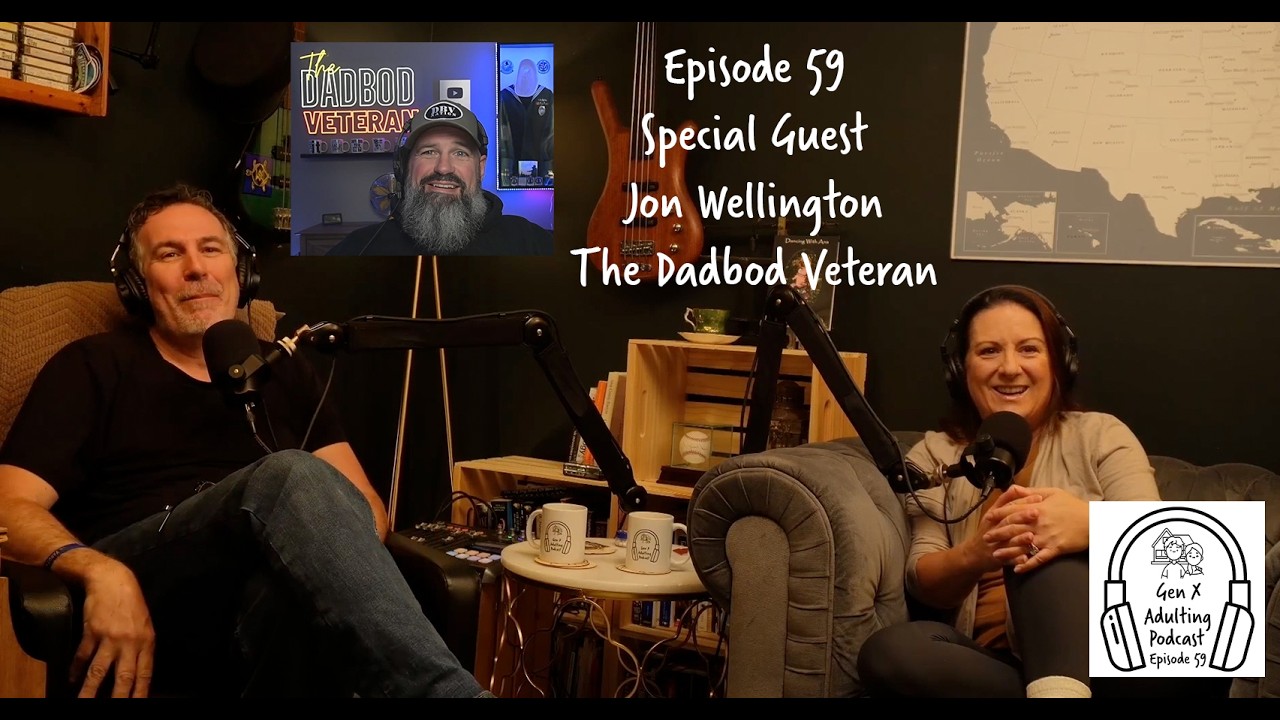
In Episode 59 of the GenX Adulting Podcast, hosts Brian and Nicole interview Jon Wellington, known as the Dadbod Veteran. Jon shares his experiences growing up as a 'baby Gen Xer,' his military background, and the challenges he faced with ADHD, family dynamics, and the impact of 9/11 on his naval career.
Welcome to GenX Adulting. And today we have Jon Wellington, better known as the Dad Bod Veteran with us. Welcome, Jon. Thank you very much. I'm very honored to be here. We are so happy to have you. And our first question is always, what year were you born? baby gen xer. I'm a 79er. I know, it depends on how you talk to it. I'm a xennial which I hate that word. But yeah, I'm a baby gen xer. You are a baby. Yeah, it's interesting because you are considered a xennial but a lot of Gen Xers that are your age don't want to be called xennials They're Gen X. No, I think that Xennial was made for the millennials who felt bad that they didn't get included in the Gen Xers, not the other way around. Yep, that's how I view it. think it's more for like the 81 to 84 babies, you know, because you're Gen X. There's no question. Yep, yeah. You're just you just you just got in there. Yeah, exactly. And where right. were you born? Youngstown, Ohio. It's interesting. actually a very, it was a very big running joke when I lived in South Carolina because in South Carolina there's a lot of transplants from Ohio and so for my duration of my life I never told anybody that I was from Ohio Okay. until we did the show in Charleston. And I was already on my way out. I was already leaving Charleston and I made a big bit about, you know, people from Ohio in Charleston and how we don't like them and blah blah blah. And then I was like, by the way, and you could hear the gasp in the room. They were like, and I was like, yeah, you guys all love somebody from Ohio. And then they were like, my God, it's like clutch my pearls. It was like the worst thing ever for them that they supported somebody from Ohio. So wait, what do you think the draw is from Ohio to Charleston?
So wait, what do you think the draw is from Ohio to Charleston? Well, it was the when the automotive industry started to shift from the north to the south, a lot of the Okay. tier one suppliers moved from like the Ohio area and stuff like that and came down into South Carolina. Not the not the full manufacturers that came later, but a lot of the jobs shifted to South Carolina. So there was a lot of natural migration from Ohio and Detroit and some other areas into South Carolina. Ohio just happened to be the big one. That is so interesting. Now with Ohio, were your grandparents from there? Your great grandparents? Who first arrived there? So, Youngstown, Ohio is where all of my parents' family are from, both sides. That's where my parents grew up. I was the only Okay. kid of my parents that was born in Ohio, because we were a military family. My brother was born in Virginia at Langley Air Force Base, and my sister was born in Tucson at Tucson Air Force Base. Mm. But I was the only one that was born in Ohio. So I'm really native. I'm the lucky one, yeah. I'm the favorite actually on both sides. How did your parents meet? They were high school sweethearts. They met when they were 13. No way. Wow. Yeah, when they were 13, they were their only relationship in their lives. Both of have passed on now, but they were the only relationship they had in their life. Yeah. Wow. So that would have been like eighth grade, ninth grade, somewhere around there. Yeah. Yeah, many many. Yes. But way too young if you think about it now. Yeah. And it did. So did they both go in the military or just your dad? No, my dad was in the Air Force and my mom was a stay at home mom for the most part until the later years when we Okay.
Yeah. And it did. So did they both go in the military or just your dad? No, my dad was in the Air Force and my mom was a stay at home mom for the most part until the later years when we Okay. started getting little bit older, she went into work. But yeah, she was pretty much stay at home mom the whole time. And did your dad go into the Air Force right at 18? Um, I think so. I think about yeah, because my brother is three years older than me. So that would have put him right at right at 18 or 19 when he was born. Okay, so you're the middle? Okay. And then you don't seem Yeah, in the middle, in the middle, Hence the attention needing. like a middle baby. I'm an ADHD child who learned all the corrective techniques on how to manage in the world and make it an advantage instead of a disadvantage. I'm probably the that is most structured person in the Gen X Takeover group. They call me the adult. But I do have a lot of the middle child syndromes that happen as far as... Especially my my the missus she she'll she like yeah, he's a middle child. He's Attention star center of attention that kind of stuff amongst this smaller group now when I get into the bigger group like the Gen X takeover I can't compete with those guys Mm-hmm. They are definitely more Spotlighty and I'll just kind of fade back But yeah So as far as the ADHD, was that something that you were diagnosed with when you were a kid or more as an adult? I was, yeah, I was one of the cool age HD kids, you know, the Ritalin test babies. That was me. Yeah. For shit. they actually, because there's so many Gen Xers that were not diagnosed and were just out there drowning. no, I was- So they diagnosed you.
shit. they actually, because there's so many Gen Xers that were not diagnosed and were just out there drowning. no, I was- So they diagnosed you. I was a wild kid up until like third grade. think that's when my mom sent me in and she's like, you need to get checked. And I was the brand bucks just one that couldn't sit still on the bouncing off the walls, like a spider monkey, I'm out and do that was me until Okay. about third grade where she had me diagnosed. And then I was on Ritalin for basically there until about high school. And then in high school I found football and so football became my outlet for ADHD, which is great. Yeah. It's a great outlet and I played other sports of wrestling and some other stuff and then yeah, so that's when I started to taper off of taking Ritalin at that point. Did Ritalin help? my god Did it help it helps so much? I mean it was like it was like one of those things that can Take you know, cuz it cuz it is it's an amphetamine, right? And so Mm-hmm. for most kids who are normally wired it it makes them go faster But for ADHD kids who are truly ADHD kids, it just basically reverses that and they turn into kind of a vegetable and they'll actually sit still. And Ow. it was the drug of choice for that type of a condition back then. I mean, then there's all times other ones that have come out since then and different ways to it, et cetera. But yeah, it worked for me. So for you, kind of downshifted you, where for others, Yeah. it would speed everyone up. It just brought you down. Yeah. But were you still able to stay engaged? Do feel you were able to stay engaged with everything or were you kind of too down? No, it's a balance, right? Because you can over-rescribe Mm-hmm.
Yeah. But were you still able to stay engaged? Do feel you were able to stay engaged with everything or were you kind of too down? No, it's a balance, right? Because you can over-rescribe Mm-hmm. or you can overdose, et cetera. And we had to find that balance when I was a kid. I ended up being the sixth. So third grade was when I was diagnosed. fourth grade at Lambs Elementary School in Charleston, I went from being the kid who was in the principal's office all year long to being the citizen of the year for the school, like getting this big award and this big thing for being That's awesome. the honorary kid, which is way outside of my swim lane for that time. But yeah, so it does work if it's properly done. you know, comes with therapy. Cause you know, at the same time I'm taking Ritalin, I'm also getting therapy on how to learn these life skills, on how to manage it, how to use lists to track your, you gotta do and how to become structured, et cetera. Cause all those things matter to help an ADHD person cope in the real world. Right. And I think that might be one of the big differences between the way that they used to handle it and the way that they handle it now is because I don't think the therapy comes with it as much as it used to because it was always had to go together. 100%. It's tandem, right? Right. And so I think you're right, though, on that. I think now it's more prescriptive-based and goodbye, this will fix it without that supportive. Right, and it's also almost a badge of honor kind of thing today, where every kid wants to have a diagnosis and Yes. Yeah. Yeah. every kid wants to have a different condition or whatever it is, and then maybe it's a little overdone now.
Yes. Yeah. Yeah. every kid wants to have a different condition or whatever it is, and then maybe it's a little overdone now. Yeah, I think it's also used now as kind of a scapegoat for certain behaviors instead of just Mm-hmm. addressing a behavior that should be addressed a normal behavior. It's ADHD or it's always... Yes. Right. It's ADHD fault, right? And that's one thing I will say that I don't like about what's going on now is that there's a lot of identification via condition. Instead of, Jon has ADHD, Jon is ADHD. Yes. You know, and that becomes the excuse for accountability of your own decisions. because ADHD made me do it because I'm ADHD. No, no, no. You have ADHD. Yes, you have to learn some coping skills to be able to function properly, whatever the condition may be, but that's not you. You are still the one that makes the decision. You still should be accountable. But you know, anyway. Yeah, people are defining themselves with their condition to your point. You have it, you deal with it, it Right, exactly. They define themselves by their condition. becomes a part of you, but not all of you. Yeah. Exactly. Because the reality is, when you get older and you get on the real world, the real world doesn't really care. Bills come, Doesn't matter, money must go towards bills, things Yeah. have to be done. And if you can't do it, sad story. Right? Yeah, I think that's going to be a rude wake up for a lot of the younger generation is realizing you're I think they're hitting it now.
have to be done. And if you can't do it, sad story. Right? Yeah, I think that's going to be a rude wake up for a lot of the younger generation is realizing you're I think they're hitting it now. coddled right now. think they're hitting it now. You're coddled right now in elementary, junior high, high school, maybe even college. But once you're in the world, the world is not going to even though society is way different now than it was when we were growing up. And there is a lot more space for things in general. I still think it there then they're expected to be held accountable. for who they are, it's almost unfair. They haven't been held accountable during their formative years. They have no idea. they have no idea what that's like. I mean, there's good stuff. mean, there's more compassion and empathy towards, you know, emotions and things like that in the world where we had none of that. But at the same time, there's only so much that the world will accept of that before it says, okay, now you gotta do your job, right? And that's where Yeah. Yeah. the part where they don't understand, because it's never happened to them. We got the opposite of that pendulum, which was zero emotional support, zero emotional empathy, et cetera. And so now the pendulum is back the other way and we got to figure out how we find the balance between the two. I think usually that's how goes, right? It has to go all the way this way before it can like settle in the middle. And maybe when the Gen Z start having children, they're the ones that will find that middle ground. Cause I know, the gen alphas. the Gen Alpha, I don't know. The Gen Alphas though, I think that's mainly millennials kids and then some older Gen Zs. Yeah, but I call them the Gen X squared. yeah.
the gen alphas. the Gen Alpha, I don't know. The Gen Alphas though, I think that's mainly millennials kids and then some older Gen Zs. Yeah, but I call them the Gen X squared. yeah. I do because they're like they're like they're like honey badgers like us with technology. No way. Yeah. That's dangerous. They're wild. They're wild. I have spent so much time like reacting to videos of gen alphas and just how wild they're because it's like. It's almost like something clicked in the wiring when they were born that they are rebutting against these helicopter parents of the millennials and the Gen Zs, cetera. And they're just being wild, just crazy. But then they have technology in their hands since the day that they were born. So they have connectivity and the ability to do things that we could have never done. And their parents, it's Yeah, that makes sense. cute. Yes, it's like they have the self-esteem. They've been built up to have the self-esteem and confidence we weren't given, and they've Right. received all this attention and validation, and they've been given technology to research anything they want, find out about anything they want, which has just given them complete power, but then they're feral. It's a dangerous Exactly. And there's no consequences. No, no, none. I don't know, is there no consequences? No, you can lawyer up. My parents will hire a lawyer and they'll go into the school and know it's the principal. Whatever that is. It's insane the things that they get away with like the fact that their parents will watch them be absolutely wild. Whereas we would have got like, you know, got taken out back if we would have acted like some of these Gen Alphas, Yeah. especially if it was anywhere near a camera. You know, like Yes. yeah.
Yeah. especially if it was anywhere near a camera. You know, like Yes. yeah. grandpa's videotaping or something like that. We're acting a little off kilter. We would have got taken out back for that. the parents now they're They're recording it and they think it's funny and then they're posting it. And it's like, you're celebrating what was the condition that we were trying to mitigate. This will be interesting actually to watch them grow up. Okay, so your brother was born in Virginia, you said, and then they went to Ohio, you were born. Yeah, at Langley. Right. How long were they in Ohio then before they moved again? I think that so my my dad was in the Air Force for a little while he was stationed in Langley as my brother was born and then he decided to get back out and come back home and that's when I was born in Ohio and then he that didn't work out he's working at like Dow Chemical and some pretty Mm. gnarly places back then that didn't work out so he went back into the Air Force and then he got stationed in Tucson and that's when my sister was born so I want to say there was like a period of maybe two to three years he was in Ohio before Okay. he got back in and once he went from Tucson, he moved to Charleston to be at the Charleston Air Force Base and that's where he retired from and we stayed there. So I was in Charleston from age five on. Yeah, you weren't in Youngstown very long. Probably don't remember much. Yeah. It's a good thing. Yeah, No, no, no, So it's, I mean, it's my birthplace by all rights, but it's not the place that I grew up. it's a good thing too. It's a rough area. And so much It is, I mean it's- money left that area around that time which Yeah.
it's a good thing too. It's a rough area. And so much It is, I mean it's- money left that area around that time which Yeah. makes it hard to make a living there. So makes sense to not stick around too long. No, unfortunately. Yeah. Yeah, yeah. And it hasn't come back. mean, the Lordstown plant has closed, the GM plant there. They're not, the North is not having a good time when it comes to, and not like the No, South is. Everybody's going South. Yeah, yes. Speaking as people from Florida and then I know South Carolina has grown like crazy. But when you moved there at five, was Charleston as much of just this thriving? I know it's always been a historical town. I know that. But was it this thriving metropolis that it became? No, God, no, it was a military town. So the Navy base was here. That was the Mm-hmm. big employer. And then there was a Westvaco, which was a paper mill. Those were the big employers back then. There was nothing else here. yeah, yeah. So if you came, Yeah, you can smell that paper mill. Yeah. if you lived in Charleston, you worked at one of the two or supplier for that. And nobody really knew about Charleston as a historic city either at that time. Mm. So Charleston has a very interesting history because basically up until 1997, which was the year I graduated high school, there was nothing but those two employers. And then in 1997, I don't know if you remember what was called the BRAC, the Base Realignment Enclosure, that was under Clinton. And Mm-hmm. that's where he decided that we need to have less military bases. And so Mm.
Mm-hmm. that's where he decided that we need to have less military bases. And so Mm. as part of that, there was a reconciliation, and there was basically a whole year of kind of a bid war to try to keep Charleston open. And Norfolk was doing the same thing, to try to keep Norfolk open. The thing that caused the base to close in Charleston was the fact that you could not get a ship underneath the Cooper River Bridge. And in Norfolk, they have tunnels, so it was never an issue. So was one of the big factors is they could get as big of a ship as they wanted to in the Norfolk Harbor, and Charleston could only get really small ships underneath the bridge to be able to go to the shipyard. Today, many years later, there's a giant bridge that any supertanker can fit underneath, right? Yeah. But that wasn't the case back then. We had those old rickety bridges. So the Charleston Air Force or the Charleston Navy base closed, the Air Force base is still here. And when that happened, there was a sucking sound of employment in the Charleston area. I mean, it was like a vacuum. And I graduated high school and... There was no real jobs there and I was dating this girl and she decided she wanted to go off and be a model and so I decided I needed to get as far away from this place as possible so I joined the Navy. Okay. And so that's how I got, and that's how I got my veteran tag, was I joined the Navy in 1997, two weeks after I got to go to high school and left. Okay.
Okay. And so that's how I got, and that's how I got my veteran tag, was I joined the Navy in 1997, two weeks after I got to go to high school and left. Okay. And so I went in and lived up in Chicago and then came back to Norfolk and et cetera. But the Charleston story, they're kind of matching. The Charleston story and my story kind of coincide with each other. So after I did my time in the Navy, I wanted to come back to Charleston. It was always planned. Because that girl that was, ended up. that wanted to be a model ended up being pregnant at the time, which was my daughter. And she didn't know it until after we were in, I was in bootcamp and I my first phone call home and she said, hey, I'm pregnant. And I was excited because I always wanted to be a dad. She was very not excited. So we ended up being married and we ended up having three kids together. And we were in a relationship for 12 years and we're still good friends. In fact, she lives in Arkansas as well. trying to keep the story as concise as I can. So when I got out, we were coming back to Charleston. When at that time Charleston really didn't have any employment, big business employment. So I got a job at a little local manufacturing place here. Then this place called Global Aeronautica came in and it was an aerospace manufacturer. And so they were making parts for the Boeing 787 Dreamliner. I'm sure you've heard about that airplane. Mm-hmm. So I got a job there as their safety manager in their facility, big facility. And it's the only place where they make the middle section of the fuselage for that airplane. They actually make it out of composite. It's really cool Thank
Thank process. If you ever deep dive into how that works, it's really cool and scary at the same time to know how thin airplanes are. I don't like flying. I don't like flying up. We can deep dive that one too. Like a dope camera. I don't think I want to know. That's funny. So I'm working at this little local manufacturing place. I decided to apply for this place called Glover and Attica. I get the job. And I don't think anything about what's about to happen to the Charleston area, but I enjoy the job. It pays well. I love it. And then all of sudden Boeing decided that they had their, their, their supply chain was too spread out and they decided to vertically integrate. in other words, they decided to buy up all of their suppliers so they're part of the company. And so they bought Global Aeronautica and the other company that was next door bought and they became the mid body and the aft body of the airplane. They then also decided that because of the union issues in Seattle that they were going to put the second production line for the Boeing 787, the full production line in Charleston. Wow. And this is where the shift happens in Charleston because now they have the only wide-body airplane manufacturing for Boeing outside of Seattle is in Charleston. Now I don't know if you've ever seen an airplane get sold, but do you think about a car sale, right? You go in there, they give you the bow, they take your picture, they do all the celebration, you get your keys, it's all big party, okay? Amp that up to $200 million. When somebody buys an airplane, there's fireworks, depending on the airline, there's hula girls. There's all these other things. These guys come in, they fly in, they're buying a $200 million airplane. They go to the local place and they fill it with goods because they're flying out of there back to their home country and they fill it with goods from that place. So they get exposed to whatever's in that area.
see. Now remember at this time Charleston, nobody knows about it. Nobody has any idea about Charleston, right? It's just this quaint little city and all of sudden all these guys with all their money come into Charleston and start seeing Charleston and go, that's nice. That's real nice. And the inadvertent thing that happened was Boeing exposed Charleston to the world. And this is the story. I'm not telling you that there's business studies on this and all that stuff. That's the wealth too. So there has always been old money there, but now there's new money, Yeah. That explains the wealth there. Yeah. Yeah. right? And so we've got, now we have five-star hotels there. It's Yeah. become a tourism capital, but it was that was the catalyst. Boeing coming We were hurt. in, changed it. Amazing that explains it because we were there like five years ago or so 20 20 20 and I was blown away We're in Boca, South Florida. We see Lambos Yeah. and Ferraris and Rolls Royces, But to see that in Charleston Lambos Ferraris Yeah. rolls just around town the high-end hotels I was like, where's this? What's the money here that explains it? Okay And that's where it's still coming from. So then there was even bigger of a shift, right? Now Charleston is known for high-tech manufacturing. They get a name for themselves because Seattle is the only other place they make airplanes like that. How can Charleston Thank you. do that? They must have the labor and skill force. So then Mercedes shows up. Mm-hmm.
Thank you. do that? They must have the labor and skill force. So then Mercedes shows up. Mm-hmm. They build the Sprinter van here. Then Volvo shows up. The only Volvo plant in the US is 10 miles down the road from Boeing. With all that comes all the people that need to live there to support it, the real estate, the grocery stores, the stores, the entertainment, all that stuff happens at the same time. And by the way, we're getting hit by Conde Nast as the number one place in the world to travel for 10 years in a row. Wow, that's crazy. Talk about a cultural shift. Like my god, it was insane. gentrification on steroids then, right? Yeah. Oh, you have no idea. was insane. all this, and all, you know, in the meantime, you have all this old money who's like, oh no, we don't need no big roads. We don't need infrastructure. Yeah. We'll find just the way we are, you know? And they're Yeah. not shifting that part. So what happened is all these people came, started moving there to the tune of like 130 a day on average. were coming because they were vacationing here or they found a job here and when they were vacationing they decided they're not going to leave. Then the investors with the Airbnbs and the hotels, the Bennett Hotel and some of these other things happen. Poof, Charleston is this huge place almost overnight. Go ahead. Well, Mike, I have two cousins who live in, is it Sutherland or Summerland? It's West? Summerville. Oh, do? Okay. His Somerville. That's where I live. That's actually where I live. Somerville. Yeah. cousin. I have two cousins, one from New York, one from New Jersey. And his one cousin's a real estate agent there. And I think he moved there, what, like five, six years ago? He's part of the problem. They love it. I'm
Part of the problem. You can throw a rock and hit a real estate agent. Any direction. sure. I'm sure. How did they handle it with the infrastructure? I mean, how? They still haven't. That's the problem. Well, so there's, It's like a bomb going off almost. there's a couple of things that, that hurt Charleston, right? Most of Charleston is swamp land. You Mm-hmm. can only build bridges on certain types of land without having to do a lot of swamp mitigation, et cetera. And you don't want to do that because that's what absorbs the hurricane water is all the swamps. So they're very sensitive about that. In fact, there's a couple of times where they built too much concrete around neighborhoods and then they ended up having to buy the neighborhood because of the runoff issue. Right? Okay. So Charleston is very... there's not as much opportunity to build up the infrastructure like you need to. And then there's also the blue bloods that, you know, they're protective of their lands and they don't want an interstate running through their land. there's, the infrastructure hasn't changed very much since 1997. That's amazing. I mean, I know when we drive through there, it's one of the only states, because we've traveled up and down the Eastern Seaboard hundreds of times because our youngest son plays travel across. So from Florida to the Northeast and back. It's the one of the... 95 is the worst. It's one of the biggest frustrations 95. because it's just the two lanes. Two lanes, Yeah, it's just two lanes. Yeah, and we're like, we just got to get through South Carolina. And there's a culture clash. you Yeah. call them blue bloods, They're just chilling. We're trying Yeah. to get somewhere. It's gridlocked.
Yeah. call them blue bloods, They're just chilling. We're trying Yeah. to get somewhere. It's gridlocked. And I mean, if you drive through Alabama, Alabama has three lane highways. They have no traffic. None. Yeah. Yes. Yes. No, you're right. Yeah, it's so true. Well, I mean, again, we loved it. We were tourists. But I know what you're talking about to some degree, not completely, but where we live during Covid. I think it was we absorbed 80000 people in a matter of 12 months or something. I wow. don't know. Some crazy. And it completely changed Florida everywhere you go. And they keep coming. They keep coming. They keep coming. So. Yeah, yeah. Keep coming. But not to that degree. mean, Florida was already, you know, the cities around here were cities. Yeah. Right. But for Charleston, so this all happened, what, like late 90s, early 2000s? We're talking about 2007 was when I started at GA from 2007 Okay. to about 2015. That was Okay. the major boom. And that was during the recession for the rest of us, 2007, 2008. There was no recession in Charleston. Right, right, there was no recession in Charleston. There was no recession. What a trip. Does Boeing make the full plane then now in South Carolina?
Right, right, there was no recession in Charleston. There was no recession. What a trip. Does Boeing make the full plane then now in South Carolina? Yeah, so then to make things even worse, Boeing first decided that they're going to... So it used to be that there was two production lines for the 87. There was one in Seattle and then the second one was in Charleston. Boeing decided they were going to completely move the 87 out of Seattle and move it to Charleston. So it became the only final assembly for the 787. here. So that turned the employment level for the Boeing facility up to like 12,000. Just recently, I don't say like four or five months ago, they just announced that they're building a second final assembly for the A7 in wow. Charleston. So they're expanding again. At the same time Have you been out? that Mercedes has decided to expand and double their production, at the same time Volvo has decided to expand to double their production. Can the surrounding areas support the workforce that's gonna have to come in to support all of this? Well, so that's the problem if you look at places like downtown Charleston their biggest their biggest pain point is getting people to work in The hotels in the restaurants, etc. It's not that they can't pay them it's just they can't get them there because Yeah. where they have to live for the for the wage that they can pay is Sometimes 50 60 70 miles away Because okay.
Yeah. where they have to live for the for the wage that they can pay is Sometimes 50 60 70 miles away Because okay. all the investors are coming in with their buying all the properties the properties return I just sold, I'm toot my own horn for a minute, I bought a house and one of the reasons I moved to Arkansas was so I can be financially free, but I bought a house for $600,000, very big house on an Acre property. I thought I was living the dream in South Carolina. I really thought I was living a dream. That was four years ago. It's gonna be sold for more than a million dollars. like in a week or so. And so we're going to be mortgage free here in Arkansas because Arkansas is still... and that was the Congratulations. Yeah, congratulations. That's awesome. That's amazing. That's amazing. that was kind of one of the motivations to move here is that we can retire in our 40s. But it would never have happened anywhere else. Anywhere else. That much of a shift. Yeah, yeah, it can happen here for us. Yeah, we need to move soon. Yeah, he wants to do the same thing. Florida kind of went through have because of all that kind of went through something similar. But but to your point, if we were to do that, we would have to move out of Florida. Right. It's it's anywhere else in Florida. It's it's the same. You're not you're not becoming financially free. And like you, I think you had mentioned your daughter lives there. So you have your daughter there. Yeah. and your ex-wife. So there's family. All and their family. three of our kids are still here. So that's our balance is figuring out, okay, so how can we bring them all with us? Are you?
Yeah. and your ex-wife. So there's family. All and their family. three of our kids are still here. So that's our balance is figuring out, okay, so how can we bring them all with us? Are you? Yeah, and so that's what we're doing slowly. Yeah, so we have between the two of us. have five kids. She has two and then I have my three. I've got one here. My the youngest I have twin boys. The youngest one is in the Navy and he's in Mississippi and the other one is in Seattle. So they all had left Charleston before we made this decision. Now she has one in North Carolina and then one. Who had just got out of the Navy but was living with us and going to the Citadel. and he agreed that he wanted to move with us. So basically we're transplanting all of them with us. Her mother just moved from Asheville, North Carolina and is here now. She just bought a house and she's working on her cousin and her aunt to move them out here. So we're trying to move everybody out here because it's affordable. Yeah, I think that's so smart. My dream is to be able to buy enough property where I can have a family compound and everyone build their houses. Yeah, And the Midwest is the place to go. I think that's, well, maybe we won't air that part. I have a question Yeah, don't tell anyone. going back to the Boeing stuff. Two part question. Have you been out to like SeaTac area? yeah, I've been out to the Boeing facility and been all through that. So in South Carolina, like we used to live in Oregon while she grew up in Oregon. We lived in Portland and I would have Portland. Portland. Yeah. no way. What part? Okay, the Mrs. is from Bend. Yeah.
What part? Okay, the Mrs. is from Bend. Yeah. Okay. Yeah. One of our good friends actually he's been on the podcast lives in Ben. Yeah. I grew up in Beaverton. Yeah. And Ben's beautiful. Ben is gorgeous. yeah. And all of Oregon. Talk Okay, yeah, yeah. That's exactly what I said. Yeah, and it's another place to blow them up too. Yeah. about like the price of housing is insane. Ridiculous. I graduated high school in 89 and then went to college in Ashland, which is Southern Oregon, just south of Medford. That's where we met. Okay. then we got married right out of college, had our first son and within a year moved to Jersey. So I haven't lived in Oregon since 1996. And it did change a lot over the years, but in the last five years, in Portland alone, not how I recognize, it's become is not how I recognize. Portland's... Portland, don't like. No, it makes me sad. And I always say I won't go back until it was a great city. And I said this on air, so I don't care. But I won't I won't go back until they get they fix it. Yeah, they need to clean it up. But it used to be To clean it, yeah. Yeah, me describe it. growing up there. I could leave my high school in Beaverton, drive into downtown, get a slice of pizza from Escape from New York Pizza in northwest Portland and make it back for class. We would all hang out on the waterfront downtown. It was beautiful. It was safe. It wasn't how it is now. But Ben really just recently, I want to say what the last 10 years is when it really. lot of the California transplants, I think. Beautiful area, Yeah. California runaways. that's so good. So you're married to a Pacific Northwest girl just like Brian. Yeah, we'll compare notes later. It's been fun. It's been a challenge. Yeah, we will.
Yeah. California runaways. that's so good. So you're married to a Pacific Northwest girl just like Brian. Yeah, we'll compare notes later. It's been fun. It's been a challenge. Yeah, we will. OK, so my question is, when we are out there and they would build a new plane, they'd have like the maiden voyage or whatever it Yeah. Yeah. on the news. Is that? Does that go on in South Carolina? That's what I think he was referring to all the time. about the party. so do they show it on the news and... Sometimes it depends on how it depends on who is there I mean if it's somebody that's buying ten airplanes They're not gonna do all of them But if it's if It's not a big deal, yeah. it's somebody that they haven't done before, you know, like Hawaiian Airlines or something like that. Yeah, they'll broadcast it they make it a big community event and it's It's it's insane Yeah, yeah. Yeah, that's what I mean. Yeah, it's kind of funny. what they do what they how much they spend to stuff that jet with stuff There's Yeah. a tanger outlets literally across the street from the Boeing facility and they literally will clean out a store Wow. That's amazing. Is it mainly? The financial impact is unmeasurable. Yeah, I was gonna say, it to have helped so many businesses there.
Wow. That's amazing. Is it mainly? The financial impact is unmeasurable. Yeah, I was gonna say, it to have helped so many businesses there. my god, and then and just to wrap your mind around what bowing has to do to accommodate these folks. They actually have people In the bowing company and I can say this I don't work there anymore that will go out and try the restaurants They'll meet the owners. They'll sleep in the beds. They'll They know and they're trained to know where I can allow this type of country of origin customer to sleep, or I can allow this type of, because I don't want any conflicts because of ethnicity, blah, blah, blah. It is amazing. This process is amazing. That explains why it's so cultured. Yes. It's not asked backwards in any way in that Carlson area. Yes. No, and it's in the Charleston area has the people who are local who could not get their mind around something that's outside of Charleston have had struggled severely. And I'm talking about the Blue Bloods. They've struggled Mm-hmm. Yeah. severely with the amount of cultural impact that has happened. Now I was in the military, so I got exposed at a young age to different cultures, but There's a lot of people that have struggled with that, of having people with all these different origins and different ideas, especially a lot of people from the West Coast and their ideas about how the way the world should work. it has changed Charleston significantly into the place that it is today, but it's gone through its challenges and people have been very hesitant to upset the way the world was going to be. How did the school system support and the health care system support the influx of all the people?
How did the school system support and the health care system support the influx of all the people? The healthcare system is blown up. I mean, luckily there are two main hospitals that... saw the writing on the wall quickly and they adapted fast. So the healthcare system is actually still really good. The school system in the place where most people move to is adapted well. In the other counties and districts, they haven't adapted as well, but there's one particular place called Mount Pleasant. That's where the real estate agents always push people to go to because A, it's next to an island and the beaches and it's the nicer part of the neighborhood because it's so new. It wasn't really a place until after that bridge got built. Like, you because it was very hard to access. The North of downtown is not pleasant. And Mm-hmm. I said it's north of downtown, isn't it? Yeah, I think I'm familiar with that, I would say that that place as a town itself is like 20 years old. Yeah. And so that's where they would always push all the transplants to go move because it was pretty, it was all brand new and all the things that they were accustomed to from their origins, right? Whereas some of the other places like Somerville, more historic. less changing, et cetera. So yeah, so there's pockets of success within there, and there's pockets of not success. That makes sense. You know, what's funny is our daughter's 25. So she's right in the middle of that Gen Z. And I think with her and her friends, their exposure to Charleston was that reality show. Did you know there was a route? Southern Charm. That didn't help either. Yeah. So they all guess what? On one of their girls trips, guess where they went? Charleston. And it was because course.
Southern Charm. That didn't help either. Yeah. So they all guess what? On one of their girls trips, guess where they went? Charleston. And it was because course. of that. you have a new generation of girls, young women, that it's one of their desk like like Nashville's their destination. Yeah, Nashville's. Charleston's now a destination spot for them. So you probably are seeing bachelorette parties. All that stuff that Nashville sees, know, Yep. Yep. the turning 21, it's become a destination spot for girls in their twenties. So that's a whole nother aspect. It's a whole other aspect and it just it spirals. There's all kinds of different aspects that happen to that. It does. Yeah, for sure. Well, going back to when Charleston was not the Charleston it is now and you're young and you're in elementary school, Yeah. did you participate in any sports and any clubs, art, theater? Did you have any interests outside of academics? So I didn't have any interest in academics. It wasn't until like middle school that my mom really got me into sports and sports was the great outlet. For the most part, I was just a struggling child trying to make it through for elementary school. But once Okay. Yeah. I found sports, that's when I found kind of purpose, if you will. So what age, because you were struggling with the ADHD, Yeah. what age did you, did she get you into a sport and what sport was it? the one I did play soccer and I did play baseball, but I didn't latch on until football and that was seventh grade where she put me Okay.
the one I did play soccer and I did play baseball, but I didn't latch on until football and that was seventh grade where she put me Okay. into the local, I call them Bannum league, if you will. football team. That was my first time playing football. First time actually being exposed to football because on the Air Force base they didn't have football. But when I got out of town, they actually had football and it was big deal. So I played there for a year on the little youth league. And then I went to the high school league for, we called it the B team, which was kind of the middle school high school football and played there and had great success for four years, five years. So you grew up on an Air Force base basically? I grew up on an Air Force base until my dad had retired, which was my sixth grade year. So, was elementary school a school on the Air Force Base? Yeah. So, all the other kids around you were children of military Air Force Brats. So Air Force Brats. Yeah. then, when you went into seventh grade, did you switch off the Air Force Base for school? Yeah, the sixth grade. So I switched off the Air Force Base to the Somerville area in sixth grade and went to College Park Middle School. And my seventh grade year was the year that I found football and got into the football. So how was that shift from being on an Air Force base with all military brats and then going into general population?
So how was that shift from being on an Air Force base with all military brats and then going into general population? Jempop. It wasn't that big for me. wasn't that big. I'm sure it was a big deal for my parents. Because my dad got cancer when he was in the Air Force. He worked around asbestos and et cetera, et cetera, et So he got medically retired. So for my parents, was probably a bigger deal because the community of the Air Force and all their friends and all that stuff weren't there anymore. So I can remember that there were some struggles there to try to cope with that and also adapt with my dad's sickness at the same time. Right. But for us as kids, I would say it was more freeing. than anything because now we're in this place where we could just go. There Yeah. was no guards, was no fences, there was no nothing. Like that was where the feral years started. So, I was going to say, so would you say your Gen X childhood feral years started when you left the Air Force base? yeah, because I lived next to woods at that point. Okay. And that's when I really, that's when I went out. Woods and was building crap with my dad's lumber and you know, doing all the things that we do in the woods, which now all those woods are houses, but you know, tree forts and all that and riding bikes over the dirt ramps and all that stuff. That's when it all started. So when you switched over to Gen Pop, was it pretty easy to make friends in your new school? I mean yeah because I started at the beginning of sixth grade. Mm-hmm.
So when you switched over to Gen Pop, was it pretty easy to make friends in your new school? I mean yeah because I started at the beginning of sixth grade. Mm-hmm. elementary school was K through five and then middle school was six, seven, eight and then high school was everything else. And so everybody was coming in from different schools at the same time. So we were all new and newly getting clustered together. And so it was very easy to find friends at that time for me because everybody was now. Perfect timing. probably had a skill set too because of being on the military bases, kind of that brat mode. I'm sure you Yeah, yeah. had people coming and going throughout your formative Well, years, right? yeah, and there was lots of other military bases around there. got the Navy bases around there Yeah. at the time. And you still have the Navy weapons station there. So there was lots of military kids coming in. was one of my best friends at the time. His dad was a Navy guy. So it was pretty easy to make friends amongst them. And then did you kind of you and your crew would do the typical Gen X thing of go out Yeah. biking and not come back until the streetlights came on? Yeah, I kind of have my school crew and then I have my my neighborhood crew, right? The neighborhood crew Yeah. is one we rode the bikes and we played in the woods and all that stuff. And so we're different relationships amongst the different circles and different relationships. Now, as I get older with some of them, like one of them is still my best friend that I'll call almost That's cool. every day, every morning. He's at work. I'm not because I work from home and I'll just tell him how much his Right. That's cool. life sucks.
That's cool. every day, every morning. He's at work. I'm not because I work from home and I'll just tell him how much his Right. That's cool. life sucks. That's awesome. And then you also had your football team friends. Yeah, and then you get your football friends starting in seventh grade. And those are bonds. I mean, that's like a military bond. Your football friends are like a military bond. Yeah. You're bonded for life with those guys. so you go to war every Friday. Yeah. go to war together on the Practically. Yeah. Yeah. So you pretty much your focus through junior high was football, but then really took off in high school. yeah, because football is, I mean, you know, in Florida, football is huge for the kids. Like if you're on the football team, you're good. But if you, Yeah. you know, play, you're God, right? And I started, so Yeah. Okay. I was a starting offensive lineman. I was the center for three years. So I was kind of a little, little king shit, know? Key position. Okay. It's a key position. Yeah, that's cool. I actually got to touch the ball more than anybody else on the field. Very important. Now that makes life in high school a lot easier. It did make life and life and I hate to say that. I hate that that's real, but it did make life in high school. Yeah, yeah. It is, especially back when we grew up, you're talking the early 90s, right? Or early to mid 90s? Yeah, we're talking about early 90s, 93 to 97, was high school. Yeah, yeah, I mean that's just how it was. But it sounds like Let's do some of those. you also floated, like you had your neighborhood friends, had your teammates, you had... Yeah. So you had, and like Brian alluded to, growing up in an Air Force base, you probably had that skill set to kind of get along with anyone.
Yeah. So you had, and like Brian alluded to, growing up in an Air Force base, you probably had that skill set to kind of get along with anyone. Yeah, and it's transactional relationships, right? There people who were there for a period of time, then they left and you became accustomed to that. You didn't die over the fact that one of your friends moved away. It's just the way it was. Well, it's different how it is now. Now, if someone moves away, you still text them, FaceTime them, call them, follow them, social media like kids stay connected all over the world for us. I don't think that kids like connect in person anymore. Unless it's convenient, unless it's right there. Unless it's convenient and easy. know? Yeah. Unless it's forced, yes, it's part of their daily rhythm. Like the one that lives with us now that's going to college, none of his friends were in South Carolina. They were all in Virginia that he knew. And he met Mm. Yeah. them through online gaming. And then they met in person afterwards. Right. Our neighbor across the street, him and our son are good friends, but they had been gaming for months. And then the parents were like, hey, I think our kids play. And then they met in person. We didn't know they even knew each other for a couple of years. And then all of a sudden we were at a lacrosse tryout or something and their sons there. And we didn't still didn't know until literally we they were behind us as we're driving home. We pull in our driveway, they pull in there. and they pull an air-dryer away. And we're like, wait, but they'd been playing Xbox together for like a good year or two. was now That's wild. they physically go out and things. here last night. Yeah. But Yeah.
And we're like, wait, but they'd been playing Xbox together for like a good year or two. was now That's wild. they physically go out and things. here last night. Yeah. But Yeah. and he's right across the street. Right. So I think if it's like sports or school, like you're it's there. as far Right. as other than that, I think it is a much more of digital footprint. You know, so It is. and there's there's pros and cons. They can keep in touch with people that live out of state and have those relationships for us. If your friend moved. It's kind of like, are you ever going to see them again? Yeah, it was No, you're not. like over. Maybe write them a letter or get on Right. a landline. But that's only going to last so long. Life goes on Right. for these guys. They can maintain a digital relationship with someone for years. Yeah. They do. And they do and they do so. So when you were in high school, was college ever on the horizon or was it always going into the military? it was never going into the military. And neither was college. Neither, neither Okay. Okay. was college. I was going to be a bum. That was that was my goal in life. I was going to be I was going to go find some job, probably be like a welder or work in a car shop or something like that. I never had any aspirations in life. I'll just say it that way. So okay, so let me paint the picture. My dad was Like said, he had cancer and his downfall came my junior year. He was very sick for basically the time that he retired to the time that I graduated high school. And he passed away December 7th of my junior year. So jeez.
jeez. I didn't have a very good outlook on life because of what was going on at home. And at the same time, my mom and I think I think my mom had some emotional problems from her upbringing being she was in an Italian family, a very rough family. But I also think because of the fact that my dad was her rock and that he was going down, that didn't help. And so she had a lot of mental issues at the same time. She was very, attempted suicide many times, et cetera. And so I didn't exactly have the best home life with the two competing crises. I kind of lived in a constant state of crisis. Yeah. So football was my anchor. if you will. It was my escape from not just being an ADHD child, but also from everything that had going on at home. And then my father passing away when I was 17 was probably the worst thing that could have happened to me in my life because he was a strong, silent kind of guy. I mean, he never told you he loved you because he was a boomer. He never said he loved you, but he said it in different ways, like spending time with you, taking you fishing, and blah, blah. He did a lot of that. And I didn't deal with that very well when he passed away, so I went to kind of a rough spot, drugs, and running away, and things like that. So between the end of my junior year and the end of my senior year, I think there was a lot of people in that area that probably thought I'd be dead, Mm. honestly. Mm-hmm.
Mm. honestly. Mm-hmm. And in fact, my mother struggled with me so badly because she was dealing with the loss of her life partner that she actually sent me up to my grandmother's house in North Carolina because she couldn't deal with me. And so she shipped me off to my grandmother's house, which this is my dad's mom, and sent me up there. Now, my grandmother is the saint of all saints of people in the world. She is the chubby-cheeked, short, make-a-Thanksgiving dinner every day. She was the mother of five boys. She had a husband who was a Marine. She is the quintessential grandma. She could not say a bad thing about anybody in her life. I don't think her bones would allow her to. Sweetest woman ever. But she was also a very strong woman. She was also a very tough woman to be able to raise five boys. Yeah. You know, have a have a husband who was in not just in World War Two, but also in Korea, you know, and to be able to deal with all that, she was the strongest woman ever. So she took me in for that summer. And that was probably what saved me, to be honest with you, because I now was living under my dad's. Parents rule. Right, which is a lot more tough and a lot more strict a lot more loving because she had the capability to do it because my mom couldn't do it. Um, and she really kind of she really kind of saved me that summer. Between junior and senior year. Yeah. Spiraling dad dad died halfway through school year. Yeah. Was that the summer in between junior and senior or the summer? OK, so junior year, you're spiraling, you're spiraling. And who is your mom? You're both. And is your brother gone? Right. He's in the military by that point. No, no, my brother was at Clemson University at that time. He did go off to college, but then he Okay.
No, no, my brother was at Clemson University at that time. He did go off to college, but then he Okay. did come back. He quit school and he came back, and then my sister was still living with my mom. And so the world didn't think I was coming back when I went to North Carolina. They thought that I was done, you know, and it kind of wrote me off, but Mm-hmm. I did come back. And when I came back, I came back a different man. You know, I just lived under my mom. I remember one time I worked at Hardee's, which was down the street from my grandmother's house. She lived out in rural North Carolina. And I didn't want to get up for work. You know what mean? Like, I'm a teenager. I don't want to get up for work. And she came in and she said, she said, you need to get up for work. I said, yeah. She came in second time, she said, you need to get up for work. said, yeah, blah, blah, She came in third time, she said, you know what? If you were your dad, I would have took a belt to you for that second time. And that was when I was like, oh my God, this is the woman who spanked my dad. You know what mean? It was that Yes. Yeah. Yeah. Yeah. kind of a moment of realization and it changed me. It really did change me. It still changed me to this day. And I really got on a much better path after that. Oh my God. That had to have been such a trip, that realization, because that had never even entered your realm of thinking before. Yes. Yeah. Right, it's your grandmother. You never think about your grandmother as a person who spanked your dad. Right. I've never thought about that. No, what a trip. and then that was that shift for you.
Right, it's your grandmother. You never think about your grandmother as a person who spanked your dad. Right. I've never thought about that. No, what a trip. and then that was that shift for you. That was the shift. That was the shift. And then I turned around and I was, I was working out, you know, I was taking cinder blocks in her backyard and putting it between a broomstick to lift weights, because she didn't have any weights. So I was working out and I got really strong and really big that year. And I came back to football. And when I came back to football, they're like, I can't believe you're here, but it came back to football, a different person. And I kind of became kind of a superstar. I moved from offensive line to defensive line and kind of became this. superstar for my senior year and then halfway through my senior year, it's funny story. I met this girl who just happened to be that same girl that wanted to be a model on the football field and we dated for that year and then you know the story goes off after that when I graduate and had a really good senior year, had a really good senior year after all that. It's such a success story. mean, it's because were you still on ADHD medication during that? No, no, no, I stopped when I was in sophomore year. Okay, so, you had football became almost your medicine. Yeah, football became the structure. Okay, and then, then substance abuse during that junior year. Yeah. And, and then that moment, just that, gosh, I can see it at that moment. And then to come back, it literally, you couldn't write that. I mean, that's just, that's like a movie. That's like a movie, honestly. And I'm I know. I've never told anybody about that, by the way. Yeah, yeah.
I know. I've never told anybody about that, by the way. Yeah, yeah. sure when you returned, Had your mom also gone through her own, any type of healing process or was she still struggling? She never recovered. Okay. Yeah, she never recovered. So she lived for 20 more years after my dad died, but she never, she just went, she is a spent a 20 year downslide. She just never recovered from, It's like her heart risk was Just kind of Yeah. So you. gone. Right. So you you come back. I mean, to maintain that new perspective, living in a home with someone who is still struggling and still in that space, similar to where you were before you left. That would have taken a lot of energy and focus to. Well, like I said, I had football and I had this young lady Right. that were my distractions. Yes. Did you become kind of a caretaker at all to your mom? No. Your brother? I No, my brother did. My brother did. have a question. On the, when you, your mom is the one who got you your, your, your help with the ADHD when you were younger, right? Yeah. It sounds like she recognized, I got a problem here. We got to do something. Do you kind of credit her with that at all in recognizing it? yeah, look, my mom was so, so she, this is the way I look at parents. And this is what I think that as we get older, the shift from our parents were horrible to us turns into our parents did the best that they could with the tools that they had. You know, she Totally agree. Yeah. didn't get a good set of tools to start with, but she did the best that she could have. Like she went to parenting classes and then yes, they spanked us all, but She also realized that her and my dad realized at some point that they were spanking us wrong. So they went to a spanking class. And I know that sounds Wow.
Wow. horrible, but if you think about the context of the time, they went Yeah. to a class to learn how to spank properly. I've never heard of that, that's awesome. is in a weird way loving. Totally. It's like saying, recognize that I'm doing something that I don't know how to do right. I know it's a necessary part or I think that it's a necessary part of rearing my children, because that's the way it was at the time. So Mm-hmm. I need to learn how to do it better. So I'm going to take the time and effort to go down this path to learn how to do it better. That's the key there. They did think it was a necessary part of parenting. Like younger generations may hear that and be horrified. Like your parents learned went to a class, learned how to abuse you, but that's not it. It was a tool of parenting when we were growing up. I That's on it. got hit with the wooden spoon. It was a tool of parenting. But your parents thought, OK, but I think we're doing we're maybe doing this too harshly or doing this wrong. I want to do it. So worked like the Right, how do we do it right? Yeah. technique. Should we go with a backhand or a forehand? No, I'll tell you one. Here's a great example of where everybody else in the world would say this was abuse and you should be scarred by this. But Right. looking back, I go, get it. Me and my brother were fighting one time and they would into their spanking class. And their solution that they'd come up with is like, you're gonna, we're gonna spank both of you in order to spank you properly, you're gonna look each other in the eyes. Put your hands on each other's shoulders and we're gonna spank you at the same time. Now, my gosh. everybody in the world will say, you should be so traumatized. You should be, no, why? Yes.
my gosh. everybody in the world will say, you should be so traumatized. You should be, no, why? Yes. They were doing the best that they knew how to do. Yes, I was there. I witnessed it. It's I know. Sounds like a bonding experience for you and your brother. hilarious. Honestly, it's hilarious. Yeah, it is such a Gen X story. That is such a Gen X story. Yeah, it is such a genetic story. That's awesome. And the fact that she even went to parenting class, I never heard of anyone going to parenting classes when we were growing up. Not one parent, nobody. So she was progressive. Nobody. Nobody would take that time. Yeah. It's almost like if she had been given even more of the right tools, you Yeah. know, she could have really been doing amazing. The fact that she recognized the ADHD and took action and was proactive on your part. Right. And so that's huge. as far as plus, didn't she have your brother when she was like 18 or 19, 18, yeah. 18? OK, so that goes into play, too. Right. And Yeah. then your dad was her rock, her everything. She Right. raised you guys. So and then if there was some depression, anxiety there and that wasn't acknowledged for that generation was acknowledged for our generation. I don't know Right. if that's what it was, but there was something there. Right. Mental illness. Yeah, yeah. So. Um, you know, she did, she did, like you said, she's doing, she was trying those classes are a sign of doing the best with the tools she got. that. Yeah. So, but again, so you met this girl and you had football. So as you're coming towards the end of senior year, this girl is saying, I'm going to go be a model. Yep. And what helped you decide what you're going to do when you graduate?
Yep. And what helped you decide what you're going to do when you graduate? Well, like I said, so she was my escape from all that, from everything that was going Right. on with my mom. I spent a lot of time with her, a lot of Right. time with her. And the absence of that, I thought that was gonna live forever. You know what Because in my simple mind, my parents got together when they were 13. I thought Right. they were going to live forever. So when she decided to be a model, I really freaked out. And I was like, I can't be here anymore. I just can't be here anymore. And I had never thought about the military. Never once. Never once thought about the military. None. Yeah, but I never thought about that for me. I thought I was going to go work a job and... Yeah, So interesting because your dad was in the military and you grew up on this Air Force base. Right. Did you almost reject it? almost. Yeah. It's like, because again, my dad got cancer from the military. So I was like... Yeah, You know, maybe subliminally I did reject it for that fact. So then I was like, how do I get out of here as fast as possible? wait, there's a recruiter's office. And funny story, this is where ADHD comes full circle. I go into the Coast Guard recruiter's office first because my uncle was in the Coast Guard. And he was the Mm. only person that was still in the military that I could talk to. And he said, go talk to the Coast Guard recruiter. So I go talk to the Coast Guard recruiter and said, hey, I want to be in the Coast Guard. And he says, cool. Did you ever take Ritalin? And I went, yeah. And he goes, well, I can't take you. I'm like, what do mean you can't Interesting.
Interesting. take me? He's like, well, because we're a department, you know, we're not DOD. At that time, I don't know what they were. was before Homeland Security became a thing, but they weren't actually DOD. They did counter drug ops. So you couldn't be in the Coast Guard if you took a Schedule I narcotic, which is Wow. what Ritalin was. It's an amphetamine. So But it's true. he kicked me out. He was like, I can't talk to you anymore. So was like, damn it. So then the Navy recruiter was in the room when this happened. And he walked out with me and he goes, hey, let me ask you a question. Did you take Ritalin? And I go, yeah. He says, okay. Let me ask you a question and I want you to be completely honest with me. Did you take Ritalin?" And I said, yeah. And he goes, I'm going to ask you a question and I want you to be completely honest with me. Thank Did you ever take Ritalin in your life? I go, no. He goes, good. Don't ever change that answer. Mm. And so he would have had to say no too, I guess, at that point. Right. Right. But then he comes back with this question, and this is hilarious. He says, hey, did you ever smoke pot? And I go, no. And he goes, dude, seriously, did you ever smoke pot? I go, bro, no. And he goes, I'm gonna ask you one more time, and I want you to be completely honest with me. Did you ever smoke pot? You And I go, no. And he's like, if you ever change your answer on this question, I will hunt you down myself. He says, because I can waiver you in so fast on pot, but if you ever change your answer, I will hunt you down. And of course. Right, right, right, right, right.
Right, right, right, right, right. But it's just an interesting symptom of what the times were around things at that time. Because Riddleland was an absolute no for everybody, but Pot was like, well, where were you in? No big deal. And Right. so he was like, OK, cool. And so I go and take the ASVAB, which is the test to get in the military. And I score phenomenally off the charts, because a lot of it's like electromechanical, which is a huge thing in my brain. And. I go to MEPs, which is where you do the processing, and they say, hey, you should go take the nuke test to go be a nuclear engineer. And my detailer immediately says, he's not taking it. And I go, whoa, whoa, they're offering me all this bonus money, blah, blah, blah. They're do all this. He says, listen, the difference between the job that I want you to have and a nuke is that if you do the job that I want you to have, which is called a fire controlman, you do the ship's weapon systems, the guns and the missiles. is that if you make a mistake, you're gonna shoot down the wrong airplane. If you make a mistake as a nuke, you're gonna blow up the whole ship that you're on. He says, that's Mm. Mm. the difference. Everything else is the same. I go, cool, I get to blow stuff up? He goes, yeah. Okay, cool, let's go that route. And it was the best job I could ever have. I loved it. So you stayed with the not the nuclear one, right? Fire No, it's called a fire control in the FC. control. OK, OK. So what that's just when you said blow stuff up, I was like, wait, are we blowing up the ship or we blow it up? And if you make a mistake. OK, Yeah. so what exactly did you do? Like, what were you responsible for?
Yeah. so what exactly did you do? Like, what were you responsible for? So I went to school for two years to be an electromechanical tech basically, and I maintained and operated the ship's self-defense missile system on an aircraft carrier. And there's different ones. There's like the big guns and the Tomahawk missile and all those. Those are all the same job that I could have went into, but I got into the one that was the ship's self-defense missile system on an aircraft carrier, which was the best job I could have ever had. So were you on ships pretty much the whole time? Yeah, basically our job is on ships. I was on two aircraft carriers. I was on the USS George Washington and the USS Jon F. Kennedy. Yeah. That's wild. Wow. That's cool. And it was all because the detailer or excuse my recruiter, he was also an FC and he wanted me to be an FC. He said, you want a great FC. So the job it's Is that what the job is called in FC? called an F fire control minutes, just abbreviation. Yeah. Okay. And was it technical? Like was a lot of the maintaining? Okay. Okay. very technical, super technical. Electronics, electromechanical, motor repairs, electrical troubleshooting, et cetera, all of that was the job. And you just had a knack for that? I loved it because that's the way my brain was wired. That's why I said I was gonna get a job as like an automotive tech or something like that because that's the way my brain was wired. And so. OK. All right. Did you have to go did they have like a boot camp or anything like that.
OK. All right. Did you have to go did they have like a boot camp or anything like that. Yeah, you go to boot camp in Chicago, and then, because that's where all the Navy boot camps are now, and then you go through your technical training. So I did a year and a half more in Chicago, and then I went down to Dam Neck, Virginia for six months for my system-specific training. And that's where I learned about the actual system that I was going to work on. But the rest of that stuff was all standard across the board for every FC to go through all this electromechanical training and learn about radars Okay. and stuff like that. Had you been on a lot of boat like out in the ocean a lot growing up? Wow. That's interesting. Never. Never. Never. And you were willing to go on the Coast Guard and hadn't had any exposure on the water. Yeah, never. Never. mean, I've been on like a couple river boats and stuff like that, but no, never been out in the open ocean. So now you're what like 20 when you got your assignment like Yeah, so was 21, 21 I got to my first ship, which Okay. was the George Washington. And that was in Norfolk. Now, back up, because remember in boot camp, I found out I had a pregnant girlfriend. So as soon as boot camp was over, we got married. She stayed, she was in Okay. And where was she? Was she in Charleston? Somerville. Yeah, Somerville, okay.
Okay. And where was she? Was she in Charleston? Somerville. Yeah, Somerville, okay. so she stayed in Somerville. I was up in school. in Chicago and then we both moved to Dam Neck, Virginia, which is Virginia Beach, where I went to my school together. That was first time we lived together in an apartment with our little baby girl. That's what my oldest. And so I did my six month of training there and then I went and got stationed on the George Washington, which was in the shipyards at the time, which is cool because you get to Mm-hmm. see an aircraft carrier out of water. don't know if you ever thought about that, but that's a pretty big deal. Yeah, I bet that's a trip. Yeah. But what turned out to be is that, interesting story, is that fire control men work and radars work in a very particular way. When a radar in a fire control system is targeting an airplane, it sets off lot of alarms in the airplane. If you think about the movies where they say I'm being locked on and they get the bells and the whistles, Yeah, yeah. that's a fire control radar locking onto them. So... If you think about an aircraft carrier, they're flying planes all day long, right? That's what they do. Aircraft carriers push the airplanes off the pointy end and they catch them on the blunt end. That's what they do all day long. I wasn't allowed to turn my radar on whenever they were flying because of the airplanes flying. So I didn't do anything for six months. just you were just there. sat there, I was just there in case something happened. All this knowledge and all this stuff, with all his knowledge, but just assuming.
just you were just there. sat there, I was just there in case something happened. All this knowledge and all this stuff, with all his knowledge, but just assuming. so I worked out a lot. I studied, I did, I learned things, I learned new things. I went to great ports when I was out to sea and had a very, very good time and I worked very, very little. So what ports did you go to? my God. Halifax, Nova Scotia, Key West, we went down to Key West. We went to Key West the same weekend as St. Patty's Day and Spring Break weekend. They decided to dump an aircraft carrier of 5,000 people in there. That was wild. that's awesome. That's amazing. I bet. Let's see. So when we went overseas, we went to Palma de Maraca, which is an island of Spain. Wow. We went to Naples, Italy, which I took the train and went to Rome. We went to Trieste, Italy, which I went to Venice. We went to Dubrovnik, Croatia. We went to Corfu, Greece, which is my favorite place in the world, Corfu. Beautiful island. If you ever get a chance, Corfu is the place. Antalya, Turkey, Marmas, Turkey. And then in the Persian Gulf, because this was at the time of the Persian Gulf activity, we went to Dubai in the UAE. Bahrain, which there's a Navy base there in Bahrain. So how long are you in each of these ports on average? Usually about two, three, maybe four days depending on the port. Yeah. So long enough to explore. That's amazing. Yeah. And get paid. And get paid. So what's one of your most memorable moments from all of these ports and the struggle? I mean, I was in the Colosseum in Rome. I went to the Vatican when Pope Jon Paul II was doing his military mass. I was... I mean, Corfu was awesome. I had a blast in Corfu. I went to the same restaurant four times in Corfu. What about Corfu 6 with you?
What about Corfu 6 with you? It's like this tiny island. It's not a big island. It's a tiny island. Crushed shell beaches, but then there's this road on this place called Ipsos Beach is their primary beach. And all of the restaurants are these old houses that are all open air. They just have like a garage door where they roll up and there's... Delicious food and you're looking at these mountains and the ocean is clear and there's Crushed Shell Beach and then there's like, you little feral cats that'll walk up to you while you're eating and it's just, it was so peaceful. I mean, Rome What a trip. is crazy, right? Naples is crazy. Those are crazy towns. But it was just so peaceful there. I loved it so much. And I got really, really hammered there too. Really hammered. How were the locals to you guys when you would port? They loved us. I mean at that time we were still a beloved country at that point. No, Yeah, yeah, you didn't run into any problems anywhere really. we didn't run into any problems anywhere. I I was nervous when we were in like Dubai and stuff like that because you're exposed to the Islamic culture and things of that nature. Because we would always get a port brief before we would go into a port and they would tell us things to not do. Like for instance if you're in an Islamic culture you don't do anything with your left hand. Really? Because that's the hand they wipe their ass with. Mm-hmm. And they don't use toilet paper. So it's very insulting. No. No, I'm not kidding. They would tell us this is important for you that you don't do anything with your left hand because it's insulting. And I'm left-handed. Wait, wait, wait. What does that mean not to do anything? Is that a fact?
Wait, wait, wait. What does that mean not to do anything? Is that a fact? Like you don't pick up anything, you don't receive anything, you don't reach out and take a dollar bill from somebody with your left hand. Like you don't with your left hand out there. grab something off of a food tray with your left hand because it's all very culturally insulting. Wait, wait, you said they don't use toilet paper? No. No, no, is that real? Yeah. I wouldn't come on your podcast a lot of you. No, it's true. There's a lot of things in the world that we Americans don't know about. Like for instance, we're one of the few countries that actually use toilets. A lot of countries actually just have porcelain holes in the floor with skids on the side and they squat. my goodness. If you go into some of the, like in Turkey, they don't have shower doors and there's no such thing as a male and female bathroom. And so they're What? just squatting over this porcelain hole on the floor and there's no such thing as a male and female bathroom. it's, and we, as Americans, we would want to try to shelter the females, know, like we would make a man wall Yeah. in front of, you can't do that. So is there a lot of sexual assault going on? Okay. I don't know. just know that there are very big cultural differences between the way that we live and the way that other worlds live. You've got a good gig going here. Yeah, I know that. You don't have to tell me. Don't get me started. But is that a class thing or is that like from the top down? no matter how rich you are to. I mean, I don't know about those guys way up here, but I know what I was exposed to and what I saw and what Mm-hmm. I was told to do and not to do. It's those things. Yeah.
I mean, I don't know about those guys way up here, but I know what I was exposed to and what I saw and what Mm-hmm. I was told to do and not to do. It's those things. Yeah. Wow. Wow. You know what's cool is, my dad was in the Navy. I don't know when, 50s, 60s, right? Yeah, it was, yeah. We've got this big bag of like eight millimeter film. So he was going all. around the same places. We've got video from, you know, on eight millimeter film. Yeah. That's cool. That kind of stuff of the Coliseum and Grease. Yeah. A lot of the same places you're talking about seem to have a big focus on the Mediterranean, or at least that's where most of his films. Yeah. Yeah, because that's kind of the theater is the Med, right? Because we have so many allies in the Med and we have agreements to protect them. And there's threats from the Western, or excuse me, from the Eastern Europe side of the USSR at that time. And now Russia is always big threat. So we always have a presence there. And then of course, at my time, the Persian Gulf was a big area because of Iraq and all that stuff. But were you, was this going on during 9-11 for you? Were you out? So there's another, I didn't say it before, but that was probably the single most memorable thing that happened in my military service. Let me set the picture for you. We had just got done with our deployment, six months we'd been out to sea. We just came back and we went into another yard period. And that's where they take the ship and they do the maintenance in the yards. When you come out of, what's that? Yeah, Norfolk, yeah. What yard are you in? Norfolk? Were you in Norfolk? Was that your yard? Okay.
What yard are you in? Norfolk? Were you in Norfolk? Was that your yard? Okay. Yeah, Portsmouth, Portsmouth actually. Portsmouth Naval Shipyard. So after you do a yard period you have a short underway period called a shake And what this means is they take the aircraft carrier or whatever ship it is They take it out of into the ocean and they shake it and try to see what falls off All right, like did they and they see what they see what's not done. What's working? What's not weird? But they call it a shake because back in the I World War two, they literally were trying to shake stuff off interesting. So you're only out to sea for four days the ship has no ammo The has no fuel. It's just the wow. compliment of people on the boat. Okay. We left 9-10-2001. 9-11-2001, we're out to sea. We as FCs have nothing to do because we don't have any, our ship's weapon systems aren't armed, none of that is there. I have chills right now. my gosh. We're watching the news in our work center. We're all having coffee like we do every morning. And we're watching the Today Show. And I still watch the Today Show up to today. And all of sudden, they flip it over and they show the first tower get hit. And we're all like, that's crazy. And so then we just keep watching and they start talking about it, blah, blah, blah. And then the second one hit and we're like, that's not crazy anymore. That's purposeful. And then the TV went off. And then... the CO came over the 1MC and he said, hey guys, we're not going home. I had four pairs of underwear. And there's pictures of this on the internet. The George Washington went up into New York Harbor and was doing what's called plain guard. In other words, we were looking for the next attack. We were waiting for the next attack in New York Harbor. We were basically protecting New York Harbor because we were the closest ship that could get there that was already out to sea. We had no weapons, we had no fuel, and on the way up to New York Harbor, every capable weapon that could be put on our boat was put on our boat. So like we would have helos coming in and doing what's
like boats would right now. called a vert rep, vertical replenishment, and bringing all the weapons and ammo and supplies that we needed to be able to make it through. however long we were gonna be out. We didn't know how long we were gonna be out. We ended up loading our missile launchers with what are called telemetry birds. So this is getting very technical, but in a normal missile launcher, they have warhead birds. Warhead birds are not meant to actually hit a target. They get close to a target and then they blow up and then they shoot shrapnel, whatever it is, and that usually takes out a target. A telemetry bird, it's meant for... If you're doing a test missile shoot, it has a bunch of electronics in the warhead and it really has no purpose to actually kill an enemy, right? But that's what we had available to us. So we loaded up all of our launchers with telemetry burns just in case there was another one and we would have had to. Could you have done damage with that? Well, I mean, if you hit it skin to skin, you can. But Yeah. Yeah. Okay. if you don't, know, and, you know, missiles go like, like Mach 2 and targets go fast. So it's, it's a whole Right, right. thing. So they loaded us up with that. And then we went up and we sat in New York Harbor. We sat in New York Harbor for like four days. And we could smell New York City. I mean, like I said, look it up the George Washington, New York Harbor, you'll see that that was us. feel like we may have seen it because we lived up there at the time and Yeah. we had some vantage points, you know, being locals where you could, I'm curious if you're calling New York Harbor, would that be out by like the Statue of Liberty or more up in Manhattan or just kind of out maybe out in perimeter? Yeah.
It was just out. It was just out. just, you know, know that I could see the smoke from the top of the flight deck and, Yeah, yeah. you know, we were probably out a little bit more because we couldn't be in there where all the shipping containers were, et cetera. Yeah, I mean there was a tremendous military presence shortly after that, obviously, right? Between Yeah. Yeah. the Coast Guard and then this wasn't military, but the Red Cross brought in their main boat. Okay, so you brought out the Red Cross. All right, so this is a story that nobody's ever heard. So when an airplane flies, it squawks what's called IFF. It's a code, and every day the code changes, right? And that's that code that IFF means identify friend or foe. And it's what they send out to all of the ships or any of the radar towers, et cetera, to say, hey, I'm safe, I'm a good guy. This is the right code. I'm sending it out. A Red Cross plane came towards New York Harbor and was not squawking the right code. Now, I wasn't on watch that day. My supervisor was on watch that day, or when this actually took place. When we get a target as an FC, we don't discern friend or foe. That's done by somebody else. By the time it's gone through the widgets and the people have made the decision, we just get a target. and we're told to take it out or not to take it out. And there was a very stressful time in the combat information system of them trying to get this particular airplane to squawk the right code. And I guess it came down to a very, very tight window where it was about to come to us as a target because this Red Cross plane full of blood was not squawking IFF or the right IFF. So that was a pretty hairy moment. That's pretty wild. Yeah. But then I assume they did.
That's pretty wild. Yeah. But then I assume they did. that I got to hear about secondhand. Yeah, they did. They eventually did get ahold of the plane and, you know, talk them off the ledge. No, we're out there for two weeks. Yeah, so that's when I learned that you can take your underwear and you can turn them right side out, inside out, left Geez. How long were you out there? You said four days you were out in there? Two weeks. OK, you had four days of underwear. and right, up and down. There's so many different ways you can wear a pair of underwear. That's hilarious. Was it mainly men on your ship? We had females on our ship at that time, yeah. Yeah. Yeah, we're all together. And we Okay, so you're all dealing with it together. It's just you're all together that has were radio silent. We couldn't email, we couldn't call. I mean, back then there was no phones It's a big deal. on ship. We had no communication with our families. didn't know what was going on with the missus and the daughter back home. None of that. No idea. If you go back a little bit, preceding that and after that, actually, especially after that, right, we went to we started bombing and things got pretty Yeah. crazy. Were you still in the Navy during all of that? And was it peaceful beforehand? Then 9-11 hit and kind of things got real and.
Yeah. crazy. Were you still in the Navy during all of that? And was it peaceful beforehand? Then 9-11 hit and kind of things got real and. Well, I think that, so when we went over to the Persian Gulf for that deployment before that, it was still a war deployment because it wasn't so much the Persian Gulf that was the issue. It was up in the Baltic that was the problem at that time. So the Persian Gulf has always been a combat zone, but then the Baltic was a combat zone at that time as well. we spent a lot more time up there doing active missions. I don't know exactly what I know. All I know is that airplanes went off the front end with bombs on them and they came back empty. What were the Baltics back then? Where would that be? can't remember what was going on back there. was, I don't know. Yeah, Bosnia, Was that like Bosnia or Yugoslavia? Yugoslavia, maybe that was the theater at the time. Yeah, that whole... Yeah, okay. But then, of course, 9-11 happened and that all went kind of kabosh. Yeah, yeah. And then were you sent back out after 9-11? you? Yeah, so then the story changes it. So after 9-11, we go back in after that two week period and we park and we're continuing to do our workups for our next deployment cycle. But then I get a phone call that there's another ship that needs a second class, which that was me, an E5 because they have too many chiefs, too many E7. So they need to swap with a ship. but it would have meant that I have to go straight to another ship after I just got back from a deployment less than like two months ago. So I talked it over with the wife and I said, hey, there's this ask if we could do that. She's a, well, what are you gonna get out of it? And I said, well, maybe if I work my cards right, I can get follow on orders of my choice. Cause that was, you know, it was a negotiation. So I called the detail and I said, hey, I'll do this swap. But after this year that I give to this other ship, I want to choose my orders for the next slide. He goes, deal, done. We need you bad because this is a combat ship. This one's going to do the thing, right? So I go from the George Washington, which was a beautiful, beautiful, beautiful, sparkling nuclear aircraft carrier, brand new to the Jon F. Kennedy, which was a reserve ship that they had reactivated after 9-11. It was
wow. a diesel from God. Vietnam. It was barely holding together. It was a rough, rough boat. It was a very rough boat. But we did a combat deployment. I mean, we did a real deal. This was after 9-11. We left with a lot of ordnance. We got rid of all that ordnance. We got more ordnance. We got rid of all that ordnance. I mean, the cycle kept going where every airplane was leaving with bombs and it came back without them. How long did that go? Okay. that's. That was a six month deployment. Yeah. So they had, they had, they have never shifted. They hadn't shifted over to these long deployments like they have today now during that time. So during that deployment, I got to make my phone call to the detailer and I said, Hey, I'm, I'm pulling my card now. I want my follow on orders. He says, okay, where you want to go? He says, I want to go to Charleston. I want to go back home because I'm done after this. After this I'm done. Cause you know, I missed a lot of my daughter's life. at that time. And I said, let's just, let's send it back home. So I did, I got my following orders back to Charleston. And when we got back to Charleston, actually, so here's another part is when I decided to take that duty station at Jon F. Kennedy, I bought a house in Charleston, always with the plan to come back here. And I had moved my wife and daughter to Charleston. from Norfolk, so they were back here with family. I had always planned to come back here and it just happened to be that because I'd been out to sea so much, I said, hey, I'm done. So when I got back to Charleston, that's when she got pregnant with the twin boys. Okay. So they were born while I was stationed there in Charleston and I'd never have missed a birthday of theirs.
Okay. So they were born while I was stationed there in Charleston and I'd never have missed a birthday of theirs. How old was your daughter when you finally got stationed in Charleston? I want to say she was four. Yeah. OK, and so, yeah, because you had missed that time you were in Chicago. That's like, what, a year and a half of her life or Yeah, year and a half. so. Would you visit at least or would she visit you in Chicago? OK. wow. And then when you. Yeah, right. I think I've visited her twice. Because we're in training, you you can't miss training. And then when you were in Virginia, they came up and were with you for those six months. But then you Yeah, they lived with me in Virginia for six months and then, were deployed. but then I was on the ship. Yeah. on the ship and you said back then compared to now where the deployment six months at a time. Yeah, there were six months of time, but that's the actual deployment. There was always what's called a workup cycle. That's where you'd go out for a week here, a week there, two weeks here, a month there. And it was an 18 month period where you got the ship ready for that six month deployment. So you to do all these qualifications and things. You Yeah. go out to sea and you do circles in the water and test stuff and make it ready. So from the time she was born until you finally were able to get stationed in Charleston, was it maybe what 10 times, 15 times? I probably like, I probably missed three years. Yeah, I was thinking I was doing the numbers in my head. So I Yeah, probably missed three years altogether. don't think people realize the sacrifice. It doesn't connect the dots. And it's worse now. It's worse now. Well, they have that you're saying it's worse now.
don't think people realize the sacrifice. It doesn't connect the dots. And it's worse now. It's worse now. Well, they have that you're saying it's worse now. Yeah, their ship deployments are nine months now. Standard. Yeah, it's longer. It is a sacrifice and the family sacrifice. I'm always the first Yeah. to say that the wives or the husbands that are home with the children, they're sacrificing too. Do you know why they're longer now? because there's not as many ships. Okay. They're still keeping the same op tempo without the number of ships. Our Navy is like three quarters the size it was during my time. And that's three that do more with less. quarters the size it was during Vietnam. And Vietnam is three quarters the size it was during World War II. Yeah, yeah. Are they in the process or they do you know, have you heard, do they have any plans to start building ships again or? Yeah. I mean, they're building ships, but they're just not building as many ships as fast because the theaters are changing. Naval supremacy is always going to be the big thing, right? Because if you have naval supremacy, you can do whatever you want. And we still have that for now. But the cost of a ship now, I mean, if you look at an aircraft carrier, you're talking about $10 billion just for the ship. Yeah. And then you think about the aircraft that goes on it now, because they don't have F-14 Tomcats like it was when I was in. Now you've got F-35s and F-22s and these things are almost a billion dollars a piece. Are you a military nerd at all? Like track the equipment they're making, the planes, the ships and all that. Are you into that? I try to keep up, on the air and aircraft carrier side, just because it was something I was on. Yeah. Yeah.
I try to keep up, on the air and aircraft carrier side, just because it was something I was on. Yeah. Yeah. But I'm not, I wouldn't say that I'm totally up to speed. Yeah, it's fascinating stuff. It's so high tech, my gosh. It is so tight. Like the new aircraft carriers that are coming out, they don't use steam at all. So like ours use steam to propel those catapults. They use electromagnetic rails. That's crazy. I have a question, actually. I have a technical one. Okay. Go ahead. I love the tech of it. He's a nerd. You were saying the whole lock-on with the radar. So you couldn't turn radar on when planes were flying around, right? Correct. So how does that translate into when you're in theater and it is, say, live when it's combat time? So you have different type of radars, technical question. You have different type of radars. You have long range search radars, and then you have fire control radars. Just thinking generically, there's more than that. One finds stuff, right? One speed stuff, one locks on. Yeah. And then one tracks stuff. So Mm-hmm. if you think about your airport radar, that's a long range search radar. At the time it was like 48 echo, 49, but anyway, those are technical numbers. And all they do is they just hit it with a radar blip to know exactly where it is. And then they'll hit it again during the radar's next pass. And then that's how you can see the motion. That's like the radar blip so you're pinging.
so you're pinging. that you see everybody doing on movies and stuff like that. That's a long range search radar. A fire control radar, it drives a single beam to that particular target and it stays on it. It doesn't move off of it, right? It stays on it because what happens is the missile is going to follow that particular radar beam. to hit the target. And there's different variations of it. There's semi-active beam riders, et cetera. There's all kinds of different variations for missiles, but that's the difference is that one's just scanning the world. This one says, that's all I care about. That's the only thing I care about. So we couldn't turn our radars on at all because if one of those beams would have hit a plane, they would have ejected. They just would have pulled parachute and be like, I'm done. What about our adversaries though? Can they detect when we lock on like you're talking about? yeah, yeah, everybody's planes have a... Because basically what the skin of the plane is looking for, or the radome of the plane is looking for, is that RF signature that's steady. So, versus a blip. So if Okay, got it. makes sense. Yeah, got it. Got it. you feel a steady RF signature, you're gonna say, that's not good. So they have radar detection systems that says, I've got this electromagnetic pulse that's tracking with me. right. We've been seen and we're about to get shot down. Okay. That's fascinating. So Yeah, basically. And that's kind of how the system works. Yeah. when you got stationed in Charleston, so you're still in the Navy. It's not that you left the Navy. just now, you have not left the Navy yet. So Yeah, haven't left the Navy yet. Yeah. how much longer were you in the Navy once you got to Charleston?
Yeah, haven't left the Navy yet. Yeah. how much longer were you in the Navy once you got to Charleston? Three years, I did my full shore duty, is what we call them, at the nuclear power training unit, which is in Goose Creek, South Carolina, just down the street from Somerville. And that's the school for all of the nukes. So there's two, now there's three, there's two submarines that are in the water there that the propellers have been completely flattened, but will still spin. They have active reactors in there and that's where they train reactor techs. on how to use reactors. They're live. And so I was a nuclear security specialist at that time. Wow. So I carried an M16 and a nine millimeter and stood the watch and made sure that the bad guys didn't go get the subs because they were defenseless basically. Yeah, yeah, there's peers and there's guard shacks and the whole nine yards and it's. Yeah, And you did that for three years. I did that for three years. And so when you had bought the house and you had moved your wife and daughter into it, was your mom and your brother and sister around family for them? Like, so she had that support system. then and her family. Yeah, yeah, yeah, they were all still here. Yeah, and then her family too, because she's from the area as well. OK. And then you come back your home. She's got your twin. You guys have your twin boys. Yep. you have more of a traditional family existence. Yep. Yeah, getting normal because I was just working shift work, you know. Okay, so and she has a stay-at-home mom? Yep. Yep. And well, she also was, she had grown up here and there and she had worked at a horse stables, black bottom stable. Okay.
Okay, so and she has a stay-at-home mom? Yep. Yep. And well, she also was, she had grown up here and there and she had worked at a horse stables, black bottom stable. Okay. So she's a horse girl her whole life. So she worked out there at the stables and my daughter went out there with her and worked horses. So my daughter, my daughter Okay, that's cool. was raised on horses pretty much. She used to, she used to, but she was, Does your daughter ride? OK. she never, never via our pay. She always wrote, she was always a free rider, if you will. where people, they needed their horse to be ridden, et cetera. She was one of the girls that would do that. Yeah, to exercise your horse or to keep them in train, yeah. like that to exercise like almost like taking a dog or a walk okay what about your boys did they ride No, I mean, we let one of them ride once, but they never really grasped onto it at all. But I mean, now Okay, because that's a whole life. that I say that, mean, my ex, she was riding horses pregnant with twins all the way up until 36 weeks. my goodness. Wow. I assume not if not at full Yeah, she was a broodmare. cantor, whatever it's called. I'm sure she was still taking it easy. Wow. Yeah, well, I mean, she was still going. She was still go out there working. was, she is what's funny is she always used to say, she's like, I never wanted kids, but I'm made for breeding. Cause she said Yeah. that she's since, since we got divorced, she's has two more baby girls, in her forties. I'm like, wow, bless your heart.
Yeah. that she's since, since we got divorced, she's has two more baby girls, in her forties. I'm like, wow, bless your heart. OK, OK. geez, geez. We had our last one. I turned thirty nine. So that was a surprise. Our bonus because we have twenty eight, twenty five and fifteen. And so just squeezing him in at thirty nine, I can't imagine 40s. I can't because I struggled with being thirty nine. geez. Yeah, she did like the water birth and the at-home birth and like one actually the last one she had she couldn't make it to the hospital so they just turned around and she had him in the bathroom. stop, not at 14. Yeah, no, I think she's like 43. wow, God bless her. That's I know. when I did natural the first two by 39. was like epidural. went backwards. didn't do that. she Yeah, she was all epidural for the boys. mean, she was all the whole nine yards for the boys. flipped. So you guys are humming along, you have settled into your family life. How long were you married? Okay. 12 years, 12 years. And then we just, I mean, we just realized that we were not, we got married way too young and that we're better friends than, you in a relationship. But that's nice that you guys, it was amicable in a way. It wasn't always like that, but it is now. It is now. Yeah. That's wonderful. And that you guys were able to co-parent and. Yeah, that's the one thing that we did say. When we got divorced, we said, and I wish that more people would do this, no matter what, whatever decision we make, we make it with the kids first. Yeah. And if you can do that, there's so much less fighting. There's so much less fighting because it's very easy. It's the kids. No, I was...
Yeah. And if you can do that, there's so much less fighting. There's so much less fighting because it's very easy. It's the kids. No, I was... Yes, it's It's better for the kids. Because you were what, 30 then when you got divorced? Because weren't you 18 when you guys got married? I'm trying to think, 31. 31, yeah. Yeah. so close to there. But you did your shorter duty for three years, you said? And what did you do after that? Yep, and then I got out. And that's when I started. I worked like one or two small jobs, but then I got that job at Global Aeronautica, which turned into Boeing. Okay. Okay. So corporate, Yeah, corporate. was there a big shift for you professionally, mentally, all that? Like, what was it like going from? Okay. So Oh my god. Oh my, mentally, mentally. It's so hard! yeah. So the hands are slackers. yeah, you came in with your military background, probably some discipline. Well, I mean, it's just getting up and going to work and also Yeah. and also that one of the things that my My first class of my chiefs would always say is whatever your problems are they didn't come in your sea bag Mm. You know, I mean like that's a great thing that you have that issue But that's not the problem for the place of employment in the military. So I had to learn really fast that everybody's problems You They do come in their sea bag in the civilian world And you got to deal with Definitely. That's especially as a manager. amazing. So you're managing civilian. That was the worst part was trying to learn how to manage civilians and all I'm sure. their sad stories.
Definitely. That's especially as a manager. amazing. So you're managing civilian. That was the worst part was trying to learn how to manage civilians and all I'm sure. their sad stories. I'm sure. And also the fact learning that things, I don't know how it was where you worked, but in general with corporate things are slow and there aren't a lot of resolutions that ever there's not a lot of problem solving. It's more of just like, let's just keep moving these pieces. Right, military moves at a speed. Decisions are made at speed. And especially in You Boeing, it's like paralysis by analysis. Because the way that Boeing works is if you think about an automotive company, do five hours of wrenching for every one minute of thinking. Well, aerospace, Yeah. they do five hours of thinking for every one minute of wrenching because the roof is bigger, right? Yeah. Yeah. Airplanes fall apart. Obviously, Boeing's having that problem. But cars don't do that and you don't have to put as much stress upon the decision that you make when you put a car together you just do a You know recall and you fix the problem. Well, you can't do that in aerospace So Right. thought and so you're like, my god, can we just decide what we're doing? I've done this chart like 55,000 times I've recolored it. I've recoded I've said it 16 different ways. Can we just make a decision and move on? Yeah. Did you not find, the military not like that? Because part of what you're describing, think, is Boeing does so, has so much government regulation, right? So they're just like nervous. They don't want to get in trouble. The military moves quicker. Military is command and control. There's a person in charge and he makes the decision, right? There you go. That makes sense. Yeah. Yeah.
Military is command and control. There's a person in charge and he makes the decision, right? There you go. That makes sense. Yeah. Yeah. And there's no committee, there's no group committee. of people that absolve the accountability of an individual, Yeah. There's just the guy. And if he makes Yeah. the wrong call, well, it's the guy's fault. In the corporate world, there's committees and there's teams and there's an absolution of accountability on an individual, right? It's... Everybody has plausible deniability. Yeah. Exactly. They're like, yeah, I was part of the team, but wow, I don't remember that being chosen. You know, exactly. Yeah, she did it. did you? Were there growing pains where you were in HR's my god. office because people complained that you were mean to them? No, it wasn't so much that. It's just I found some good mentors along the way Yeah. to help me through that transition. they, they, would always go to, there's one guy that worked at Global Aeronautica and then Boeing with me, him and I would go to lunch every day together. And he was an older guy. He was also ex-Air Force. And we would kind of, he would kind of mentor me through these challenges. And he's still a really good friend of mine and just help. coach me through all this. And that's how I made it really was people like that. I never got in trouble. I loved the one thing I will say about this different about the military leadership structure versus the corporate leadership structure is most of the time military leadership structural structure and managers and leaders actually care about their employees or the people that work with them because they're in the trenches together, right? If you don't Yeah. do your job, I'm going to die Mm-hmm.
Yeah. do your job, I'm going to die Mm-hmm. kind of scenario where And when you transition into the civilian world, at least for the initial period, you still care about your employees like that. Where in the Right. corporate world, that doesn't happen. You're just a number. I will be nice to you as much as I'm required to be by the policy, but I don't really care about you. And so I always loved my employees, especially my first seven employees, six employees when I was at the GA. And I loved every one of them. I knew them all. I'd break them. The Mrs. would bake them cakes and bring them food and they would bring in food. And we always had this very family atmosphere. And a lot of people were very jealous of what we had. And it's just because I I'm sure. wasn't a civilian. Right. Well, that's the irony, right? People would think it's the opposite. But the military is more personal and the corporate is impersonal. people would think. Very much so. Yeah, we're more personal. There's lines, right? There's lines of personality. Right. And there's times when personal issues matter, and there's times when it doesn't. And the corporate world doesn't understand that. And the Right. Yeah. Yeah. people haven't grown up in that to be structured to know when to turn it off and turn it on. I've found my best tires have been military guys. 100%. Yeah, you have a Marine? Yeah. Yeah, they're point and shoot kind of guys. I mean, like you can give them a task and say, I need it by the X date. They're probably going to have it done early and better. You know what I found is they get the totality better, think. Bigger thinking, Yeah, they understand the big picture. yeah. So how long did you do that? The corporate world.
You know what I found is they get the totality better, think. Bigger thinking, Yeah, they understand the big picture. yeah. So how long did you do that? The corporate world. With Boeing, so I went from Boeing. I was 10 years with Boeing and then Mercedes had a position to do a ramp up again. And I went over to the Mercedes facility in Charleston that builds a Sprinter van and I did their safety security and other thing program for 10 years. And I technically still work for Mercedes, technically, but that will Okay. come to a close here in March. when I retire. Yeah. Nice. you've been able to OK, so before I jump into that, so you're working for is is did the content creation come when you were working for Mercedes? It came, yeah, it came kind of post-COVID, shortly post-COVID. Okay, so you get divorced from your first wife and you're still living in Charleston at that time and you're co-parenting. At that time, yeah, yeah, yeah, yeah. How long from then till you met your current wife? it actually overlapped. It overlapped for all of us. Yeah, it actually, Okay. I was going to joke in six months before, but... I mean, because in South Carolina, you have to be separated for a year before you can get divorced. And you, yeah, and you can't cohabitate. You can't be intimate together for an entire year. That's the law. And they, that is enforced hard. Like if they find out that you guys That's like the law and court and force type of thing. Wow. Wow. Really? slept, like even spent the night in the same domicile, it's like counter restarts. No kidding. Wow. Yeah, they're strict about that. South Carolina is very strict about that. So Okay.
slept, like even spent the night in the same domicile, it's like counter restarts. No kidding. Wow. Yeah, they're strict about that. South Carolina is very strict about that. So Okay. we had to be separated for a year. And so of course I was dating. And that's when I met Julie, current or the Mrs. DBV as well as you will. That's where Your wife. Yes. Yes. I love that. Okay. I met her. And we've been together ever since. And she has children. She had children from a previous marriage. Yeah, she had children from, and she was getting divorced at the same time. So it was like she was waiting for her year at the same time. So we're all waiting for our Right, right, right. year because at that same time, Jenny, my first wife, she met the father of her two kids. all in this, we're all, yeah, we're all doing the same thing. We're all Okay, you're all kind of doing this thing waiting. waiting for our year to be up and we meet these other people and you know, it worked out. So your what did your wife have daughters from her first marriage or son and daughter? What? so she's got two boys. Yeah. two boys and how and were they close in age to your two boys and daughter? Yeah, so my daughter is the oldest, and then there's Nick, her oldest, and then there's Jackson, her youngest, and then there's my twin boys. And how was it blending the family? It was difficult. She's, you know, what we talked about. She's from Oregon. I'm from South Carolina. So there's two different perspectives on how parenting works. And Right. we had to come to the meeting in the middle of what that really should look like for the larger group. Now there's still some nuances for individuals, but we've come to a good place. Now all of them are old. I mean, the one that lives with us, he's 26. And
Right. he's going to college. So they're all the rest of them are out and gone on their own So there was actually only a very short period of time before they all kind of moved on and got out on their own What brought her to South Carolina? So she was in the Air Force as well okay. and After she got out of the Air Force she's in the technical field of industrial hygiene if you're familiar with that those are the people that go out and they test for chemical exposure and You know do safety assessments, etc interesting. That's the field she was in. So she worked for a company down in Florida, and that's where her and her ex-husband lived. And then she got a job here at the nuclear power training unit where I was stationed at. Now we didn't know each other. We didn't know each other at the time. And that's where she worked as an industrial hygienist. We actually met on match.com. How that's so crazy, right? The works Yeah. at the same place. Yeah, we worked at the same place, didn't know until after we met. What a trip. is wild. Yeah. Yeah. So, well, OK, so she's she's from Oregon, but she's military. So the Air Force, I think. Oh, really? Oh, I didn't know that. She's Air Force. Be careful. Throw the military term around with Air Forces. That's pretty strong. Oh, OK. They don't consider themselves military. No, they Well, that's the joke, right? They're corporate. do. the Marines and the Navy don't. The Marines, Navy, and the Army are the military and then the Air Force is corporate. mean, because look, they're Yeah. how funny. different. Air Force is just different. That's all I can say. They're the Primadonnas probably, right? They got Top Gun as the movie. They are, they have, they have Marriott points, okay? We have, we have ships and field tents.
They're the Primadonnas probably, right? They got Top Gun as the movie. They are, they have, they have Marriott points, okay? We have, we have ships and field tents. Yeah, yeah. That's awesome. OK, so I was going to say, even though from Oregon, she probably still was way more structured than a typical Oregonian would be when it yeah, yeah, yeah. comes to parenting. Eastern Oregon is different. Even though it's been though. Yeah. But still, that would have helped you guys meld better than if it was like a straight up like from Portland, I think. It's a million. Yeah, yeah, yeah, yeah, Portland probably would have never worked out. No, no. So and when you said nuance, I mean, that's even with normal parenting. It's nuanced with every Right. kid. Right. So that's, I see you guys did it obviously, cause they're all grown and doing well. So you figured Yeah. it out. Plus there's children from your first wife that are your kid, your, your guys's you have like blending going both ways, right? It's like a C. Yeah. It's, yeah, it's just, it's so much blending. It's so much blending because even to the point where her kids that she has now, her younger kids that have now are kind of our surrogate grandkids. Because our, yeah, for my first wife, they're our surrogate grand. Okay, your first wife, right? Yeah, yeah. So like, my kids have not gotten off of their rumpus and given me grandkids yet. You know, I had my daughter when Yeah. I was 18. I was, you know, born when my parents were young. So where the heck, chop chop. Drop chop. You're preaching to the choir. I'm, I'm waiting I'm not getting any younger. too. That's awesome. I say the same thing. Yeah. She's ready. I'm ready. I'm all over him. We have three of our kids are probably not a good bet for kids just
I'm not getting any younger. too. That's awesome. I say the same thing. Yeah. She's ready. I'm ready. I'm all over him. We have three of our kids are probably not a good bet for kids just Mm. because of the life that they chose. And we have two of them that are good bets. We have one Okay. of them that's Right? And You're almost there. You're almost there. is he probably the 95 % bet. He's the one that's in Alright. the Navy, which is funny because he's the baby. But there's that nuance, you so know. Yeah, he turned, but he's 21 and it's kind of like, okay kid, come on, I'm gonna pony up. Yeah, yeah. And then how old are the children from your first wife that she had with her current husband? they are five and three. Yeah, they're babies and they're sweet. Yeah. So we see each other every Friday. we go, so Okay, so they're littles. Yeah, yeah. So how often do you guys all get together? Ever? No way. everybody who says I should write a book about this or do a reality TV show because her mother moved from South Carolina. My, my ex-wife, Jenny, her mother moved from Right? South Carolina to Arkansas because they were originally from the Missouri area. And we're Okay. like 10 miles from Missouri. And so she bought a condo next to where my ex-wife lives. There's actually a piece of property between the two, anyway. So she bought a condo next to my ex-wife and then there's another unit and then Julie's mom bought the other unit on the other side of that. And so No way. every Friday we have family dinners, all of us, over at That's amazing. All of you. Jenny's mom's house. That's actually really, really cool. That is really cool. That's really cool. Yeah.
No way. every Friday we have family dinners, all of us, over at That's amazing. All of you. Jenny's mom's house. That's actually really, really cool. That is really cool. That's really cool. Yeah. Yeah, and we all get along and it's very community. And we're trying to bring more family in. You know, we're in conversations with lots of different family members and friends. I got a couple of kids I can send your way if you want. What do her, your first wife's kids call you and your wife? Okay, so not like Ann or uncle or anything like that. okay. Jon. Jon and Julie. Yeah, no, no, Yeah, Mr. Jon and Ms. Julie. That's very, very, very cool. Okay, so Julie was there from the start of your content creation because you were still working corporate. yeah, yeah, yeah. I was still working corporate, I, but, I worked at the plant, the Vans plant for two years. And then I got the nod from the corporate security guy and he says, Hey, I love what you do. I love how you are. Do you want to come up to corporate? And I said, okay, well, what does that mean? First, before I say yes, he says, well, you get to work from home. And I said, I don't need to hear anything else. I don't hear anything else. Yeah. Yeah. Sign me up. Cause the factory life is rough. I will tell everybody to the day that I die. If you are going into the factory life, I don't care if they're spending, you know, paying you millions of dollars, just be ready. You're giving your life to that place. Cause no, it's because Is it because of the hours or? factories make stuff and they don't stop. If they stop, they should close a factory. So as long as you're part of that factory, you're attached to making stuff all the time and things break and things don't work out and people get hurt.
And things break. Yeah, constantly. Yeah. And fights happen because people are spending a lot of time together and and Mm-hmm. you know, it's it's aggressive and then there's business cycles of we're selling stuff and we're not selling stuff and there's layoffs and there's All this other stuff and it's very emotional and it's not I mean it's made to make stuff. That's what it's made to do Everything that's Yeah, it's high stress. not helping that or making that faster is an overhead And during that time, were you managing people? And they're different people. Yeah. Yeah. Yeah. yeah, yeah. And they're different people. Yeah. And so I went from when I was at Boeing, I was just safety and I had six safety specialists and industrial hygienists. When I went to Mercedes, I was safety, security, medical, and then the, the, the teamwork store, the cafeteria had all this stuff under my umbrella and all these different personalities and different work scopes. And Wow. Yeah. it was rough. So as soon as he said, you get to work from home, I said, I'm done. And he says, Yeah. and you don't have to manage people. said, you're you already told me how much you love me." And then he says, and oh, by the way, you're going to be responsible for events for the entire globe. And I go, oh, what? And he says, yeah, you're going to be the process manager for event security for the whole world, for Mercedes. And I'm like, what? I was like, that's a thing, first of all? And he's like, yeah, it's a thing. And so basically the entire process and managing the process itself, right? But not actually doing the events, but managing the process of event security is my responsibility for all of Mercedes. Now, I took advantage of that and went to a lot of really cool events. Think about what Mercedes has their star on. Formula One.
Yeah. fashion shows, tennis, football games, you name it, all that stuff. I decided to take advantage of the opportunity because my kids are grown Yeah. It's all high-end stuff. Yeah. Yeah, that's cool. Yeah, that's amazing. and went and did that before COVID. Were you able to bring Julie to? So it's just you. OK. I was not, not for that. It was just me. But I got to do some really cool stuff, see some really cool cars, meet some awesome, like Lewis Hamilton, Alicia Keys. I mean, I got to meet all these people and be their security. Like physically, their security Yeah. or... Okay, so you would go and you were there to be like the secure guy, the security guy. But then you were all... But when you Secure. Yeah, yeah. So I managed the process, but when I went to the events, I would act. went to... Right, so you're overseeing it and then kind of picked and choose where you actually want to physically drop yourself, yeah. Yeah, where I wanted to go. Like I went to the consumer electronics show for a couple of years and got to see everything at CES and got to do all this. Went to Germany a couple of few times and got to hang out there and see. It's just amazing. I was like, this is a job. They pay people to do this. And on top of the fact that That's amazing. And when you do that. I wasn't in the factory anymore either. Yeah, that's huge. When you do that, What a transition. and it's is it like, OK, Mercedes is going to go to this event and here's the people involved. So you kind of you almost have a barrier, right? It's not the whole event, but it's just those people like the VIP type of thing.
Yeah, so it's like Mercedes is, depending on the situation, whether Mercedes is the primary host or whatever, I would come in and I would evaluate the situation, evaluate the risk associated with it. Are there gonna be prototype cars? Are there gonna be celebrities? You know, is there a party? How many people are gonna be? And I create the security plan and I'd go find security companies to do the actual security, per my plan. And then globally, Okay. Okay. I would manage the process for how that's done. And Okay. that's my job. That's cool. And then on the ones you want to go to, you happen to pop in and be like, I'm here today. And then I'd pick and choose. I'd be like, I want to go to Vegas. I spent two weeks in Vegas. my God. That's horrible. I signed up. Yeah, three days is my max. if I never go there again, it's too soon. But we That's too long. Vegas, tell everyone is three to four days max. Yeah. Yeah. had this, we call it the National Dealers Meeting. And this is where all of the Mercedes dealers across the country come together once a year to look at the brand new, beautiful cars. And I signed up and I said, hey, I'll take it and I'll do it. and I sat at the Wynn Hotel, best hotel in Vegas, but I was there for two weeks. Because we had Yeah, too much. It's too much. to be there before the prototype cars got there and make sure they were secure. And we had to stay later until the prototype cars were gone. So it's a lot. Yeah, that's a place I tell people don't if you're coming like for people not from America, Yeah, you. don't go to Vegas isn't where you go for two weeks. Make it stop for a weekend and get out. It's everything you need. Yes. Yes. yeah, you can go up to Colorado for two weeks or something like that, but not Vegas.
yeah, you can go up to Colorado for two weeks or something like that, but not Vegas. It's very different. OK, so you were doing that. Was that through Covid too? Yeah, so then COVID happened and everything kind of stopped, right? No more events. Right. I was now managing kind of the COVID, helping with my boss to manage the COVID crisis for Mercedes in the US. His factories Mm-hmm. were stopping, we had to all these masks. I ended up being the mask coordinator for the entire region. I don't know how I signed up for that. That was horrible. It was horrible. What a trip. Yeah. Because the logistics of getting masks for Mercedes, getting them from China to the plants, distribution and managing, that's... It's a nightmare. The whole supply chain network kind of collapsed there for a while. Yeah, yeah. And but luckily we have, we have physical Mercedes has physical plants in China. So we had an in to be able to actually get masks. Mm-hmm. Mm. Wow. And so it was, it was actually nice, right? Not very many companies have that luxury of having Yeah. Chinese nationals that have connections in country to be able to do that for us. So that helped a lot, but still the logistics of all. Yeah. But even China, China was disrupted too though, right? That Yeah. you want to get political, but you would say that's the epicenter of COVID. So they had their own challenges.
Yeah. But even China, China was disrupted too though, right? That Yeah. you want to get political, but you would say that's the epicenter of COVID. So they had their own challenges. Mm-hmm. So I did that for about a year when COVID happened. And then the catalyst for all this is interesting, and this is probably the meat story, is that during this time, my son was playing football through COVID and he was, my youngest, was gonna graduate from high school. Okay. He always wanted to be like dad and he always wanted to join the Navy. Him and I are like twins. We are joined at the hip, he's my baby. And he had talked to the recruiters and said, okay, I'm going to go in August. And we're like, cool, we're going to get a summer together. It's going to be great. Last summer, last year, we were going to spend all this time together. And he comes to me on a Monday and he says, hey, dad, the Navy said that if I leave early, I can get a $25,000 bonus. Wow. And he was like, I was like, well, that's a lot of money. I mean, that's the decision that you're going have to make as a man, whether you want to do it or not. And so he said, he says, all right, let me think about it. So we thought about it and he said, yeah, I'm gonna do it. I'm gonna take it. I said, okay, do you know when you're gonna leave? He says, I don't know. I don't know, but I'm gonna call recruiter and tell him. so he calls recruiter that Monday. He tells him, recruiter said, okay, cool. I appreciate that. He calls him the next day. Sorry about that. He calls him the next day and he says, okay, you're leaving. And he goes, Wednesday. my goodness.
my goodness. So. I have been a dad since I was 18. It has been my life. My father passed away. My life goal has always been to be a dad. I never chose a place of employment for my benefit. was always, can I support my family? How can I make a better life for them? And all of a sudden, the rug got ripped out from under me to where I am actually now older than my dad ever was, right? Because my dad died at 39. I'm in my 40s, and I don't know what the hell to do with my life. I don't know what the I go into like a spiraling depression after my son leaves. My son leaving for boot camp is probably the most traumatic experience of my life because I now don't have kids anymore. And I'm just spiraling, I'm empty nesters, spiraling, depression, thinking about not being here anymore, you all that kind of stuff Mm-hmm. because my purpose in life was gone. Then one day, Decide to start messing around on my phone because my kids tell me about this social media thing I have no idea what the hell this is at this point And I said, okay, that's interesting. So I make a couple stupid videos whatever just to try to distract myself and Then I have this aha moment of hey, maybe I should start documenting What the world was like when I was a kid? And wouldn't it be cool if I have a voice? of storyteller that I think that I'd love to hear a story told by because my dad never told me stories because I never got that experience of having a grandpa. And again, all in the background of thinking I'm not gonna live that long because my dad only lived until he was 39. So me and my brother had always had this friendly competition of who's gonna die first. Mm.
Mm. And both of us are still here, so we've already ruined that. So we started recording videos. of me telling stories of how the world was when I was a kid with this humorous and sarcastic guy, all with what I call the Disney undertones of, you know how Disney movies are where they've got the adult undertones in the storyline, but it's Yeah. meant for kids. That's what I was doing. Yeah. And, The voice has no origin other than the fact of it's a voice that I came up with, but he has his own kind of dialect. He's got everything that he's got. But if you'll notice, whenever I'm doing my videos, I'm always looking down and to the left, like I'm talking to a little kid. Yeah. That placement is like, you know, we're both leaning over the rail and we're talking to each other, but you're smaller than me. And so that's why that angle is the way that angle is, and it always will be for the... amount of time that I do content. And so that became very therapeutic for me, very therapeutic for me for the time where my son's gone and it helped a lot. Now he's at bootcamp, which is actually quite hilarious. He's at bootcamp and all of sudden this thing starts to blow up because somebody sends me a video and they said, Hey, I love your stories. What does the dad bod think about this? And it was a story of a kid asking, what did they do to deliver pizzas before GPS? And the dad bod was like, well they had a map and it was on the wall and they all Ha knew the map and they would deliver the pizza and then they would show up at the door and hand them the money because they knew where the house was. You know, like how we used to do it. And it Yeah. Yes.
Yeah. Yes. went bonkers. It went absolutely bonkers. I'm like, that's crazy. And then somebody else asked again, they're like, well, what about this? Or what about this? What about this? And it just kept snowballing. And I just kept doing these reaction videos and it was self feeding. at that time. And then I go up to Chicago for my son's bootcamp graduation. This is three months later. This is now in August, I believe. Yeah. And so we're going to the bootcamp graduation. And I was writing him and telling him kind of how this thing is evolving. And he's like, that's cool. That's cool. That's really cool. And then I go to, so he has his graduation and after his graduation we had to leave the site so he could go do his things and get his bags and whatever. And I was meeting him out at the front desk to pick him up. So we go, I go to pick him up and all of sudden there's a fan. And it happened to be his drill instructor. No way. Yeah, happened to be a drilling server. So I'm over there talking to him and Max comes walking up and he goes, he goes with the drill or show, you know, he salutes them and he says, Hey sir, how you doing? He says, this is your dad. And he goes, yeah. And then he looks at me and he's like, just got this, his eyes. He doesn't know what to do. He has no idea what to do. And it was absolutely cute to watch his little face. And he's like, I absolutely love your dad. Now this is the guy that's been beating on him for the past three months. You know? Yeah, yeah. And it was so cute. I was really, mean, it was, think the TikTok was at like 600K at that point. I mean, it was way Yeah.
Yeah, yeah. And it was so cute. I was really, mean, it was, think the TikTok was at like 600K at that point. I mean, it was way Yeah. before it turned into what it is now. It was just such an awesome moment to see the realization in his eyes of what had changed with me. And it was all his fault, honestly. And he's Yeah. still to this day, he'll be like, well, it's my fault that you're where you are. I started all this. And so it was, yeah, he takes credit all Yeah. He takes credit. That's it. the time. Was that the first time you were recognized by a fan? No, no, no, it was just happened to be the first time I was recognized with him. And it's gone. It's I love it. I love it. Okay. How cool. How cool is that though? is cool. I love it. And it's kind of it's kind of great because even now, like he's in Guam right now and his Mm. first class, his boss is a super is a fan of mine and she'll take pictures of him and she'll DM them to me and she'll be like, what he's doing now. I said, well, go do this to him and she'll go do it just to razz him a little bit. Just a little bit, you might have caused this to happen, but I have the control. Yeah. Here's the repercussions. Yeah, yeah. That's amazing though. And I think that's what a cool opportunity and experience for a Gen Xer who's life has shifted now, right? You're pretty midlife at that point. You're all of a sudden empty nest during a matter of days. Like that alone Yeah. is dramatic parental experience. And, you know, kind of went into the depths and then you created this thing from it. And then your child got to witness this new chapter of your life and how you did it right before his eyes. Like, that's so cool. I know. That's like the story. That's what we want. That's what we want.
I know. That's like the story. That's what we want. That's what we want. Yes. Yes. Because they see us as parents. And then so many of us, by the way, we have three dogs, so the dog's not going to bother us at all. Now, Yeah, I'm just trying to get her to be quiet while we're talking. it doesn't matter for us, just so you know. But for so many of us, Gen Xers, as we are hitting midlife, a lot of us are actually finally chasing dreams, trying to accomplish the things we always want to accomplish or whatever, but are also lost of, wait, who am I? What is my purpose? What do I do now? Yeah. And so, but our kids have only seen us as parents. And so for them to have the opportunity and for us to have the experience of them witnessing us be this, authentic person, probably for the first time, that's just our thing. It's not Right. really related to being a parent or even a spouse. It's us, just us. You know, that's so cool. It's just so unique, too. And you I know. I know. got to see it happen in real time. I did. I did. so I was going to ask you the name. The dad bod veteran. Did that name exist before? the storytelling character or did you already have that handle? No, I had to come up with a name for him. That's what I did. Okay.
No, I had to come up with a name for him. That's what I did. Okay. So early content, he had latched on and I had created a name for him, but I tried to get away from him. I tried to, because I have a thing about accents. It's my thing. If I'm around somebody for a long period of time, I'm gonna pick up their accent. I'm gonna start talking like them. If I'm drinking around somebody, I'm gonna do their accent like almost immediately. And then every once in a I mean, me and my kids have always talked to each other in accents. It's just the way that we do it. It's the way that we get through uncomfortable situations, et cetera. So I do a lot of different accents that I think I'm good at, or least I think I'm good at. And so I tried to do different ones like Joey the dead body. He's a guy from New York. You know what mean? He's the ball buster. He's that guy. You know, mean, there's that like there's an Irish one. Mm-hmm. That was pretty good, Joey. Yeah. Yeah, Joe, Joe, he's a good guy. I really like that guy. He's a really good guy. But he didn't he didn't catch on because people don't like him. They was like, who are you? What are you doing? And so for the longest time, everybody I tried different and they never latched on. Everybody thought this was me. Like. Nobody had ever heard me unless you knew me. They never heard my real voice. And even to this day, when I'm like streaming or something like that, or I meet somebody in public, like, you're not from England? Ha ha ha ha ha I know, I'm not from England, but he's not actually from England either. It's just the transatlantic Right.
Ha ha ha ha ha I know, I'm not from England, but he's not actually from England either. It's just the transatlantic Right. accent is the closest thing I can call it. They're just very surprised. And I can't believe that people were so committed to that voice. that they thought that that was real, like that there was a real person that looked like me, was on a porch in South Carolina, but yet sounded like that. But that's the mystical quality of it all, think, is that it was like you almost said Disney-esque. Like Yeah. it's a character that seems so unreal that it's mesmerizing, if that makes sense. Yeah. Yeah, and he's got his own dialect and he's got his own, and he really does. He has his own vocabulary that I don't use in normal life. And that's just to help us accentuate the properness of the way that he speaks and Yeah. help that make it more sellable. I just, it's amazing how much this social media phenomenon can cause people to believe what they see is real. Real. I'm dying because you've you got me and I was telling Nicole earlier I found you before I knew who you were I was we have a pool. I were in South Florida. We have a pool our pool guys kind of a he is what he is so I'm thinking I'm gonna take over my pool responsibilities and So I'm starting to look up pool stuff and I found you my pool cleaning videos. Your pool cleaning stuff, and I think you're single-handedly costing me my pool guy every month because it's the one where you talk about the alkalinity and Yeah. you're like the pH is good, the chlorine is good, but the alkalinity, but I'm still going in. And I was like, this guy. I found you that way. You had me. I thought your accent was how you talked. Did Yeah, yeah. you do the accent in that video?
Yeah, yeah. you do the accent in that video? Yeah, I was doing the pool cleaning videos in the accent because people couldn't, they couldn't accept it. They literally You were? can't accept it from a view perspective. They can't accept me as this. So I watched that whole series. do you have you ever when you when this was first coming about, did you ever test your normal voice in a video and see what happened? Yeah, I've tested it and it bombed. Like I've tested it today and they still bomb. Yeah. Really? That is so... Do you think that's the algorithm though? Or do you... I think the, maybe it's the algorithm, maybe it's just the people, like they just can't, the best time that people find out is when I'm streaming and playing video games. I do it on Twitch and then they're like, what? That's what, where's the voice? And then I'll, yeah, yeah. They're like, you just Have you had people upset with you? Really? ruined my life. I thought this was real. And I'm like, I'm my God. sorry. Well, I think, you know, I view it as when your videos come up for people as in a lot of situations this happens, you kind of help them escape, right? Escape from whatever Yeah. is going on and whatever is happening. Well, even if it's just sitting in a doctor's office or it could be something serious like depression, there's two and bookends here. But in between, people have stuff going on in your videos or give a laugh or takes them out of their head for a while. So Well, that's what it is for me. Yeah. That's what it should be. Yeah. Yeah. But on the internet, things can get a little wonky sometimes, you know.
Well, that's what it is for me. Yeah. That's what it should be. Yeah. Yeah. But on the internet, things can get a little wonky sometimes, you know. Well, there's one thing that I hate about creators is a lot of creators lose themselves in what they started doing it for. And they start getting political or start getting opinionated or they start showing the inside of themselves in a space that was never designed for them to do that. They came up and people watched them for a reason. Maybe it's because it's cooking, maybe it's because it's comedy, maybe it's because of whatever. But at some point they get to the point where they believe that they should shift and start telling some of those inner monologue things that their audience never asked for. Right. Or maybe one person out of their audience said, what do you think about this? Because I get them all the time. What do you think about Israel and Palestine? I think a lot about it, but it's not something that I'm going to put out there because this platform I created to be an escape, to be a place of comedy, to place of humor. Right. Exactly. That Hollywood syndrome. Yeah. Yeah. Right. Right. Yeah, it's at Hollywood, which I'm like, nobody cares. don't that there's there are people in a very small circle in my life that get to know that about me. And that's it. It's never going to be content. My content is going to be the Right, right. Right. same. Now, and you shouldn't. And I know there's people out there that try to strong arm. even got an email last week that we should be doing something and I didn't even respond to it. But it's they they once you get and we're not even close, but your platform people, I'm sure, will try to strong arm you like you should use Yeah.
Yeah. your platform for. And it's like, no, my platform is just to offer escape from reality. And that's it. and holding that, that's what actually makes your platform authentic is, and that's why it's successful. It's because you're sticking with the reason you were doing it in the first place, and you're not deviating from that in any way for any other purpose. Right. Yeah, and the other part is that I might get one or two of those. It's not 5.5 million people that are asking me to do that. Until Exactly. the point where it's three million people that are asking me to shift, then I'll consider it. I have no reason to touch it. I don't pay attention to an individual comment that's negative, because first of all, there's nothing in my content that's negative, and so I'm not gonna pay attention to you. Right. And I feel like content creators always... focus on those one percenters, you know what I mean, and start giving Mm-hmm. them a lot more attention than they should. So I try my best to stay away from that small group of people that are saying a particular thing and focus on the 95 % that really want more of this and stay whole to that. And it's worked. That is the brilliant way to go about it, because typically negative people are just projecting their own situation anyways. And it really has nothing to do with you. know? Right. Yeah, it's nothing to do with me. So it's the whole haters are gonna hate. Yeah, and to stop Yeah. and actually type something negative out and read it and then say, I mean, there's something going on inside of them. That's more. and by the way, this is all gonna go away someday, so I don't really care. Because this is not gonna last forever. That's my Gen Yeah, yeah. Right.
and by the way, this is all gonna go away someday, so I don't really care. Because this is not gonna last forever. That's my Gen Yeah, yeah. Right. X mind that says that this is the dumbest thing I've ever been a part of. The Ha! fact that I can pick up my phone right now and I can talk to my phone and somehow make money off of it is ridiculous. Yeah. Right. It's the dumbest thing I've ever been a part of. It's so stupid. It's so stupid. An amazing concept. Well, so wait, what year did that? What was that summer when you went to pick up your son or went up to Chicago? What year are we talking when that work? 2022. Twenty twenty two. OK, so you started what? Within three months, you were up to six hundred thousand from the time you started. That's Yeah. Yeah. that's amazing. And then. My first video, my actual first video they posted was February of that year, but my first dad bod video was May of that year. Yeah. That's amazing. That is amazing. And so you continue to do that and work for Mercedes, obviously. Yep. And you guys were still living in Charleston. And so when did you connect with Sherri and Nick and Kelly? Like, when did that come about? So Sherri and I had a very parallel path. We started at about the same time. We kind of grew at the same level. We both put some variety and went across different platforms. Mm-hmm.
So Sherri and I had a very parallel path. We started at about the same time. We kind of grew at the same level. We both put some variety and went across different platforms. Mm-hmm. at the same time, to Instagram and Facebook and things of that nature. I had seen Kelly and I'd seen Nick, but Kelly and Nick were a little bit bigger than me, especially on TikTok at the time. So I didn't really talk to them because they had both started very early, way before Sherri and I did. So I had been DMing with Sherri, you know, talking just to be friendly, never met her in person. And then one day she hits me with a, hey, I'm like, hey, she's like, do you want to go to, some other creators and hang out? And I'm like, I know. Now, I shifted my paradigm of thinking at this point because of all these things that have happened with the growth of this thing. And I started to say, I need to turn myself into a yes man in life because everything that has happened in my life is because I've said yes. I've taken a risk, I've been given an opportunity and I said yes to it. If I'm not supposed to have it, the world will say no for me. Either I don't have enough time or I don't have enough money. Those are two of the most probable things that are why I, the world will say no for me. So I say yes to everything. And so just like this, say yes to the pockets. Yeah.
Yeah. So Sherri hit me up and she said, hey, let's go hang out. like, sure, let's do it. Don't know how it's gonna pan out. Don't know how we're gonna get there. Don't know how we're gonna do it. Let's do it. So she reaches out to Kelly and Nick and she had met Nick at the Cheer Choice Awards a year before and now we're in 2024 and she says, okay, cool, we're gonna all go to Nashville on Labor Day and hang out. We're gonna rent an Airbnb, we're gonna hang out. Maybe we'll go out in the town, maybe we'll see some fans and we'll do some creator stuff. And I'm like, cool, sounds like a plan. gonna eat bonbons, we're gonna watch rom-coms, and we're gonna paint our toenails, whatever. And so then we get this all planned out and the wives get involved and they're like, wait, we don't want to pay for this. And we're like, okay, whatever. Then come up with money somehow and they're like, cool, you guys are gonna dance. We're like, what do you mean we're gonna dance? You're gonna dance on stage. You're gonna do comedy. Because Nick had already done comedy before. Now, Kelly, Right. Sherri and I had never done stand-up comedy before in our life. And they said, okay, we're gonna go rent this place out and you're gonna do comedy. And we're like, okay, I guess we're all gonna learn how to do stand-up comedy before. And I never thought own thing. about being a stand-up comedian in my life, never once. Never even a thought, because I'm a corporate guy, right? And doing Yeah, yeah. the content was just doing the content, just as what it is. So we put together a show. and we go and we put our tickets up for sale. It's only 100 seat theater, actually 88 seat theater. And so we put the first one up for sale, it sells out in an hour. We're like, Wow.
Wow. okay, well, cool. Can we book for another show? They're like, yeah, cool. So we put the other one up for sale, it sells out in a day. And we're like, okay, well, maybe we should do a party afterwards as well. So we look for a venue to go to an after party, we find this place called Pins Mechanical, which is like an adult arcade. They've got video games, they've got pinball bowling, they've got giant Jenga, they've got all the things. And they're like, can we rent this place out? And they're like, yeah, sure. So we rent it out, we have 600 more people who buy tickets to this. So between the two shows and the 600 people at this thing, we turn into, you know, almost 800 people that came to see us on our first hoo-ha. Insane. Insane. And you thought you were maybe just going to make some content out on Broadway Street or whatever it is Yeah. in your Airbnb and you would collab. Yeah, right, Yeah, that's what we thought we did. And we did that too, you know. right, right. Of course, that's just the bonus. But then you have this actual machine that just happened. Yeah. Yeah. Yeah, this machine and none of us know what the hell we're doing. We have no tour manager, we have no anything, it's just us and our wives. Who got the venue? that Nick's wife? Nick's wife got the venue. was it right? Lisa. Nick's wife. Nick's wife. Nick's wife. Yeah. Yeah. And then Krista is Sherri's wife helps with kind of the coordination and Airbnb and all that stuff. Did the two of them come up with the idea that you guys? I think so, yeah. there was a two, because Julie was like, I don't care, you do your thing. This is weird. Because she's always been, she was always very apprehensive of this whole social media thing. Right. Just her Air Force mind. And Right.
Right. Just her Air Force mind. And Right. so she was like very standoffish at the beginning. So yeah, was Krista and Lisa were kind of driving the train on all of this stuff. That's a great idea, though. How innovative of them to be like, wait, how can we make some cash off of this to even cover the trip? Probably they were thinking, let's cover this trip. Yeah, that's so brilliant. Yeah, that's what it was. It was just cover the trip. It's just cover the trip. I love it. Sorry. Have you guys ever met in person before? Was that your first? wow. No, no, the first time we all met in person. So it's so Gen X to just like trauma bond over this moment. The key blind. Yeah exactly. Let's all just go hang out together. We don't know each other but we all come from the same roots so it'll be fine. is to say yes. My gosh, I would have probably been like, what? No, no way. An Airbnb with people I don't know and there's no escape hatch? Well, yeah. Well, and it was really funny because a lot of things occurred at that show that have become the staples in our life for the Gen X takeover. So one of the biggest ones is my aunt lives up in Ohio, my mom's sister, and she was like, oh, I wanna come see the show. And I'm like, cool, I'll give you some tickets, no big deal. So she comes down and she rents a hotel room, right? Because she's not gonna stay in the Airbnb. Now we get this big old Airbnb with like a lot of rooms and we have extra rooms, blah, blah, blah, whatever. So we're like, just come over to Airbnb, hang out with us, meet everybody. So she comes over and she's Italian. And the first thing she does is she looks in space and she goes, my God, there's like pizza boxes and paper plates and everything. And she starts cleaning and she starts, then she goes to the grocery store and she starts putting stuff in the fridge. And we all start to notice this. And during the show, you know, she's kind of hanging out in the background with Julie, because her and Julie know each other. Nick brings her up on stage and says, just want to give a huge thank you to Joyce for everything that she did to be kind of our road mom. And she is now our road mom. She's on the tour with us. She's in her 60s,
Is she really cool? That's amazing. she's retired and she loves it. She absolutely loves it. Yeah, my God. She's like over I'm sure. That's awesome. Talk about purpose. That's perfect. Yeah. the Christmas holidays. She's like, we need to go on the road. We need to go. I'm bored. We need to go. I'm sure, I'm sure, that's awesome. So she's getting ahold of venue. She's taking care of all the dietary needs. She's doing all that road mom stuff and we pay her and we take care of all her travel, but she's part of the Yeah, crew. it's amazing. But that also helps you guys stay healthy, stay yeah. on your, she's you guys are taken care of so that you can produce at these shows. You can't Yeah, yeah, so that we can do the thing. do that if you're exhausted, not eating right, dehydrated like that. All of that matters. You know. Right. It all matters. Like she knows that I want a vodka tonic or a Guinness as soon as I get off stage to you kill my nerves. And she's ready there with it in her hand. I love it. And you know what? It's beautiful because it's someone you can completely trust and you know will always have the best interests of all of you. It's family. That's gold. Yeah, and when we pay her, she's like, this is too much. This is too much. I'm like, no, it's not. For what you do for us, if we had it catered, you'd spend a whole lot more than that. Yeah. She Yeah. Yeah. That's awesome. That is so awesome. So he was there right from the start. was there right from the start. And then so we got done with that one and we have a phone call together. We're like, OK, that went really well. Now, now we will tell you that the pins mechanical thing was crazy. It was Mm.
Mm. insane. So we did not know what had what we had in store, but basically the four of us, we were just gonna walk around and talk to people. We thought we were nobody. We still think Yeah. Right. we're nobody. And we thought that we could just meander and everything was gonna be fine. Reality Yeah. was, there were 600 people there that wanted a picture with every one of us. So what happened was four lines formed for each, a line for each one of us, and that's Yeah. how it stayed for three hours. Was your security mind going crazy once you realized? you did. No, no, I did bring security guys in. I did hire security guys. I had already done that because I was like, no, no, no, no, no. I don't, that's not Okay, good. how this works. We're bringing security and we're paying for it. So I already had that planned out. Okay, good. I wondered about like, was this just a free for all or was there some organization? Okay, No, it was not a free-for-all. We had a plan. that's good. But the security guys halfway through it, actually, the security guys didn't do this. The wives told the security guys to do this, but halfway through it, they told the security guys, stop their lines. And they basically had taken the upstairs of this place, which was kind of a balcony, and secured it off. And we went up there and we were so emotionally drained from hearing everybody's stories and all of this, which I love. Yeah, yeah, yeah. but it was just so draining to have never experienced that before. Yeah. We collapsed on the floor. We were like crying, collapsed on the floor. Like it was just I'm sure.
Yeah, yeah, yeah. but it was just so draining to have never experienced that before. Yeah. We collapsed on the floor. We were like crying, collapsed on the floor. Like it was just I'm sure. so much. So we took like a 15 minute break and then we stood on the balcony and we said some words to the whole crowd and got them all riled up. And then we went back down there and did it again for another hour and half. Amazing. I mean, first of all, you guys are also lucky that Chris and Lisa are keeping in touch with the emotional needs of you guys to be able to be like, they need a break. And Yeah. Yeah. so that's like another asset that is like a handler, but a handler that loves you guys. Yeah, yeah, it's just like a handler. Yeah, that's key. And to give you that moment. But during that 15 minutes, did you guys just kind of all look at each other like speechless, like what's happening right now? Yeah. No, me and Kelly were literally crying on the floor. It was just like emotionally overwhelming. She was like, what the fuck are we doing? It's like, my God. Yeah. Yeah. my God, what are we doing? I'm so overwhelmed. Well, and also, and it is a beautiful thing, but absorbing people's energy even Yes. sometimes, especially when it's love versus hate. Love is powerful. Yes. Wow. And it was a lot of it was a very emotional energy of you saved me during this time and all those stories and you're like you're trying your best to like get through it. Yeah. You want to be present. Like when we met you and I met you, you're present. I No. felt you were looking at me. You're putting that effort in to make that person feel like I see you. Well, that takes a lot of energy.
No. felt you were looking at me. You're putting that effort in to make that person feel like I see you. Well, that takes a lot of energy. but we don't deserve this. That's how I look at it. We don't deserve this. I'm not anybody. I'm a corporate guy. Well, that's a Gen X. I'm gonna be a corporate guy till the day that they put me in the ground. I don't deserve to do this. This is only gonna last for a period of my life anyway. That might be a long period, this is not how I started out. And Right. so I don't see myself as any different than the people that I talk to. So it's a weird thing that I've had to wrap my mind around and I try. my best to put myself in the position of the other person instead of my position. Because my position is I'm weirded out and I don't Mm-hmm. know how to handle this and I don't know why you're looking at me like this. Rather, I put myself in their position and say, they have seen me every day of their life. I've become part of their life. I've become integrated and they want to meet me and say thank you and tell me how much they appreciate me for what I do. Okay, that's easier for me to absorb than to look at it through my eyes. Because I don't deserve this kind of thing. Right. You've created space for them to be able to express to you how much you mean to them. And they need to do that. Right. Right. You're serving them. You are. Correct. Because them meeting me isn't for me. Them meeting me is for them. Yeah. And they're the reason I exist as this. Right? Right. It's symbiotic. Yeah. So I owe them in my opinion. And I think that's, I wish that every celebrity in the world would realize that is like you don't, you're not above anybody. You owe every person that.
Yeah. So I owe them in my opinion. And I think that's, I wish that every celebrity in the world would realize that is like you don't, you're not above anybody. You owe every person that. Right. think that's what makes you guys special though. You guys are completely humble. At the Fort Lauderdale event we went to, you guys are totally accessible, generous Yeah. with your time. I think that's what separates you guys for 100%. It's I don't think an interesting dynamic. It's cool. it's never gonna change because social media is about that. We've created a relationship through the Mm-hmm. stories or through what we say in our social media videos. That's how we are even engaged with each other. And so why would it be anything less than that? Now, for us, it gets very crazy sometimes. I'm sure. I would tell you on the cruise was even wilder. Like... I'm sure because how did you hold any boundaries on the cruise? Well, we brought security, but we only brought security for certain people in the group because certain people are higher risk. Obviously, Kelly and Sherri are higher risk. So Right. we had dedicated security for them. One of them was Kelly's boyfriend. He was actually our security. And then we brought another guy for Sherri. Like when we did our first cocktail party, which we thought it was just gonna be a relaxing cocktail party kickoff. No, no, no, it was 800 people in a space that was meant for like 200. And Mm-hmm. the same thing happened, the line started forming and it wasn't a cocktail party for us, was a photo op for us. So, yeah. Right. Yeah. It's it's I think what it is is that you guys are authentic and in a sea of inauthenticity within the social media world. People crave that so much. And I know.
Right. Yeah. It's it's I think what it is is that you guys are authentic and in a sea of inauthenticity within the social media world. People crave that so much. And I know. I think and you've and that's why people feel so connected to you because what you see is what you get. And people can sense that and they appreciate that. And it is life changing for them because I think it gives them hope. OK, there's real people out there. And then that need to let you know, you know, you were the lifeline or you're the one real person I have right now that's helping Yeah. me in life. It's that need. And just again, you creating that space for them to be able to express that is just another form of your authenticity. And I think that's Thank you. the success here, though, really. And because you guys are who you are. I see this long standing. I know you keep referring to this is going to eventually you know, go away, but it's such a rare gift. And the fact that the four of you have found it together, that's very powerful, honestly. Yeah, yeah, and we stay grounded. mean, I'm not gonna lie to you. There are, we have knocked down drag outs between the four of us. We have come to Jesus's where we say, I'm sure. all right, let's lay down the line. Are we gonna keep doing this or not? Right.
I'm sure. all right, let's lay down the line. Are we gonna keep doing this or not? Right. you know, I think that the fact that we both, all four of us come from different backgrounds and none of those backgrounds are in a celebrity format where we think we're bigger than our own britches. When we have those conversations and we vent through the frustrations or the situations etc. That's what allows us to keep doing this as a foursome. We also remember two things. Number one, this thing doesn't work without all four of us and the only reason that we're here is for the people. It's not about the money, it's not about all any of that stuff. We're here to interact with our fans like we wanted to do in Nashville and everything else is gravy. So We keep those in the forefront of how we operate this business and that's saved us so many times. I'm sure and I'm sure when there is conflict and you guys have resolution through it, you're probably closer than you were before, right? Or bonded more. Yeah. Yeah. Yeah. yeah, because I mean, we go through tears and crying together and, you know, here's how I feel about this particular thing or, you know, this, that, and the other. you know, we get to understand and know each other and it's almost like we're becoming siblings. Like, especially Sherri and I, we are siblings. We really are. I will poke at her all day long and she will poke at me. Thank you. Yeah, yeah. She's amazing. But we have very similar backgrounds. You know, she worked in the corporate world. I worked in the corporate world. She came from a rough upbringing, I came from a rough upbringing, and so we have a very similar perspective on life with that. And social media is sugar on the frosting, it's not really the cake for us.
Yeah, that makes sense. She has that. I think it was an LP background, right? Yeah. And she's from Ohio. Yeah, Yeah, yeah, she's lost prevention. She's security background. Yep. Yeah. I think Toledo, right? Yeah. Yep, she's from that little area. She lived in Cleveland or Chris is from Cleveland and then she worked in Detroit for a long time. So when we go to the Detroit show, she's got some deep roots over there. So. Yes, I'm excited for her for that show. You've alluded to little bit as imposter syndrome. Is the way that you've dealt with that, is that viewing that I'm serving my audience? Yes, yes, because I'm an imposter. I'm 100 % imposter. I don't deserve to be here. I'm not supposed to be here. This is not mine. And so if it was just me purely looking at it, it is 100 % imposter syndrome. Every time I go out on stage, it's imposter syndrome. It's like, why are you laughing at me? Hehehe. That's the dumbest thing I've ever said in my life, but you're laughing at it. And like, laughing at it. So I still have it. And we've had a very long break between our last time performing, which was the cruise and Detroit. Alright. So this is going to be interesting because now I have all new content, especially after hip surgery. Most of my content is going to be about, you know, gen X getting older surgeries, you know, being able to repair our bodies when they're breaking down and let's Right. like, and the things that I've learned, et cetera, that I hope it goes well. Well, I mean, you'll know after next weekend, You're going to make me nervous. Yeah, I'll know within the first five minutes of my performance whether it was worth it.
Well, I mean, you'll know after next weekend, You're going to make me nervous. Yeah, I'll know within the first five minutes of my performance whether it was worth it. To go back, when the social media took off from there to GenX Takeover, were there other opportunities? Like before GenX Takeover, did you have any other events or things that came off the social media? So what other? yeah, yeah, like NASCAR called me. I got to go to a NASCAR race for free. That was so cool. So my boss, my current boss, when it started to grow, he was very supportive. And he's probably one of the reasons that I've been able to work both lives together is because he's been just so supportive of it. And he's a huge fan of it. I took him to NASCAR. I called him, said one day, said, hey, NASCAR called me, they want me go to the race in Nashville, do you want to go? And he's like, yeah. I said, cool, we'll V fly you down, take care of you, you're going to be my plus one, backslash tour manager, whatever, whatever Yeah. I need to call you. So he was out there, this guy could sell ice to an Eskimo. I mean, we're walking around the tailgating area and I'm very timid about, you know, going forward and talking to people. We're walking around the tailgate area and he's just, I give him a bag of merch as like stickers and koozies and all that stuff. I said, just go give these away. He's walking up into everybody's tailgate party and be like, Hey, do know the dad bought veteran? Here's a koozie. You Here's a stick. We didn't even get into the race and all of his merch is gone. And my gosh. I was like, dude, you're crazy. He's like, man, that's what you, that's where Alright.
You Here's a stick. We didn't even get into the race and all of his merch is gone. And my gosh. I was like, dude, you're crazy. He's like, man, that's what you, that's where Alright. you brought me here. And so, you know, we got to go down pit road together. He's over there walking up and talking to drivers and I'm kind of hanging back. Cause I'm like, no, that's a driver, you know? Yeah. Yeah. It was a really cool experience. So I got to do that. I've got to do so many other things with different brands and things like that that I've got to work with. And even up to the point right now where I'm in conversations with some really cool brands to do cool stuff like Crocs and Swoveralls and things of the nature, that's awesome. which are totally up my, you the dad bods alley. It's just. It's insane what social media can offer if you want it. Now, I don't go out and explore things. don't go after things. I don't have an agent. I don't do any of that kind of stuff because again, maybe it's that imposter syndrome in my mind is like, I don't deserve that. So I don't go after stuff. So I'll wait for people to contact me. And every time somebody contacts me, of course I say yes, unless the world says I can't. And everything that I've done has turned out to be just awesome, super awesome. That's because probably what's been coming to you is what was for you in that moment. know, Yeah. if you're not out chasing, going for it, it's coming to you. You can almost trust it, right? I know. That's Yeah, yeah, like the fact that we're with AARP. It's the awesome. dumbest thing in the world and I love it so much. That's awesome. When we were in Fort Lauderdale and I saw that, you know, the screens that you see Yeah.
awesome. dumbest thing in the world and I love it so much. That's awesome. When we were in Fort Lauderdale and I saw that, you know, the screens that you see Yeah. before you guys come on. And then when I saw AARP, said, Brian, I think they're sponsored by AARP. And he's like, what? like, no, think they I thought it was part of the bit. No, I said, I think they really are. Yeah. It's part of my bed. It was part of my bed before that because well, and a funny story was that they contacted us before Nashville. As soon as they heard about it, as soon as they saw Really? it broadcasted, they contacted us. We that's smart. never thought that we were like, hey, maybe we can go get the pens or maybe we can go get like a leave or, you know, multi vitamins or something like that. And no AARP contacts us. And I baked it into the pit in Nashville because it's just hilarious that AARP. It is. It's so funny. It's wild to think we qualify for AARP now. We now get the mail and stuff. We are. Yeah. Yeah. We're next. Yeah, we're the demo. We are their target demo. They're like, we got the boomers and they're, you know, on their way to Valhalla. We're next. Yeah. It's wild. Okay. So you guys did. So when was Nashville? Labor Day weekend 24. Okay. And so, and then, and then we're the next dates after Nashville in 2025. No, so we did Cleveland in 2024. That was our reality check, right? Because we were like, okay, Right. we did this in Nashville, let's do it again just to see if it sticks, if it really sticks. So Right.
Right. we did this in Nashville, let's do it again just to see if it sticks, if it really sticks. So Right. we rented out a dueling piano bar in Nashville. And this was probably the single coolest event, right? So we had the show, the comedy show, but then we had an after party in the dueling piano bar. And the show went off without a hitch. And that's where I kind of, the set that I did in Nashville was completely different than the set that I did in Cleveland, because I learned a lot. And that was the first time that I did the whole Atlanta story about me, know, taking up, know, doing what I did. Yes. Yes. That was great. that was hilarious. He was dying. Yeah. As a It was a true story, very true story. guy, I'm like, yeah, OK. I knew that was true. There was no, that was very, you could just. And what I didn't say was I did it in a Mercedes Benz. It was in my company car. There you go. my god, that makes it even better. Yeah. I figured that's not something I want to tell everybody. So it was the first time I did that. the dueling, but the dueling piano bar part of it. And plus that's my hometown. That's kind of close to my hometown. So I had a lot of family Yeah. from Youngstown that had driven up for that. That's cool. And we sold out, that was 350 seats, just one show, 350 seats sold out in like two days. And then we had an after party, which that was a banger of an after party. Cause the... dueling piano players were actually there playing with us and we're up on the stage singing with them. It turned into almost like a giant karaoke event for That's awesome.
That's awesome. us and we had a blast. So it was after Cleveland that we said, okay, I think we have something. Let's do another one. And then we're like, well, let's do Sherri's hometown Atlanta. And we were struggling to find a venue in Atlanta. And so she had been reached out to by Justin Ruppel. saying, hey, we want you to come up to Seattle to play at our club up here. And oh, by the way, is there anything we can do to help you along the way? And we were like, yeah, we're struggling to find a venue in Atlanta. And so he said, hold on, let me reach out to my friend, Ruben, who's been his business partner for a while and say, what can we do? Now Ruben, unbeknownst to us, is a highly connected person in the comedy world. He has... Nate Bergazzi, he's got Bert Kreischer, he's got Tom Segura, all in his phone and calls them regularly. Wow. Wow. Very, very nice guy, very behind the scenes guy, but has been very connected in the comedy scene for his entire life. In fact, him and Dave Chappelle and Dono Rawlings are all kind of good friends over in Ohio. So Wow. Ruben Ake's a call on behalf of us, doesn't know us from Adam and... gets us the Atlanta Comedy Theater. Now don't know anything about anything. I'm so naive to the whole world at this point. But the Atlanta Comedy Theater is a very, very historic theater where all the big kids have played. Matt Reif, all those people that I just mentioned. You go into the Yeah. Atlanta Comedy Theater and there's paintings of them on the wall from when they played there. Wow.
Yeah. Atlanta Comedy Theater and there's paintings of them on the wall from when they played there. Wow. Huge, huge, very historic place. Now it's a dive. It's a dive of all comedy clubs. So we did two shows there at 350 people and sold both of them out. And that's when we're like, okay, we've got a thing. Now, this was the point that we met Justin and Ruben, and this was the first time that Justin had been our opener, was in Atlanta. Before that, it was just us. was in Atlanta. So did he, so he kind of found you guys and reached out to you. Yeah, reached out to us for us to come to a Seattle club, then helped us along with the Atlanta. Atlanta. Okay, so was he his own comedian? Okay, okay. Yeah, he's been a comedian forever. he's been he's been a comedian. He's kind of coached and mentored each one of us individually to help us deliver punchlines better, etc. He's been very helpful Right. on that. But in the background, there's Ruben Ruben is a Right. freaking powerhouse. So the show itself went off excellent with all of their recommended changes and adjustments, etc. And again, they did this all for free. And we're like, hey, do you guys want to do this with us? want to help us with us? And that's when it changed. Yeah. I mean, that's when it really changed. Yeah. Because with Ruben on board, he has the connections to get us venues and bigger venues. And with Justin on board to polish the show. And Right. then we brought Jojo, who wasn't in Lauderdale. Jojo is our musician for the Right. regular shows. He adds another flair to it. The three of them have helped us take this thing to a different level and make it a real performance. So what does JoJo do? Does he play music like in between sets?
So what does JoJo do? Does he play music like in between sets? Yeah, so he's on stage with his keyboard and all of his things and his guitars and everything. And when the show kicks off, not only give too much away, but when the show gives off, he does music that he plays himself. And then he'll do sound cues throughout the show and music cues throughout the show that we have baked into the big show. Okay. And then also at the very end, we have a sing along that we all do with the crowd and he manages all of that for us. which we kind of did a sing along at the end of Bon Jovi. Yeah. wow. See, this is We did a little, we did a little, little snippet of that. Yeah, yeah, just a little bit, but we all do individually, we do our own songs and it's, yeah, we all have our own. why I want you guys to come back to South Florida, because I want to go to a big show. Yeah. Yeah, the big shows are a hoot. Yeah. Well, that's awesome. So then was 2025 kind of how it just kept getting bigger and bigger and bigger. Yeah, we went from Atlanta to New Orleans and New Orleans is Nick's hometown. We Mm-hmm. did that one. That was a great show as well. It was also during Mardi Gras. Mm, awesome. Well, it wasn't wasn't that good. The weather was horrible and everybody got sick off of food poisoning. I don't know what everybody got sick. It was wild. It's a crazy tone actually. But that was when we that was the second time with Justin and then we went to Vegas. for the Palms. We played the Palms in our second. Actually, our fifth show, How was that? was at the Palms in Vegas. What was it like for you to perform in Vegas? it was it was it was weird. It's weird because it's again This is like kind of imposter syndrome and all of a at the palms Yeah.
What was it like for you to perform in Vegas? it was it was it was weird. It's weird because it's again This is like kind of imposter syndrome and all of a at the palms Yeah. How am I doing this? Why am I doing this? Should I be doing this? but we're there and we got that we got invited because of the cheer choice awards. The cheer choice always has a comedy Associated with it. But what happened was our show was better than the cheer choice awards From a production standpoint from a flow standpoint from an attendant standpoint. It was way better than cheer choice awards and so Yeah, we kind of made a name for ourselves there. Yeah. And after that was the first big show and that was St. Louis. So that's Kelly's hometown. Yeah. And that was 2,100 people and it was a sellout banger. Wow. That's amazing. That is cool. Yeah, so in the time of less than a year, we go from an 80 person comedy club to a 2100 sellout. How do you handle, do you have stage fright? every day, every day I pray. I do a lot of praying in the background. Do you rely on your faith? Yeah, yeah, I do a lot of praying. I'm like, please don't let me barf. Please let me pass out. Yeah. Please don't let me. I am not a good public speaker. I really am not. I do. So So do you kind of just go into a zone and just kind of? Yeah. my method is I write a script. have a little karaoke machine here at the house and I will practice it in front of Julie. Julie will time me and critique me. She'll tell me that's over the line. Add this, delete that. You're too long. You're too... you know, and we'll, we'll rehearse it, right? Mm-hmm. I'm never going to be that guy that can do crowd work. I just can't. Yeah.
Mm-hmm. I'm never going to be that guy that can do crowd work. I just can't. Yeah. There's too many other people watching. Now, if we're having an individual conversation, that's fine. I can do it all day long, Right. with, you know, 2000 more people staring at me. How was it your first show? You guys are down in Nashville and it's like, did you even prepare? how did, cause what you're doing now in front of the karaoke machine, figuring it out. What did you do that first time? I did a smaller version of that. didn't practice in front of Julie. So I know that that was a huge mistake hindsight But I did write a script and I did practice to myself But I didn't study If Mm-hmm. you will so I have I don't watch I hate this I hate this part of it But it's it's it's an essential part when I watch comedians. I'm not just watching them for the punchlines anymore I'm watching to see how they're doing it the method of which they deliver the jokes where do they put their pauses? Not that I want their content, but how do they, what's their method around the way that they do it? And they all have different versions. Yeah. And I try to adapt pieces of everybody's method into mine. Which Ruben, who has been on the scene for many years, he said, that's huge that you even acknowledge to watch that particular thing, but it sucks because I love watching standup comedy and now I'm studying standup comedy instead of just watching it for the pure laugh. Yeah. So I've molded myself through learning about how to be a better comedian because it's like anything, this is a job, right? I get paid to go up there and give a show and I wanna make sure I'm doing the best that I can because going all the way back to my military roots, that's what I'm supposed to do is to try to get better.
Right. you study any of the classics like a Bob Hope or a Don Rickles or Eddie Murphy, those guys that all... Yeah, Andrew Dice, yeah, yeah. Any of them, Dice, Eddie Murphy, you name it, I study them and then I study all the new greats, you know, as they throw Yeah. new stuff out. It's because it's not, I don't want to be like anybody. I want to be Yeah, it's such an art. like me, but me is also a sum of all the things that I've been exposed to. And so I'm a storyteller like Bert, but I love Yeah, yeah, yeah Right how dry Tom Segura is when he delivers. But then I love Right. the way that Dice used to deliver his punch lines. Yeah, Yes. You know, and so be the best of all of those that you can be and the show's gonna be great. And honestly, I only have 20 minutes, so there's not much pressure. Yeah, there you go. mean, you get through that. And has it changed how you I mean, you just kind of said that. So when you're watching stand up comedy now, it's probably not relaxing for you. It's homework. It's still, try to still relax. I try not to get too much into the how did they make that movie kind of philosophy. And I try to pay attention, but it's hard. So I still do enjoy Mm-hmm. Mm-hmm. Mm-hmm. I'm sure. it. I just don't enjoy it the way I used to. Right, that makes sense. Is it? Is it an outlet for you at all? Like musicians, think, performing as an outlet. It's a high, yeah, so. it's a high. It's a high. As much as I say that it's stressful, as soon Mm-hmm. as that first one lands, your juice is going. And you're like, okay, Yeah, yeah, cool. they're eating out of my hand now. As soon as you get that first one. And for Detroit, Yeah. Yeah.
Mm-hmm. as that first one lands, your juice is going. And you're like, okay, Yeah, yeah, cool. they're eating out of my hand now. As soon as you get that first one. And for Detroit, Yeah. Yeah. I've got a huge setup that it's just gonna be when I walk out on stage. That's when I'm gonna start, they're gonna start eating out of my hand is as soon as I walk on stage. So first thing I say, I'm not gonna give it away. They're gonna be eating out of my hand. That's the plan. And from there, it's just going to go. I can't wait for your guys's Netflix special because I'm manifesting that. I'm manifesting it because I want to see it. I can't see Detroit, but I want to see. And I'm hoping we will see a big show in South Florida. But I can't wait until your show becomes available to the world, honestly. Yeah, I'm manifesting it. I am. I'm manifesting it. I would love it. I would love it. I mean, manifest it for me. I'm saying yes. yes. Say yes. So you guys finished the cruise. and then somewhere along the line, you're having hip surgery. What happened there? Well, the hip surgery has been planned. I mean, throughout this whole time. I've just got Okay, so when it, what happened? did, like? a, you know, I'm a big horse and you know, big dogs get hip dysplasia and all that stuff. My, we've got arthritic hips on both sides. This one just Okay. happens to be the worst one, the more painful one. I go in to get a hip replacement and the doctor says you're too young and your bones are too good and you're not a good candidate for it. And I'm like, that sucks. What am supposed to do? Just walk around in pain? So then Yeah.
Yeah. there's a specialist in Columbia, South Carolina, and he specializes in what's called hip resurfacing. And it's a different technique. So instead of cutting the femur off and shoving a new hip joint in there, He takes the existing hip and he grinds down the ball and he grinds down the hip and he puts a new cap on your hip, your femur, just the femur ball, and then he puts a new receiver in your hip. A much more painful process. Wow. That sounds so painful. I'm here cringing. The recovery process is much worse, but the, the ability to be more natural in the long run is there. So think about Bo Jackson. Remember when Bo Jackson had his hip replacement? He couldn't play after that. He sucked. He couldn't even run a first base because he had a Yeah. Yeah. Yeah. hip replacement, but a hip resurfacing. The way that I found out about it was I was doing a charity softball game in Charleston with the river dogs. and one of the, with some MLB players and one of the players was a local. guy, he's in his 30s and he had already had hip resurfacing, but he was running bases. And he's like, yeah, it's the same mobility and everything because all you've Wow. Because does it allow you to keep the same mobility? Is that what it is? done is you've just basically put a new surface on the tip of your femur and a new thing in your receiver of your hip. Yeah, Kind like an oil change. yeah, it's like a CV joint replacement, right? So Yeah, yeah. Are you recovered yet? Are you still in the recovery phase? I'm still in the recovery, so the recovery is much longer for hip resurfacing. It's a whole year process and I'm at, you Yeah. Wow. know, month two right now. December 3rd. Yeah.
I'm still in the recovery, so the recovery is much longer for hip resurfacing. It's a whole year process and I'm at, you Yeah. Wow. know, month two right now. December 3rd. Yeah. When was your surgery? it December? That's what I thought. Okay. And so how long were you in the hospital? Well, believe it or not, was, everything is outpatient now. Yeah. Yeah. They just, they, Really? Yeah, they send you home, right? Wow. it's about an hour and a half surgery. Now I will say that the other part that makes it worse is that, the surgical incision is on your butt, not on the front. Interesting. She can't sit. Yeah. So they cut through all the muscle versus a man. hip replacement. They just basically come in through the front, the side front, and Yeah. they avoid all the muscle. So it's much worse in every So how? facet, but. But you've been sitting for a few, a couple of hours. OK, Yeah, I'm sitting in a very particular way. OK. Yeah. So there's some magic going on there. And you're using a cane, right? There's some magic going on behind me and that's why I keep kind of adjusting. Yeah, I'm on the cane. I just switched over to the cane last week. Been on crutches the whole time. Okay, I thought I saw you put up something about that. when you go, why should I not give anything? I was thinking when you're No, no, on the road, is it are you using the cane? I didn't know I didn't know that was part of the Yeah, I'll be on the I'll tell you I'm gonna be on the cane. I'm not gonna tell you which cane I'm gonna be on. okay, okay, okay. It's got to add to the pit. No, right. Right. It's in the bit. Listen, the whole bit is pretty much nothing but all this and the comedy that goes with like, Yeah. Awesome.
okay, okay, okay. It's got to add to the pit. No, right. Right. It's in the bit. Listen, the whole bit is pretty much nothing but all this and the comedy that goes with like, Yeah. Awesome. like when you have hip surgery, you don't realize how much you need other people Yeah. for very particular, very personal parts of life. There's Mm hmm. a story that goes with that. I'm sure I'm sure they do sell bidets. Yeah, but There's a story that goes with that. my gosh. OK, so are you you guys have a lot of dates this year already? Yeah. Yeah, we've got 26 dates already. Yeah. So are you you're just basically need to be careful and keep with your recovery, I assume. Yeah, yeah, I'm just, I'd stay with my PT and, you know, stay on my recovery path. I'm pretty much past the really risky point of when I could have a hip fracture. That's Right. the biggest risk with this is a hip fracture. But I'm past kind of the real risk point, which was the first six weeks. And now Right. it's just back into the point of trying to get my muscles back up and... the natural flow of things back up. So I'll be doing Yeah. that until about six months. Out of the, all the two, all the dates this year, is there one in particular you're really looking forward to? going all over the place. I'm really looking forward to Kansas, the Wichita date, Mmm. because it's in a rodeo arena. So That's cool. the Kansas casino is a rodeo arena that they basically quarter in half, put a stage in there, and then you use the angled seating of the rodeo. That's Wow, that's cool.
That's cool. the Kansas casino is a rodeo arena that they basically quarter in half, put a stage in there, and then you use the angled seating of the rodeo. That's Wow, that's cool. really cool. This is going to sound bad. I don't... get too excited about a particular place. Maybe it's because I was in the military and I traveled all over the world. It's like, this is the job, I go to the place. And you know, I did this with Mercedes as well. This is the job, Right. I go to the place, I do the thing, and then I leave. That's just the way that I'm kind of wired. My relaxation happens when I get home and things like that. That makes sense. So it's not any particular, it's more about getting back on the road and being with the guys and gals again, I know. and hanging out and doing the thing and meeting the people that matters more to me than the city or the venue. Do you guys have a decent amount of time in between dates where you can go home and kind of recalibrate before hitting the next one? every month except for March. March is, we can't say March Madness because that's trademarked, we have nine shows in March. And so every weekend, Wow. God. almost every weekend is two shows. And some of them are like day together. Like so San Antonio, we'll go from San Antonio to Palm Springs the next day. Wow. know, we glossed over it, but you said you have 26 bookings this year. That's Yeah. incredible. Congratulations to you guys. That's phenomenal. That's amazing. Yeah, thank you. Thank you. is. That's that's a lot of Rubin and his PR magic and his selling magic. have a we we luckily we have a good booking agent, UAA, who we've been with for now two years. They have a huge cadre of people on their their talent roster, one being Vanilla Ice and the I Love 90s tour.
Mm. So we're fortunate to have them. They've done a great job finding us all these venues and all these shows that work out. Doesn't he live around here? He's up in Palm Beach. Yeah, he lives at Wellington or somewhere up there. You guys should come down and collaborate. Yeah, so we're talking about something, nothing official yet, but since we have the same booking agent, there's some conversations to have a bigger GenX thing for both of our tours at the same time. Well, he does live down here. So if you guys are coming to South Florida, at least have him come over to your show. I mean, when we did the Charleston show, we had Edwin McCain on stage, which was awesome. Yeah. Nice. Nice. Nick is very good friends with him, and so we got to meet him, and he's local Charleston boy, so that helped out. Very cool. that was the first time we had that type of scenario, and Vanilla Ice is definitely on the list of people we want to have that same opportunity with. Yeah, that would make sense. Now does Julie travel with you? Most of the time she does, but she works from home and travels. So as long as the schedules Okay. don't conflict, which for most of March, the schedule is gonna conflict, but there's a lot of dates that she's gonna be there for. Like she's not gonna be there for Detroit, so. Yeah, I mean, it's seems like it's very family oriented, though. Your group. it is. is. I mean, you know, our security guys, Barani is our head of security. That's Kelly's boyfriend. Steve, who was also in the Lauderdale show, he used to work for me at the Vans plant in Charleston. Thank
Thank So he's our other security guy. And then we've got another security guy. And then, of course, there's Ruben and Justin and Joyce and... You know, we're very family-oriented. It's honestly about having people that we can trust, right? Because Yes. we all know that this could go very sideways, especially as it gets bigger, especially Yep. as there's more money involved, that people can become opportunistic. And, you know, we're trying to keep it small, close, people that we trust a lot in that very small circle. smart and you have your road mom to hold it all together you know. Yeah, our road mom, but keep us all together. And she's in talks with Detroit right now about we can't have these snacks because Sherri's a vegan and all this, you know, we've got, she's got a very structured process. I love it. love it. I'm not surprised at all about the success. Like I said, it's because of the source of you guys is good. You just good people. And that's needed. And I think and even in the live on social media, obviously, but that live experience is probably like no other being able to really see people. People can really see you, the reaction back and forth. I just think. You basically are out there spreading positivity. And I know that sounds so cliche, but you truly are. And it's not just you guys, but it's your team. So when you enter an area, it's all good. And I think Gen Xers, especially for them when they come, it's such a relief from the grind and from whatever Right.
Right. they're carrying. Because so many Gen Xers are still carrying so much crap from their childhood, from whatever's going on in their life. And for you guys to just give them that reprieve. I really think that's in addition to the obvious talent, but I think the energy and the vibe surrounding all of that and authenticity is the same power. And I think you guys are just going to continue. Be ready to grow. I'm ready. mean, of all the generations, I think we have the most shared experiences that are not publicized. as much as other generations, especially the newer generations. I think that's what, and we struck a vein, I mean, we struck a vein like no other, is that Okay. I believe the Gen Xers have just been looking for that opportunity to community around those shared experiences. And we created that for them, the four of us, and call us the Voltron, call us the, know, the Captain Planet, whatever you want to call us of the Gen X, but we all come from different backgrounds and different demographics and different values and different ways that we put our content out there that we bring almost every GenXer into the room through one of our channels to create this powerhouse of a thing. you're right, I, you know, on one hand I do say that it's only gonna last for so long, but then the other hand there's that positive outlook of it. It's got legs and it's got opportunity to grow for a very long time as long as the GenXers are around, which we got some time still. Yeah, I think we'll be around for a little bit. You helped Gen X feel seen and we've been invisible for so long. Everyone skips over us, Another forgotten generation.
Yeah, I think we'll be around for a little bit. You helped Gen X feel seen and we've been invisible for so long. Everyone skips over us, Another forgotten generation. Or the forgotten. So you guys are the first ones really to come out and be like, we see you, we get you. We are all part of this shared experience, even coming from different backgrounds. We're giving you a space. We're giving you an outlet. We're giving you that moment where you're validated. You're not crazy. You did go through that thing or you did have that experience. because we did too. And wasn't that crazy? Can you Yeah. believe we did that? Can you believe we're all live here still after all the other things we did? So again, I think you guys are the first to really give that to Gen X. you're just at the start of this, I think. Well, our goal is to no longer be the forgotten generation, but to be the generation that no one's going to forget. So that's what we're going to do. That's right. I love that. You're such an inspiration, honestly. And I know you have this imposter syndrome that you're that you're and I get it that you fight and all that. But you truly are an inspiration and you're an inspiration to other Gen Xers to you know, because we just started this a year and five months ago. We're new to what we're doing. And but seeing other people in our generation doing the non normative thing. and being fearless and doing the thing that seems weird to our generation and risky and putting ourselves out there and being vulnerable or whatever. People like you inspire people like us to do the thing. So thank Well, I appreciate that. you for putting yourself out there because I knew... Look, if anybody's watching, any idiot with a phone like me can do this. Just, you Ha ha ha ha!
Well, I appreciate that. you for putting yourself out there because I knew... Look, if anybody's watching, any idiot with a phone like me can do this. Just, you Ha ha ha ha! just gotta do it. That's it. It's funny. I just got to do it. Yeah. We were talking to someone the other day who was who watches the podcast and he and it's what you're talking about is that collective shared experience that all of us Gen Xers have where he grew up here in Florida. She grew up in Oregon, grew up in South Carolina. I grew up in New Jersey. We all did the same shit around the same ages. Yeah, we've noticed that too. You're right. Yeah. I mean the people in Australia, the people in England, the people in Germany, all the same. Like verbatim I'm like, there's no way we were all drinking out of freaking garden hoses at the same time. But yes we were, all of us. Yeah the global, that's that was the big Yeah. I forgot about the global perspective of this. aha moment. It wasn't the United States, it's when somebody from the UK Yeah. came in and chimed like that, or somebody from Australia did that. And I'm like what? And they're like Yeah. yeah seriously Mike, that's exactly how was. Well, you know what's really cool is you guys can use your platform to travel the world and go to Australia and see people freak out just like they do here and go to the UK and Europe. Yeah. That's the plan. That's the plan. And that'll be a different experience for you traveling the world than when you were with the military. It'll be a totally different experience. Yeah. That'd be totally different, totally different. Yeah. Before I ask my last question, do you have any other questions? She always does this to me. I'm not prepared right now. I was so into the conversation. I don't think so. And I
Yeah. Before I ask my last question, do you have any other questions? She always does this to me. I'm not prepared right now. I was so into the conversation. I don't think so. And I You know what? really appreciate you spending so much time with us. And I find your story really fascinating. I can relate to a lot of the things you were talking about. I up playing football and all of, you know, just the same generational stuff. You're a corporate guy. And I'm a corporate guy. corporate. So I get it. He's a corporate guy doing a non-normative thing, you know, so. And I know that's uncomfortable, especially if you're to following the structure. A script, yes, exactly. I get the imposter syndrome to it, right? It's like, who wants to hear me talk? And I take that more into my professional life. It's like, okay, I don't really want to give a speech or something, because who the hell wants to listen to me? I'm just one opinion. Yeah, if anything, I'm talking from my position at work, not from my situation, right? My Yeah, yeah. Yeah. Yeah. position and my title are what's talking, not me as a person. You know what? Yes, yes, exactly. I just thought about it, and if you've got five or 10 minutes, I want to tell this story because Yes, please.
Yes, yes, exactly. I just thought about it, and if you've got five or 10 minutes, I want to tell this story because Yes, please. probably the most interesting thing that has happened to me with this social media thing was we were, so Julie used to work for Boeing as well. And she was over in the UK doing a safety audit. That's what she was. She was a safety auditor. And so I decided to trail with her because I had time off and I flew out to the UK. This was back in 24. And the social media thing had kind of taken off at that point and we went to London and then she got an email from a person in Edinburgh. This guy said hey, do you want to go to a Scotch tasting? And I didn't know anything about Scotch never really tried Scotch in my life. I don't know if you have as well, but Yeah, so I was I do nothing about Scotch and I've never been a really big bourbon guy either I've always kind of been a tequila vodka guy and so in the yes mode We say yes, don't know who this guy is. Don't know the situation. Don't know whatever so we we go from London London We take the train to Edinburgh We're gonna spend a day in Edinburgh and we're also, we're spending two days in Edinburgh and we're also gonna do this thing and have this whiskey tasting. And we don't know where it is. We only know that we have a cabbie and that this guy is supposed to meet us. His name is Mike. So we had become friends with this cabbie. He was a really cool guy. His name is Jamesy and very thick Scottish accent. I'm not even gonna try it I'm gonna butcher it. And he Thank
Thank kind of becomes a friend of ours and he doesn't know anything about me social media wise, which was great. And we said, okay, James, we're going to this spot. I need you to take us there, but we don't know what's going on here. So I need you to come back at exactly this time and pick us up no matter what. And he was like, gotcha. So he drives us up there and he's like, this is, this is like where, the big guys, this is the billionaire's row. This is the big part of town. And I'm like, okay, cool. So We get to the spot and Mike calls me and he says, hey, I'm not going to make it. My girlfriend got pulled over in my Maserati and she didn't have her driver's license on me. So the law around here is the car got impounded. So this whole man. story is going to stay up where it stay where it was. He wasn't going to make it. And so I'm now at a stranger's house. going to try Scotch for the first time, a topic that I knew nothing about, and I'm just supposed to knock on the door. So the guy's name is Charles McLean. Now I don't know if you've probably heard this name, okay? Get ready. I'm gonna go for a run guy. No, no, hold on, hold on, hold on. Not an F1 guy. I go up and I knock on the door and Charles is this older Scottish guy, very Scottish guy, very proper, very, you he's got his wispy mustache that's curled over and he's in a loft and he's got beautiful library of books and he walks us into this room and Charles McLean is one of two guys in Scotland who is a whiskey profiler. In other words, he professionally drinks. and writes all those beautiful words about a scotch on the side of the bottle. And that's what he does professionally. Yeah. Yes. Wow.
Yeah. Yes. Wow. So I know nothing about scotch. I bring him a bottle of scotch from the place there that they recommended. It was a funny story because when I went to the whiskey shop and I said, hey, I'm going to whiskey tasting at Charles MacLean house, what should I bring? And they go, oh, you're going to Charles's house. And I'm like, I still don't know who this guy is. And they're like, well, you need something he doesn't have. And he gets this bottle out of the back. And he says, here, it's like 100 euros. I'm like, fine, that's fine. Let's do it. And so Charles is a super nice guy. And on his desk is nothing but little vials of whiskey in his library. All is just little vials of whiskey. And all he does all day is just try them and write the flavor profiles. That's his job. So. We're sitting there and it was the most extraordinary experience of my life to sit there with this guy who's like renowned for scotch and you know, I have a whole different appreciation for scotch Now at the same time julie is there with me And one of charles's sons is there his name is lachlan MacLean And he's talking and he's like he's like hey i'm a young guy i'm a a you know a world athlete and I like to do extreme stuff And we're like, that's crazy. That's cool. And he's like, yeah, I just got done rowing around rowing across the Atlantic on a rowboat with my brothers for charity. I'm like, that's that's really wild and cool. He's like, yeah, I'm about to row across the Pacific. And I'm like, that's wild for charity and all this stuff. Come to find out. don't know if you watched the news last year, but he is one of the brothers who just rowed across the Pacific Ocean for charity in one hundred and twenty days. Yeah. Yeah. yes, I remember that. I remember that. Wow. Whoa.
yes, I remember that. I remember that. Wow. Whoa. I was with, I was hanging out with them. Yeah, and drinking scotch with his dad. And then I see him on TV and I'm like, that's what they meant by Ro across the Pacific. Yeah, and we're friends now. And I still have not met Mike. Yeah. Amazing. mean, we're. That's awesome. It's got to be the most surreal moment like that. That's funny, but stuff like that when that happens, it's got to be so surreal I mean you have to just be looking around like is this actually That's okay It is so surreal. You're like, why am I here in this random place? And so they have a charity line of Scotches because Charles is so in tight with all of the distillers there. They have been Yeah. donating casks of Scotch to the McLeans and they've been rebottling it and rebranding it under their charity label for Clean Water Missions for the World. And... Wow. every bottle, every run that they've gone, that they've put out, I bought one, except for the first one, because it happened before I met them. And so now I have this collection Wow, that's really cool. That is so cool. of Scotches on my wall in the little rack there that is all the MacLean. from a guy that didn't drink, I taste them, I just taste them because they're super rare and they're phenomenal. So for a guy that didn't drink scotch, you probably know more about scotch than people who drink scotch. I know way more about Scotland. I know about every region of Scotland and why they're different Yeah. and the peat moss and the burn rates and I know everything about it and it's amazing. Okay. Do they sell the charity bottles like in like, like total wine? No, you have to order them from Royal Mile Whiskeys and have them sent Royal-
Okay. Do they sell the charity bottles like in like, like total wine? No, you have to order them from Royal Mile Whiskeys and have them sent Royal- over here and you're going to pay an extraordinary amount for shipping. But it's I'm sure it's okay. one of 240 bottles for that run. That's it. Wow. That alone jacks the price up. Yeah. Yeah. When did you do this? Yeah. When did I do this? Yeah. When did you have that meeting with him? When did you, when, when were you over there doing that? Wow. That's, May of 24. Yeah. gosh, that's kind of like in the heart when things were starting to. Yeah. Yeah. Yeah. Yeah. when social media was picking up and before the tour started. Yeah. Very cool. Very cool opportunity. Experience. It was so crazy. Yeah. I bet you have different things like that happen to you. Maybe not on that level, but even smaller things that. Probably on the regular that just make you pot they do. They do. I just can't think of them, you know, when I put on the spot, but that one for sure. But yeah, there's lots of moments. Right. But that's a big one. That's a big one. What makes it cool, though, is because of the four of you or your whole squad, you guys appreciate it. And Yeah. that's what makes it cool. It's not like you're like, this is just the way it's supposed to be. You guys appreciate it. So you do deserve it. And it makes it cool. And you're present. You're present in the moment. Yeah. Yeah.
Yeah. Yeah. You know, and that's also key is you you can actually you you know what's going on and are appreciative while tapping and are aware You're almost representing all of us Gen Xers because we would all think this is so cool. And so you're you're appreciating it for us, you know, instead of thinking, and trying to trying to be be better because you think that's what the experience requires. But you're still being authentic and real like any of us would be, too. You know, so do you get recognized a lot when you're out and about? Yeah, does that. All the time. luckily Berryville, where I live now, is so small that it doesn't happen very often yet, but it's starting. Like, I was getting some trees taken out before this picture. My place was wild with trees, and they just got done this week. But one of the guys who was clearing the trees out, he recognized me. So the guy at the dump recognized me and a couple other people. So it's going to start spreading who I am and where I am. it's kind of like, Julie was always like, don't tell them where we live. I don't tell How tall are you? You're a tall guy. them. Six, three. Yeah, okay. I mean, I get what she's saying and you're in the security world, so... Yeah. and trust me, you're not going to get to my house without being noticed. I promise. Yeah, I think you're at that level. mean, anyone, we have cameras, so most people are aware, but I think you guys are at that level where you got to keep an eye out because there's always that one random. People are crazy. Yeah, there are some crazy people. I'd like to give everybody the benefit of doubt, always trust but verify.
Yeah, there are some crazy people. I'd like to give everybody the benefit of doubt, always trust but verify. To be careful. Okay, so can I ask my last question? Yeah, no, I'm good. Okay. I'm good. So my last question is always, where do you see yourself in five years? not dead. That's where we're going to start, right? If we can Well, that's good. get, if we can accomplish that mission, then we're good to go. I want to see myself as a grandpa in five years. That's what matters the most. Mm-hmm. Yeah. Will the tour keep going in five years? I hope so. I hope that it does. I hope that it's got that much legs. I don't have any particular dreams or visions that I want to achieve or aspire other than being able to continue to do fun stuff in my life that I enjoy and share that with awesome people. What that looks like, I don't know. Because the way that this social media thing is going and the way that the tour is going and the opportunities that are coming that I can see and that are materializing, I have no idea what's next. And I don't want to, honestly. I used to be a five-year plan guy. I used to be I have to have a five year plan and even if that five year plan is never achieved, I always have that five year vision of what's next. I don't have that anymore. I see opportunities. I go after opportunities and it shifts the you know the timeline completely 180 from what it was going on and that's OK like this whole move to Arkansas was not a foretold conclusion. It was a. Let's you know you know my my corporate career was coming to an end and. It wasn't my choice, we are coming to that point and we have to adjust. So there was an opportunity to come here and be mortgage free and we took that opportunity and who knows where that's gonna lead to. It's my five year vision. I'm just along for the ride because honestly I'm
You're along for the ride. Yeah. on extra endings anyway. I passed where my dad got, so. Hmm. everything right here is bonus rounds. just want to make it to that point where I get to see my grandkids. It's a great perspective. Yeah, the world will tell you no. Yeah. And why not? We're not going to be here forever. You can do all that behind the scenes, You can all question, but as soon as you say yes, you're committed, right? Until the world... Yeah. When did you make that change? When were you, when you did say, I'm going to start saying yes. Okay. Yeah. Yeah. Well, when I started the social media thing, I mean, when it started to pick up and people started asking me to do new videos and do this and do that and do that and do this. We wear my hat or we do this thing. I mean, the whole reason that I have my own merch is not because I wanted to make my own merch. It was because Yeah. my fans say, hey, wouldn't it be cool if you had your own logo? Yeah, yeah, it would be cool. Or wouldn't it be Mm-hmm. Yeah. cool if you had your own challenge coin? Because like in the shadow box back there, those were all my challenge coins. I make one every year. I was like, yeah, it'd be cool if I my own challenge coin. Let's do that. You probably had to like you. You talked about this. Embrace that like it was almost like you're going for it or not. There was a moment where you're like, OK, I'm going to go for this. I'm going to keep saying yes till the world tells me no, because if you didn't, it wouldn't have happened in a way. If you hadn't.
Yeah, if you think about it in the military, the military never changes. But corporate world does. Right? Corporate world is always open to new ways to be more efficient and more inventive and more creative about the way that they do something or else the corporate that you work for is not going to survive. Right? And I think that mentality of, especially with Boeing, was being open to new ideas about the way that things can happen. Introduced that to me. And then when I worked for Mercedes, who is anti-new idea, because they're Germans, Germans are very anti-new ideas. They're awesome people. They are the most efficient, most structured, most, they engineer things up to the hundredth degree. They're the best at it, but new ideas, not so good, right? I was like, why don't we do it this way? And then, you know, when the opportunity came up with social media, it's like, why not say yes? What, Yeah. what am I going to lose? The only thing that I'm going to lose is that opportunity. Yes, exactly. I'm. and earn regret. Right, right. Very cool. Exactly. And earn regret. I'm excited to see where all your yeses continue to take you. Me too. And I think you're going to keep inspiring not just Gen X, but other generations, too. I'm really looking forward to coming to a big show in Florida. So please speak. You can come outside of Florida. You can come outside. They have these things called airplanes, and they work really well. Maybe we'll have to make a trip just to see you guys. say yes. But we can't, we know you're so busy. We know you have a lot on your plate with everything. We can't thank you enough for spending this time with us, sharing your story with us and with our listeners and with your fans. It really means a lot to us. So thank you.
Well, thank you. And I wish you guys the best. mean, you guys have a huge program right here and you're doing a great job and it's well structured. And I think you have the same opportunities that I do. Thank you. That means a lot. And for our listeners, Jon Wellington, the Dad Bod Veteran, that's where you will find him on all socials and the GenX Takeover Tour. Check out their dates. GenXTakeoverTour.com. Is that correct? GenXTakeover.com or the GenXTakeOver.com or TheDadBogVeteran.com, your choice. DadBodVeteran.com. will also put everywhere you can find Jon. Dadbot Veteran and GenX Takeover Tour in the show notes. So every place you can find them will be in the show notes. And as always, please leave any comments or questions. We love to hear from you. And I know Jon would love to hear from you. So please feel free to share anything and we will see you next time. Bye. Bye.