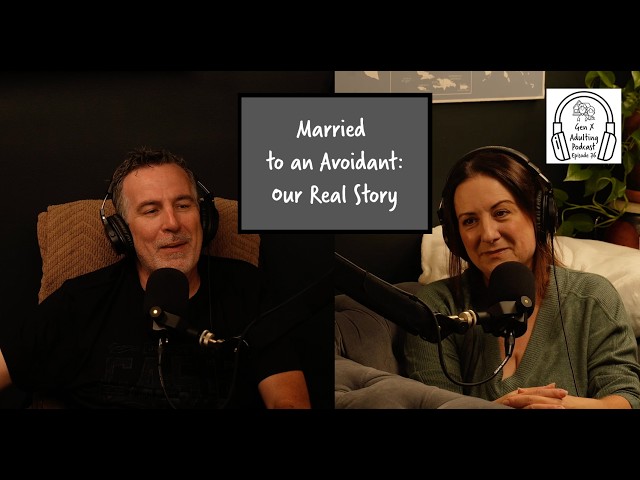
In Episode 76 of the GenX Adulting Podcast, hosts Brian and Nicole discuss the complexities of being in a relationship with an avoidant partner. They explore the emotional challenges faced by non-avoidant partners, particularly women, and share insights from listener comments about their experiences with avoidant behavior.
Welcome to GenX Adulting and today we are talking about being in a relationship with an avoidant. We have touched on this topic in our attachment style episode. So we have previously covered this a little bit and the response to that episode, the response on social media to the clips we put up, especially one clip in particular where I explained to Brian the concept of what happens to a woman when her male partner is avoidant. That one really took off. So today we actually are going to, I'm going to read some of the comments from under that clip and we're going to cover some things, some aspects about what it's like for a woman to be in a relationship with an avoidant. So buckle up on that. Yeah. This is boots on the ground research. I think it's fair to say, and I'll be curious if Brian will agree, but in general, would you say you are probably an avoidant? I think historically probably. Right. Yeah. I think that's something I've tried to work on a little bit. Oh. Historically for sure. Absolutely. I think most guys are. And it's interesting you say that because I wonder, is it our Gen X guys, your peers, boys and men that you, boys you grew up with, men you've known, is that the vibe you've gotten from the men in your generation? I don't know. It's not like we sit around and talk about it necessarily, but you've seen that couple I've showed you their videos. They they've got some great videos where the guy apologizes to his wife and it's awesome. He just put one up the other day. I was dying laughing because he put up a video apologizing to his wife and she kind of sits there all sour faced and like pouty and she, he was apologizing because when she asked him if he likes how she looks in the black dress, he said, yes, I do.
But she, he apologized because that meant she didn't think he liked how she looked in the red dress. And I found that funny because that's something all guys can relate to. And it's not the literal red versus black, but it's the unintended consequences of some of our answers. So sometimes avoiding things is much safer ground than getting too far into things. It's very interesting. And so, and it's interesting to use the word sour, puss face and pouty. That is the, that's the shtick though. That's, it's an act, right? It's a, it's a, it's a shtick. They're doing, it's not like this is real. He's not really apologizing. Right. She's sitting there just like, right. You know, but it's interesting how you summed that up. Yeah. Where I would say maybe like looking sad or looking like her feelings are hurt. Yeah. And yours is more direct. No, no, no, but no, but it's not, no, it's not a problem because we're talking about it. Right. So, cause in my mind, and I think some female listeners, some women listeners, when you said that, that would have felt kind of derogatory. Do you know what I mean? Like it would have felt. And so that, so I think that's interesting, but I think that's part of our generation too. Like just summing up something in that way. Cause you know, younger generations are so PC where Gen X guys will still kind of typically, if they're not censoring themselves, just say whatever they grew up saying. And that would have been things you would have said. So that's, it's very interesting. But I think what I find even more interesting is that is avoiding, do you view it as protecting yourself?
is avoiding, do you view it as protecting yourself? No, I don't think it's protecting myself as much as it, and I feel this is probably representative of most men. It's maintaining peace and harmony. And when we talked about this last time, I think I got completely shit on. But, and I think the example was, I'll go work in the garage and let the steam blow off. Right. But then that just doesn't fly. I think it's trying to maintain peace and harmony and contain the blast zone or blast radius instead of things blowing up. It's more of a, well, let's see if we can let things cool off and then kind of go from there. That makes sense. Well, no, it makes, I think it makes sense for you. Yes. But here's the thing is, if I interrupt you for a sec, I think it's a general, it makes sense for most men. But where you're probably going is maybe that it makes sense for men, but it's not really what's neither healthy nor what works for women. Right. Yeah. And that's the rub, but it's, it's what we think is going to work and we're going to try it. We're going to try to maybe avoid this little feed into it a little bit, try to cool things off, you know, and then come back later. Okay. But that's not avoidant. So an avoidant doesn't return to the topic at hand and they avoid it until, until quote unquote things return to normal and by, and through silence and avoidance,
Okay. But that's not avoidant. So an avoidant doesn't return to the topic at hand and they avoid it until, until quote unquote things return to normal and by, and through silence and avoidance, they almost shun their partner until their partner accepts that there is not going to be real resolution to the situation. And so their partner can either choose to accept the silence and the shunning and figure out how to live that way, feeling disconnected from their partner or accept that nothing's going to change and once again, just move forward. And there really isn't any true progress. So that's what happens there now, because we did have people comment about that. If the man says, the partner says, I can't talk about this right now. I need some time to cool off. I need some time to think about this. Can we revisit this tonight? Can we revisit this tomorrow? Can we revisit this in two hours? That's not avoidance. That's healthy, functioning communication in a healthy relationship. Because when you do that, you're acknowledging your partner, I hear you, I see you, I can't process what you're saying right now. You got to give me time to figure this out so that I can come back to you where we can be productive in the conversation. If I try to have this conversation with you right now, I may blow up, I may get angry, I may say things I actually don't mean out of frustration. So just I need time to process this. I think 99.9% of women would be like, okay, I respect you. I thank you for acknowledging that. I give you space. And then as long as he returns to when he says he's going to, that's not an avoidant. Do you see the difference? Yeah, no, I agree with you. And I think if you develop that pattern to come back and have the conversation, then it's probably pretty good.
Yeah, no, I agree with you. And I think if you develop that pattern to come back and have the conversation, then it's probably pretty good. It's excellent. It's a great escape patch for both parties involved to cool off, kind of get their thoughts collected together and come back and have a productive conversation. 100% agree with that. I think it's great. And I think that, and I do think that that tactic or that strategy, whatever, actually does start to diffuse the bomb. That diffuses the bomb. What ignites the bomb actually isn't the initial, I want to talk about this. I'm upset about this. This is bothering me. That's not the bomb. The bomb when you're talking to an avoidant is when they pretty much abandon you and abandon the conversation and never return. And then the explosion, the bomb is the explosion of the resentment. So you choose an interesting word, abandon you. So if it's, let's clear the air here on one thing. Now, avoidance, do you think they typically are men? Are there avoidant women as well? There are. Okay. So this is a generic behavioral conversation around avoidance, not just men. Although men are probably maybe at least the comments. Were more women not happy with the avoidant and how they've been struck by it and the negative repercussions of it? If I had to do a percentage, I would say 97% women and 3% men coming in. There were men that came in and said, women can be avoidance too. I was married to one or I am married to one. And she does exactly what you're talking about. So no, and it's not, when I say abandon, you're abandoning your partner. I'm not meaning it like your partner has an abandonment issue and they're projecting that onto you. You're abandoning your partner. You're abandoning the partnership because
no, no, I think you're avoiding conflict or escaping conflict. You're running from it. You're running from it. And that's abandoned. And it's, and it could be temporarily, right? And that is the strategy, right? Sure. I get out of this. Hopefully it cools off. But that's why it's called to you. You're saying abandon. If that's what the perception is, then that's really bad, right? That really is an escalator. Yes. And I would say, and we got a lot of that word in a lot of the comments. Abandoning. Abandonment. Abandoned. I feel abandoned. I feel invalidated. I feel like they truly, truly do not care about me. Like I could either be here or not. That's how bad it gets. But you use an interesting word, escape. And so if the avoiding is trying to escape the conflict, because let's be real here. We're talking about conflict resolution, right? And for most of Gen X, there was no modeling of conflict resolution. So even if you grew up in a house that seemed even the most perfect home, if your parents never had, not you, if in general, your parents never had disputes, arguments, disagreements in front of you, and you didn't get to witness the resolution of that and that life continued on and returned to normal, that could create a fear of conflict in a child. Like, okay, so everything always has to be okay and even keel, because if it's not, I don't know if things are going to be okay. Then you have the flip side of that. Kids who grew up with constant conflict and maybe abuse and mental, emotional, physical, whatever, those people may be trying to avoid conflict because that is, that triggers their trauma. Like personal safety.
those people may be trying to avoid conflict because that is, that triggers their trauma. Like personal safety. That's a personal safety error. Like I can't go there. So I think for our generation, at least not having any modeling of conflict resolution was such a detriment to us. So then you end up, if you end up with married to or in a relationship with an avoidant, neither one of you probably had conflict resolution. So you're having to navigate it together as partners. But if one person runs every time there's conflict, that as a couple, you're never going to get in your own groove of resolving conflict. Because for every couple, that's going to be unique to them. How does this couple, every couple is going to resolve conflict differently. And so like we talked about before, for some people, it may be like when we have a conflict or if I bring something to my husband and then he says to me, I need an hour. I know, it's a trust thing. I can trust him. Then in an hour, he's going to come back and say, let's talk about this. So I can comfortably and confidently let it go. Because I trust him with an avoidant that doesn't say that or never returns to the topic. There's no trust. And without trust, there's no true foundation of conflict resolution or connection. And without trust, resentment builds. And trust is so much the cornerstone of a relationship. Let me ask you this. How do you think people get so far into relationships with that dysfunction
And without trust, resentment builds. And trust is so much the cornerstone of a relationship. Let me ask you this. How do you think people get so far into relationships with that dysfunction at the core? What do you think? Right? It's a core thing. Or do you think people evolve into avoidance? And I do think there's probably an element of each, right? Maybe you go through the honeymoon phase, you're not fighting or anything. Maybe you get into a fight or so and you kind of avoid it and circle back and everything's cool. But you know, I'm going to sleep. Oh, I do. So for women, I mean, so when we're younger, right, we have our hormones are very near, they're geared towards nurturing, they're geared towards being in a partnership, they're geared towards starting a family and they're geared towards supporting us kind of just ignoring some things. Right. And also, I think in the beginning of a relationship, you're building a life and you you don't know the pattern jet, right? Because everything's new. So it takes a while to recognize a pattern in a relationship. And also, if it's something that's hurtful, it may be hard to acknowledge or accept that this is a part of who I am with, like I married, who I'm with or the relationship. This is a part of who they are. I think it takes a form of maturity and perspective to recognize that to even see that. Okay, this is a part of who they are. Why are they like this? Obviously, this is a routine something that takes a lot of growth to because at first you're just hurt. And you don't under you're confused. There's a lot of confusion, confusion in the beginning with this. There's a lot it breeds self doubt. You feel rejected.
And you don't under you're confused. There's a lot of confusion, confusion in the beginning with this. There's a lot it breeds self doubt. You feel rejected. And so there's, I think you can sit and hurt for a long time. And then I think the partner, the avoidant partner, thinks that eventually you guys have just worked it out. Life's returning back to normal. Everything's fine that it did quote unquote, cool off. Look, it worked. We're returning back to normal, right? But for a lot of women, and I'm speaking, I can't speak to men in avoidant relationships with women. I can't speak to it. I don't know what it's like. I'm speaking from a women's perspective. I can't speak, I would assume some of this is similar, but we're different. So I don't know. But for the woman, she's just hurt right when she's younger going through this. And but she's also busy if you have a family, you know, you're raising young children, building careers, maintaining a home, you know, sometimes life doesn't give you the space to even really take the time to maybe say, Wait a minute, this is a pattern. This doesn't work for me, we need to fix this. And a lot of women will go decades before they're like, this doesn't work for me. Women can go a long time before they say, this doesn't work for me. And it's because they put everyone else first. Do you think that's a phase of life thing? Where you finally right because I don't know the age of the respondents, right? Or the people that were commenting. But you think they're maybe our age or the younger or older. I think there's a phase of life here probably too, if going down the track you're going on.
Right? No, I think that they're probably older millennial to boomer. Yeah, so us older millennial boomer. I don't know, right? There's probably there could be some younger millennial women in there. But you know, people give, they, they give their partners a chance repeatedly because you're married and life's happening fast. Life's happening, right? So it's moving along. Life's happening, right? And so it's tough because it takes a lot of energy to hold that boundary and hold that space for the person who's with the avoidant. So if you're a 32 year old, and you've got a four year old and two year old, and you guys are going to sports and doing all the crazy things, and there's been an issue and he's avoided, and you guys maybe haven't been really grooving or talking or whatever. Eventually life has to click back in because you guys are moving. And this, you're touching on the functional aspect of, of being an avoidant, right? Because you can't always stop and just go in on it. Sometimes it's okay to back burner it, let it go. Maybe you come back to it. Maybe you don't, because it's a lot going on and something took a higher priority. Okay, and then that decision to not go back to it, it never goes away for her. And so from that, from that, and there is always time, there's time, it could be, it could be a 30 minute conversation. I think the thing that the avoidance don't realize is that if they actually just sat down and made space for their partner and said, okay, listen, tell me your perspective of what's going on. I want to, I'm not, I'm not going to get defensive. I'm just going to hear you and your perspective. That would be such a functional conflict resolution moment that it actually could get resolved within 30 minutes, an hour, 20 minutes.
20 minutes. You realize what you're saying. What you're describing is an extremely healthy perspective on communications and dynamics within a relationship. Most people have baggage and most people have blind spots and most people don't communicate like that. Right? I mean, you're describing an extremely healthy, productive mode of communication. I just don't think most people are equipped with that. But I think that most people should be able to recognize, okay, my partner is not happy and I am, this isn't working. I'm walking away from the situation. She's wanting to talk about it. This something needs to change. Basically people need to grow the fuck up and say, okay, like I don't know why I'm like this. Why am I like this? Well, maybe that's something I don't want to deal with right now is to figure out why I'm like this. But for my wife, I'm at least going to try to figure out how to work with her. And so let me put some time into it, some effort into this. Let me show her, she matters enough for me to try to figure out how to effectively communicate. That's what it is. I can't tell you how many divorces have happened because of this. Because of this. And it's almost like the men can't get past themselves in order to value their wife. The ones who like were it ends in divorce, right? They literally can't get past themselves. And I don't know how many avoidance have narcissistic tendencies or are narcissistic. I don't know. But a narcissist certainly can never get past himself or herself. Again, I'm speaking in these terms because this is what I can speak to. And you're not a narcissist. I'm gonna clear that up. You're a man. So you have narcissistic tendencies because I think all men do to some degree because of our society, right?
But and I think that you had way more narcissistic tendencies when you were younger compared to now, right? So when we've had issues with your avoidance, I don't think narcissism has been a speed bump in that as I'm gonna be clear. But I do think, I would say most narcissists are avoidance, but not all avoidance are narcissists, if that makes sense. It's an interesting theory. I think so. But why don't we, before we, because continue talking like on this line, but I'm gonna read some of the comments. Because I think it's good because we can speak about our experience and we will continue, we'll go back to us because I don't want it to sound like that was just a little bit that we touched on. Because we've been married, you know, I keep saying, I don't know. So we got married in 1994 and it's 2026. So next month, how many years is that? I don't know. It's a long time. Is it 32? I think it's 32. So we've been married 32 years and together 33 years. So we can speak to this topic. We, I would say we're experts in this topic. Wait, why are we experts? Because I'm an avoidant. Because you're an avoidant. Yeah, that we've had a marriage where that has survived. Because most marriages and in divorce, they do. Or the partners are not best friends anymore. They're just functioning in the home in roles and they're living separate lives. You and I are best friends. You and I are connected. You know, we have, we still figure it out. Still. Just for listeners, we haven't figured it out. We are, we're still, I think it's just, it's a thing that you're always kind of working on. But the effort and the, it gets, there's instances that cause major issues get fewer and farther between now, if that makes sense. Yeah. Yeah.
it gets, there's instances that cause major issues get fewer and farther between now, if that makes sense. Yeah. Yeah. Does that make sense? Oh, yeah. Yeah. So actually it's to the point where when. I was going to make a smart ass comment, but I'm not opening that whole Pandora's box. So I'm avoiding that. Oh, well, that might be a good. See the defense. See how good that is. That's good. That's actually before I get to this, let me ask you a question. I should have shut up. See, should have avoided that. No, no, no. Why, why do you think you are an avoidant though? Why? Because there's a lot of theories on it. A lot of people tie it to emotional development. A lot of people tie it to Gen X boys. If we're talking about just our generation, we're not given the space to have emotional development beyond feeling like anger. A lot of people say it's self protection because there's a deep seated hurt there or pain. And from something that doesn't even have to do with their partner, but if layers are open, then that can be opening up a can of worms of stuff. And so just general avoidance of conflict has been the go to sense, you know, the avoidant was a child, but as an avoidant, what would be your opinion on that? I don't know. That's a great question. That's got me thinking. I think I'm not totally into conflict. And I do have a switch that when I get put into too conflicting of a space, you know, it's almost like I become the Hulk or something, right? Not, you know what I mean? It's like a switch flips, not necessarily totally pleased with who that guy is, but it's also, there's a spectrum to that in the conflict, say, in protection. I'm not, I'm okay. Let's go type of thing. At an interpersonal level, the conflict,
I'm not, I'm okay. Let's go type of thing. At an interpersonal level, the conflict, you know, there's that switch and sometimes you do or say things that aren't necessarily productive or okay or hurtful. So, and then it's, you know, if you don't want to kind of go there. So I avoid to keep peace and harmony because there is a another side of the conflict. That's either you have to be self introspective and probably vulnerable and learn about yourself. And sometimes I would say, well, it's not all in the mood for that, right? Or it's not, you don't want to. And there's a time and a place, but it doesn't have to be in the middle of a, of an argument. I don't think it's deep seated or deep rooted that I can think of, except there's, it's, I'm a, I'm a peace and love guy and I don't like the conflict, but I'm not afraid of conflict, but it's not a, it's not always productive to be in a conflict. That makes, does that make sense? No, I think that's your experience. And as some people say, that's your truth, right? That's your, but my question would be, why do you think there's a switch? I think we just all have a threshold. You know, it's almost like if you take it away from, say, more of an interpersonal relationship and someone's doing stupid shit, I don't necessarily always sit on the sidelines. I will get involved and tell someone they're out of control or whatever. I may not know them, but I will get involved to a point and, and I don't, and if someone's bullying someone or treating, mistreating someone, right? I'm not typically the one that sits on the sidelines. I will stand up for that person. And there's a switch there. It's like, all right, you've hit my threshold and now you've kind of woken up the wrong person. In the, in the relationship, it's more the switch of I'm trying to avoid, but I'm not able to. And I really want to avoid, but I'm really not being allowed to. So that switch comes out and then you, you know, you respond. So if you respond, I think there's a, what's the right word?
There's a multiplying force of if you're not going to stop, I'm going to stop it type of thing. And that's interesting. So, but what's happening is, is you're being held accountable, right? That, that person is holding you accountable for something that they want to talk to you about that has either upset them or they're not comfortable with, or they're bringing you something. This, this is an issue for me. Can we talk it out? And I, I'm envisioning, so they're holding you accountable for something that affects them. Or assigning you ownership of something that belongs to them that is now being tagged and assigned to you. And I, and so you're, so how often do you view when, when I bring you something, how often do you view it as you think I'm projecting my stuff onto you and that I'm not, how are you able to even see in that moment that it maybe isn't me and it is you? Are you able in that moment? It's never me. No, it's an interesting question because I have a feeling as we've gotten older and as we figure it out, I'm probably more capable of seeing that it's, I'm more capable of seeing that now. Seeing what? That it probably may not be you. It's probably my behavior that affected you. And now you're confronting it and I'm trying to not be confronted on it, right? Right. So now, but that's an evolutionary thing. It's still not a hundred percent me, but it's probably, I'm probably willing to accept more, you know, now as opposed to historically. Would you agree? Yes, you have grown a lot because, and for listeners, because I do. But I think we've both grown a lot.
Would you agree? Yes, you have grown a lot because, and for listeners, because I do. But I think we've both grown a lot. Oh, right. I have, listen, I've done my story on here. We have yet to still hear your story. So I'll be the first to own my shit. And you know, if anyone goes back and listens to my episode and then through different episodes, I think I've been very candid about any past issues I've had, where they came from. So I will, I will definitely own my shit. And, you know, I've talked about in our attachment style episode, I did say how when I was younger, I had an anxious attachment style, right? And an anxious attachment style does not mix with an avoidance. Yeah, we talked about that. I mean, it's amazing. We made it. Yeah. It really is amazing. But think about that, right? I think you've grown quite a bit, quite a bit, right? And, but I think I've also gone along for the ride as well, my own growth, but along with, so we've grown together. You've grown, I've grown, we've grown together. Yeah. And so some of that anxious attachment and my avoidance is just naturally, I don't know if it's healed or evolved or whatever it is. Yeah, I think a lot of it has healed. A lot of it is healed on both. We've, we've, I mean, I've worked, I will say I've worked hard to try to, I've been on a healing journey for quite a few years.
of it has healed. A lot of it is healed on both. We've, we've, I mean, I've worked, I will say I've worked hard to try to, I've been on a healing journey for quite a few years. And I think you went through, you've talked about this on episodes, like around the time you turned 50, you kind of had an enlightenment period where you looked at your life and you had a whole new appreciation for what you have. And I'm assuming one of those things was our marriage, you know, and that your children and this family and your life, basically, it was more like really looking around and saying, holy shit, look at, look at this life, right? You kind of take inventory. You take inventory. So through that comes growth. That's why I said it's fewer, fewer and farther between to the point where when we do have an argument that does go further than it should, and it is as a result of your avoidance, it's almost like the rugs pulled out for me. And I'm shocked because we haven't had that in so long that it comes out of left field. And I almost at first, I'm like, what's happening because it's been so long since it's happened. And then it takes me a minute to be like, okay, right, we're he's avoiding, he's dismissing, right? Because you haven't. So let me ask you this, when that happens, do you then step back and say, why is he avoiding? Why not just he is, but why? Why is he doing that? Um, I it probably depends on what we're talking about. And I think that I try to, I try to think of the best way to communicate to not trigger more avoidance.
Um, I it probably depends on what we're talking about. And I think that I try to, I try to think of the best way to communicate to not trigger more avoidance. And part of that is, is putting myself in your shoes to try to understand. But I there's been many times I still don't understand, like I really have tried to understand and I haven't, I haven't understood why can we not talk about this right now, I don't understand why this is so upsetting. And that's, that's when I think this is a trigger for you. So when you were talking about how you felt, I was visualizing almost like an animal being cornered. So you're cornered and you're stuck. And you lash out like you said the Hulk. And that's, that's probably a bad analogy, because I'm not I don't get crazy like, No, no, no, no, no, no, to be clear, you're not by the other person. Yeah, yeah. No, but you might, you don't raise your voice typically, but you have in those situations, right? So I think, and then if something like that happens, I can be honest and say, I am still confused. I don't understand why that reaction is so strong. I truly don't understand, right? But then, of course, my feelings, I'm even hurt, right? I'm more hurt. And so then there's the reaction to that. And then we have a big, like cyclic mess, right? And, and so, and then there's avoidance. And, you know, and, and, and do things get resolved? Or not? I don't know. I don't know. Still, if we, you know, to be honest with listeners, I don't know if we ever return back to the topic. I think we try. I am trying to think like, well, we might agree to disagree and move on. Right? That's not the most unhealthy thing either. Well, no, but I think the most recent thing I can think of are we had a situation which we haven't had in so long.
Well, no, but I think the most recent thing I can think of are we had a situation which we haven't had in so long. I think I did. I mean, I think I gave it like a week and a half and then revisited the topic. We had a very calm conflict resolution conversation. I didn't walk away from that feeling like you still understood where I was coming from. But it was one of those things where it, I'm just going to move forward because it's, it's not going to get resolved, I don't think. But I, I think it's still the fact that we had that calm conflict resolution conversation and you were able to participate in it calmly as well. So it didn't automatically trigger defensiveness in you. You did have an open mind and you did participate in the conversation and you did express that you didn't understand. Do you, I mean, I, I think you, you, you, have you ever been an avoidant or have you always been rated or like, let's talk. I have never been an avoidant. I've, I've always. What about, what about with your, like your mom or, or maybe other people from your, your childhood? Not with friends. Well, I mean, if there's somebody that's like a friend or a family member that's toxic, I've cut them out of my life. That's like the ultimate avoidant move probably, but I view that as different because that's not someone I'm trying to have an interpersonal relationship. Yeah, no, that's not a relationship. So no, I have cut peep toxic peep out of my life. When, even in, in issue, in times where there has been conflict, let's say with my mom,
When, even in, in issue, in times where there has been conflict, let's say with my mom, we've, even up till recently, like, you know, midlife and, and we have talked it out. We have talked it out. Like if there's been a topic now, maybe I haven't brought it to her right away, but typically it's a topic that I want to bring and we talk about it. So no. And in my inner part, like before, um, my boyfriends and stuff, you like, no, I was never, I was never an avoidant. So were you always an avoidant? Would you say like, can you look back on, um, I had to have been no doubt. I'm sure. Right. I would think so. Cause you really only had one real serious relationship in high school and then college, you just dated. Um, but I would assume it's hard, right? Because when you're a teenager, you don't know how much stuff is based on being a teenager and how much, you know, is rooted in who you're going to be. So I will say from, and for listeners, cause I know there's women out there that are going to listen to this and are probably in a relationship with an avoidant and maybe living in a nightmare situation and feel very lonely and lost. Um, I will say that the pattern in our marriage, uh, that I noticed, I didn't know what it was at the time, but I noticed that you avoided, um, when there was conflict pretty much from the start of our marriage. But I now looking back, I see that. But when I was, we got married at 23.
when there was conflict pretty much from the start of our marriage. But I now looking back, I see that. But when I was, we got married at 23. So I was so young and then I became a mother at 26. But I remember even then, and your way of avoiding was you would be in front of your computer. And as I was standing there trying to talk to you about something, you would continue just staring at your computer and doing stuff on your computer and just kind of very important, very important stuff. But just kind of hoping that eventually I drop it. I'm assuming that's what you were hoping is that she'll talk it out. Do you think that's, is that what an avoidant is thinking is, um, if I'm just like, don't participate and she, they just, she just keeps going and going. Eventually she'll tire herself out and it'll be over. I think it's very basic and I completely got shit on for this, you know, when we talked about it originally, but it's a form of conflict resolution. For you. No, I'm just saying there's lots of ways to resolve conflict, right? And avoiding is a, is a, uh, form of it. Now it doesn't work for everybody, but, and it, and like we're discussing it, it escalates for the person being avoided, right? But for the avoid in, it's a strategy and it's a valid strategy to solve a conflict and bring resolution. Now that's an underdeveloped thought, right? Or an underdeveloped behavior. It's an immature behavior, but it is a behavior. It is a tactic and it does work sometimes. And to your point, right? Everything you're discussing is the,
you know, you're, you've got a couple of kids, you're married and, and there's not enough time or it's like, you got to keep moving on. Cause there's priorities. That's how this stuff evolves because it's a, it's a underdeveloped, immature response to conflict that no one ever takes time to think about and talk about and address at a young age. Cause you're too, you're not developed enough and as crazy as that is, right? Cause you're married, you're having kids, you should be developed in some level, but we carry so much baggage from our, our childhoods that people just, people just don't recognize this stuff. And it just kind of happens. And if you can figure it out and keep moving forward, it works. Not healthy, but it works. It works in the moment. Well, in the moment it works for the avoidant. The partner is left feeling hurt, alone, confused. But say you reconcile. It worked. You never truly reconcile. Maybe, maybe not, but you never truly reconcile. You reconcile, but only to a certain point. Oh, picture like you're filling a bucket. So there's an empty bucket. And every time you get into an argument with an avoidant and nothing gets resolved and the avoidant avoids. Sure. Time goes by, life goes on and everything seems to return to normal, but a scoop of resentment went into that bucket. And so your reconciliation can own is only as deep as that bucket. And so every time this happens, the bucket gets more resentment put into it. So that connection with your partner doesn't go as deep as it could. It's not as intimate as it could be. And it, and the trust isn't as solid as it could be. And it's there, you're there and you're together and you're doing life, but it's not as pure and authentic as it could be because the trust.
But it's very powerful because of intermittent learning. BF Skinner, intermittent learning. It's like the right a mouse knows it can go get cheese and it may only get cheese one or two times out of its 10 times going, but that 20% of success is extremely powerful in a learning model. So are you saying the avoidant is testing the waters and seeing how far they can push the boundary each time? No, no, because none of this is malicious behavior. I think you need to say that again for listeners that are in this situation. None of this is malicious behavior. What I'm saying is say one or two times of trust building is far more exponential than the eight times of trust degradation, because it's, it's a reward and it's fucked up. I'm not saying this is good, but this is fairly scientific, you know, behavior, psychology and the intermittent learning process. So two times of success versus eight times of failure. Those two times of success are extremely, extremely powerful. So you're saying that's how the relationship continues is that life gets good again. And then the avoidant probably does some really awesome things or is a really awesome partner and comes through for their wife in 10 million other ways. Life goes on. She feels good. Some people would call that an abusive cycle. Maybe. Right. Yeah. I mean, would you agree that? Let me ask you this before we skip off that topic. Now abuse, I think is a very strong, strong word. Right. Because like I say, this isn't necessarily malicious. It's a coping mechanism to get out of conflict. So that's not malicious. But can it be depending on the avoidant?
But can it be depending on the avoidant? Now, if you're a manipulative, narcissistic dickhead, yes. 100%. Yeah. I know if you're playing games, a thousand percent. Right. If you're truly an avoidant to just, I really just. So you can't handle it. Right. Can't handle it. Yeah. Lots of dynamics going to be an avoidant. Right. It's like maybe you can't handle it. Maybe you don't want to handle it. Maybe whatever you're tired. Whatever. But if you, so I think you say like maybe you don't want to handle it when what your wife would hear is or what the wife would hear is I'm not valuable enough. He doesn't value me enough to want to work on this now. He just doesn't want to. So then she views her value to him as less than. Because if it really mattered to him, it wouldn't matter how tired he is and it wouldn't matter if he wanted to or not. He would want to resolve this so that she isn't hurt. That they're okay. That they stay connected. So I think there's totally varying degrees of this. There can be the incapable avoidant, meaning I just can't deal with this. I cannot even wrap my head around how I jump into this conversation and provide a path forward. Right. I think that's realistic. There's the other part is I don't fucking want to deal with this. This is fucking crazy again. Right. That kind of shit. There's lots of different and then there's and then there's a narcissistic manipulator that's truly being abusive. And might be evil and malicious and laughing about it. Correct. Like a psychopath. Yeah, psychopaths. So the first scenario you mentioned of I just can't handle this. This is too much. And again, I'm visualizing the animal that's cornered type of thing. Wouldn't the best,
Yeah, psychopaths. So the first scenario you mentioned of I just can't handle this. This is too much. And again, I'm visualizing the animal that's cornered type of thing. Wouldn't the best, wouldn't your advice to that avoidant man be just tell your wife, tell your girlfriend, I need two hours. I need tonight. Okay. Like wouldn't that be the number one tactic? Look at her and say, I hear you. I can't do this right now. You need to give me time to process. I promise you, I will come back to you at 8am tomorrow morning, noon tomorrow, 10 tonight. Wouldn't you say that's a really effective tactic? Yeah, I just don't know how many people are emotionally developed enough to have that conversation. But if they're open to learning, wouldn't that be a good, good advice? I'd be curious to hear from our listeners, both male and female. Sure. That's a, that's a hell of an approach, right? I, I'm not in the right state of mind right now to have this conversation, but I promise you, I love you more than anything. I will circle back on this and let's have it the conversation. It's totally healthy. I think that's reasonable. I think every woman, if they hear that, every man that they hear that, they should probably be like, okay, cool. What, what would stop someone from being able to say that? An emotional lack of development or acknowledgement, right? Or just, and it could just be anger. Maybe, you know, there's lots of things that can happen and, and it might just be, you really do need to separate and blow off some steam and you're not going to say anything that's productive, right? That's even that, even like, I just need a minute, like, I just need a minute. Now, think about if you're spun up and you're really, you know, lots of situations, right?
That's even that, even like, I just need a minute, like, I just need a minute. Now, think about if you're spun up and you're really, you know, lots of situations, right? It's triggered. It, I think applies here. It feels like it's triggered. Oh, if you're totally triggered. Yeah, that's what I mean. That's a great word there. That spectrum of, of triggered conflict, anger, sadness, whatever, right? All the, the whole spectrum. You're in an emotional state that your emotions are not under control and you're just not level headed enough to say, I love you. Let's talk in two hours. That's just, you know, that's sometimes, I mean, crazy shit goes on in the world, right? So that's what you're describing is very healthy. Not everybody's healthy. Yes. Yes. But, um, and then the second scenario you talked about of, I just don't want to, I don't want to deal with this. Like that you're, you're like, I don't even care. I don't want to deal with this. So that's dismissive, right? And that really is saying this person in front of me, whatever she's saying, I don't want to deal with it. So it totally devalues her. So what do you do with a someone like that? That is literally like, I'm not dealing with it. Tough shit. I don't know what you're going to do about that, but I'm not going to, I'm not going to help you here. I'm going to do what I want and you have to live with it.
Yeah. I think that depends on the pattern of your the relationship you're in. If that's the more of the norm, then you've got a problem and you probably, you know, you might not be able to fix that. If it's kind of like in the, the heat of the moment, and it's like, I'm not fucking dealing with you right now. You're out of control and I don't give a fuck. I need to get out of here. A little different, right? That's that emotional. That kind of goes back to what we were previously talking about. But if you're, if that's the pattern, that's your communication style, you know, I'm just dismissing you and I'm always going to dismiss you. You got problems, right? You got problems. And then of course, then there's the narcissistic manipulator who's doing this for psych, he's a psychopath and that's, you got to run. Yeah. That's just abuse. Yeah. Do you want me to read some of the comments? Sure. Okay. So I'm just going to go over some of the comments that we received under the clip where I was explaining what happens to a woman when her partner avoids, is an avoidant. So this one woman said, I am living this nightmare. And I found it interesting. She called it a nightmare because it definitely can feel that way. And then she had a bunch of women respond under it, saying same. Another woman said me too, for 24 years, so much could have been easily resolved. This makes everything worse. Another woman said me too. Another woman said same. And then another woman said, been there, escaped that, take care of yourself. It's endless and exhausting. Do you recall like what the video was? Was it a short, I assume?
Do you recall like what the video was? Was it a short, I assume? Yeah. It's the clip where I'm, do you remember the one where I say you lit a match? It's the one where you kind of laugh and people get mad at you for laughing. It's that one. Do you want to address the laugh? Because people, I will say this, people think you're laughing at me, that you're truly finding a, you think it's silly. I don't think at all that's where you were coming from. So do you want to explain to listeners? No, I'm laughing because I know you're about to go off and I'm laughing with you because I know you're about to go in on something and it's like, okay, here she comes. Right. I'm not laughing at the, yeah. You're not laughing at me, right? No. It's more like my wife's about to go off on something, right? And everybody's stand back. Right. Yeah, here she goes. So another woman, this is a new comment said, and let's be real. Usually she's not even angry or trying to fight. She's simply trying to talk to him about something he doesn't want to hear. He gets defensive and dismissive. Then she gets angry. They do it to themselves because they can't be the slightest bit uncomfy. She's meaning the avoidance, do it to themselves because they can't be uncomfortable. Another woman said, I think timing is a thing. If he agrees to pick a time to discuss, having time to process could help. If he doesn't care or try to listen, then it's going to breed resentment, which was what we've talked about that. Another woman said, you are so right. My husband does this all the time and you are right. I resent and I am distressed. He will not talk about it. You are right. Where is the help? I am to the point I can't take it much longer.
I mean, that's sad. It's no, there's not cool. There's a lot of this. There's a lot of this. Another woman said that her husband says, let's just have a good evening. Meaning, he doesn't want to talk about it. Let's just go back to normal. Can we? So then they put a blame on her. You're trying to ruin our evening by trying to resolve the issue you have. I just don't want to. I'm avoiding. Why can't we just have a good evening? That's a manipulation tactic. So he says that and she's saying now in her comment, but the issue has set all day without being dealt with. Another woman said and they say she nags. She is trying to talk and solve issues. Once she stops doing it, she is free. And I don't think men, there's that whole saying the divorce came out of nowhere. I don't think men understand when she goes silent and stops trying to resolve things with you and pretty much gives up. That is the beginning of the end. That's, it's, the divorce is coming or she's already mentally and emotionally disconnecting and preparing herself to be separate from this person. Another woman said about you. This guy got nothing from that. He had no intention of listening to her and you can feel him immediately disregard it. There was a lot of that. Yeah. No, I took some blows there. You did. I remember about me going in the garage. I was just describing the scenario. Right. Yeah. You know, you go in the garage, work in the garage for a little while, let the steam blow off. I got destroyed for that. Like from some people. Well, you, yeah, because the way you presented it wasn't that you were letting steam blow off was that you're leaving and you're going in the garage and you're not coming back. That's I think what triggered a lot of people.
You know, it's interesting. And the more, you know, as I think about this and I look at that, that guy who apologizes to his wife whose feelings were hurt and is sad. We're not, we don't always choose our words that well and they trigger, right? And it's not intended. It's an interesting thing because I think that's part of the avoidance strategy. It's like, okay, shit, I'm just, I'm not gonna hit a home run here on this one. Maybe we'll let, maybe it'll blow off, right? Or it'll blow over. But it never does. No, I know, but I think I'm speaking for men, right? Not just me, but I think for men, it's like, all right, I'm not gonna, I'm not, I'm not gonna figure this out. Right. And so let me just try to avoid it. It doesn't work. Right. But you're kind of explaining like maybe the reasoning behind the tactic. Yeah. Yeah. For certain, for certain. It's not malicious. For most people, I don't think it's malicious. I truly think it's a, all right, maybe, you know. They're ill equipped. Yeah, ill equipped. 100%. And that goes back to, and again, I can only speak to our generation Gen X men. They were not, because our sons, especially our third, because you know, you always do better with each kid. But our oldest is, his emotional development is really good. But we create space for them to express their emotions and talk and feel comfortable saying, I feel anxious, or I'm sad, or I'm so that they had emotional development, because I'm sending them off into the world to marry someone. And I'm not gonna have her be looking at me like, what'd you do? Why did you raise him like this? Like, it's my responsibility to raise a man that will be a good partner for his wife.
Do you think there's a gender switch or flip on this? Because he's pretty dialed in. And I have a feeling he's probably more dialed in than maybe a lot of the girls his age and his maturity, emotional maturity, and ability to communicate. I don't know. I know. I don't, I think his, I don't know. It just depends on how each of the kids, the kids are being raised in their house. But as a generation pure wise, they even create space for each other to express emotions. They don't judge each other if they say those things as much like, if someone's having a hard time, or depressed or whatever, they don't judge they're more like, how can we help this person. So I think just culturally, they have created the space for their peers. So you think it's more of a generational thing where both boys and girls or males and females are more accepting or understanding. Yeah, I think it's yeah, society. I think society has created that for them. But going back to Gen X men, part of me thinks when when a Gen X man is presented with conflict by his partner. And if his first emotion is feeling trapped, that he his toolbox of emotions that he could go to to help participate in the conflict resolution is empty, because he was never given the tools. And so his only tools in that toolbox is anger, or frustration, and pride, because those were the things that were encouraged in Gen X boys, right? So they, it's almost like, you don't have the tools to go to at first when you're growing, you're in your 20s or whatever.
But you need to get to and you need to acknowledge that as a couple. And then, as you grow and mature, say, Okay, I wasn't given these tools. But I need to figure this out, because that's not fair to my partner. If I'm ill equipped, I need to figure out how to equip myself so I can be a better partner to my wife. Yeah, but that kind of shit gets taught at like some men's empowerment seminar, right? It's not like, no, you've seen that at it. Now podcasts, for sure. We're talking about so the guy listens and whatever. But that's like some male empowerment, like, Come on, guys, let's be better husbands or better men. But a lot of that that's not I think and I think but I did with the younger generations. Yeah, yeah. But for art, I think it's why so many Gen Xers are getting divorced is because I do think there's a lot of Gen X men that don't even want to hear this and don't want to take account of that. I don't think Gen X boys were held accountable for a lot. I think not just Gen X Gen X boys, boys were not held accountable in general up until probably recent generations. Maybe Gen Z Gen X moms. I think the accountability was different. I think they're being held they've always been held accountable to say independence, financial stability, financial performance to raise your family to carry your family, right? So that's what's been encouraged, facilitated, rewarded. Yes. And with that comes a little bit of damage, right? A little bit of an emotional toll on everybody, everybody involved. Yes. Yeah. Interesting is I think we were both surprised. I was surprised at least I think you were too when some of the guys were like, Yeah, but if I open up and I show some emotion, I get completely exploited, taken advantage of, mistreated. I found that interesting.
So we had a lot of men that would comment that if I open up to a woman, she'll use that against me. And I don't know if it was they literally were speaking from experience or they were stating a fear of it. I don't remember the actual with each one. But it was she will use my emotions against me. Yeah. Which I found really interesting because I would never do that. Right? So I, if there are women that would use, if a man is going to be vulnerable to you, and you use that against him, you know, you're a horrible person. But that goes both ways, right? I don't understand how you would even do that, though. Like, what's the mechanism or the scenario? I can't even picture it. I don't know if you can. Unless you call them him names, like, I guess for Gen X, it'd be like you're a wuss or you can't even handle things you're crying. Or remember that time you maybe laughing at them? Like, remember that time you cried about this or you were weak? Like in a fight, they could say, well, you're weak. You were crying about this. Like, just snipe it, use it to snipe at them. That's the only thing I could think of because I was so it was such a out of my room. Like, how could anyone even do that? Now, I will say, if you have been with your partner and you have, you know that the trauma they've gone through and you know the things that they've worked on healing and the issues they've had that they've worked on. And in an argument, you use those issues against them knowing they've healed from them. But you project that the issue is because of their issues that they've already dealt with. You're an asshole because you are because like if somebody has been on that journey with you, whether it is addiction,
having abandonment issues, whatever it is, if you're in an argument and you say, well, you're acting like this because of, you know, your issue, you're an asshole. Because you watch that person go, you knew that from the start and you watch them heal from it. So then to not take accountability for your own actions as one step, but then to put it back on them because of their issues, you're an asshole. That's hilarious. Yeah. I mean, some things are off out of bounds. Absolutely. That should be, talk about breaking trust. Yeah. It's really hard to come back from that. So another woman wrote, "He's wrong. Avoidance lacked the capacity for emotional intimacy." I found that to be, and I think that's what we're talking about. Avoidance lacked the capacity for emotional intimacy. They hide behind excuses and self-sabotage because they feel threatened by normal relationship shit like connection, intimacy, deep conversations, etc. And so it's almost like they're uncomfortable with that and so they avoid it. But in order to be close with your wife or girlfriend, you can't avoid connection, intimacy and deep. If you want to be in a relationship with a woman, you have to be comfortable with intimacy, deep conversations and connection. It's a woman. If you want to, don't want any of that. No, no, no. If you don't want any of that, then be with a guy. If you're going to be with a woman, you need to be able to love all the things about a woman. I think that's too broad of a brush. I don't think all women are capable of that either, though.
I think that's too broad of a brush. I don't think all women are capable of that either, though. Okay, if your wife or girlfriend is like a normal typical woman and one needs to connect with her partner, wants to feel intimate with her partner beyond just sex, because I think most men should know that for a woman to truly connect sexually, she has to feel comfortable intimately with other aspects with her partner emotionally. I think there's an element of the financial relationships as well. We're in South Florida. There are plenty of relationships here where that's just a financial transaction and situation. I'm not talking about those relationships. I'm talking about normal relationships. I'm not talking about relationships where it's a sugar daddy, two people that got married because they loved each other. Okay. Heterosexuals, right? I mean, you can go with homosexuals too, but then it's different. Men and men, they have different needs, but a woman in a woman relationship, although it depends. I think you're painting a very broad brush here on a slippery slope. I think it's just human dynamics. I think in general, I think it's male, male. I think it's female, female, male, female. I think it's the full spectrum. This is a personality thing. But I think in a typical heterosexual relationship, if a man is with a woman, he needs to be able to understand that she needs connection. She's going to want to have deep conversations and she requires intimacy that's not just sexual in order to lead to the sexual intimacy. Like men totally underestimate kissing, hand holding, kissing on the back of the neck, smacking her ass, hugs. They really don't understand that that is foreplay. And if you don't touch her non-sexually and then just want to jump on her in bed,
hugs. They really don't understand that that is foreplay. And if you don't touch her non-sexually and then just want to jump on her in bed, you're not getting what you could. Let's put it that way. You're either not getting it at all or you're getting something, but it could be so much better if you just would put the consistent time in all the other ways because she's then going to totally open up to you. Men totally underestimate that, especially men who have been in relationships for a long time. So anyways, back to this. That feels like a whole episode on its own. Maybe we'll talk about that. A sex coach type of thing. Yeah, right. Okay, so another comment said, "Anyone else notice how he couldn't wait to argue with her and point out how she's wrong? He wasn't listening to understand. He was listening to respond and prove her wrong. I was married to that. It doesn't work." Yeah, it's awesome. Somebody said, "The way she has to manage his emotions in this interview is wild." Quote-unquote, "I'm not speaking to you." He interrupted again, "This isn't about you," she says. He gets uncomfortable again. "This isn't personal," she says, and she said, "Stop." I wonder what I was doing that really triggered that. I think you were trying to talk and the laughing, the laughing really got them. Somebody said, "These are all women. Sometimes men just need a little bit of time to process. The important thing is coming back in a reasonable amount of time. If you can communicate before you walk away, I just need a bit of time. I love you. It makes the space easier." Which we just we've talked to. We just covered that.
I do think that's golden. Yes. If you can do it and you're emotionally mature enough to do it and discover it on your own or you watch this podcast and go back 20 minutes or whatever it was or listen to this. I do think that's sage advice. I think it's great advice, especially the "I love you" part. Like looking at somebody like, "I love you. I need you to give me like four hours and just can we separate now, but I love you." It goes so far. Somebody said, "It's not a generational thing. It's an indication of a man who is immature, has low emotional intelligence and no idea how to communicate. This guy is a prime example." I love it. Listen to him laugh at this woman's explanation and then try to justify the avoidance with a need for peace. Classic behavior of unresolved childhood issues. Somebody else said, "Avoidance only brings peace to the avoidant." I agree. "When you ignore the other partner, when they're upset, all the other partner feels is ignored, unloved and unhearn again and again and again. The wall is built by the avoidant with their stone walling." Then this woman says, "Yes, mine goes as far as to tell me that he doesn't care. Never returns, never resolves. It is truly more lonely than actually being by yourself. It messes with your head so much to have someone tell you that they love you yet totally dismiss everything about you unless it benefits them. Then they throw crumbs your way." And those crumbs, that goes back to that intermittent learning I was talking about. Those crumbs are very... It's called breadcrumbing. Whatever you want to call it. It's intermittent learning. But it's very powerful, extremely powerful. Until it isn't. It reaches a point where you can't.
It's called breadcrumbing. Whatever you want to call it. It's intermittent learning. But it's very powerful, extremely powerful. Until it isn't. It reaches a point where you can't. I'm just saying from a learning perspective, it's extremely powerful. It's like they sit, like right, if a bear ever bites someone or whatever, an alligator bites someone down here in our neck of the woods, they kill it. And it's because they now have tasted the blood. It's the concept, right? And it's very powerful. Now they know it's a food source. So when you're saying powerful, are you meaning it's powerful for the avoidant? Because he knows if I just give her enough, then things will go back to normal enough and things are good. Or is it powerful that she is getting enough? Is it both? No, I don't typically think the male, because we're picking on men here, are intentionally doing it per se. They don't know the intermittent learning concept, I don't think. I don't even know it because I'd had to do a report on BF Skinner when I was in high school or college. And that was one of his most powerful things that resonated with me. It's the victim in this sense, or it's the woman who's being intermittently given breadcrumbs. The breadcrumbs are just extremely powerful. It's a behavioral learning approach, and intermittent rewards is extremely powerful compared to consistent rewards. Think of it this way. If you go and you always, the mice, they hit the lever, and they always get food, they're just like, "Okay, whatever, I'm going to go get food." And it's easy if the reward is expected, and it's consistent. Like I'm saying, if they go
Like I'm saying, if they go three times and they get the reward, they get the food, and then they don't get it for like four more tries, they still know there's a shot. There's a shot to get food if I go back there. They go back at once, and then four more times they don't get it. It's extremely powerful. They're like, "Well, I can go back there." So are you saying the woman is the mouse? Yes. But it's men too. If they're with an avoidant. It's the woman. And this brings me to, and I know some women get upset when I have said this, but I do think perimenopause and menopause is a catalyst in the woman not accepting the crumbs anymore. And I think if there's something that, I think there's a couple nuggets here for people to take away, to be honest with you. I do think I'm going in on this intermittent thing because I just know it's very powerful. If you know the concept now, if that resonates and say, "Oh man." The pattern. The pattern, because it's pattern. It is. It's almost like a random pattern with intermittent rewards that teach you that if I keep trying, I'll eventually get there. It'll happen again. I'll be rewarded and it's a dopamine hit. Right. But again, like I said, I think perimenopause and menopause, the rose colored glasses come off, the tolerance for bullshit goes away, and the breadcrumbing is not acceptable anymore. So those intermittent hits worked until they don't. And I think that's an important thing because if you recognize that is the pattern, you can break it. And I think that's when you recognize it.
And I think that's an important thing because if you recognize that is the pattern, you can break it. And I think that's when you recognize it. And I think, I'll acknowledge what you're saying. Yes, it is the perimenopause. It's the menopause. Probably it's the rose colored glasses and goggles that are removed. It's that enlightenment. And I think we hit it. This is that thing I'm talking about when you hit 50 as a guy. There's some level of enlightenment. Women go through it as well. And enough is enough. I'm done. Enough is enough. And I'm not saying it's just because of hormones, because that's what people get upset when I've said that. I'm not saying it's wisdom. It's that, yes, all of that resentment finally wins. All of that resentment finally has a space because with the hormonal changes, space is created. And it's like enough, if that makes sense. This other woman says, you're making it an argument by dismissing her feelings. He's diffusing his emotions by walking away because they don't know how to deal with them avoiding. And that goes back to what you talked about. It is diffusing your emotions when you're walking away. But unless you've said, I love you. I can't talk about this now. This is when I can. Her emotions now, and that's when I said, let a match. Her emotions are worse than before she even came to you. And that's that. But think about that too. That's why I say I don't think this is all malicious. If it works for me, why doesn't it work for you? But that's a male thing too. Because women automatically, in general, have an amazing ability to look at everything from everyone else's perspective, especially her family. I think men do too. I think men... Maybe not at the emotional level. Not at the political level.
I think men do too. I think men... Maybe not at the emotional level. Not at the political level. Sure, sure. But I'm talking about on an emotional level of identifying how her children are feeling or what they need, her husband and what he needs. She is always, she carries the emotional baggage for the family, but she's always, she's able to easily put herself into their shoes. And that's how she kind of helps figure it all out. It's very rare a woman will automatically think, it works for me. So it's going to work for them. She doesn't blanket what works for her onto everyone else. She, and this works for Sally. This works for Johnny. This works for Timmy. And this works for my husband. Men, I think, when it comes to emotional stuff, even sexual stuff, well, this is what I like. This is what works for me. So it must be what works for everyone else. It must be what works for my wife. And I think that's that next step in emotional development, where he needs to stand back and be like, I may like something like this, or this may work for me. But maybe it doesn't for her, because when I try it, she only, it only escalates the situation. How many times does he need to try what works for him on her before he understands? It doesn't work for her. You need to learn what works for her. I'm laughing because it's sort of like the calm down, calm down, right? But that just, no, you're, you're, you're lighting the fuse there with calm down.
I'm laughing because it's sort of like the calm down, calm down, right? But that just, no, you're, you're, you're lighting the fuse there with calm down. What I was going to say, so think about men, we're problem solvers. We solve problems. And the best way to solve a problem in an emotional situation is to diffuse the situation, diffuse the emotions. Let's all calm down everybody, not just you, but everybody calms down. And let's get into a more like analytical thing here instead of it being emotional. But you're, but okay. So but again, that's where you're trying to apply what works for you on to her scientifically proven that there are decisions when their emotions are checked. No, there is, but that's not how you connect with your partner, first of all. But let me tell you something. If you can figure out what works for her, you are going to diffuse the situation. I agree. Diffusing the situation is a very effective tool and part of resolution. You know, but, but the way men go about it is how it works for them. And for avoidance, it's walking away from the situation, which isn't going to work for her. But you know what works for the avoidant is just deal with it. Let's just, let's just separate for now. Let's avoid it. It'll just figure itself out. But it doesn't. And then, and then the resentment builds. So, okay. So the next one, avoiding someone else's feelings is not a problem. It's a woman coming to her man that is feeling hurt. You're avoiding taking accountability and being compassionate. This one was very interesting. Shunning is abuse. I agree. Shunning is abuse. How is, um, how is avoiding, um, I don't know, just a shunning. Um, they mean that avoiding shunning. They're using the word. They're, they're changing the word up.
How is, um, how is avoiding, um, I don't know, just a shunning. Um, they mean that avoiding shunning. They're using the word. They're, they're changing the word up. I, yeah, but, but that, that they're not the same avoiding is I'm trying to avoid something. Shunning is an intentional behavior to like, I don't know, like almost push someone away or ignore someone. This dismisses. But that happens when you avoid, you are pushing someone away and ignoring them. You're ignoring their feelings. You're ignoring what they're trying to bring to you. You are pushing them away. You're, you're a band. It's an abandonment of your partner. It's an abandonment. It's that we're partners. We're supposed to be doing this life together, but anytime I have a situation, not anytime in certain situations, when I need to talk about something that's might be kind of deep or we need to go somewhere, you leave and that's abandonment. And that's not being a partner, right? And that's where, again, the healthy conversation of, I'm not, I'm kind of, I want to come back to this, but then the avoidant has to come back. He can't say that and not come back. You mean she or she, whatever, but we're talking right now. Yeah, she or he needs to come back. If you break that trust, if you make the person think, okay, he's going to talk, we're going to talk about this or she's going to talk about this in four hours so you can call him, you know, okay. And then they never come back. You've doubled down now. It's only going to be 10 times worse. So you have to follow through with what you said.
GenX Adulting Podcast - Nicole: This person said, it's an even bigger conversation than what she's revealing here. Avoiding conflict and resolution is harming her health and possibly shortening her life. Your wife could literally die or become disabled because you shut her down over and over and forced her to bear the entire load by herself, forced her to swallow all the emotions instead of expressing them. You removed care from her when she most needed it. You communicated that she doesn't really matter to you. Over time, this not only ruins your marriage, it literally harms your wife. When she gets cancer or an autoimmune disease, you may literally be at cause. So if you do love her and many men truly do not love their wives, protect her health and longevity, not your own weakness. And I found that very interesting because most people who have autoimmune diseases are women and so much of it is because they carry the load of everything. Especially Gen X women were raised to just keep going, to have pride in the fact that we sacrifice ourselves for our family. We were raised seeing grandmothers that sacrificed everything for their family and their wonderful amazing women, but that was like a badge of honor. The more you could give your family, the better woman you are. There was no space created for, you know, now grandma's going to go get a massage once a week. Now I'm not saying there aren't any grandmas that didn't do that, but in general it was this viewed as this very honorable, admirable thing that this woman gave everything for her children and husband. Well a lot of women end up with autoimmune diseases because they're trying to replicate this sacrifice, at least our generation, and then add in our generation are doing the domestic load and then also then we started working outside the home. We were the first, our mothers started doing it and then we really walked into that. So if you have, if you're then on top of all of that with an avoidant, yeah, it's gonna, it is gonna wreck your health. Like where's the break there, you know?
Do you have any thoughts on that? No, I was just thinking how strong and wonderful woman my grandmother was. She was so strong, outlived like three husbands. And this is not a dig at grandma's. I just want to be clear about that, but she was right and she was amazing, but there were probably so many times she put herself on the back burner for everyone else. But maybe she didn't, who knows? I don't know. I don't know. You know, she, there are, were women that were balanced. I know like for Thanksgiving, she'd probably get up at four in the morning and start making dinner and we'd eat by like 11 or noon or something. And you've watched me for 32 years get up and do all of Thanksgiving as well. You know, I mean that I've been doing that now for 32 years. So and that's, that's admirable, but also crazy to do all that on your own. So, you know, and I know you've been telling me that your grandma, you're very proud of that of her, that she got up at four in the morning and did all of this and you guys were eating at one and it was wonderful because your grandma did that. And I'm not saying it's not. Okay. But that is a lot to exemplify to other women. And I also have to work on that. That I've done Thanksgiving all by myself for 32 years. That is not an example. I necessarily am proud that I've given my daughter because I don't want my daughter to feel like she needs to do Thanksgiving for everyone. I don't want her to feel that way. So now that I'm aware,
GenX Adulting Podcast - Nicole: I don't want her to feel that way. So now that I'm aware, I'm going to adjust things and also communicate with her because I don't want her to try to emulate what I did. It's too much. And just a side note, we've done an episode on the labor of the holidays. If anyone wants to check that out, I talk more about this. So this person said, what's wild is that this was not recorded. Oh, what's wild is that if this was not recorded, dude would be defensive as fuck and consider this an argument when it's merely a discussion, but you can see his need to be right and defend his position rather than approaching this with openness and curiosity. He tried to interrupt and override her multiple times and then reinforce his position that it's a strategy and not the worst thing. And his need to repeat temporary peace is not the worst thing. Then he continues to try and interrupt with well and but because he still needs to be right and is making no attempt to actually hear what she is saying, which is the issue with avoidance in general. It's not about hearing you. It's about maintaining their position using deflection, defensiveness and avoidance. Healthy communicators would not have tried to interrupt or repeat their position and laugh when she finally makes her point. His takeaway, man that woman is confrontational as fuck and I'd like to get the fuck out and putz around in my garage. He heard little to nothing what she said as evidence when he says yeah, yeah, and yeah, yeah, yeah, and only waiting for her to pause so he can interject not to mention him laughing when she says lit a match.
Temporary peace translation equals I don't give enough fucks to hear her out and when he says it's an entire generation. Classic yeah, but with no acknowledgement or accountability. Take notes behavior is a language what is said and how it is said and when it is said all matter and this applies to women and men. This is not a man thing, but his stance of it being a generation thing completely negates the actual issue at hand and tries to make it about men versus women, which isn't just an avoidance issue. There are a lot of layers here, but any one of these should be enough red flags to run. We struck a chord on that one. Yes, yes, but I think she brought up some good points, but you definitely triggered her, but I think that there's a lot of people. That can relate to what she said. I would triple down on the. Temporary piece is OK. Doesn't you know if you've broken it in communicated is is probably valuable. Obviously yeah, it's you're using the right word. You gotta broker this right? If you just walk away and honestly, is it really peaceful for you like for an avoidant? If they're walking away, it can't be totally peaceful. They know that their partner is upset. That's still there. Yeah, yeah, yeah. So it's not like they're like whimsical like la di da di da. They know it's sitting there. They and they're just hoping it eventually goes away, but it's not totally peaceful. I think it's more diffusing a situation getting out of a direct conflict at that.
I think it's more diffusing a situation getting out of a direct conflict at that. It's escaping time. It's escaping. It's the wild animal escaping. This person said when men do this, they're putting their comfort above everyone. Everything else. Avoidant people refuse to feel discomfort and they run away from it. You know, it's if their part, it's as if their partner, you stop bringing things to them. You start carefully choosing your words and approach, etc. You're enabling more avoidance. The only way to move forward is to have firm boundaries with consequences you fully intend to carry out when the boundary is violated. And that's tough. And I did, I commented under this saying it is so important to have boundaries, but setting a boundary is like breaking a habit and learning a new skill at the same time. So you have to be gentle with yourself when you're doing that, especially in a situation where you're dealing with an avoidant partner. You may fail at that boundary 10, 15 times when you're starting, because it's a huge deal. And that's going to be one of the hardest boundaries you've ever set the boundary for yourself. But I do agree with her. There has to be a boundary set of this is what I will tolerate going forward in this relationship. And this is what I won't. And you may only hold it in the beginning a few times. And he may think or she may think, Okay, well, they don't really mean it, because I was able to get past that this fourth time. But eventually, if you keep practicing it, it becomes cemented. And that is how the things are going forward.
What I was going to say is, I think what we've not talked about at all yet, and maybe across both of these episodes, it is a defense mechanism. As we were just talking about it, it's a defense mechanism. And I think if you acknowledge it in that light, it's like every other defense mechanism. Is that rooted in childhood? Childhood? Maybe. I don't know. Do you feel that Gen X men, Gen X boys were given space to have emotional development growing up? When you really think about emotional development. No, no, no. We've talked about this, right? We were allowed to be angry. I think that was it, right? So what would we were allowed to be aggressive or angry? I don't know if we were allowed to cry a whole lot. So would you say the defensiveness comes from what I alluded to earlier of not having the tools to participate in the resolution? And they feel, in a way, inadequate in that moment? No, not at all. Okay, so it doesn't come from feeling that you're not able to participate in the resolution. What are you defending? I think it's like all defense mechanisms, right? There's a spectrum to it, right? You can rationalize behavior. That's a defense mechanism. Avoidance, I think, is a defense mechanism. You just don't want to engage and maybe expose yourself to being vulnerable, right? That's what you want to hear? No, no, I'm just kidding. I think that's in play, right? You're defending your emotions, your emotional stance, if you're emotional, and especially if you're wrong, right? If you're in the wrong, then it's a defense mechanism to protect yourself from being exposed emotionally out there, whatever, right? It's defending yourself from being exposed, really.
It's defending yourself from being exposed, really. But it's not that callous. Again, I don't think it's always intentional. I think you avoid situations that are uncomfortable or that you just don't want to deal with. But it's because, I think it's because the avoidant does not feel confident in their ability to participate in the conflict resolution without their pride and ego being damaged because they will be vulnerable in that situation. Not at all. I don't think so at all. And it might be in certain situations. Again, we're talking spectrum here. I would say for myself, it's not what it is. It's just, I don't want to deal with this right now. I'm not in the mood to deal with this right now. And I do think that's my perspective, I think, for the most part. But I think since you brought it to you, you don't ever want to revisit it either. Why would you? And that's the problem, right? I'm partially kidding. But it makes you uncomfortable. You use that word. I think it makes you uncomfortable to process conflict with your wife. Man, I don't know. I don't know. I don't want to defend the fact that maybe I am uncomfortable. But I don't truly don't think that's what it is. It's truly just easier. For you. It's a path of least resistance. Is it? Because temporarily 100%. But not in the long run. In the long run, it's not easier. Yeah, but again, you go back to my go out in the garage and putz around for an hour and let the steam come to an hour. So that actually brings me to my next question is. I don't think I'm alone in that perspective either. Oh, no, trust me, you're not. But a lot of those guys are divorced. But I will say, so my next question is. How did this flip over?
I don't think I'm alone in that perspective either. Oh, no, trust me, you're not. But a lot of those guys are divorced. But I will say, so my next question is. How did this flip over? Because you brought it to you. Now, but my opinion, I do want to ask your opinion on this, because it is, I have read that a lot of avoidance dehumanize their partner in that moment. They disconnect and dehumanize them, which justifies their their ability to remove all empathy and compassion from the other person, which is why they seem so cold and cruel in that moment, because they have almost gone into a sociopathic state. And is that what also allows them to walk away? And it truly is easier on them. Whereas if a woman left her partner in that state, she would feel intense guilt and and worry about how she left her partner feeling. But the avoidant can walk away and find peace through the escape where a woman or a non-avoidant would feel bad about how they left their partner feeling. I think what you just touched on is fight or flight, right? It's fight or flight, and you're choosing the flight. You're trying to fly away at that moment. And and it doesn't tell you're not. It's not like this. This is the fascinating part. I mean, really explain it. Yeah, no, I think this is because it seems in the moment so cruel. Yeah. No, I know that's the most damaging piece of this, I think, is that I think the person on the other side, again, it's men and women probably. That's what we're talking about. But it's not a it's I think it's truly like fight or flight. I think it's self-preservation. I think it's sort of a retreat to go get get kind of control again. Right. And if you take it to a primal level, say you're in a I don't know, you watch the internet, Jesus,
or the news and all these fights, people are fighting. You know what I mean? It's like they were fighting at a boardwalk or something at a state fair the other day. And if I'm in that situation, it's kind of like, all right, I'm going to see what's going on. Where can I retreat to? Right. I'm going to avoid it unless somebody is attacking you. Right. But, you know, picture, I'm going to avoid it and get to a safe spot so I can really look at it. And and it's very primal. It's not intentional to hurt someone else's feelings. I don't think I think it's unless again, you're the narcissist or you're the manipulator and you're just fucking with someone. But if it's true relationship dynamics, I truly think it's more of fight or flight. I want to flight and kind of regroup. All right. What's happening here? You know, it's like, because. Okay. So but but you can't do that in a relationship. Right. When someone is bringing something that matters to them, to the other person and says that, here's my trusted feelings about a situation. Depends. It's very damaging. That's without the saying, can we revisit this? Yeah. But but think of it this way. It's all situational, right? You know, it's kind of like. What's the presentation of the conversation to the avoidant? It feels like it's more of a in the spur of the moment, emotionally charged disagreement. Right. That's kind of the context I feel like I've been we've been talking about. Right. It's not like. Not always. No, I know it's not always. But a lot of times.
Not always. No, I know it's not always. But a lot of times. A lot of times it's actually the again, I'm speaking from a female perspective, a woman's perspective. It's been something she's thought about probably for a while and has been figuring out how to approach her husband with it in the best way possible where he will be able to hear her and understand, you know, she probably has. Has put time into it. And I think then that's like a double hit. That's where I was. That's why I'm chuckling. Because then it's like, God, I, you know, I've I tried to actually approach this in a way where I know this person well enough to know. Okay, so here's the thing. I think that women get frustrated with is they will put the time in to try to work with an avoidant partner and they don't feel the avoidant partner will put in even a millimeter of the time to try to figure out how to work with their part. They're not avoidant partner. Think about what you just described to an avoidant person. You've sat back. You've thought about this. You're trying to pick the most opportune time to talk to the avoidant. You're coming with your case to present it for why your feelings were hurt or right, whatever. And an avoidant isn't a totally intellectually devoid individual. They're probably somewhat thinkers or whatever, right? They're maybe, maybe not. But it's kind of like, whoa, what the hell's this? You came out of nowhere. You've got a you've got an argument that you're going to make in a sense of your case. You have data. You've thought about this. That's a lot. You want to be able to get on equal footing, I would think. Okay. And that's fine if you say, I need time. We can agree on that. That's the global agreement. That's the best thing.
That's a lot. You want to be able to get on equal footing, I would think. Okay. And that's fine if you say, I need time. We can agree on that. That's the global agreement. That's the best thing. See, you just said two things. The first thing you said was they're probably coming at you hot. Yeah. But that's the perception. I'm describing the perception. Then they're coming calmly. And that is where that feeling. No, that is where that feeling of no matter how a woman may feel, no matter how I approach him, he's going to have the same reaction. It doesn't matter. There's no winning here for the non-avoidant person. And that's why they end up feeling alone and depressed. We've read about in these comments, they feel isolated. They feel abandoned. They feel hurt. They feel devalued because they have jumped through the hoops. They have taken the time. They've come calmly. They've come rationally. They've come emotionally. They've done it all. It's always the same reaction from the avoidant. That's the damage that's done. That is where the avoidant needs to grow the fuck up and be like, "I can't run from this person every time she comes to me or else she went up and divorce." And just for listeners, we're not getting divorced. So every time I say that, I'm saying that many, many marriages that are where you have an avoidant and non-avoidant end because it's a stalemate. But typically, the woman has tried, the non-avoidant has tried everything. And I think eventually she's like, "I give up." Yeah, it's funny because now that you know I'm an avoidant, and I know I'm an avoidant, that now becomes part of the conversation. Well, yeah. You're being an avoidant to stop.
Yeah, it's funny because now that you know I'm an avoidant, and I know I'm an avoidant, that now becomes part of the conversation. Well, yeah. You're being an avoidant to stop. That's not fair. No, but don't you think it's actually really beneficial to you? Don't you think being self-aware is an asset for a person? Oh, 100%. And most avoidants are not in that area of their life. Most people that are avoidant don't know they're avoidant. And most people that are in relationships with them may not know yet either. Like if I would have known you were avoidant from the start of our marriage, we could have started working on this much sooner, and it probably would have derailed a lot of potential conflicts that we had. Because we would have been able to put words to things, just like we would have known I'm an anxious attachment. We could have been like, "Okay, this isn't working because of this and these characteristics." And then we could have been like, "Let's step back and let's figure out what's work." We didn't have any tools. Well, let's talk about that for a second. We wouldn't have had any tools. Yeah. We didn't have any tools. Where now, all of this is out there for people to learn about attachment styles before you get married, you know? And it doesn't mean you shouldn't get married if your attachment styles don't melt. It means we're aware enough about this on how it may affect. So with the information that's out there, that at least gives people a fighting chance, no pun intended, to be self-aware about their attachment style and to learn about each other's attachment style. The avoidance should put the effort in to learn about their partner's attachment style too. But they can't use it against them maliciously. They can bring it up, just like the non-avoidant partner can bring up the avoidance, but in a constructive way. Mm-hmm. You can't use the things you learn about your partner's weapon. You can't weaponize that information against your partner during conflict. It's really one of the lowest blows you can do.
Your attachment style and how that can spin it up, right? That can become an escalator, like an accelerant. Yeah. If I'm avoiding, you're trying harder. All right, I'm pushing me more. You're trying harder, right? So that's like the cop-out. And there's no compassion from you in that moment to stop avoiding. You know what I mean? To stop avoiding and be like, "Okay." No, because I think that a lot of avoidance don't realize, if they would just hug their partner in that moment and be like, "Let's just take a beat." Okay, let's just remember. It's another healthy approach, but not all of these are healthy. No, no. The avoidance is not a healthy behavior. Right. So yeah, hugs, kisses, let's stop and talk in two hours. All that stuff is good, and it's smart, and it's advanced, right? It's like you've made it to the next round here or the next level, but that's just not the reality. Until there's acknowledgement and awareness and self-reflection and self-awareness, that's just not happening. 100%. No, I totally agree. Like with my, I had an anxious attachment, but I resolved that anxious attachment. I'm not anxiously attached anymore. But in the past when I was younger, but then I gone through a healing journey, become self-aware. Some of them may, there's four main points and avoidance does. I wrote it down. Deflect, redirect, dismiss, and then avoid. And that's kind of how it goes. So the deflect comes from the defensiveness. Redirect is a lot of times they'll kind of turn it on to the other person.
dismiss, and then avoid. And that's kind of how it goes. So the deflect comes from the defensiveness. Redirect is a lot of times they'll kind of turn it on to the other person. Dismiss is the walking, really walking away, like leaving that abandoning, and then avoiding is just not coming back to it, just, you know, being gone from it. And I think that, I don't think the avoidant partner understands how much absolute damage that does to a person's psyche. It breaks them down, you know, and we've seen it. I read all these comments, and especially this one I keep, try to keep on top of, because there's so many women who've really been destroyed over this. So I want to know they're seen. I've seen them. And that's a constant thing, is just how much it's destroyed them as a person. Like that people have had to go through therapy and healing after being in a relationship with an avoidant and have not been able to have a normal relationship for years. It's incredibly damaging. How do you solve this? How do you-- Talking about it. Yeah. You know, there aren't a lot of-- So if you look up avoidant dismissive attachment, one of the things it says is it's basically impossible to have a relationship with these people, and it's advised not to. No way. Yeah. And if you look on, let's say, social media and stuff, everyone's like, "Run." If you think they're avoidant, run. Don't even do it. Red flag, red flag, red flag.
No way. Yeah. And if you look on, let's say, social media and stuff, everyone's like, "Run." If you think they're avoidant, run. Don't even do it. Red flag, red flag, red flag. So it's just greater awareness. Yes. And I was going to say this earlier. I forget what it was that prompted it. But this is all-- I'm a huge evolutionist. Right. And evolution will solve this over time. Yes. Over time. I agree. So what you're describing is social media and someone putting up, "There's the red flag. This guy, you know, you've engaged and you want to talk about something. He doesn't want to talk about it." Give him three tries after the third strike. Get the hell out of dodge. Something like that. That's kind of how this evolves and you move on. It's information, right? Yeah. It's, like I said, learning your attachment style and your partner's attachment style before you decide to get married. And if your partner is an avoidant, it 100% can still work. I am here to say, you can 100% be in a relationship with an avoidant. And I'm saying this as a Gen X woman who's been in a relationship with an avoidant for 32 years. I think the younger generation has a lot more hope because of the way they communicate. Their acknowledgement of things, their education of things. And I think they can work stuff out and also hold boundaries, you know, and set standards before they even get married. But I think there's a lot of women, aren't my age, that suffer in silence, that are very alone, that feel crazy. You start to feel crazy. Because the avoidant, you know, I know you say that they're in general not malicious, but there are avoidance that will completely gaslight a woman into thinking she is fucking crazy. Like, tell her the sky is purple and that anything else.
Like, tell her the sky is purple and that anything else. So there's a fine line of mental and emotional abuse in a situation with an avoidant. So it's just, you just have to be careful and aware. But it really is an attachment style and you have to make sure you're... Well, you're saying an avoidant is an attachment style? And how is that? So it's a... Avoidant-dispusive attachment. It's one of the attachment styles. We talked about it in that episode. That was one of the... That's what I was explaining to you in the clip that set people off, was I was explaining what happens when the avoidant avoids. How it affects this part. But how is it considered an attachment style if you're avoiding? It's a style. Like, I saw you, I was like, I'm going to go get this damaged goods person. And right, is that... So your attachment style comes from your childhood. So it really doesn't have anything to do with me. You were an avoidant when I met you. Right? But, and I was an anxious attachment. I think we both know, and if anyone's listened to my episode, why I was an anxious attachment, I had a very unstable childhood. Very unstable. And there was trauma and all that. So that's why I went back to Gen X men. Whatever was going on when you were growing up, and some of it is a generational thing. But it's also what was going on in the home. Was there conflict resolution? Or did you witness people not having conflict resolution, just not speaking to each other? When there was a conflict, was the resolution to avoid and not speak to someone for years? Oh, yay. Go to your opposite corners. Or not see a relative for years because of one conflict. That's my mom's side. That's avoidance.
Oh, yay. Go to your opposite corners. Or not see a relative for years because of one conflict. That's my mom's side. That's avoidance. So when you're a child and you're one, two, three, four, five, six, seven, eight, nine, 10 formative years, whether consciously or subconsciously, you've witnessed the way that conflict was resolved through avoidance. Well, that becomes a characteristic of your makeup, right? And then if you look at the overall picture of how your family resolves conflicts, it's to stop speaking. It's wonderful. And we never revisit. We never talk about the issue, right? You never talk about it. You never acknowledge it, right? You just stop speaking until things have to go to normal, whether it's a family party, whether it's an event, something for a wedding, something forces it, everyone to be normal again. But no one ever talked about the issue. That's avoidance. And there's a lot of value in that at a macro level. There's no value. There's a lot of value. That's the thing. What there is is a lot of hurt, a lot of disconnection, a lot of dysfunction. And you're never really close. Yeah. It's just what happens. You end up not really close with anybody. And I'm not even putting that on how you grew up. Just you're never really... Let's face it. There's a lot of people who've gone no contact, right? And I bet there's that avoidance. There's probably that could be an underlying factor right there, I would think. Yeah. Yeah. No, I would agree that I would. I think you're on to something that probably in the no contact world, if I were to guess, there's a high percentage of kids who probably have tried to talk to their avoidant parents. Yeah, yeah.
Yeah, yeah. And their avoidant parents do not want to talk about the issue and just want to avoid it until things go back to normal. But their kids are millennials and Gen Z. And they're not going to go along with the avoiding. They know... That's what I'm saying. They're way more educated on all this stuff. And their standards are much higher with this. And they don't put up with toxic bullshit. And they really are aware of being functional and healthy and having healthy communication. So I think in some situations, I'm not saying all. But I think in some no contact situations, I would bet those kids have tried to talk about the issue at hand, whether it's something that happened in their childhood that matters to them. Who are their parents? Are they boomers or older Gen X? Yeah. Yeah, I would think so. Boomers and older Gen X. Could be like our age too. We have kids in their 20s. So it's Gen X and boomers. But if you have a kid coming to you and saying, "This happened and this affected me. And I need to talk about this with you." And the parents like, "It was in the past. Who cares? Just get over it." Yeah. Eventually, the kid's going to be like, "Bye." Because this is it. And that's avoiding. And that's a different way where avoidance is really damaging, because it's destroying the relationship with your child. I mean, talk about digging in on your avoidance. Yeah. But whole families do it. And you end up not being close with that family. So it's really, it's out of all the attachment styles, it's considered the most, I believe it's considered the most damaging one. Because it can cause so much pain.
Because it can cause so much pain. And it's- Well, especially with kids. I can't imagine that. If your kids come to you with something, you really should. I don't know, it's different. Maybe, you know, I'm going to take one for the team here, but you should probably do the same with your spouses as well. Right? But with your own kids, it's a little different because you are the adult. It's not two adults dealing with some conflict. It's the adult being the parent addressing the unsettled situation. You can't avoid that. I don't avoid that. I hit that- No, no. Right, right on the chin. And your kids have held you accountable in certain times, and you have risen to the occasion 100%. But, you know, you have to, parents have to be able to get past themselves, and there's a lot of narcissism, a lot of narcissistic parents. A lot of parents can't get past themselves, even for their children. And that seems so foreign to us, but there's a lot of parents like that. Yeah, yeah. So, let me ask you, what would be your advice to other people who are avoidance, that are in relationships, that you think is actual real advice that somewhat an avoidant may listen to, from one avoidant to another? Yeah, that's a great question. You know, I think you have to acknowledge that you would prefer to avoid than engage all the time. And I think maybe it could make sense if you could try to communicate to your partner that, "Hey, I'm gonna avoid it." And then hopefully that partner would be receptive, and maybe do a little research on it, and then you guys can kind of figure it out.
And then hopefully that partner would be receptive, and maybe do a little research on it, and then you guys can kind of figure it out. I don't know if you need to necessarily know why. Maybe you do, you know, if you're into it, that's cool. It'll help you figure it out better, I guess. I just think acknowledging it, and then making, probably an effort to try to figure out how you adapt your communication style to make it work better. That's good advice. Acknowledgement is like a huge step in self-awareness. I think just to take it off the avoidance, and I don't want to open up a whole other Pandora's box, because this is a whole other topic. But it's like social anxiety, right? I work with someone who just cracks me up. Look, I'm totally anxious around social situations. I know it. My wife knows it, and I try to avoid it. And then once I get there, it's okay, and whatever, it's fine, but I still have anxiety over it. So it's the similar thing, right? If you have a partner, and one's not socially, doesn't have social anxiety, the other does. If you guys know that and recognize it, you can kind of sort it out. I think the avoidant is the same type of situation. Yeah, I agree. Do you think that men in general are capable of that? Or do you, in our age group, or do you think they're just so hardwired against, they would view it as a weakness to acknowledge that they're an avoidant? I have no idea. I don't honestly view it as a weakness. I think it's an opportunity for me, but I'm kind of still semi-defending it, right? In some ways,
GenX Adulting Podcast - Brian: I have no idea. I don't honestly view it as a weakness. I think it's an opportunity for me, but I'm kind of still semi-defending it, right? In some ways, maybe it's just so ingrained. But it makes sense to me at certain levels, and maybe I'm immature and an emotionally underdeveloped man. I don't know. Maybe I'm stubborn. I know I can be stubborn. I'm stubborn. But I don't think it's something to be embarrassed or ashamed of, right? It's almost like we've talked a lot about how, and a lot of people talk about this, when we were kids, you couldn't have a mental illness. It was a stigma. Now it's okay to say, "I have a therapist." It's okay to say, "I go and talk to someone who helps me deal with my shit." I don't think any of this stuff is taboo. Who cares? Who cares? You are who you are, and we all have bumps and bruises and blemishes and pimples, whatever, right? It is what it is, and you just kind of-- if you can acknowledge it, you can deal with it. If you remain in a state of denial or have blind spots-- Or avoid it. Or avoid it, you know, then I'll admit it. I was going to ask you this. I'll take one for the team. "You've seen my varying degrees of avoidance." Have you pinpointed me yet? I'm sure you have, right? What do you mean? Meaning, I don't know, certain topics, situations I may avoid a little more than others, right? So there's-- and I don't need to necessarily know the answer, per se, but I think that's in play as well. Certain topics are-- there's a stronger desire to avoid than other topics. And so, you know, that kind of--
Yeah, and I will answer that to some degree, because I'm sure there are women that could really-- I know I actually know women that have expressed something similar to me, so I know other women have felt this way or gone through this. Yes. I think one of the triggers for you with avoiding when it comes to us is when I have-- and this is-- you know, remember, we're talking about a 32-year marriage, so this is like at different times over the years. I've come to you needing more from you intimacy-wise that's not sexual, like I talked about earlier. And that has triggered you. And then that makes me, you know, think about the defense mechanism. Are you feeling attacked that you-- in the way that you show your affection to me is not enough or adequate in that moment? Like, are you feeling defensive because you feel I'm attacking the way you love me, basically, right? I don't know. Only you can answer that. But in the past, especially when we were younger, what's funny is some of the things that I would come to you with and say, "I just want you to do this once in a while, please." You do now. So, you know, now you do do some of those things. Like, one of those things is I do like flowers, right? And there's a lot of-- there's women who don't. And there's women who love flowers. I love flowers. In the beginning of our marriage, you know, I was-- could you just bring your flowers sometimes? And that was a point of contention for you. I think it triggered a defense mechanism, you know? But now you-- That sounds so silly. I know. But it was like a thing where you just were like-- that was a battle you felt you needed to fight. I gotta win this one.
But now you-- That sounds so silly. I know. But it was like a thing where you just were like-- that was a battle you felt you needed to fight. I gotta win this one. You gotta win that one. You dug in your-- yeah, you look back now and probably think, "Dude, why didn't you just buy the fucking flowers?" You know, but now you do show up with flowers. Yeah. You do. Like-- But now it's something else. But I think, you know-- OK, but here's something that some-- I bet there's some women that could relate to. You hate going out to dinner. And I always would say, for Brian, I would have to do like a two-week PowerPoint presentation on why we're going to go out to dinner in two weeks. And you would-- it's almost like counting down the time when you're leaving the playground with the child. We're leaving in 15 minutes. We're leaving in 10. We're leaving in 5. For you, it'd be like, we're going to dinner in two weeks. OK, we're going in a week. OK, we're going in five days. And it didn't matter how much notice you had. But even up until the hour before we left, you know-- and it would get-- you would actually-- it would get worse. Like, you just hated it. I didn't know at the time you have some social anxiety. I don't think you knew, right? And so, again, if we knew these things at the beginning of our marriage, I would have handled all-- I probably would have been like, we don't have to go. Or maybe-- or we could compromise. Could we just go once every two months and not-- But I think I just viewed it as you just don't want to put the time in to go out.
Yeah, you took it personally. And I don't think it's social anxiety as much as I just don't want it to go out to dinner. Yeah, but-- I just don't like the whole dynamic, the whole thing. It's just not my thing. I'll go grab a burger. I'm cool with that. Right. But I'm not into going and sitting down and doing the whole thing. And I wouldn't say that's social anxiety. But I think we have talked about how you do have some social anxiety. Yeah, I don't like to be social. Simple as that. OK, so-- but a lot of times in our earlier marriage, we were going out with couples. We were going out with couples. And remember our friends. Remember our friends? So-- I don't have any. That-- yeah. So that's what-- that's where we would make plans with people and it would become a whole thing. And then the funny part is we'd arrive and then you'd have the best time ever. And I'd be like, oh my god. But these are those small things and those small battles. But as far as pinpointing, one other thing that I know that the avoidance gets worse is when you're really, really, really-- when you're really stressed with work in an intense way. Like if there's going to be a big change with work over the-- as your career has changed. Before every career change, you've had a very strong avoidant period. And I now understand that I think you just have so much and you just can't handle anything else. And you just can't. And-- My cup is full. Your cup is full. Well, you know-- And I do think that's an important call out, especially for male, female, breadwinner, caretaker-- If you're doing-- Especially traditional gender roles. Yeah.
Well, you know-- And I do think that's an important call out, especially for male, female, breadwinner, caretaker-- If you're doing-- Especially traditional gender roles. Yeah. I mean, there's a lot-- at times it's like the world's fucking crazy, right? The expectations put on a breadwinner are fucking nuts at times. And it's unnatural. It's totally unnatural. It's not to say that the caretaker role, when if you're taking care of children and maybe you're in that sandwich generation of you got an adult parent or kids and stuff, whatever, everybody's got a lot of shit going on. And that's why it's like, hey, let's just avoid this conversation for now. And we'll pick it up on the other side. I'm telling you, it is not as-- In my heart, I'm telling you that it is not malicious. And I say that not just to you, but to people. It's not always malicious. It's just someone's cup might be full. There might be a reason for it. It's not always directed at the person who's being avoided. Yeah. The hard part, though, is their cup might be full, too. And they are coming to their partner needing something. These are human relationship dynamics. It's all a fucking mess. It's not a mess. It's beautiful at times. It's messy at other times. It's just it's work. It's effort. And no, it is. But I think it's good we talked about this, because we'll be hopefully a resource for people. I haven't found-- I don't know. I'm sure there's somebody who's talked about this, but very many married couples who've been married as long as we have that have talked about this. Sometimes I think it's like the secret that people live with. And it shouldn't be just like you said,
like how we couldn't talk about mental health when we were growing up. We should all be able to talk about if we have avoided-- like have attachment styles and how they worked within our relationships. If there's nothing to be ashamed of with that, and it can help others and maybe save marriages. I will say what probably got us through the really rough patches was our friendship. And I always say that. So being friends with your partner, whether they're avoidant or not, is really key to like, we're going to be married 32 years next month. I'm very proud of that. And it is a beautiful thing. And it's something you do work on together. But talking about these things could help other people get through it. But the avoidant has to be willing to acknowledge their avoidance. I think that's the first step. I think the avoided needs to be acknowledged that they're with an avoidant. Then both parties need to kind of sort it out. Yeah. And if the one who isn't an avoidant does have anxious attachment, they need to acknowledge that and understand the more they try with the avoidant, it's just going to get worse. But that's not to excuse the avoidance behavior. It's just so much of it's just understanding the situation. But you can do it together. I don't even think-- you know, I've been getting shit on here as far as I'm an avoidant. I'm like this-- At the far end of the spectrum of avoiding, I don't talk at all. It's not true. And that's probably-- that is the powerful part of the avoidance. And that goes back to my intermittent conditioning thing, right? There's that spectrum. Certain things need to be avoided at first. Other things don't. And you got to sort that out.
No. I mean, we talk about so many things all the time and work so many things out. It is really those pinpoint things that where you-- and it's just the pinpoint things. But overall, no, you're there to talk about-- no, we talk constantly. You're there to talk about issues and work things out. But it's when things get-- And you have a lot of issues. Yeah. That you talk to. So my cup's full. Yeah, your cup's full. But we're here to show that it can be done. Mm-hmm. And we have a very-- we're incredibly tight. We are partners. We're in this for life. We love each other very much. We're best friends. But we are here to say it hasn't always been easy. We have had arguments. We have had disagreements. We have-- I've had those moments where I have felt alone and crazy because-- you know, especially when we were younger and not understanding what was going on and feeling abandoned and all that. And you've had the stress of not being able to handle things and just walking away from them. So-- That's not true. As an avoidance. No, I'm just saying, as you framed it that way, it's like, OK, I got to-- Oh, no. Oh, that's-- I'm not doing that. No, no, no. In us, like when I brought-- Oh. As an avoidance. I'm going to the garage. Yeah. I'm out.
No, no, no. In us, like when I brought-- Oh. As an avoidance. I'm going to the garage. Yeah. I'm out. As an avoidance. Not in like leaving, like I'm going to get milk and not coming back. No, just not wanting to acknowledge something. But we're just here to say, like, it's not all perfect. And this is what we've learned in our marriage. And we feel this one aspect-- we have done an episode about marriage. I think it's like our second or third episode way back. So we do talk about marriage. But we've never talked about this part of our marriage. And so I think this could be very helpful for hopefully others, or at least help some people feel validated and seen. Which is the whole point of this podcast, is if we can help one person not feel alone and help them feel seen, and then it resonates with them. That's the main reason we do this. And that's why we have our guests on to acknowledge and be witness to their life story. But also, so maybe something from their story will help a listener or a listener will feel seen. So it benefits both our guests, but it also benefits our listeners as well. So we do appreciate you listening for this episode. And Brian, thank you for being so candid about your attachment style and being willing as a Gen X man to talk about it and be open about it. Because that is a leap for our generation. Yeah, I don't think you need to thank me. I think it's a very interesting conversation, actually. Do you? I do. You feel good about it? Yeah. Yeah, I think so. I mean, like I say, none of us, we're just not perfect. Nobody's perfect. So I don't, I find it interesting. I mean, 10, 15 years ago, what I have said, I'm an avoidant. Maybe not. No.
No. I'm here to say no, he would not have. So now you, as much as I've gone on a healing journey, you really have also gone on a huge growth journey as a man. And that's, as I've gone through perimenopause and menopause, and I talk about this, the partner needs to also grow with his wife as she goes through this. And you certainly, in so many ways, have. And that's another reason this works. So anyways, listeners, hopefully you've enjoyed this episode. And I wanted to also ask if anyone is listening to this that may be interested in, if I did a live, like on a regular basis on social media somewhere, to talk about being married to an avoidant where other women can come on and share their, not to talk about you, right? But they can, where women feel comfortable coming on and sharing their own experiences with someone who has been married to an avoidant to kind of create a trusted space. So if anyone is interested in that, please leave it in the comments, because that may be something that I set up, like a kind of a little bit of a support group just to help out. Maybe some women who are going through this and men too. Again, yes, women can be avoidants. It's just much higher with men. So did you have anything before I sign off that you want to say? Well, good. Okay. So we'll go back to, we have another guest coming up next. So our next episode after this will be returning to guest appearance, but we were excited to be able to do one together again. We're going to try to, it's been a while, so we're going to try to do these a little more often, but thank you for listening. Listeners, we love all you guys and we love to hear from you and we will see you next time. Bye.