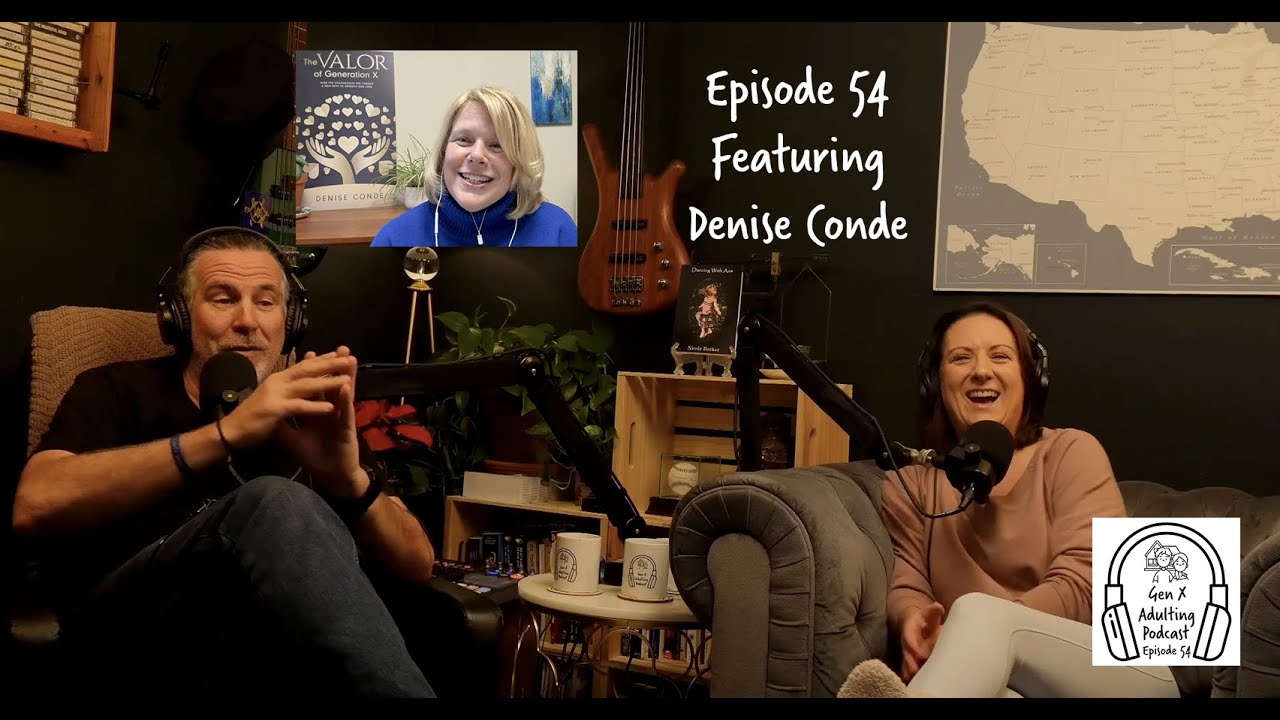
In Episode 54 of the GenX Speaks Series, Denise Conde discusses her experiences growing up as a member of Generation X, detailing her challenging childhood marked by family dysfunction and abuse. She reflects on her journey to adulthood, her career as a teacher, and the importance of breaking generational trauma while raising her own children.
[Music] Welcome to Gen X Adulting and today we have Denise Conde, the author of The Valor of Generation X with us. Welcome, Denise. Thank you. Thank you for having me. We're so thrilled to have you. Our first question is always what year were you born? 1972. Okay, so you are Gen X. 100%. Nice. Nice. And where were you born? I was born in Buffalo, New York. Nice. And we have a lot of Buffalo fans as listeners, so they'll love to hear that. Were your parents from Buffalo? My father was, my mother was not. My mom was from Florida. She was a Navy, Navy brat, so to speak. She's traveled all over, but they, they traveled back this way where my father's family was from. Okay, so were your grand, your paternal grandparents from Buffalo? No. Well, yes, they were. But their parents were from like Germany and across Europe. Okay, so your grandparents were for second generation or first generation? First generation. First generation. And then your dad is second generation? Correct. And in Buffalo, your grandparents settled in Buffalo? Yes. So you were really from Buffalo? Really from Buffalo. I'm actually from a little small suburb called Lackawanna. That's where I was born. And then when I was 18 months old, my father was in the military and he got a job in Youngstown in the village that I currently live in, in my hometown, as to work on a hovercraft, which was to travel from Youngstown across Lake Ontario to Toronto and back and forth. And so he was a mechanic on that because he did a lot of work on hovercrafts and things of that nature in Vietnam. And so it was the perfect fit for him. And so when we moved, so then he moved our family to Youngstown, New York, which is where I currently reside.
things of that nature in Vietnam. And so it was the perfect fit for him. And so when we moved, so then he moved our family to Youngstown, New York, which is where I currently reside. So what branch of the military was he? Navy. Okay. So, okay. So he's from Buffalo. He grew up in Buffalo. And then he didn't go to college. He went into the Navy after high school? Correct. And he was stationed in San Diego. And so that's where he met my mother. My mother was living in San Diego. My grandfather was on my mom's side, was in the Navy, and that's where they met. Okay. So your dad was in the Navy. Your mom, as you said, was a Navy brat. So her dad was in the Navy. Do you know how they met in San Diego? They met. I don't know exactly how they met. I think it was on the beach. Oh, cool. Oh, wait a second. I do know. So my father and a bunch of his buddies had a place on the beach. In some little small town, I can't remember the name of it right now, but right near San Diego, in the Navy base and everything there, and they were always having a lot of parties on the beach. And my mother and her girlfriends, my mom was 16 in high school. My father was 19. And they met. My mother got pregnant. She was 16 when she got pregnant. And their parents made them get married. My father left for Vietnam during my mother's pregnancy. She turned 17 with my oldest sister. And my father went off to Vietnam for a year and came back when my sister was born. So she was a year old before he was the first time that he saw her when she was a year old. So were they married? So they got married before he left. And then when he came back, was she still in San Diego? She was. Yes. And then he got stationed in New Jersey. And so
year old. So were they married? So they got married before he left. And then when he came back, was she still in San Diego? She was. Yes. And then he got stationed in New Jersey. And so they moved with my sister from San Diego to New Jersey. And then my father wanted out of the Navy and he wanted to be closer to family. And then they came back to Buffalo. And then when they were here, he was looking for jobs and so on and so forth. And then he had, you know, my sister was already born. There's I have a middle sister. And so then by the time I was born, like he had jobs. And I mean, back then, like, you know, everybody was getting laid off. They were getting hired. Then they were getting laid off. I mean, like everybody was struggling financially. So this seemed like the dream job for my father. And so that's when my family moved here to where I am now. But like literally a year and a half, I think they were here. And the hovercraft like something horrific happened. And the bit like they never were able to repair it. And it went like out of business and he was stuck driving. But he loved it here so much for like where we were living and the neighborhood and the schools and everything for the kit for us. And so they didn't want to go back to Buffalo. And so they my father ended up like working in Buffalo. And then he had enough of that because he continually just got laid off. It was like the way that things were like Bethlehem Steel was a big deal here. Ford plant. And he was a mechanic. He was mechanically inclined. So he did a ton of work in construction. And then he just ended up opening his own construction company. And he stayed local to this area in Niagara County. Just because I'm sure Brian knows,
So he did a ton of work in construction. And then he just ended up opening his own construction company. And he stayed local to this area in Niagara County. Just because I'm sure Brian knows, but I don't. When you're saying hovercraft, what do you, is it like a ship? It's like a boat on like pontoons kind of like are blown up like around the boat. And it's got the fan on the back to push it. Okay. Okay. All right. Kind of like kind of what I was picturing. Yeah. Okay. So kind of like we have airboats down here. So that kind of fan, right? That would be pushing the airboats. Yeah. But you have to picture like an inflated base with then, you know, like an inflated bottom, like a big tire tube almost. And so, but that wasn't through the milk, the Navy, right? That was a private company. And so something happened where there was a hole in it and people were able to get rescued off of it that were traveling back and forth. It was kind of like a fairy, but it was a hovercraft. But that wasn't his job. So it was like a fairy. It was kind of the concept of a fairy that would transfer people from your area into Canada, right? Correct. Yes, exactly. Was he was the one of the mechanics to take care of that hovercraft? Correct. Okay. Okay. And so when it, when it sunk, then that job was done. Correct. Okay. And then he went through and then he settled and he started his own construction company. That's probably big news back then. Yeah, right. The hovercraft sunk and we're out of business. Yeah. Well, I mean, I was like two. So you're older sisters born in San Diego. Your middle sister, I assume is born in New Jersey. No, she was born here. Okay. So they got a pair of. Same as me where her and I are only 18 months apart. Okay. And
sisters born in San Diego. Your middle sister, I assume is born in New Jersey. No, she was born here. Okay. So they got a pair of. Same as me where her and I are only 18 months apart. Okay. And then you were born. So are there three of you? Yes. Okay. And so, and then you guys, was your mama stay at home mom? She was until I was about, I don't know, 10, 8, 9, 10. And she started working for Niagara Mohawk, which now is National Grid, which is the power company in this area. And so she worked for them. So, yeah. So then after that, after my mom went to work, like, you know, it was youth gone wild. Like we all, like it was on. We were all just doing our own things. When your mom went back to work, when you were like around 10, your older sisters would have been what, 11 and then 13, if I'm doing the math. Yeah. Yeah. So if I was 10, my oldest sister, she is six years older than me. So she was 16. She's 16. And then my other sister's just a year, you know, depending on the month. So did you, and you're the one that you're close in age with, did you guys go to daycare? Was your older sister in charge of taking care of you guys? Well, my mom was home when we were little, little, little, and then we went and then we start, no, we never went to daycare. You'd been like, that's what I mean. When your mom went to work and she was 10, did you become a latchkey? No, like I didn't go to afterschool programs or I, but yeah, latchkey, like, I mean, I let myself in and back and forth. Yeah. Yeah. Of course. I also, you know, it's funny because my, my sibling is closest to me and age. Her and I, she's deaf. So she went to St. Mary's school for the deaf in Buffalo. So like there, there was that huge age gap
funny because my, my sibling is closest to me and age. Her and I, she's deaf. So she went to St. Mary's school for the deaf in Buffalo. So like there, there was that huge age gap between myself and my, my older sister. And then I was like, oh, I'm not going to do that. And then the sister that I was closest in age to, because she was deaf, she, she traveled to go to school. So, and she was allowed to sleep there in Buffalo during the week. And even when they, she became a certain age, like she rarely came home on the weekends or her friends were over would come because most of her friends were in Buffalo or like the outlying areas of Buffalo. So there was a lot of time where it was, it was just me. Like I come home and my, my sister at 18, she went into the military. So as I aged and my other sister was at school in Buffalo. So I literally was letting myself in and out and of the house. It was funny because I would often miss the bus because I would have to get myself up dressed and you know, fed and get on the bus and I missed the bus. And there was a lot. And there was like a neighboring mom that like I played soccer with her daughters. And she was like the only mom in the area that was home. And so I went during the day or in the morning, like all parents were gone, right? So I would call her. And so she kind of her and I kind of kept it a secret because, you know, she didn't want me to get in trouble for, for, for missing the bus. So she was like a secondary mom to me. And it was, it was really funny too. That is amazing. So did your mom ever find out? Yeah, they eventually found out, but I was older. I think I was like 12 by that time. And my parents were like, what? You know, what were
funny too. That is amazing. So did your mom ever find out? Yeah, they eventually found out, but I was older. I think I was like 12 by that time. And my parents were like, what? You know, what were you doing? Were they upset or were they happy that she had helped you or were they more upset with you? I think they were pretty embarrassed, to be honest. I think they were upset. They were not happy about it, which, you know, my, my dad was oftentimes home asleep. And I, I'd have to get myself up and whatever. And it was like, so to tell him, I would have gotten my ass kicked. Like, you know what I mean? So, so I had to find somebody else that was going in another safe adult that was going to hook me up and get me. You missed the bus and it was better to go down the road to the neighbor than to stick around and tell your dad, I need a ride to school or whatever. Yeah. So I mean, I was, I left alone a lot because of the, like, yes, I had siblings, but because they each difference, my sister being deaf, I was, I was 100% like a ski kid. I mean, my, my diet when I came home from school was pickles and freezy pops. Yeah, that sounds about right. That sounds about right. And your sister was almost like in a boarding situation where she was sleeping in. So you said your dad was asleep. So did his, was his hours where he was still at home. Like you said he was asleep and you were getting out for school. So he wasn't up and heading out to work at that same time. Well, he worked for himself and he also like, um, so he could make his own hours and he, as a Vietnam veteran, I mean, he had a lot of mental health issues. So, you know, you didn't know what you were going to get if you interacted with him. Uh, you know, when you were
he, as a Vietnam veteran, I mean, he had a lot of mental health issues. So, you know, you didn't know what you were going to get if you interacted with him. Uh, you know, when you were supposed to be getting yourself on the bus at eight, nine, 10 years old, which is ridiculous, right? All in itself. But, um, you know, it, so yeah, I mean, he would be home. My father had this like thing where he would just, he wouldn't leave the house. Like you wouldn't, and you were like scared to come home. You know what I mean? Like you didn't know what you were going to get. It was very explosive. Um, he'd be very kind and loving, but, um, you know, it was, it was a difficult. I had a difficult childhood. There's no question about it. Um, you know, which I also write about, um, a bunch in my book, um, about my dad. Um, I loved my dad. Um, but he did have a lot of mental health issues. So, so you were walking on eggshells probably for most of your childhood. Oh, absolutely. I mean, I lived in a very explosive home. Like my parents were constantly fighting and you know, I don't mean this like screaming and yelling. I mean, like shipping thrown across the house, like banging, yelling, you know, I would be sitting down and I would be woken up when I was little girl down. And I hit up like a, like, where we lived our house. Um, it was like considered the basement, but it wasn't, it was like a third story. It was the basement, but it had windows and like a door and a walkout to it. And, um, and then the second like main street level. And then there was a third story. So my sister and I, our bedrooms, the sister and I, that where I was closest and age to, we were in the basement level of the home. And so, you
level. And then there was a third story. So my sister and I, our bedrooms, the sister and I, that where I was closest and age to, we were in the basement level of the home. And so, you know, shit would all of a sudden, shit would break loose and, uh, you know, and it was like, oh my God, what is going on? And she's deaf. So she couldn't hear any of that. So I would wake her up because I'm younger and I'm scared. And I'm telling her like, what's going on? And, um, and signing to her. I learned sign language in the dark. I learned sign language. We learned to communicate like hand over hand, like signing so that we could communicate what was going on in our home when we were young. Oh, wow. Not even, I can't sign, but you're touching her hands doing this. The concept of Helen Keller, how Helen Keller learned. Yeah. Yeah. So, so like during the day, like the ABC, D E F. And so we would, um, like, I knew that part of it. And so then when we were like, in like, it all hell broke loose and I would wake her up. Um, she would, we would communicate in the dark. So I would be signing to her letters and I was like, we would feel each other's hands. We would go like that. Okay. I got it. Then like spelling the next word. And you would think of be fingerspelling on each other's hands, basically. Correct. Wow. That is, that is such a unique, traumatic experience. Right. It's, I think about that. Like, holy shit. Yeah. It's experiencing trauma in silence, but while you're communicating with each other. Well, right. I'm hearing it. She's not, I'm communicating to her what's going on. And, um, you know, and a lot of times my oldest sister, um, when she lived at home would be involved in it. Um, whether it was, you know, she had
not, I'm communicating to her what's going on. And, um, you know, and a lot of times my oldest sister, um, when she lived at home would be involved in it. Um, whether it was, you know, she had come home late or, you know, there was an argument that she was, you know, there was an argument between my parents that she got in between. So there, there was me and my, um, my, my closer sister that was to age, my deaf sister. We, um, her and I were, um, be listening to all hellbreak loops. So it was, it was really difficult. So then my oldest sister left, she ran away. She was like her senior year. She graduated from high school. She was like, I'm out of here. She moved in with close family friends. And then the two of them, her and her best friend joined the military, which was like, my father didn't want her to do that. And, um, she was like, whatever, fuck you. Like I'm doing whatever I want with my life. And so then my sister, then closest and age with as we were aging, she then was more involved. Like, you know, when you start joining sports and everything, you're after school. Once she became like 12 around that age, 12, 13, she was staying at school like consistently. So then I was home by myself the majority of that time until she graduated from high school. And then she went to Gallaudet University in Washington, DC. So is that a school for the deaf? Mm hmm. It's a deaf university in DC. Okay. So do you feel in a weird way you can relate to being an only child in the way, like you had some liens, but do you feel that you probably also had a lot of only child experiences growing up? I do. And I, you know, I talk about this, this part in my book about, you know, families and getting different versions of our parents as kids,
also had a lot of only child experiences growing up? I do. And I, you know, I talk about this, this part in my book about, you know, families and getting different versions of our parents as kids, you know, especially when you're talking with your siblings about your, your experiences growing up from your childhood. And, you know, it's like, well, you're a spoiled brat. You know, my sister, my oldest sister would say to me and I'm like, I, you know, like, I didn't choose this, like, I didn't choose where, you know, to be in this order of birth. And, you know, because I did get better versions of my parents. In some ways, they were very supportive when it came to sports, my friendships, boyfriends were like, that was not the case for my oldest sister. Like, I mean, anybody that my sister brought home, whether it was a friend or a boyfriend, they were fucking losers. Like, that's what my father would say to her, where my parents opened the doors more to my, they learned, right? They learned from their experience. And you have that one child that's, excuse me, off and running. She's gone. She's in the military. She doesn't have anything to do with you. And you have another child at home, and you have the one that's up in Buffalo all the time. So they were split in a lot of different ways. When it came to me and my closest sibling, because we were both very active in sports. We ran track, we played soccer, both of us. She didn't really play soccer like I did. But I mean, my father traveled with me all over the place with soccer. Like my sister, my oldest sister didn't get that experience. So I was close to my dad, but at the same time, he was very controlling. He was extremely violent. I mean, if I screwed up,
soccer. Like my sister, my oldest sister didn't get that experience. So I was close to my dad, but at the same time, he was very controlling. He was extremely violent. I mean, if I screwed up, like, I got it. Like, you know, I got hit by the belt. Like, I can't even tell you the tape. So was that his form of physical punishment? Was it always the belt or were there slaps across the face and that type of stuff? Yeah, yeah. Slaps across the face. And I mean, you know, like I would I was like constantly running for my parents. And but at the same time, like, and I think it's such a generational thing, too, for many Gen Xers, like the parents never really looked at themselves in what was causing their kid to never want to come home or to stay out all night and pass curfew. Well, it's because I was scared to death to come home late or, you know, for any reason, get the shit kicked out of you. And so, you know, and then be grounded for weeks on end. I mean, I think my longest grounding was like 10 weeks, literally. And and at that time, like my sister, my my I think I was like in my sophomore year of high school. So my oldest sister was gone. She was in the military. I think she might have even been married by then. And my the sibling that's closest to me was like never around. And the worst thing that a parent could possibly do to a Gen X kid is to take away their music. Right. He literally came into my because I would be grounded in like whatever I and especially because we snuck in and out of the house and I had my own door. I had my own door where I would come and go anyway. So they would go to bed and I would just like walk out the door and I had to climb over this fence to get out of the yard because it was like a
where I would come and go anyway. So they would go to bed and I would just like walk out the door and I had to climb over this fence to get out of the yard because it was like a lower level. But I did. You know, so I was just living my life normally until my father realized where to really hurt me, which was to take away all of my music. And that was torture. Like, I mean, I literally went to school, came home and went to my bedroom. Like the idea was to just study. And it was, you know, I had gotten. I was like failing like everything I had like C's and D's and F's and maybe one B in gym. You know, understandable considering what was going on in the home, because not only were you experiencing physical abuse, but I'm assuming you were experiencing severe emotional abuse as well from your father. I mean, it's almost God, what a weird because my dad wasn't in my life consistently, but I would think so. And to me, I had an absent father. But in a way, the situation you were in is you had a father that was there, but an absent father, like he didn't give you anything you needed as a as a young girl that a girl needs from her father. So he's there. The shell of him is there. You're just getting all the abuse from him and not the things you should be getting from your father. So there has. So it almost makes me wonder for children in that situation, do they still experience an abandonment complex because 100 percent you have the parent there because I had severe abandonment issues severe. Well, because I didn't have a father, right. But you did. But you still didn't. So there has been an imminent issues there, right? Oh, of course. Of course. I mean, you know, it's funny. And of course, all Gen X, we all joke
But you did. But you still didn't. So there has been an imminent issues there, right? Oh, of course. Of course. I mean, you know, it's funny. And of course, all Gen X, we all joke about our our issues, right? Because it just makes it easier to deal with, I guess, the sarcasm and humor. And, you know, I was saying to my husband, I couldn't find him. I we were at a social gathering. I couldn't find him for like, I don't know, 10 minutes. And all of a sudden I was like in this this like, oh, my God, where is he? And I found him and I'm like, God, there goes my abandonment issue showing up. I like, you know, it's like like, did you leave me here? No, of course not. Like, you know how we can get so far in our lives and and really acknowledge every issue we had. We can get deep and get the loaded layers and and heal and and do right by our kids and all that. But there's always that one those demons are there that always that one thing that can bring us right back for that moment. But what's so great is you recognized it. You're like, yeah, you knew right. You know, you're like, oh, there it is. You know, there it is. There is. There's me freaking out for no reason. Like, are you serious? And he's like, get a grip. So wait. So that was your situation with your dad. Did your mom counter it with warmth and support and everything you would need from a mother? No, my mother was I mean, remember how young my mom was. My mom was a kid herself when when as far as I'm concerned, I mean, you know, I'm not defending her actions by any means. But I mean, when you look at you, look at how young my parents actually were, too. Not excusing not any of that. But my mom just kind of mirrored it. I mean, my mother was by the
any means. But I mean, when you look at you, look at how young my parents actually were, too. Not excusing not any of that. But my mom just kind of mirrored it. I mean, my mother was by the time I was 16, you know, 17, 18, I had a car and I was leaving and doing whatever I wanted. You know, when I come home and I get the shit kicked out of me, my mother would tell me I deserved it. So, you know, and I mean, it thinks it just like escalated and got worse and worse. Like, as I aged, you know, I was it was to the point where I would just like go out drinking with my friends and I want to come home for a week because I knew that if I went home, what would happen? I wouldn't be protected. I would get the shit kicked out of me. And none of my siblings were home at that point. I was by myself. They no longer lived with my parents. So it was just me for a long time at, you know, into my 20s and trying to go to college. You know, I knew that I always wanted to be a teacher, but I also was always running, always running for safety, always trying to find safety, always, always drinking, always partying, coping with the fact that I don't really truly have anywhere safe to live. And so I how old was I? I think I was I failed out of college. My. So I went to a community college in the area for the first year and I was living at home and the the abuse just continued. It was worse. And, you know, and I would fight back. But, you know, I think it was not until I was like 20, 21, 22 years old, because I would leave like I would go stay with friends and then I would come back. I would leave. I would come in. You know what I mean? Like that domestic abuse kind of thing where you would it takes how many times before a woman would
with friends and then I would come back. I would leave. I would come in. You know what I mean? Like that domestic abuse kind of thing where you would it takes how many times before a woman would actually leave the situation constantly coming back because I didn't have what I wanted was a stable place where I could thrive in. So I could go to college on a consistent basis. And so I had the opportunity to go to a community college up in the Adirondacks here in New York. And I took it and I went and I had a fairly successful year. I think I'm skipping around here, though. So I went to community college and I got into a state college, Buffalo State College here in Buffalo. My first semester there living alone, I on my own, I should say, I failed out. I partied. I like stopped going to classes. Of course, I self-sabotage. I didn't know how to live on my own successfully. And yeah, tanked. And then my father wanted to know like my grades and whatever and my boyfriend at the time and I made up a fake report card. And when computers just like came out, you know, and like the printers with like the little thing that you had to peel off on the side. We generated a fake report card. Then he happened to know somebody in one of the offices, like the enrollment office or something like that. And he was able to get my grades. Oh, my gosh. So I have a question going back a little bit. You had mentioned, you know, you would leave for like a week, then come back. And then, you know, and how women, it takes multiple tries to leave a situation. Right. And I have a question that goes back to my college days. I volunteered in a center for, you know, think technically is better and abused women and their children. It's like a
situation. Right. And I have a question that goes back to my college days. I volunteered in a center for, you know, think technically is better and abused women and their children. It's like a counselor for the kids. And I never could rationalize or come to grips with why they would come back. And they told me this is going to happen. So, you know, women are going to they're going to show up and then they're going to go back to their situation. And it's going to repeat itself and they're going to come back. And I could never I never got it. And I never knew anyone to ask. And you might be the first. Why is that? What's the dynamic there that that has has women going back to the I just I just think it's kind of like a stock homie kind of thing. You know what I mean? Where you just hope and pray that things are going to be better, that things are going to somehow be different, that the that, you know, your parents or, you know, for that situation, the spouse is going to make the changes. And, you know, it's a complete trauma bond. You know, you don't you don't realize, I mean, at the back then, too, like, well, I had no idea why I was continuing to go back. I just wanted things to be different. But now, in hindsight, it's like, well, it's just glaring that, you know, I just wanted to be loved unconditionally. And I didn't want somebody kick the shit out of me, but like I always, you know, and I didn't have the means, you know, I just feel like you're always better. I know I did. I felt like I was better when, like, as far as like going out and drinking and partying and having a regular routine and structure, I felt like I was that my parents kind of helped me with that. Although the second that, like, there was a
like going out and drinking and partying and having a regular routine and structure, I felt like I was that my parents kind of helped me with that. Although the second that, like, there was a conflict or there was an issue, there was a problem, then I'll help broke loose in it became very heightened and violent. I honestly can't remember a time ever having a conversation with either one of my parents without it getting completely violent. So, you know, I hope that answers your question. It does. And I think I have a theory on it, too, though, like I've a psych degree. So I don't practice it by any means, but enough to be dangerous. And there's that concept of intermittent learning is the most powerful learning. And if you do repetition, repetition, you create memory. But if you do something and then you don't do it for a while, then you come back and you do it, that's that intermittent piece. I just wonder, because you had mentioned your sister viewed you as being spoiled and you had mentioned that you're you and your dad. It sounds like you spent some time on the sports front with, you know, he was there watching games or practices, whatever. So you've got little nuggets of peace and love, acceptance, probably. And then and then all hell breaks loose. I wouldn't do what he wanted me to do. Right. Yeah. Yeah. It's powerful. And I, you know, it took me the dynamics in my family. I really didn't it wasn't able to come to terms with them until I was forty seven, forty four for around there, you know. And at that point, like, you know, here here I am now, I have my own children. I'm in my second marriage. I have a blended family. And it's just crazy that because I had gone no contact
And at that point, like, you know, here here I am now, I have my own children. I'm in my second marriage. I have a blended family. And it's just crazy that because I had gone no contact from my family multiple times, from the time I was in my early 20s. And then once again, like once I started having my daughters, when they were very young, I went no contact. And then again, I and so it's like this keep going back. Right. Like you keep going back into this dysfunctional family in hopes that people are going to mature, that people are going to change, that people are going to make right by you. And and I also the thing is that I think that women in situations like like these, they don't realize how horribly traumatized they are. And and until they start talking about or somebody actually starts pointing it out like and how it's affecting your body, your nervous system, your brain, the, you know, the severity of it. I mean, especially like, you know, back when we're talking when I was 18 years old, I mean, we were all so young and nobody was going to get mental health treatments or anything like that. You were just told you're fucking crazy. Get over it. Like you put up with this shit. This is the way your parents are like they're good people. What's wrong with you? You know, my father and mother both were very involved in the community that I currently live in. My dad was a soccer coach. Like my mom was like on the board of the soccer, the soccer tournament things and whatever. I mean, they were they were very involved publicly. So to, you know, be able to tell people, you know, that this is what's going on behind closed doors. Only my closest dearest friends knew it and they knew it because they'd have to
publicly. So to, you know, be able to tell people, you know, that this is what's going on behind closed doors. Only my closest dearest friends knew it and they knew it because they'd have to pick me up when I left the house. And, you know, thankfully I had my girlfriends look very close to me. And so I was able to walk to their houses and I walk in, you know, crying, you know, upset after being thrown up against the wall and up by my neck. My necklace is broken and I'm like disheveled and I'm a mess and I'm walking and bawling and, you know, and they're. But even the parents during that time, like my best friend's parents were in domestic abuse situations because kids don't they're they attract. You know, vibrationally, you attract and trauma bond to kids that are going through the exact same thing as you are. Yeah. Yeah. And so that's why it's so hard to to get out of it because it's so normalized. You everybody's going through it while everybody's going through everybody's dad kicks the shit out of them. Their mom's quiet and the mom says or the mom kicks the shit out of you to and or the mom says that you deserve it. This is this is what's going on in all of the homes of all of the girls that I was very close with. And my dad was also an alcoholic until I was he quit drinking, I think around the age of eight. But he still had a lot of violent tendencies like the drinking went away, but the violence didn't end that. So does that make sense how I said that? It does. I was just I was just thinking that the thing about as far as like women going back to abusive situations, they leave and then go back. Sometimes if you're in an abusive situation and for you, this is from basically birth and your
about as far as like women going back to abusive situations, they leave and then go back. Sometimes if you're in an abusive situation and for you, this is from basically birth and your entire childhood. So it's all you knew, right? It's the foundation as chaotic and traumatic as it was. It was the foundation of your entire existence. And sometimes something different than that can feel more traumatic than the comfort. You know, this monster, this monster you're familiar with. You know what to expect. You know the rules. You know what hoops you have to jump through and you know what the final result will be when you break the rules. But it's known that you don't know. And that might be more healthy and that might get you out of this situation. But it's such a huge unknown and it's so opposite of what you know that it's scarier sometimes to follow that healthy path than to just say where you are. So just to go off of what you're saying is build off of that. Let's talk about the nervous system and cortisol cortisol levels. So I'm raised and raised in this environment through my entire life. Right. So where do you think my cortisol levels were all the time. And so you took me out of that situation and my cortisol levels started to drop. And all of a sudden my nervous system is going what the fuck. This isn't where I'm used to living. I don't know how to survive like this. So guess what I'm going to do. I'm going to create some chaos in your life for you because I need to feel comfortable. I need to feel up here because that's the way your your your body is wired. Like everything your nervous system is wired for it and you're addicted to the cortisol levels. Your body your own body is and you're killing yourself. You
your your your body is wired. Like everything your nervous system is wired for it and you're addicted to the cortisol levels. Your body your own body is and you're killing yourself. You don't even realize that. But I think that's another reason from the nervous system standpoint. When you talk about women in situations like this that continue to go back to because in some weird way the body actually craves it. And which is out of your control. You know, I mean, to a certain extent, to a certain extent. You know what I mean? Like you it's physiological. It's so physiological. Yeah. It's it's how an answer and subconscious so much as in deep in the subconscious. And that all works together. And I mean, my God, you are hardwired. I mean, your entire system. It's not even like you were you married into an abusive situation in your 20s. But before that, things were fine. This is your entire existence and essence. Right. Yes. Yes. So it's it's only been six years since I've been no contact from my my mother and my sisters. And so I'm 53 now. And so I was 47 when I went no contact. And and I mean, there was this huge event with my mother that like was orchestrated. So now my mother starts. We get we go to track all the way forward. Right. Until just how was I when my father passed away when I was 42. Wait, I'm 53. It's two thousand. Yeah. If I was 43 because it's been 10 years. So he he passes away. And I mean, it's like there's the yin to the yang of the relationship because my father was more of a peacekeeper. Then I realized when it came to my mother, which was really bizarre. Right. Because and she was constantly triangulating me and my mother. And she was always triangulating me and my sisters against each other.
when it came to my mother, which was really bizarre. Right. Because and she was constantly triangulating me and my mother. And she was always triangulating me and my sisters against each other. And talking about us behind our backs, she'd come to my house. She talked shit about my sisters and vice versa. And she she was always the hero in the situations between all of us. And she'd always tell us how fucked up my sisters are and how fucked I am to my sisters. And so there was that that like underlying pattern that was constantly there that even in my 30s, I was my first daughter. And I mean, I brought to my sister's attention because there was this constant enmeshment. There was this thing like if there was an issue within the family between two people, it was everyone. It was all five of us. And my father always would call and say, you know, your sister, you shouldn't have said that. And blah, blah, blah, blah. And our parents were always involved in my relationships with my sisters. And I mean, I learned at a very young age that I couldn't rely on my sisters because they would betray me. They would tell my parents anything that I said, anything that I did about, you know, and I would do the same. So there was this constant. Was that always like from the start when you were young, like like when you were signing in the dark to your sister, even then you didn't have full trust in her. I didn't with her. Her and I were very, very close all the way up to. I mean, we were always close. She was always she was very protective of me because I was younger than her and I have her because of her disability. So we always were. We were very close. But that broke when my father passed away because my mother, her triangulation
because I was younger than her and I have her because of her disability. So we always were. We were very close. But that broke when my father passed away because my mother, her triangulation took over like. I mean, she was just tell tell lies and say things that were completely untrue or exaggerations about me. So from the time of childhood, you and that sister were tight and you could trust her. And she's got you. Yeah. Take the older sister out of this. So you were like that until you were 43. Your dad passes away and your mom's narcissism, I think, is what we're talking about here. A hundred percent. You're not saying something. Yeah, I know you gently were like, I think that was sweet of you, but I know it comes in to fuck shit up. Oh, big time that she broke that that relationship between you and your sister. I don't know if she broke it. Yeah, I would say at the end she broke it because she was lying so horribly about me about the things that I was doing things in relation to my own daughters. She she just she painted this picture like I was this raving lunatic alcoholic. And and yeah, I had issues with alcohol. There's no question about it. And my cat might count like, I mean, hello. We did a whole episode, Brian, I on it of our own. We had, you know, I think it was one of our coping mechanisms and it doesn't mean we were all raging alcoholics, but we might have all had a couple glasses of wine or a martini each night for quite a while because of all the shit. So a lot of us were functioning or are functioning alcoholics because of what we've gone through. Correct. So, you know, and it's funny because I went into I went specifically into counseling with a drug and alcohol counselor because
alcoholics because of what we've gone through. Correct. So, you know, and it's funny because I went into I went specifically into counseling with a drug and alcohol counselor because she was making all these accusations. She was like, you're an alcoholic, you're abusive to your children, you're false allegations. And she called CPS on me. And this was like when I started calling her out. I started calling her out and asking for better treatment. I like because she would come to my house whenever she wanted. She was like flirting with my husband. It was really bizarre. Some of like to think like he was trimming our house. He does custom woodworking. He's very talented. And so he was like trimming our house. We had remodeled and she like walked by it and she like did this thing where she ran her hand down and she was like, oh my God, oh my God, it's just so beautiful. And she like turns and looks at him and I'm like, no, like what is happening here? Am I seeing what I think I'm seeing? And so then when I so then she was like his best friend and so she inflated his ego. You know what I mean? Like she made him feel like he was the most special person in the room while belittling me. And so I had these conversations with her. I went to talk to her one on one at her house and brought up the situation and said, you know, I'm feeling like you only take Michael side during conversations that you're only saying these certain things that you're treating me this way. And she sat back and she crossed her arms and she looked at me and she said, you're jealous of the relationship I have with Michael. Insane. I mean, but this is like narcissism 101, right? Oh, 100%. So then I start saying things I have
looked at me and she said, you're jealous of the relationship I have with Michael. Insane. I mean, but this is like narcissism 101, right? Oh, 100%. So then I start saying things I have seen for better treatment. Okay, fine. Okay, fine. I can do that. So then she, she starts texting before she comes over like two seconds before, you know what I mean? But she's just sucking all the room out of the all the air out of the room and saying little things to me telling, you know, I've at this point in my career, I've been a special ed teacher for 20 years and she starts telling my daughters that were complaining about teachers the way that they're teaching, you know, kids all kid, they all complain. They all complain, which is perfectly normal. And then she's so she starts telling my kids what the best way to for a teacher to teach is. And she does these little things, you know, where she's just like planting these little things to wait to see how I react or respond to her. Well, meanwhile, of course, she's over and there's about a line over here and glug glug glug glug glug glug glug, waiting, looking for the time waiting for this visit to end. So I understand how I look like an alcoholic to her. Right, right. But you're just coping. I'm coping. Yes, she was jealous. She was in competition with you and your sisters right from the start. I mean, we're talking. We're talking probably when a mother is a narcissist to that degree, their biggest enemy is usually their daughter. And so it's one of the reasons it makes sense. She didn't defend you when your father was abusing you because she she she they don't have empathy for their daughters. They have no empathy. And I know it's hard for people to understand that don't know people
when your father was abusing you because she she she they don't have empathy for their daughters. They have no empathy. And I know it's hard for people to understand that don't know people like this. But when you've known people like this, it's it's almost sociopathic, I call it because they really don't have empathy and unconditional love in any form for their children, but especially their daughters, their daughters are competition. And then they play the little games of pitting their daughters, their sisters against each other. And they want to be the hero. It's all a game, right? Because narcissists get off on that hit of reaction. They want that reaction. The best thing you can do to a narcissist is no reaction. It's not 100 percent. 100 percent. So that's why I started gray rocking. Right. At that point, I'm gray rocking. I wasn't even conscious I was gray rocking. Well, you know, the bottle of Riesling Relax wine is going down and I'm waiting for her to leave. And then she hovers. She hovers like she literally would go by my house after she would leave. Like we would move to the back of the house and go have a fire. The kids would be off, you know, at a football game or whatever. But we would move out to the fire until it was pickup time. You know, they got a ride home from somebody else. And it got so bad that she then that that was the straw when. So there was that that one conversation I had with her. And then there was like another blowout. We had gone to New York City for to watch the Macy's Day parade with our kids, with my husband's side of the family. And during that time while I was gone, my mother starts telling my sister, my oldest sister, the golden child, all these horrible things about me
kids, with my husband's side of the family. And during that time while I was gone, my mother starts telling my sister, my oldest sister, the golden child, all these horrible things about me that I'm an alcoholic. I'm abusing my daughters. I had one incident with my daughter, which still to this day, I still grieve, which is was trauma reenactment. I was grabbed by my throat. I can't even tell you how many times when I was growing up and I had a falling. I had an explosive issue, you know, problem with my daughter and my oldest. And I went after her and grabbed her by a throat. Now this had this had now, remember, I'm divorced. So I have my ex answer to my husband has his ex answer to. So there's there's a lot of adults involved in raising our kids. And when this situation went down, having to having the shame around it, having to resolve with my daughter had nothing to do with my mother. It had to do with my ex, my daughter, the kids that were were there, which none of them other none of the other kids were home during that. But of course, they heard about it. So it was it was our immediate family. And so she now two years had passed after that incident. And I still and I still feel so incredibly guilty and shameful for that incident. I know why it happened. Right. But that doesn't make it any better for my daughter. Right. Right. But so she now two years have gone by after that incident. And and I opened up to her vulnerably being a mother to mother like you beat the shit out of me like how many times. And so I'm coming to you full of shame and how to get through this and how to work through this with my own daughter. And she uses it against me two years later. So it tells me that nobody's
And so I'm coming to you full of shame and how to get through this and how to work through this with my own daughter. And she uses it against me two years later. So it tells me that nobody's nobody's there helping out my daughters. She would come in. She would come over when I wasn't there and watch my girls or whatever and like destroy me in front of my daughter's like there's cobwebs over here. There's this and I mean, I don't I don't live in an unclean. I left. I lived in a beautiful house that we were remodeling in a very fluent area. And we were we had three girls. We were outnumbered running to all the sports, three different sports events. You know how it gets the craziness of life. No, my house was not perfect. But it was like and so she would point these things out like we would be we would have breakfast in the morning and go running out the door and she would point these things out. Well, I would never have left these dishes in a sink like this when your mother was a little girl. And I'm like they would tell me so they started telling me the things that she was saying behind my back. So she was started to groom my daughters against me and daughters were were telling you what she was saying. Right. So wasn't was it totally not work. Was it not working because they were coming to you with the information. Right. They did not start. They did not open up to me until I received a CPS call. Oh, my reported against me. And so we had because I'm a mandated reporter. I'm a teacher. I'm a mandated reporter. And so what does a mandated reporter mean? You see something. You have to say something. OK. OK. Legally legally. You and I don't have to. OK. You guys don't have to. You're done. So and so now I have CPS in my life. Which is
mean? You see something. You have to say something. OK. OK. Legally legally. You and I don't have to. OK. You guys don't have to. You're done. So and so now I have CPS in my life. Which is special. Right. You as a man. It's a huge deal. And so I'm freaking out. And so I'm talking to the CPS worker over the phone who tells me what was reported, which was my mother said that I was drinking. I had that it got worse that I was abusing my child and it had gotten worse. This was the thing that echoed in my ears. The last thing that why I knew it was her was because she said for the last four years it had been four years at that point that my father had died. And I was like, oh, so then I said, well, how do we go about this? They said, well, well, you have two options. We can open up the case and investigate and find it either that. And in fact, the allegations are correct or not. Or we could put you we could have a counselor come. And I said, well, let's let's go the counseling route. I was already like on my way into counseling at that point anyways. And and I thought it would be healthy for my daughters and my husband for all of us as a family unit. And so by the end of it, I mean, they were like, yeah, if you get any more false allegations, you just let us know. This is how you you go through it, the process and so on and so forth. But I mean, she looked at allegations. They know. Oh, 100 percent. OK, it's almost a double. What you did was a double hit. And for lack of a better word, it was there's an investigation, but it's being done by the counselor who's embedded inside the family. Exactly. What's going on? Exactly. Somebody there taking notes and whatever. Yeah, that makes sense. Investigation. So
but it's being done by the counselor who's embedded inside the family. Exactly. What's going on? Exactly. Somebody there taking notes and whatever. Yeah, that makes sense. Investigation. So you were cleared. Of course. Yeah. Yeah. Yeah. So I mean, but that's when during the counseling sessions is when it all came out about what she was doing, what she was saying. The girls started opening up more and more and more about what was going on behind my back that I didn't know and how she was trying to turn them against me and the lies that she was telling to to them, which were horrific. And I mean, that like the day that CPS called was my father's birthday. And she she called. So she was trying to like pretend like it wasn't her and still stay in my life. Right. So she makes this call. She sends me a picture of me and myself. I'm sorry, me and myself, my father and myself. And it's just that. Just a picture of my father and I together like and it's just her birthday and it's his birthday. But he's dead. She's like she's sending it like memory, but she also just reported used to CPS. Yeah. On the same day, on the same day. Yeah. So and then she calls to ask to pick up one of my daughters to my youngest, who she was really working hard to groom and to take her to get her nails done, which she was really good at buying them things and getting them to, you know, come with her to do things because especially my youngest who really loved getting your nails done, doing things with with her. Yeah. And my mother would just pick at her to get get information. And then she would twist it into something. It wasn't. She would tell my oldest sister and I get a phone call from my oldest sister or, you know, and
pick at her to get get information. And then she would twist it into something. It wasn't. She would tell my oldest sister and I get a phone call from my oldest sister or, you know, and it was just it was round and round. We went. So it was after that, like that. That was the final break. I was like, that's it. Like, are you kidding me? Like the hell that my family went through also my our access. All of us had to go through for that. I was like, so I my attorney, so I can't I I have an attorney because I'm divorced, you know, involved with the kids and the custody and everything. And I contacted my attorney and he he was like, you need to set some boundaries with this woman. And he's like, are you serious? And like, so he recommended the counselor. He said, this is how we're going to layer this. You're going to get because I was already set up before all of this shit went down. I was already set up to go into counseling with somebody else completely different. And but it had been delayed because somebody in the practice had died or something had happened where they had to take on more clients. And so they pushed me back a month. So this happened. I love how the universe works, right? Like that. I'm already on my way into counseling that how breaks loose. And my attorney is like, you're going into this drug and alcohol counselor right now. I had my blood tested my my urine. All of the results were negative. I get in with my counselor. I'm a frickin mess. I couldn't even talk. Like I was so beside myself. I couldn't even piece all of this together for him. He was just like, I'm going to do this. Yeah, write it down. Like all you do, but it was like the best thing he ever could have said to somebody like
piece all of this together for him. He was just like, I'm going to do this. Yeah, write it down. Like all you do, but it was like the best thing he ever could have said to somebody like me who really enjoys writing. Right. So he's like, take, you're going to go get a journal, go write from your earliest memory of trauma that you, you can remember all the way up until today. And I started laughing. I was like, I want to need more than one journal. And he was like, what? I was like, yeah, I want to do that. And I was like, I'm serious. Like, so he went through all of that. And then at the end of it all, he was just like, you know, and like, like a Goodwill hunting kind of moment. And you just looked at me holding it. And he was just like, you know, you're a good person. Like you, you, I can't believe you've held it together all of this time. The way that things have been. I mean, it's because if you go back to your earliest memory of trauma, it's probably as early as like two or three, if I were to guess, right? I mean, it's that early. Yeah, I, I don't know. I think at what the earliest one in trauma journal sitting right over there, I still have it. I think it was around, I was five. Okay. From my earliest memory, I think I was five years old. So when you think back about the trauma of your childhood and you had two abusive parents, your father is physically and emotionally abusive. Your mom's a narcissist. So severe emotional mental abuse there. Was she ever physically abusive with you? Oh, yeah. All the, I mean, all the time, like, I don't say all the time she wasn't, she was, uh, yeah, she was. Um, and the one, the one of the other things leading up to the going, I started going low contact. When I started,
the time, like, I don't say all the time she wasn't, she was, uh, yeah, she was. Um, and the one, the one of the other things leading up to the going, I started going low contact. When I started, when I was having these conversations with her, when my father passed away, he was buried, um, in Arlington national cemetery in Washington, DC. So we had to go through this process twice. So like he, he died suddenly. Like he was diagnosed with stage four lung cancer and 28 days he died. He's died just gone. That's it. And so, which was all like that whole situation with my mother and my sister. The mass just came right off. Like it was, it was awful. Like while he was dying. Um, and then we go into, um, he, he dies. We, he is held here in, um, the cooler because he, he can't be buried immediately in Arlington. There's a waiting list. Um, and so we had to wait until February. So he passed away at the end of October. We had like a funeral or awake here. And then, um, he was held in the funeral home and then flown his casket to DC. And then we had another ceremony there and there, um, we stayed on a Navy base, um, because everybody's military and my family. And so, um, not everyone, but my mother and my oldest sister are so we can stay. We stayed there and we, the day we buried my father at Arlington, we all, we had like a dinner thing and then, um, we came back to the base and we're all sitting around. Everyone's having, having a drink and I, the, the temperature starts to come up. I start to, uh, you know, I'm starting to feel like, oh shit, all hell's going to break loose. I'm going outside. I'm going to go have a cigarette and go outside and sure enough, my mother physically attacked my, my middle sister.
like, oh shit, all hell's going to break loose. I'm going outside. I'm going to go have a cigarette and go outside and sure enough, my mother physically attacked my, my middle sister. And now thank God, my kids are down the hallway. They're in our room playing. They're old enough to be at that point to be left just down the hallway. And, um, and then my oldest sister comes out and is laughing like, um, I'm just kicked the shit out of, you know, your sister. And I'm like, and I, I remember too, like thinking, like I went in to talk to her after and it was so normalized by all of us to get the shit kicked out. We're grown women with children. Yeah. That's what I was going to ask you is if you come from a childhood of physical abuse, take the emotional mental abuse. Cause I think if there's physical abuse, there's mental and emotional abuse. That just goes without saying, but if you come and you have both parents, typically with a lot of people, it's one parent doing it. You had it from both mother and father. Um, but when someone comes from a childhood of physical abuse and then you become adults, how, how do you align with that? How do you align? It sounds like you were the only one that was looking around saying this isn't normal. This is crazy behavior. But then your sisters and your mom are like, oh, it's just, it's just what we do in our family. It's just how it is. So how does, how, how do you, um, why do you think you're the one that was able to recognize this is not normal behavior? Is it because that you were on a healing journey and you were trying to break the generational trauma and the cycle as a parent, did your children inspire you to, um, to get out of this cycle? And like, why do you think your sister stayed in
and you were trying to break the generational trauma and the cycle as a parent, did your children inspire you to, um, to get out of this cycle? And like, why do you think your sister stayed in this cycle? Well, I'm, I'm the family scapegoat for one. Um, you know, obviously like I, and I just think that there's always that one in the family that looks at is able to pull away far enough from it to become an observer and go, this is fucked up. Like, you know, and then also, you know, being a teacher, working in education and seeing, um, and knowing how to, how people, adults talk to each other on a professional manner, um, how you interact with children, so on and so forth. Um, that, that has a lot to do with it, which, I mean, when I got my bachelor's degree, which took me like eight years because I was constantly running, quitting college, dropping out, partying, living somewhere to be safe, coming back to college. It took me a long time to get my bachelor's degree. And I was the first one in my family. No, I, my sister, I'm closest with, she was the first one. I was the first one to get my master's degree. So, but when you're told like shitty things, like I'm sitting with my, my father, my oldest sister, like, oh, you fucking think you know everything because you have a bachelor's degree now. I think you're better than everybody, don't you? You know, and it's like, so it's, it's that kind of thing when you're, you're in a, a system like an education system where it's drilled into you how to navigate, um, conflicts and to honor kids. And how do we do better as adults? Um, you know, so, and you're constantly learning your in professional development, you're reading novel after novel after novel, you're constantly
And how do we do better as adults? Um, you know, so, and you're constantly learning your in professional development, you're reading novel after novel after novel, you're constantly reading your in professional, you're always learning. So like for me, that became like second nature to me. You know what I mean? So like, I'd see a situation and I'm like, so then I start going down these rabbit holes. So you were able to then really identify what was going on because, because would you say that it clicked like it took you the eight years to get your bachelor's degree because you're, you're, you're coping. So you're, you're coming from such a place of trauma. And then now you're out in the world trying to do things normies do when you're, and remember your gen X too. So you have the gen X level trauma we all, most of us have, right? And that's, that's hard enough. Like we all grind it through just trying to be normal with our normal gen X trauma. You have it like 10 times on top of that, the trauma. So it's no wonder the fact that you even finished college, I think is commendable because you were coping with alcohol, you're coping with drugs, you're coping with self-sabotage, all that stuff. But you get your degree. When did it click for you? Was it when you started teaching and being out in the world and seeing how children are supposed to be treated? Is that when it clicked for you and you were able to identify this shit is fucked up. Or did you start realizing it when you were in college and you were away from your family and you were around other people or were you with people who were also trauma? I think she individuated from the family unit, which gives you perspective. To a certain degree, but not until she went no
you were around other people or were you with people who were also trauma? I think she individuated from the family unit, which gives you perspective. To a certain degree, but not until she went no context, really. Oh, I think, I was going to say earlier, but it's just been flowing. It feels like you set some boundaries with your mom and then she ratcheted it up. And then she called CPS on you, but you tried setting some boundaries and it was like, no, no, honey. And then she went in a little bit harder, it seems like. But I'm curious, when did she have the light bulb moment of? I think there was a slow individuation and they sensed it to your point. Let's let her answer. Yeah, I don't know if there was like one specific, you know, it was like, I just knew when, even before I had kids, I I knew that I didn't want to raise my kids in an environment like I was raised. And when my first marriage started feeling like the environment that I was raised in, I left and was like, this shit is not going to be my story. I'm not, you know, I'm not going to be dependent on, you know, a man. I'm not going to be dependent on anybody, you know, because there's so Gen X too, right? We're all like that. We're like, yeah, you're not going to fucking tell me I'm going to be a mom and do my own thing. But but I just saw like some some of the things and it was both ways. You know what I mean? It wasn't just my ex. It wasn't just me. It was both of us and the the function, this the dysfunction and and just seeing it. I was just like, I don't want I don't want this to be my story. Well, what do I do? I'm thinking and I did a lot of blaming on him at the beginning of the divorce and and I tried to work through things and there were changes for
don't want this to be my story. Well, what do I do? I'm thinking and I did a lot of blaming on him at the beginning of the divorce and and I tried to work through things and there were changes for a certain amount of time. I had my own issues, my own self sabotage, my own infidelity. You know, I had you name it like I was just I was breaking it apart just as much as he was the marriage. So then I get into another relationship and now and I'm and I'm being treated the same way and I'm hearing almost similar things from both of my intimate, you know, partners. And I'm like. And all of a sudden, something starts to click within me like, well, maybe it's not just that maybe it is me. Maybe part of this is me. Maybe I need to go deeper and maybe I need to actually investigate why where these patterns are coming from. Why am I like this? Why do I shut down? Why do I explode? Why do I? Why? Why? Right. So and that's when and my my husband, I'll never forget the moment I talk about it in my book when he just looked at me. And now this is like four years after my father has passed the narcissistic abuse is full throttle. And I mean, I have anxiety through the roof. I am exploding at anything. I, you know, I am so completely dysregulated and living 100 percent in survival mode and through the subconscious. Right. So I was not a good person. I was not somebody fun to be around at all. And so and he's you know, he started calling me out. You know what I mean? Like, I can't deal with this anymore. Like something has to change. And that's when I said, OK, I'm going to go into counseling and, you know, the funny thing. And then now you know what happens like. Right. Right. Right. And now we're dealing with our
And that's when I said, OK, I'm going to go into counseling and, you know, the funny thing. And then now you know what happens like. Right. Right. Right. And now we're dealing with our own issues. His father also had died eight months before my father. So we had two widowed mothers always at our house and trying to set boundaries. Well, we have our three kids and we have our exes and we have jobs and we're trying to keep keep it all together. And it's just like it just kept bringing up everything just was like thrown in my face, like all at once. It was like you're going to deal with this. Like literally God was like, you're going to deal with this. You don't want to go to counseling. You're fine. Signed up for counseling for you. You know what? I'm going to put you there sooner. You need to see this right now. You need to see it. I'm going to give it to you all at once. Like you've got to see it. You've got to get out of this relationship. You've got to get better for your kids and for your your husband and for yourself. So it's amazing. And let's throw in just keep in mind. Perry menopause was probably starting to know 100 percent. And that's and that's not be overstated enough. That is such a huge issue. I'm so glad you brought that up. Yeah, that's such a huge issue because that affects everything. So to me, it sounds like it took most of your life to get there. It took it took most and took until your 40s to to get there where you're like, enough, enough. This is enough. And that you became the person you needed for yourself. You protected yourself. You protected that little girl because now you realize probably no one's no one's going to give me what I've been searching for. My mom is never
yourself. You protected yourself. You protected that little girl because now you realize probably no one's no one's going to give me what I've been searching for. My mom is never going to give me what I need. She's never going to give me what I need. My sisters are never going to give me what I need. It's not coming. I have I have to give it to myself enough of this shit. That's what it sounds like to me. Oh, 100 percent. And I talk about that in my book where I say I needed to get as close to that little girl as possible in order to start the journey. Yeah. So so you're exactly right. And that's exactly what I did. I mean, that it's not this kind of healing, this healing work is not for the week of heart. You know, I'm sorry, I'm getting a little emotional. No, no, no, no. Whenever I talk about getting close to my little girl, I always get emotional because my heart breaks for her. And I wish I could. I'm getting emotional. I wish I could go back and just give her a hug and tell her it's all going to be OK. I promise you, you're going to get everything you want. You just got to get through this. But we grew up not knowing is it ever going to be OK? And I don't know about you, but I had suicidal tendencies. I had suicidal tendencies for sure. Oh, I did. Definitely. So it's I mean, I feel so many of us are true survivors. Like it's legit. We're really survivors. We we could have easily not have made it. Oh, I know. I know. And that's what I thank my counselor for because he really he really brought that to the forefront for me. He was like he was the one that planted the seed, the original seed about writing my story. He was like, Denise, you like considering how successful you are, like your
forefront for me. He was like he was the one that planted the seed, the original seed about writing my story. He was like, Denise, you like considering how successful you are, like your teacher, your you know, you you're married, you have kids like, you know, you have a shit together. Considering all of the shit that you have went through, he's like, girl, like, you really need to like honor yourself. Like it's kind of a big deal. And I was like, you know, and you're like, yeah, well, I feel like for so many of us, especially Genex women, no matter what background we're coming from, we are just now at midlife honoring ourselves. It is not anything we were taught to. In fact, we were taught the opposite. Don't get too big for your britches. Don't do your own home. All that stuff. Do not celebrate yourself. And then we we became the people we we needed for our children and made sure to break that generational cycle and break the trauma. And we're just now to that point. But don't you find and I've said this before, like, I didn't have a blueprint on how to do this. Like sometimes, you know, people have told me you're such a great mother or wife or whatever you hear, like you were just saying your counselor was saying, you know, you look at you, you've done so many things. But it's like I did. I built this myself. I didn't have a blueprint. And so sometimes it's like, be careful because this could all fall apart. I could go back easily. Like this is like something not now. But there were years where I'm like, listen, I'm faking it till I make it because I no one taught me how to do this. And I'm going by instincts and what I wanted growing up. But that damaged person is still here. So that damaged person
faking it till I make it because I no one taught me how to do this. And I'm going by instincts and what I wanted growing up. But that damaged person is still here. So that damaged person could still I can still fall off the the path here. There was always that fear, you know, because it's not guaranteed. Does that make sense? That makes perfect sense. I mean, especially when you when you start understanding your own patterns and even even drill down, like you were saying earlier, like you start drilling down, you get down into, oh, my God, this is why you start realizing. Why, you know, you're where your trauma responses come from and then how toxic your trauma responses are. And then, you know, oh, my God. So and, you know, so when you've lived like that and you think about the brain, you think about the nervous system and the wiring of it all like, you know, we had the cords when we were kids, you know, with the phone and it had that memory in it. Do you know how hard it was to make that cord straighten back out? It's the same thing with your nervous system and the wiring of your brain. So that's why I give myself grace when, you know, if I if I a pattern shows up that I'm not so proud of, I'm like, fuck. But at the same time, I'm like, Grace, give some compassion to self like it's OK. You know, I know where this comes from. It's not an excuse. You know, it's just keep going. Yeah. So I totally get it. It's a great chance to also see how far you've come because I used to have it happen all the time. You know, in our opinion of our marriage, like my whole thing was you're leaving. So I'm going to do everything I can because you just leave to sleep. There's always a strain. So I don't care. I might as well
opinion of our marriage, like my whole thing was you're leaving. So I'm going to do everything I can because you just leave to sleep. There's always a strain. So I don't care. I might as well make it happen that I control over the outcome. Exactly. He talks by you leaving. Yeah. He was like, I'm not I think it took 10 years and I'm not kidding. We've been married 31 years together, 32. And I think the first 10 years of our marriage and we were raising children. And I was still like, any day now he's out. Oh, I know. And that's exactly how it how it's been. It's funny because my husband, my current husband, together, 13 years, we've been married 10. And the same thing. Just go. Yeah. Just go. Like, why are you still here? Why don't you just go? Yeah. Yeah. But so much of it is where our like it was ourselves. And then I mean, again, we're just healing now, really. But then you could be like, OK, you're not leaving. So now I need to figure out how to do this, you know, because this is like so it's so much. That's my point is so for so many of us that are Gen X that didn't have a blueprint, didn't have model behavior. But we know we want to create that so badly for our children. And so we're like, I think we should be so proud of ourselves because we the love we have for our children was so inspiring that it helped us get over our utter fear. Of doing the thing we have no idea how to do. Oh, yeah. And by the way, like if you told anybody that you were going into counseling, they're like, wow, she's really fucked up. Totally. Like now the younger generations have totally, thank God, have changed the perspective on all of it with mental health. But you're right. But you're right. For Gen X. Yeah, that was a
the younger generations have totally, thank God, have changed the perspective on all of it with mental health. But you're right. But you're right. For Gen X. Yeah, that was a weakness. You could not tell somebody that you were seeking counseling, like even like, I don't know, 10 years ago, you couldn't know. And now recently you can like, oh, good, good for you. Like, you know, but that's on the millennials and Gen Z. They have I hand that to them. They have. I agree. 100 percent. I mean, even our 15 year old and he's a boy and he'll be like, I'm feeling anxious. Like he'll say, I'm going to go brush my teeth and I'm feeling it's so natural for him to just talk about his mental health. And it's a beautiful thing. Yes. Thank you, God, that this has changed for these kids. I might forget about it. My 25 and 28 year old talk about it like. Yeah, exactly. I mean, that's something that for sure I've spent a lot of time talking about with my daughters, you know, conflict, conflict resolution, being able to have hard conversations, being open, not being afraid to have conversations, you know, all that stuff. And, you know, I talk about the ego death when you become a parent, too. And because a lot of people have kids for various reasons, but they're always self centered. They're always very ego driven. You know, so what what you dream up of your life and when you're thinking about starting a family and you have this vision, this, you know, magical place that you and your children are going to live in. And, you know, this idea of how it's going to go down and when it doesn't start going that way. And what it really actually looks like, there are requires a lot of you having to put that ego aside and say, what does this
it's going to go down and when it doesn't start going that way. And what it really actually looks like, there are requires a lot of you having to put that ego aside and say, what does this kid need? Who is this person in front of me? And how do I how do I be there for them to help them grow and to develop the way that they should in a healthy way? And I think that, you know, having parents that were completely controlling like mine, a completely violent fucked up situation. I mean, and then being able to look at your own kid and say, that's not gonna be your story. Yeah, and I'm gonna fight like hell to make sure that it's not. Absolutely. Absolutely. And you know what, you just brought up such a great point because because for those of us that didn't come from what we dreamt of wanting for our children, we didn't cut that so opposite of where we came from. It can be very scary when you are working so hard to create this wonderful childhood for them. And when it doesn't go that way, it feels scarier because you're like, no, no, no, because I need it to be this way because I came from here. I needed to stay good. I needed to say it's letting go of that ego, recognizing they're their own person, recognizing you're the parent. This doesn't have to do with you and how you're feeling about your past. You need to honor them and their childhood, their experience. That's a whole process. Yeah, that's fake. That's huge. It is. It's huge. I mean, even especially, you know, nobody tells you what it's like when they get their license and they no longer need you. You know, like nobody prepares you for that. Like, I'm never going to get my oldest. They get, they jump in the car, see you later. And I'm
they get their license and they no longer need you. You know, like nobody prepares you for that. Like, I'm never going to get my oldest. They get, they jump in the car, see you later. And I'm like, what the fuck just happened? What just happened? Did that just happen? And then they're literally gone. And you're like, oh, wow. And that, you know, that slow rolling from the license, but it happened so close. Like you have them, everything, you know, is huge. You know, it's usually, you know, everybody has conflicts. Everybody has problems and issues, parents and children. They do. However, you know, we want to keep them to a minimum through open dialogue and conversations and all of that good stuff. But so like, but from the time they're born until about 15, you know, it's like, okay, you can navigate through the hormones, all that. And then when they get six, for me anyways, this was my experience, 16 years old. And then they get their car, they're gone. And then two years after, and then it's all these last, and they're senior years. And I mean, it hits you so fast in two years, it's not even funny. And then they're off into college or, you know, they've moved out or maybe they're still living with you, whatever the case may be. But you see them less and less and less and less. Yeah, no, it's true. There is, that makes a lot of sense. But there is that from birth to 15 is kind of all similar. And then 15 to 18, it's all ratchet up like that. And then they're gone. It is. And then raising adult children, that's a whole nother phase. You know, it's crazy. But I do want to go back. So it took you the eight years to get your bachelor's degree. How many schools were you at during that time? A lot. Not many
nother phase. You know, it's crazy. But I do want to go back. So it took you the eight years to get your bachelor's degree. How many schools were you at during that time? A lot. Not many actually, wait, let me think. So I was at a community college here locally. Then I went up, then I went to Buff State. I was there, then I left there and went back to the community college. Then I left this area and went up to the Adirondacks to North Country Community College in Saranac Lake, which was beautiful, beautiful place to our beautiful area to be. Although there was a lot of LSD and mushrooms up there during that time period. So that was part of the problems and issues up there. Question for you on that. Was there any therapeutic value in that though? Absolutely. Absolutely. I'm that girl that is still eyeballing wanting to try the ayahuasca. Because I wouldn't do acid. I think it's too... That wasn't necessarily like the best thing for me at that time. I know that in hindsight, right? But as far as mushrooms, plant-based medicines, I'm all for it. I like to maintain a holistic style as much as possible when it comes to clean eating and taking care of your body and those things. Don't tell me. Get me wrong. I still drink and I have fun. I'm not completely straight-edge. But I would definitely partake in some of those plant-based things again. I do feel that it was therapeutic at the time that I really needed to destroy my reality from what I was actually living. Did you happen to... Were you in the Grateful Dead at all during that time? Yeah, very much. Very much. Do you see the tapes above Brian's head? In the corner? Yeah, okay. Okay, so that's a holder that has like 200 bootlegs. She had a ticket.
at all during that time? Yeah, very much. Very much. Do you see the tapes above Brian's head? In the corner? Yeah, okay. Okay, so that's a holder that has like 200 bootlegs. She had a ticket. I was driving up 95 from Jersey to Foxborough and we scored Buffalo tickets. Oh my God. But then we got to Foxborough and traded my Buffalo ticket for a show at Foxborough. And then we didn't wind up going up to Buffalo. And I'd regret it, but here's what it is. I've only seen The Grateful Dead in Buffalo. Isn't that funny? And the last one that I went to, the last show that I went to when Jerry was still alive, if you don't mind me sharing this because it was great. It was perfect for us for our generation. Yeah, we love it. So of course I was like broke, super broke and wanted to go and everybody was going. We were all going and I was like, "Okay, I'm going. So let me figure out how I'm going to do this." So I lived nearby reservation and so went there, bought cigarettes, two cartons of cigarettes, invested my money, went up there, sold cigarettes, $5 a pack. So it's like tripled my money, went and bought my ticket. Then, which is great, right? Like, "Okay, yeah, we're all in, we're all going." Well, there were so many bunk tickets sold and I had one of them. That there were, I don't know how many of us, there were like 200 of us or something in a large number that couldn't get in. And there were people at the gate. So the stadium was surrounded by a big, tall gate while they started banging on the gate. They took down the gate and ran into a concert and I was following behind. And that's how the last show I got into it. That is awesome. That is classic. I love that. I love that. What year was that? Late 80s or
gate and ran into a concert and I was following behind. And that's how the last show I got into it. That is awesome. That is classic. I love that. I love that. What year was that? Late 80s or early 90s? They had to be like 92 maybe. Okay, yeah. That's awesome. I wonder if you have that show on. I'm sure I'm fine. I'm up there. We'll have to look and see. On a side note, have you ever heard of Billy Strings? I don't think so. Who's Billy Strings? Check him out. He's amazing. He's like, he's kind of, Brian gets... Technically he's bluegrass. Bluegrass jam band, but really jam band. Like we've gone, we're addicted now. We're going to see Billy Strings shows like we were dead shows. So he's worth you checking out. Check out Billy Strings. I appreciate the recommendation. Probably St. Augustine, or no, St. Augustine, Tampa, then Savannah, Georgia. But when I tell you it's addicting like the dead, it is. He's amazing. He's the whole parking lot scene. See what? Early 30s, late 20s, early 30s. But he's amazing. Amazing. He does some dead covers sometimes or Jerry cover or Floyd cover. More Dylan covers. Dylan covers. But they're amazing. So definitely check him out. I definitely will. I started following Fish right after. Yeah. Yeah. Yeah. I was on a fish kick for a while for like three, four years. Was it all while you were going for your degree? Oh, yeah. Okay. So where did you eventually graduate from? From Buffalo State. Okay. From the Adirondacks. Did you go back to Buffalo State? I did. And of course I moved back in with my parents. The boyfriend that I had at that time, we had broken up. And so then I called my dad to come and get me. And I was probably at like rock bottom as far as like
back in with my parents. The boyfriend that I had at that time, we had broken up. And so then I called my dad to come and get me. And I was probably at like rock bottom as far as like drugs, alcohol, like so strong out, it wasn't even funny. And came home and then I don't know, like six months to a year later, I got into another relationship with the guy that I married for my first marriage. We moved in together. Real quick though, when your dad came to get you and you moved back home, how long had it been since the last time you had lived at home? Like two years. Okay. So and every time you went back home, was it the same exact patterns with your parents towards you? Yeah. So it was your, you're the problem. You have a drinking problem. You need to follow our routine, our rules. I mean, at this point I was like 21 years old. And I'm like, our car, our rule, our house, our rules, all that shit. And I'm like, like they per curfew. And the same shit just started all over again. Right. So like, you know, it was, well, you don't come home when we want you to, then we're going to bolt lock. You don't, I was only given it, there was two key, two locks, one on the door handle and a bolt lock. And I was only given the key to the bottom, the handle. I was not given a key to the bolt lock. So if I wasn't home and I was 21 years old, if I wasn't home when they wanted me home, they would bolt lock it. So I was bolt locked out of the house. So I knew that, and it would be like two o'clock. Two o'clock was my curfew. And I was like, I mean, I've just been living on my own. Like, I don't, you know what I mean? Yeah. Wait. So they would wait up till two to bolt lock. Yeah, I think so. I don't know. I
was like, I mean, I've just been living on my own. Like, I don't, you know what I mean? Yeah. Wait. So they would wait up till two to bolt lock. Yeah, I think so. I don't know. I don't remember, but I think he did. My father did. He would sleep on the couch. He would wait until he heard me. And, or he would set an alarm. I don't really remember exactly what he said. But yeah, well, if it was reached after two o'clock, I just wouldn't go home. You know, I would just stay with my friends or whatever. I was like, whatever I'm doing that. But it got, you know, it just, it just would escalate again. You know what I mean? It was like, I would get my life back together. I would be on a good path. And then there would be some conflict. Like I stayed out too late or my room was a mess or whatever. Whatever it was that they had an issue with. Like I, and I was going to school to become a teacher. And I mean, my father would screw, you know, because I was out partying on the weekends. He would tell me that, you know, I was never going to be a teacher, that I was a slut, that I was staying out in bars with boys, with guys and this and that. And so, I mean, the final straw when I, he physically attacked me again. But this time I was, I had just gotten out of the shower and I had a robot and I come out of the shower to go to my bedroom. And he started screaming at me about something from downstairs. And I was like, I said something like, fuck you or fuck off or something. You know, I was just like, I'm tired of this shit. And he came storming up the stairs and I had gotten into my bedroom and he grabbed me by my throat, picked me up and threw me onto my bed and my robe opened up. And I was livid. Like that was
storming up the stairs and I had gotten into my bedroom and he grabbed me by my throat, picked me up and threw me onto my bed and my robe opened up. And I was livid. Like that was like, you have now violated me more than you've ever violated me before. And I stood up and I on the bed and I was like, you ever fucking touch me again. I said, I'm calling the police, get the fuck away from me, like right in his face and was like, you know, not even this nice. You know, I was like, yeah, I mean, and and he laughed like a snipe, like, ha ha ha. And like walked out of the door and I was like, that's fucking it. And I packed up my shit and I never left back. And how old were you then? I was 21. Okay, so, so the, but that doesn't mean that I didn't have a relationship with my parents. That means that I didn't live with them anymore. So when he came to get you from the Adirondacks and you went to Buffalo State, were you still living with him? Yeah. Okay. And then when you grabbed muting, you were commuting. And so when you graduated from Buffalo State, were you still living with them? No. So I came back, I got back into Buffalo State. I was living with them for, I don't know, a semester or two. And then I was like, I'm done. And I was dating somebody and this is how it would go. Like I would run to whoever for safety that I was with. And whether the relationship that I was in was healthy or not, I was just running for safety, which I didn't even realize, right? Right. Right. You're just, it's a different home. You just need, literally need to be in a different space for your own safety. And probably those relationships were totally fucked up too. But again, that's how bad it was at home. So when you were going to Buffalo
be in a different space for your own safety. And probably those relationships were totally fucked up too. But again, that's how bad it was at home. So when you were going to Buffalo State and you moved out and you moved in, was that your first husband that you moved in with? Yes. And so how did you meet him? We had worked together. That's how we originally met. We actually went to high school together, which I didn't really know him, like when we were in high school. And, but we worked together was like how I got to know him. And then I'm at a little convenience store here in Youngstown. Okay. So you were working. It was like a grocery store, like a little mini grocery store. And he was the manager and he is a year younger than me. And so we, and then I saw him out one night and we just started talking. And I don't, and then it just kind of went from there. Like we, we all had, we had a bunch of friends in common. And so then we just started hanging out. We started dating. And then there was a period where we broke up, which I probably should have stayed broken up, but didn't, you know what I mean? Went back again. Yeah. Yeah. And then we got back together and then we moved in together. Okay. And then you were commuting to Buffalo state. Correct. Right. Was he also going to school? No, he was, he was working. He was, he works in a trade. Okay. Okay. And then how, how long until from you guys living together, did you get married? Like seven years. Oh, you lived together for seven years and then got married. Yeah. Yeah. I think it was like seven years. It was a long time during that time. Or did you? No, not until we got married, did we have kids? So I mean, I was 20, 21 around then. And then I didn't
think it was like seven years. It was a long time during that time. Or did you? No, not until we got married, did we have kids? So I mean, I was 20, 21 around then. And then I didn't get married until I was 28. And did you want to get married that whole time and he didn't or reversed or did you both just not want to get married during that time? Really what I was, I really wasn't a discussion. Like, I mean, we discussed it and everything, but I was kind of waiting for it to happen. And then I, once I got close to me, finally finishing my bachelor's degree. I was like, I don't want to stay here. Like I don't want to stay in New York. And, but here I am, I'm still here. And I was like, so, like, unless this is serious, and we're going to take this to the next level, like I'm, I'm going to look for teaching positions like in the Carolinas or somewhere. And the next thing I know there was an engagement ring. I was like, okay. Okay, so then you guys got married and you had mentioned that he was similar to your father or your mother or both? Yeah, it was similar to my, my dad in that not in the violent was not violent. No. But just in the controlling, in controlling and making people feel uncomfortable. Like, coercive control. Mm hmm. And was that comfortable? Do you think you, that like we talked about before, as opposed to going for someone who was the healthy opposite of where you came from, was your first husband, just a comfort, comfortable trauma that you knew? Yeah, 100%. Yeah. Yeah. Um, and then how long from the time you guys got married to you having your children? We had our kids like right away. So like two years, I think we were married for two years. And then so I had my first daughter when I was 30.
guys got married to you having your children? We had our kids like right away. So like two years, I think we were married for two years. And then so I had my first daughter when I was 30. And then my next, she was 18 months apart from her sister. Yeah. So I had that I wanted to have my kids like right away that I'm in hindsight, like, you know, they like, I know now why women take two years to let their bodies fully recover after having a child that needs it. But no one talked to us about that. No, no, no, no, no, no, no, no, no, no, no, no, no. How did becoming a mother change you? I was just made me way more compassionate, empathetic. I think I've always had that kind of in me anyways. But, you know, just wanting to be better, like overall, just wanting to be about a person just wanting to give them things that we didn't have. And for me was just a stable life. Yeah. Yeah. And we've kind of touched on that already a little bit of that inspiration and everything. So when you graduated from college, did you get a teaching degree right away? So the way it works in New York State is that you get certified. So you get your degree and then you get your certifications. So I was able to start working right away, which I did. And then I got two certifications, one in elementary education, one in special education. So you have your bachelor's degree and your two certifications so I could teach in both of those subject areas, so to speak. What made you choose special education? Because I always say I have two sisters who are severely mentally and physically disabled. But I always say people who work in special education are angels on earth and it takes a very special person to do that and to make that choice. What
severely mentally and physically disabled. But I always say people who work in special education are angels on earth and it takes a very special person to do that and to make that choice. What motivated you to choose that path? My sister. So because your sister was deaf and you grew up with that. Yeah, exactly. I mean, I originally was going to become a teacher of the deaf. So the pathway was to become first get my special education degree for my bachelor's and then my master's degree was to get certified to teach deaf students. And then it just kind of. I don't know what happened, but at some point there was a break where I was like, probably because I had been in it for eight years, I was like, I got to do something. I got to finish this out. And I mean, I still finished it out huge with two certifications. It just wasn't. There was a lot more work involved in becoming a teacher for the deaf and at that time I just didn't have it in me. I was like, I, it's been eight years. I need to get my degree and get working and making some real money because I had waitress like the whole time through my through college. So I worked on the weekends and yeah. Yeah. Yeah. Well, she'd been grinding always. Well, with some fucked up stuff in the back. Yeah, absolutely. So, well, probably though, being a teacher in special education, you do, do you work with some children who are deaf? I've no, not at the time I worked, but no, I haven't worked with any kids that are hearing impaired or deaf, but no, right now I work with children with autism. And a lot of, a lot of issues are speech delays. So, you know, like currently, I just think that sign language would really, really benefit a lot of kids in this population today because
And a lot of, a lot of issues are speech delays. So, you know, like currently, I just think that sign language would really, really benefit a lot of kids in this population today because there is a lot of difficulty with children of autism expressing themselves. And so just, so I took a break for three years. So I've just returned to the classroom again. And I really have landed my dream job. I love this population of kids. They, they have huge hearts and it's just a great career. I'm just happy to be there and I'm hopeful. You know, hopefully I can continue to work in the position that I'm in and then just retire eventually. Right? Isn't that the goal? But I do love this population. Well, it's funny because you know how life shifts. So you know what, where my original thought was and my, my inspiration for going to college to become a teacher started with my, my sister. But as you go on your path and you're traveling along and it's like, well, this is, this is what I, you know, this is what was offered at the time. It was also recommended to get both certifications because it made me extremely hireable because when I graduated at that time teaching was not like it is today where you can walk in and get a job almost anywhere because the need is so high. There was, you know, you would be put into a pool with 500 other people interviewing for one position, if not more than that. So I had to make myself, I had to make myself a teacher. Yeah. Yeah. During that time when I, yeah. Yeah. I don't feel like the special ed was as well funded as I remember my dad used to say, if you want a definite job, because he was obviously a father to children who were disabled. He's like special ed going special ed because there's so few
remember my dad used to say, if you want a definite job, because he was obviously a father to children who were disabled. He's like special ed going special ed because there's so few people that truly choose that path. But you're saying that wasn't a guarantee for you to not it. Not in New York state and not in New York state at that time. I mean, now there's a lot more openings for a need for special education. Also the autism, you know, it has risen at astronomically. So the need and demand is there. So on that note, so you've been doing this for 20 years. When you first started, did you see, did you have as many kids on the autism spectrum as you do now? No, absolutely not. What's your personal opinion on that? As to why? Yeah. If you might, you don't have to share it if you don't want to. I know I'll be completely honest with you because I've watched it. And I, you know, it's funny, I'm just gonna be frank, I think it has a lot to do with vaccinations. And unfortunately, you know, I, and I think there's more and more evidence that's coming out now to support that. I think that a lot of things were suppressed in the public. But I mean, you know, talk to any teacher that's been in the profession for as long as I have or even longer. And I mean, they can tell you that the increase of autism has increased drastically in each district. So districts in New York State, the way that they would handle things in regards to special education is they have like a localized center like called BOCES here in New York, where they would subcontract them. They're like a hub of like special education teachers. And they have classrooms that they they make based on need, and the districts subcontract them to educate the kids.
subcontract them. They're like a hub of like special education teachers. And they have classrooms that they they make based on need, and the districts subcontract them to educate the kids. Now districts, they're so they're so overfilled the BOCES is so overfilled and then districts are paying out over and over and over so kids are going out of district right from their home school to get educated, especially students with disabilities. Now, a lot of in New York State, a lot of the districts are moving to open up classrooms within their district because the population and the need is so big. It has gotten so big that it's not just, you know, 1% or 2% of the population overall. So they have to, they, some districts can't even afford to subcontract somebody else to take on those students of need. So they're basically, they're now creating their own classrooms within their districts to save money. I have a question. So you're saying there's a real need there because there is an argument that from one side that would say there's just better diagnostic tools, there's better recognition. It's always been the same population, but we've just now identified better today. I don't believe that. But I don't have a feeling you don't either. Right. No, no, not at all. The population has grown and it's a real big, it's a bigger challenge, I guess. Oh, absolutely. And I mean, you know, I remember I was teaching at a school in Buffalo and I mean, my, as a special education teacher, you had kids that had speech delays that, you know, they had physical impairments. Autism, like even when I was like a brand new teacher, wasn't even a thing, right? It wasn't even like on like a diagnosis here. So I got my
that, you know, they had physical impairments. Autism, like even when I was like a brand new teacher, wasn't even a thing, right? It wasn't even like on like a diagnosis here. So I got my master's degree in 2004. I graduated. So I started teaching like 2000. And I've taken, so I've taken time off for my girls. I had my girls and so it's 25 years. And so when you're looking at like this long span, because remember, I was also like, when I was going to college, I was in classrooms too. So I had to student teach, I had to observe, I had to so put all those years in there too. 90s, yeah. So now we're all the way up to 2025. And I remember specifically walking down and looking at my caseload of the special education kids on my list and how it had changed in two years. And I was like, and I and there's this diagnosis out there now called autism that's put on students, IEPs and an individual education plan that we have. And I'm like, so now this is like this new thing, right? So we're being trained and so on and so forth. And you're watching now at that time, they were like, I had two kids out of let's say 20 on my caseload. Now it's like the complete opposite. Like you only have kids that are speech, like two kids with speech lays or, and the rest are all autism. Wow. Wow. I think back to like when we were kids, we had a class for special needs kids. And then I can think of at least a couple kids who maybe were borderline that, you know, they're a little different. That's what we said, right? They're a little different. Or slow, right? When we said it was slow. But maybe they were autistic, if you think, I'm sure they were, honestly. Well, we all had vaccines, right? Like, but I don't think the same. And even my
When we said it was slow. But maybe they were autistic, if you think, I'm sure they were, honestly. Well, we all had vaccines, right? Like, but I don't think the same. And even my oldest born in, and my daughter was born in 2000. They were given a decent amount of vaccines. Right. But even the vaccine schedule between when our kids were getting vaccinated to now is vastly different, has increased like times 10. Are you alone in your thinking in your profession on that? Or is it? I don't really, I don't really discuss those kinds of things with, you know, my colleagues. I just don't. I think that we all have our own personal research and things that we look at and our own beliefs. And I just think it's better not to share some of those things sometimes with people that you work with because, you know, there's just, there's so much information. There's so much toxic energy in the air already based on the public, you know, like what's going on with politics and all of that. And so, you know, I like to work in a harmonious place and expressing how I deeply feel about something sometimes is just not the time or place, right? So. It's not going to solve anything or go in the air. It's not going to solve anything. We're there for the kids. We're there to be present. We're there for what's in front of us. I really, I love your idea though about teaching nonverbal autistic children sign language. Has that, is that being discussed at all? Is that on the radar at all? So it's, it is. And the funny thing is, is that I just received a survey from a teacher that's a coach, a special education teacher coach. They coach special education teachers, but they're also working with some students.
I just received a survey from a teacher that's a coach, a special education teacher coach. They coach special education teachers, but they're also working with some students. And they're also working with some students in a nearby university and they came up with a survey about it. So because I worked summer school and that was my first like time back with students and it was 100% like little babies, like five-year-old, four, five-year-old autistic kids and several nonverbal. And I used my sign language skills to communicate with them. And they also, but I think they also had a little bit of background because it's so, it's so easy to communicate through sign language, right? So they, the survey, back to the survey though, they're, the college kids are thinking that too, because they're like, what do you think? Share your thoughts. Take the survey about having students with autism have learned sign language. And I'm like, a hundred percent. Hell yeah. Like, yes. It's a no brainer. Yeah, it's a no brainer. Yeah. Like, why is it easy to communicate? Well, they aren't verbal. So you wouldn't, you wouldn't not speak. You wouldn't not speak. Like you still speak because they read your lips, read your face, read your expressions. That's, that's part of communicating, right? So just, I just think that upon diagnosis, that should be the first recommendation for the entire family because then they can learn to communicate with one another. And then, you know, a kid is put into a classroom with a teacher that no sign language and you're signing. It doesn't mean that you're, you're not teaching. You're not talking. It's just that there's that added layer of communication with sign. So the kids in the class, you could
you're signing. It doesn't mean that you're, you're not teaching. You're not talking. It's just that there's that added layer of communication with sign. So the kids in the class, you could have a combination of kids in a varying degree of levels, but maybe they don't need, maybe some kids don't need the sign language. Others do in the classroom, but everybody's getting the, everybody is getting communication. Part of it. And it gives that child a chance to communicate back. It's not all autism is, is speechless. Correct. Right. That's why I'm curious. Yes. Yes. The scribe makes perfect sense. It's just another medium and when you're trying to connect with people. 100%. 100%. So, so when you first started teaching, you were still married, you're having your daughters. How long were you guys married? How long was I married for my first marriage? I think 10, 11 years. So you guys were together like 17, 17, 17 years long time. So who, how did that go down with the divorce? Did you initiate that? Yeah. Well, there were lots of, lots of problems. We were having a lot of problems in our marriage for several years. It wasn't like a, like a, all of a sudden out of nowhere. And so I was still having difficulty with my family always. And also with just being a mom and feeling very, very left alone. And because I had given up teaching at that time, I was also, and so I wasn't working. So I was very dependent on him. He was very controlling. And in regards to money and things of that nature. And who I spent my time with, it was a big deal. And also whenever my friends came over, he was very rude to my friends and cold and like they weren't there or would be like, Oh, hi. Right. You know, so and so there
was a big deal. And also whenever my friends came over, he was very rude to my friends and cold and like they weren't there or would be like, Oh, hi. Right. You know, so and so there were, there were a lot of like issues, a lot, a lot of issues like that went across a lot of issues. Like he had his own set of issues like I did. And I just resolved myself one day to like, this is, I guess this is what marriage is supposed to be like, where you're just alone and you're like raising your kids because he never wanted to go anywhere or do anything as far as like, like take the kids. So if we, we got a couple, you know, like, I'm like, I'm not going to do anything. Like, it's always like, I don't want to hang out with them. Like, I mean, literally I had like very little social engagement going on when I needed it the most, when my kids were little. And so and taking the kids out of the way, I was like, okay, we can figure out what it was like. Our kids will hang out with their friends. Afterwards, it was always their fucking assholes. I don't want to hang out with them. Like, I mean, literally I had like very little social engagement going on when I needed it the most when my kids were little. So, and to get him involved in it was horrible. And so then I was like, fine, I'm just going to make myself happy. Now there had been many times, many conversations, like let's just send us, let's get a divorce. This is how we're going to do this, blah, blah, blah. And then we would work on it again. Things would be great for a period of time. And then they weren't. And then when I finally resolved myself to like, this is just what marriage is supposed to be like, and I'm going to make myself happy. And I'm going to take my daughters, even
And then they weren't. And then when I finally resolved myself to like, this is just what marriage is supposed to be like, and I'm going to make myself happy. And I'm going to take my daughters, even if it's hard, to do it all by myself, to wherever, to events and to things. And I started doing that and going out on my own. Of course, then a pup pops somebody else that is going through a divorce that I had been friends with all through high school. Like we were best friends when we were growing up together. And he's going through the same thing, right? And so then this relationship starts. Now it's not like instant, but the sexual tension, everything is there. And it's like, this is going to go bad, if I don't get away from this right now. And so I do, and I'm committing, recommit myself to my marriage and so on and so forth. And then it just keeps going. I was like, okay. So I started cheating on my ex-husband with my current husband. And then I broke it off with him and was like, I need to fix my marriage. And then I was like, this marriage is not repairable. Like I can't live with this. He doesn't deserve this. We gotta go, like enough. There's little girls involved here. And they don't need to live with us in this resentment and all of this shit. And I was like, it's time to go. So I laughed. I said, I want a divorce. He was willing to repair and everything. And I was like, we both had changes that we needed from one another. And I just don't think emotionally, we were mature wise. We were like able to do that. There was no discussion about how either one of our traumas had impacted our lives either. So it's just like, you're fucked up. You're fucked up. Okay, let's break up. And that the whole thing
There was no discussion about how either one of our traumas had impacted our lives either. So it's just like, you're fucked up. You're fucked up. Okay, let's break up. And that the whole thing falls apart because it's your fault, not mine. Yeah, exactly. But there was also that similar pattern from your relationship with your parents. It's bad. Then you leave. Things, you think they're gonna be better. You go back, it's bad. It sounds like your marriage was like that too, where it was bad and then it would get better and then bad and give it that type of thing. So it's a similar pattern, which makes it why you stayed in it so long, because again, it's all you knew. But then you reached that point. Now your current husband, you said there was that foundation of friendship and all that. Does he also come from trauma or does he come? Like I can speak for Brian. Brian came from a very traditional, there's not that there's no issues. He's an avoidant. I'd issue free. Yeah, yeah. So we deal with that. And there wasn't a lot of communication, all that stuff. But in general, that traditional 1950s parents are married. Healthy. We spoke enough. Healthy family, right? So he comes from the exact opposite of my background, which was trauma. So for your current, and it sounds like your first husband, trauma, trauma. For your current husband, does he come from more of that traditional or does he also come from-- He comes from more of a traditional, but highly avoidant, the same situation as Brian. Yeah, absolutely. Same situation, but you wouldn't, like when you look at my trauma, right? We don't wanna compare traumas here, but at the same time, like, I mean, sometimes you gotta, you know what I mean?
Same situation, but you wouldn't, like when you look at my trauma, right? We don't wanna compare traumas here, but at the same time, like, I mean, sometimes you gotta, you know what I mean? Like my trauma was worse than your trauma. But I think you might have a leg to stand on that. You got a good thing. (laughing) But at the same time, it's funny because when we started unpacking, so when things started going sideways with my current husband, with Michael, him and I, it's like, you're fucked up, no, you're fucked up. Like, and we were like, we're both fucked up. Like we both knew it. Was that with your first husband you're saying? No, with my current husband. Like, okay, we gotta do something about this. Like, we're gonna work through this. Like, he also came from, he was, you know, this is his, he's been divorced, remarried. So he's coming at the same angle as I am like, fuck another failed marriage, like I can't handle this. Like, we gotta take a deeper look at ourselves. And so when all of the shit went sideways with my mother, I had to make that point too that I, because my mother was triangulating my sisters was the point that I had to tell, I had to cut both of my sisters out of my life. I couldn't have any contact with any of them because I needed healing so bad that I didn't want, I didn't want the contact. Like, because I couldn't take hearing from my one sister about bullshit that my mother and my oldest sister were telling her lies and then trying to have to explain to her why I was healing, right? Like, she doesn't, she doesn't, my mother, my oldest sister lived here in this area. So we were physically in the same rooms together where she lived across country in Indiana.
Like, she doesn't, she doesn't, my mother, my oldest sister lived here in this area. So we were physically in the same rooms together where she lived across country in Indiana. So she was hearing things from all of us, you know what I mean? And trying to discern what was going on where she was always my protector and would help mediate as the middle child often did and does. And so she, but when there was that moment where my mother started telling so many lies about me that she started, now it was like I was getting gang bullied because she jumped in. So it was my mother, my oldest sister and my middle sister. And that's when I was like, that's it. I have to cut this out. So, and then when we were talking about that break and then getting back to my husband and, you know, and him thinking, oh, it's just, she's been through all of this trauma. And I'm like, wait a second. You were there with me through all of it. Like, this affected you, this affected our kids, this affected everybody, not just me. And also then when we start unpacking and really getting into our own traumas, what's considered trauma or conditioning, subconscious patterns, avoidant behaviors, attachment styles, trauma bonding, codependency, you blah, blah, blah, blah, blah. And then we're like, oh shit. Yeah, but he was willing to unpack that with you. So I think it takes, I think it only works if both people are willing to look in the mirror and say, okay, I gotta unpack my shit if I'm gonna save my marriage, if I'm gonna save this relationship. And it has to stop with this is you, this is you, this is you. But it sounds like you also, you had a lot going on in that moment. You had the betrayal of your
this relationship. And it has to stop with this is you, this is you, this is you. But it sounds like you also, you had a lot going on in that moment. You had the betrayal of your sister you were close to. That was a betrayal, loss of trust, right? That's a loss. That's huge. And then you also kind of went no contact in a way to save your marriage too, because you had to kill yourself in order to save your marriage. Yeah, and to be a better mother to my parents. You know, when you're surrounded by dysfunction like that and narcissistic abuse, and I don't think that people talk about it enough, what happens to the brain and how you're a amygdala, like I can't remember it. It's either shrinks or swells. I mean, this is how like deep into the brain, psychological abuse really affects people and how people just lose their shit. They walk around full of rage and completely dysregulated. And they think that you're the problem. You're the toxic one and reactive abuse, right? And that takes a long time when, you know, you've been, you don't go no contact for 47 years. So think about the wiring of your brain, the swelling, and also your prefrontal lobe, like, stops operating, like, I mean, you're like, if you look at, and there's just more and more research that's coming out about what this kind of abuse does to your brain and your body. And it's, and it, every time I hear a little snippets of it, I'm like, I can't, I can't even hear any more of it. You know what I mean? Because it's just horrifying. It is, and it's overwhelming. I mean, did you, so you went no contact at 47. Yeah. And you're 53. I'm bad at math, but is that six years? Good job. In those six years, have you physically seen a change in yourself as
I mean, did you, so you went no contact at 47. Yeah. And you're 53. I'm bad at math, but is that six years? Good job. In those six years, have you physically seen a change in yourself as your nervous system has regulated? Yeah, a hundred percent. I mean, my, so like, even right now, like, on being on this here with you, like, you know, I said I was a little nervous. And I talk about, I had a really bad, and I still have it a little bit, I have a head tremor where like, I would twitch like this when I was very heightened and upset. And so that, the psychological damage that started like right after my father passed away and the abuse like really ramped up. And it just got worse and worse and worse. This like twitching, I wasn't even conscious to it. I didn't even know it was happening. And that's how dysregulated and what happens to the body when you're living in this severe of a situation, you're not even alert to it. You're just like, oh, I just have this new twitch. Like, no, you are psychologically like physically damaged from narcissistic abuse. What's dyslexia's amount of burn? Yeah, 100% and it all lives in the body and the body remembers, right? So, it keeps the score. So it's like, when you, so like when I, for example, when I read, the body keeps the score, which has been a huge influence, you know, that was like my first one. So I read two books, the body keeps the score that was more about Toronto related to my father. And then I read Out of the Fog by Dana Morningstar, which is about narcissistic abuse. And so when I started going through, like to heal myself, right? To learn more plus counselor plus, and I added a layer of a mentor. I mean, I was just like, I can't stand myself anymore.
And so when I started going through, like to heal myself, right? To learn more plus counselor plus, and I added a layer of a mentor. I mean, I was just like, I can't stand myself anymore. Like I just need, I need like peace and calm and harmony in my life all the time in order to heal. And so, I mean, my nervous system was shot, shot. But there's been a huge change. I mean, I am not reactive, you know, to anything. And that's what I talk about a lot in my book is how to get to that place, right? And nervous system work and, you know, in nervous system work and meditations, and it's just can't be any specific, any random meditations. Like I really drill down in these things in my courses because of where you have to understand where your nervous system state is. You can't just lay down and take and do meditation. So there's just, there's so many things that are involved with healing, but at the same time, like it's, I did it in hyper speed, I think. I'm not gonna edit your book. Do you talk about that in your book? Where you, how to identify where your nervous, the state of your nervous system? I don't, I talk about it in my free course. It's called resurrect the nervous system. And so I was able to, a somatic therapist that I, I reached out to her because I found this chart on how to identify where you are, right? That she made, she designed, and I got permission from her. Her name is Ruby Jo Walker. Thank you, Ruby. So grateful for you if you're listening. Little plug for her. But anyways, so, and I mean, you can Google this too. You can Google this, this chart, but it's really great because it shows you like your physical symptoms, like what's happening with your mood, your emotions,
can Google this too. You can Google this, this chart, but it's really great because it shows you like your physical symptoms, like what's happening with your mood, your emotions, and so on and so forth. And it's like a bell curve goes up and it goes down. And then like red is like down or no, at the bottom is like, you know, you're regulated up here. It's like you're in fight or flight up here. It's like you're in freeze, like complete collapse. And then it gives you each of your physical symptoms along the way. And, but as far as like meditations and things that, I don't think that enough people, you know, you read like, how do you, whatever, calm yourself, you coerce all levels. I'm in menopause. I need to lower those. Okay, meditate. Okay, but they don't talk about exactly how to meditate. And these are things like I read in depth. And I know because I've experienced it myself in regards to meditation is that your brain waves operate in different states and, you know, high beta, beta, alpha, and theta, like low theta. Like, so when you're sleeping, you're in like theta, in a dream state, when you're regulated, you're in alpha and then beta, high beta. And if your nervous system is in, if you're depressed, let's say you're depressed, you're more in theta. Your brain waves have slowed down. You're alpha, you're operating at a good, healthy level. You're in high beta, you're anxious. So if you put on a meditation, where your nervous system is dysregulated, and you put on something that's the vibration levels, match your brain waves and hurts, right? So you put something on, it's already high beta. Do you think that's going to soothe your nervous system? So that's what like people just
match your brain waves and hurts, right? So you put something on, it's already high beta. Do you think that's going to soothe your nervous system? So that's what like people just like randomly put out there like, oh, just meditate. Like there's more involved to meditating than that. And people, you know, I think I ripped off because I know enough people talk about that it matters what, when you enter the meditation, where your nervous system state is, where your brain waves are, and how to get yourself back into alpha and to bring you back to center. And so I talk about these things in the resurrect your nervous system course, which is free. And also how important it is to recognize, to bring self-awareness to where you are so that you're not further agitating and already dysregulated. I don't know why meditation is not working for me. No, it's not working for you because you don't know what nervous state you're in and you're probably agitating your nervous system even further. This makes such sense. And you are the first person that I've heard talk about this. I haven't heard any, and I'm talking about on social media. I know people have, but it's not out there because I have tried to meditate because I can't tell you how many people have talked about meditation. And I think it's an amazingly effective tool, obviously. And I think it's something that especially all of us Gen Xers should be using, but what you're talking about is actually giving people blueprint on how to start and to do it with knowledge of yourself and what type of meditation you should use depending on where your nervous system is, makes perfect sense. But I've never heard anyone talk about that before. That's amazing.
yourself and what type of meditation you should use depending on where your nervous system is, makes perfect sense. But I've never heard anyone talk about that before. That's amazing. It's a big deal. And I put it together with, well, because I started breaking down like the courses that I offer. So I have the book, but also I have several courses that I offer and how I basically scripted how the things that I did from my own healing journey and scripted it because I'm like, therapy takes a lot of time. A lot of people can heal a lot of things all on their own if they have the right guide, somebody that's been through it. And maybe there's a stigma, they don't want to go to sit with a therapist or a counselor they don't have the time, they don't want to, any of those things. So to me, it's, there's so many things that I did too that cross all spectrums, like, okay, so when you go through the kind of abuse that I've gone through, like, okay, well then everything that she has to say doesn't apply to me because I haven't gone through what she's gone through. That's not the case because the nervous system still works the same for everybody. And so, in that sense, so there's so much knowledge that I've unpacked in regards to meditations, why certain ones work better, why certain ones don't, and why you have to be so intentional if you're going to go down that meditative journey. I mean, for me, the safest spot is to, I mean, and there's only one, if you go onto YouTube and you say alpha meditation, which is a link, I have a link into the course to it onto YouTube, but it's the, the Silva visualization meditation. And it is, it's a visualization and the, the sound is all to regulate, in hertz to regulate your
into the course to it onto YouTube, but it's the, the Silva visualization meditation. And it is, it's a visualization and the, the sound is all to regulate, in hertz to regulate your nervous system. And it's, and there's a visualization component to it, which is huge as well. So, and I've done that one and it's free. I've done that one. I can't even tell you how many times, but when I need to change things up, the other thing that for me was sound bath. And I've actually become a sound bath healer. So I play sound baths, you know, like the crystal bowls with the chakras. Yeah, is that where I'll come across them on social media where they're playing the, ooh, like that? Yeah. I love that. I love that. Well, it's like a bowl. I didn't know there were crystal bowls, but there's bowls. And what's the instrument called that you use to go around the bowl? Just, I don't know. I'm like totally blanking. It's like a, it's like a, It's like a stick, but it's not. And they, I can't remember that anymore. It's different frequencies that are coming up. Different frequencies, yeah. So the bowls are tuned into the 432 hertz, which, and there's big like discussion of around this, like whether it's like the earth's resonance or is 432 hertz, and it's aligned to that. So if you're into grounding and touching the earth and or you're surrounding yourself with sound baths, and sound and vibration. And I think that's why Gen X loves music so much because it feels so good in your body if it's the right song, right? Depending on where your nervous system is, but if you're trying to regulate and you're super heightened, you bring yourself down and you lay down into a sound bath. I mean, you are
Depending on where your nervous system is, but if you're trying to regulate and you're super heightened, you bring yourself down and you lay down into a sound bath. I mean, you are being immersed by vibration and music. And it's just such a beautiful experience. I know it was for me. And then bump it up one more and do breath work with that. Hmm. That sounds like a high. Yeah, it is. It sounds amazing. And would that be, if you bring breath work into it, does that bring in somatic healing? Cause it's physically, like somatic healing, do you need to be jumping, moving to have somatic healing? Okay. Cause I know when I dance and stuff, I'm like, oh, I feel like I'm in somatic healing right now. Like there's no question. Absolutely. Yeah, yeah, for sure. But I didn't know if somatic healing was tied to, you have to be kind of bouncing or moving in order to. No, no. And I, you know, like a lot of my healing took place laying on in my bed, flat, meditations, sound baths. Yes, I did yoga, of course, touching grass all the time, hugging trees, sunshine, all of those things. And I mean, people laugh, but I wasn't going to go on to a whole, you know, pile of pills that I could have possibly ended up on. That wasn't me. I was on antidepressants when I was in my thirties after I had my second daughter, that it was horrible. And then I was on anti-anxiety medicine after my, when my father went into the hospital and after all of that, the shit that was going on with my mother and my sister, I went on to anti-anxiety medicine just to shut myself up, like, because it was so, and to numb myself. I had to be physically numb, like just numbed out, like during the whole thing. And, but, and that's another thing as a friend of mine,
myself up, like, because it was so, and to numb myself. I had to be physically numb, like just numbed out, like during the whole thing. And, but, and that's another thing as a friend of mine, actually he was on, so the anxiety medicine that I was on was also anti-seizure medicine. So coming off of those medicines, the tremors that I have are part of that. Also, when I got into a car, I felt like I was going to die if I wasn't driving. Coming off of these meds are serious. The side effects are no joke. And I thought I was just crazy for a long time. And then all of a sudden I ran into somebody that had just come off this very similar medication and was experiencing the same thing when they were in cars, in vehicles. I have read someone who on Facebook, like someone I knew in high school that talked about that going off, it was something with being in a car and not driving. Were they Benzos? Yeah, coming off of Benzos. Benzos diasophines? What is that though? Did you ever find out an answer as to why it triggered that reaction in a car? I don't know. I just know that I have one friend that I finally feel validated. I'm like, oh my God, that happened to you. We actually traveled together to a friend's memorial service and we were going long distance and he was in the back seat. And suddenly this whole thing came up for him. He was like, had to sit like this. He was like, it's not you guys, it's me. I'm having this anxiety attack almost, but it's really the side effect of coming off of this medicine. And I had the same thing. I would be on the anxiety medication in the car. My husband would be driving and I would be like, and I don't mean the normal wifey thing. I mean, I was like, oh my God. Thinking literally we were
I would be on the anxiety medication in the car. My husband would be driving and I would be like, and I don't mean the normal wifey thing. I mean, I was like, oh my God. Thinking literally we were about to crash. Yeah. And we weren't. Your perception is really off how close you are and how far away, you know what I mean? It's very off. Well, they totally rewire your brain. 100%. And they get in there deep. Are these the benzos? Yeah. You're on benzos, right? I'm pretty sure it was a little blue pill. I think they're all benzos. And I think we are gonna do an episode on this, but they're giving these to children and then it's rewiring their brains from the time they start giving them to them. And a lot of school shooters, they find are on benzos. School shooters are on benzos. Oh, 100%. Yeah. You know, 100%. So, I mean, you're talking to somebody that isn't very keen on big pharma or anything to do with medications, especially for kids. I've watched kids go on medications and their personalities change. I've watched them go on medications and they're picking their hair out. I've watched them, they're picking their skin. Their complete personality change, they're not the same kid. And so that alone, for me personally, I've been against it, right? I'm like, "Oh, I don't really wanna go on medication. I don't wanna go on to anything that's going to rewire my brain, that's going to affect me in a way that I have to be on something for the rest of my life. Like we're so young, like I'm not going on something that I need to take every single day. Have you brought music to your classrooms? Yeah, we dance every day. What do you, I'll just a quick sidebar. I remember when we had our two kids in the cars and if it was
take every single day. Have you brought music to your classrooms? Yeah, we dance every day. What do you, I'll just a quick sidebar. I remember when we had our two kids in the cars and if it was chaos in the car, if I threw on the Grateful Dead, not even joking, within a minute, everything's calm. So to go to your frequency thing, it's got me thinking, I'm technical, I like to think of this nerdy stuff. I'm gonna look at the frequency of the Grateful Dead. But I'm curious, have you ever-- Yeah, you gotta tell me what it is. I wanna do that too, oh my God. And Billy Strings, that might be-- Maybe the same frequency. Yeah, that might be, because I know for us, the dead is an addiction in that how it makes us feel, especially going to live shows, right? Yes. Or being cover bands, you still have the same energy in the crowd. You still have the same, you dance the same, even if it's a cover band. And Billy Strings, it's that same, it's the same Grateful Dead crowd energy. If you went to Billy Strings concert, you would feel like you're amongst dead heads. I don't know how to explain it. And dancing and twirl, there's twirlers, all that type of stuff. So I wonder about the frequency. Yeah, that's got me thinking. That's why I say the kids, we'd have chaos. The kids would be crying or fighting, whatever. They're on a Grateful Dead. It's true. And they would just chill within a minute. It's true. So we have like, and so I put on, I don't know if you know what Lo-fi is. It's like, you can find it on, it's to regulate, like, Binaireal Beats and to regulate. So a lot of times when the kids are working independently, I put like almost every day. There's music in the classroom all the time. I wouldn't be
Binaireal Beats and to regulate. So a lot of times when the kids are working independently, I put like almost every day. There's music in the classroom all the time. I wouldn't be able to survive without it. (laughs) I was gonna ask you, as far as the death of your father, because I know I went through my own thing with the death of my father, but for you, was it, was part of the trauma of that, that you were never going to get the, what you needed from him. You were never going to get the recognition of what he did to you. You're never going to get the validation. You're never going to get the apology. You were never going to get the unconditional love. So you were losing your father, but then you were also losing that hope and dream that someday you were going to get that closure with him. No, I haven't thought about it like that, but to me, so I had a very, as violent as my father wasn't as fucked up as he was, I had the closest relationship out of my siblings with him. I was very nurturing to him. Like he, my parents would have fights like crazy fights, and my mother would be at my house, and I had a baby at the time, and she's like, oh, he's threatening with a gun and these things and that thing. And I'm like, so I would be the one that would go to him and look at him and sit him down and say, you're going to die a very lonely man if you don't get some help. You can't keep doing this. Like we love you, but you can't keep doing this shit. Mom's not coming to my house to live with me. This is her home. You can't be scaring the shit out of her. And so he, like when he went to the VA, he got into the VA, he went into an in-house program for six weeks. He finally got the recognition, like his unit finally got the recognition that
out of her. And so he, like when he went to the VA, he got into the VA, he went into an in-house program for six weeks. He finally got the recognition, like his unit finally got the recognition that they deserve. I was very supportive of my father and understanding. But at the same time, I didn't understand while he was alive, how all of his actions had done, how much it had impacted me in such a negative way. Like I still had that love, daughter, father, love, was very deep for him, and was very understanding to a point. I had boundaries too though. My sisters didn't, where he would call me up and be like, where did I put the goddamn blah, blah? He'd blend stuff out and then he'd think that I, and I gave it back and then he didn't remember, he would be streaming and I would be like, fuck you. Like I wouldn't take that call, right? Like I would just, and my sisters would take it. You know what I mean? But I mean, at the end, when I knew he was dying when he got his diagnosis, the way that it was delivered to me by my sister and my mother was horrible, to say the least, the way I was treated in the hospital right after, they were like, oh well, my oldest sister's daughters, my two nieces were there that were like 21, 2019, something like that, they were kept it from them. So we all had to walk on eggshells. We couldn't talk about it. And after they dumped this news that he has stage four lung cancer on me, they said, go clean yourself up. Like leave the hospital, cover up that you've been crying, and because these two over here don't know. Oh my God. I had to leave the hospital and go buy makeup and fake the fact that I just found out that my father had stage four lung cancer. And so that was the,
two over here don't know. Oh my God. I had to leave the hospital and go buy makeup and fake the fact that I just found out that my father had stage four lung cancer. And so that was the, and because I had, they set it up like, it was so fucked up. I can't even tell you. It is, it's so very, very. Suppression, suppression. Yeah, it's just so fucked up. Like before that, now I knew that something was coming. He had gone into the hospital. So then my mother, and said to them telling me, they just kept saying, oh, we don't know. The doctors are testing, doing more tests. They knew, and they kept it from me. And they were trying to handle it in this like, fucked up way. And then they were like, okay, Michael, we're gonna have you, my husband, we're gonna have you pick Denise up. No, we're gonna drop you off at Denise's work. So then you can get in the car with her. And then you can go to the hospital to deliver some news. Okay, well, are you a fucking idiot? Like, this is how you do that. This is how they set this whole thing up to begin with. From the very beginning, while I had high anxiety, I'm gonna fucking stop at a bar and have a drink. Because I know I'm about to receive some horrible news. Yeah, yeah, yeah. So we get something to eat. We both have a drink. We walk in. Hello, blah, blah, blah. Come over into this room across the hallway. It's delivered the news. Here it is. He has tumors this big, metastasized. They're everywhere. We don't know how long. Now go, stop crying, get your ass out of here, go get some makeup, and then you can come back and act like nothing happened. It's all about control. It's all about control and almost like a puppet master. Like taking any situation and seeing how far
makeup, and then you can come back and act like nothing happened. It's all about control. It's all about control and almost like a puppet master. Like taking any situation and seeing how far they can control the situation. Because it's unnecessary. It's like unnecessary things. But it's, I still think it ties back to some narcissism. Oh, 100%. Totally. Even in that situation. Even in that situation. Like how horrible. Well, and it was funny because my husband, like I said, he had just lost his dad eight months before that. So we had been with his family and it was complete opposite. Like his dad was fighting lymphoma. So he had been battling for 10 years. And so like every three years, he would have to go through all the radiation and all of the treatments. And then he was good. And then he was good. He was good until he wasn't. And so we were like with his family and that they were so kind, so sweet, so communicative, so compassionate to one another. And then he was taking turns. Like everybody was involved. It was beautiful. I was like, and then I get with-- Yeah, you knew how it could be. Right. Yeah. And my husband, my poor husband is sitting there like, who also loved my dad, you know, was like-- Yeah, yeah. What's going on here? Yeah, but I mean, did your husband have, did he, was that really the eye-opening moment for him where he really saw how bad it was, how he handled your father's death, or had he already seen really bad stuff, or was that that moment? It was at that moment. I mean, there was, you know, there was the, like, also he only has a brother, he has no sisters. So he has no experience with like, other than his ex, like, but they were very toxic too. Like my family was very
there was the, like, also he only has a brother, he has no sisters. So he has no experience with like, other than his ex, like, but they were very toxic too. Like my family was very dysfunctional, just like his exes. And so, you know, and we've always talked about that. Like, why do you choose women like this, Michael? They've been through this serious trauma. So, you know, we had to unpack that. I'm sure, I'm sure. But going back, it's like-- Yeah, Brian always says, "DAMNAGE GOODS." He likes damage goods. The rescuer, the rescuer, right? Exactly, so, okay, so your father passes away, and then it triggers this nightmare situation with your mom for the next, what, six years? Four years. Four years. And you and your husband at the same time, then you and your husband reach a point where you're like, "We better make a change," or, "This marriage isn't gonna make it." And you go no contact. And it sounds like you started your real healing journey at that point, right? With all the steps you were taking. Is that also when you started your course? Or how long from the time you went no contact and started your healing journey to when you created your course? So I believe it was because the book coincided with the courses. So I started probably a year after. I wanna say a year-- After going no contact? No, it was two years, it was two years, for sure, if not more, because I started on the book first. I started on the book first, and then I started creating after the book and talking with my editor, my publisher, they were like, they were more about bringing more information because quickly, because I didn't want a novel like this, like who's gonna buy it, who's gonna read that? And so they started advising me, maybe you should
they were more about bringing more information because quickly, because I didn't want a novel like this, like who's gonna buy it, who's gonna read that? And so they started advising me, maybe you should be working on some courses just to get people, get information out there a lot faster and for people to be able to actually participate in, like for subconscious healing, right? The subconscious mind and how I did that, who I listened to, who are the people that, what books I read, all of that stuff, right? Like you unpack all of that stuff into a course and it's in 45 minutes and damn, when you walk away with it, you're like, holy shit. (laughs) That's really smart, I'm sorry, go ahead. I was just gonna say, you can read your book and then apply it through your course. It sounds like it's connected. Vice versa, it is. Oh, they are, yeah, they're all connected. So like, for example, let me just open up the book, it's right here, just so I can hear it as reference. And I'm gonna ask too, what inspired you to write "The Valor of Generation X"? First, I was my counselor, and then I started thinking about, you know, valor in the sense of what courage and bravery means in the face of battle. And of course, it's connected to my dad. But at the same time, I'm like, what about Gen X and their battles? And what about their valor? And what about their courage of all of the things that we've survived? And I just really started thinking about it and so first it was, it was gonna be like my valor, your valor, something like that. And then I was like, holy shit, no, this is generational. This is all of us, right? I'm like, this is Gen X, it's bigger than just what I've experienced, this is the generational thing
And then I was like, holy shit, no, this is generational. This is all of us, right? I'm like, this is Gen X, it's bigger than just what I've experienced, this is the generational thing going on here. And so then I took it from my valor, your valor, to the valor of Generation X. That's how that came to be. But in regards to the courses, so like each chapter coincides basically as like a cliff note version of the course, courses. So for example, the first chapter one is "Comfortably Numb Resurrect the Nervous System." I start the book off flatly talking about that when you're on a healing journey, that's the main work. Then the next one, chapter is "Subconscious Behavior Patterns and Conditioning." I have two separate courses for those. So one is "Subconscious Behavioral Patterns," how do I identify them? And then conditioning and learning about your child, that's more of like inner child, or yeah, your inner child's healing. Is conditioning. Subconscious is like all the way from now, from the beginning till now, and like where you got your beliefs from and digging deep into them. And understanding that they were never yours to begin with. And so you can rebuild your subconscious any way you want because it's malleable, everything's malleable. Do you touch on the concept, and I can't remember the name of it, but how your trauma has been passed, you were actually carrying trauma from generations before. Like you could be carrying your grandmother's trauma and your great grandmother's trauma. Yeah, that's- I can't remember though. Oh, the name for it? Like, oh, I don't know what that is called either. There is a name for it, but do you know what I mean? How weird- Yes, I know exactly what you mean, and how-
remember though. Oh, the name for it? Like, oh, I don't know what that is called either. There is a name for it, but do you know what I mean? How weird- Yes, I know exactly what you mean, and how- You're basically carrying it. Epigenics. What's that? Was it apiagenics? Is that what you're talking about? Yes, yes. Yeah, yes. So- Epigenics. Epigenics. Epigenics. I'm like, I think I'm saying it wrong. Yes. I might be too, but it's that. Yes. Yes, it's that one. I know what you're talking about for sure. Yes, so, and I mean, it's in your cells, your DNA. Yeah. And so, you know, for when we talk about women and being burned at the stake, you know, and things like that, where some people, I believe, are still carrying those, that trauma, 100%. Totally, and how many women have been raped? Yeah. It's just the beginning of time, or sexually abused, or beaten, you know, I mean- It's still going on. The pain that- To this day. Yes, yes. It's a trip. What do you- Could go too long to put on that. You said the subconscious is not your own. It's malleable. Well, the subconscious, no, I didn't say it's not your own. No, okay, so let me reword it. So, subconscious thoughts. When we're from birth to eight years old, you have gained like the majority of your subconscious thoughts, your beliefs. Where do your beliefs come from? Who you were raised by, from society, the cultural norms, so on and so forth, right? So, this is all built into your subconscious. So, you go through life, you're only 95, you live your life 95% from your subconscious, five from your consciousness, okay? Your nervous system is connected to your subconscious, mostly, because that's where you operate from. So, you got this little 5% of your
subconscious, five from your consciousness, okay? Your nervous system is connected to your subconscious, mostly, because that's where you operate from. So, you got this little 5% of your awareness, so to speak, and how you're going to react and operate within the world, but you're going to do it through the subconscious. So, most of the time. So, that's why, even if you go on to chat GTP, or any of those AI things and ask how much of the world's actually awake, and has self-awareness, it's like 1%, it's like 1%. Like, you learn only a couple things about yourself, and then you think, okay, that's it, I'm healed, like I'm good, I can move on. But when we're talking about the generational through women, through the DNA, through trauma, through all of it, and then all of a sudden, say you're in a situation, and your nervous system, you get into a car crash, okay? This is 100% subconscious survival, right? So, some people are able to be calm, they can operate quickly, smart, other people lose their shit, they come undone, they don't know how to function in a high stress situation. And so, it's completely 100% subconscious. So, like in my book, I talk about stupid shit, like even this thing, like my dad. So, my dad always was running out the door, late, he couldn't find his keys, his glasses, none of his shit, was ever, I put it right here, it was right here, what the fuck, he'd be screaming and yelling, losing his shit, and we're all like, all right. And so, eventually he would leave, right? But like he upset the entire house before he would leave. Yeah. And so, I started realizing I had this pattern. I was like, all of us, the girls would be in the kitchen, we would all be getting ready, we'd get ready for work,
before he would leave. Yeah. And so, I started realizing I had this pattern. I was like, all of us, the girls would be in the kitchen, we would all be getting ready, we'd get ready for work, I'd have all my shit, like exactly where it was supposed to be. And I was like, ready to come in there, come in the kitchen, they were like making breakfast, getting ready, I had to get out at the door to get to work, and I would like get my stuff, I would have to grab this fork, this thing, this whatever. And I got agitated, so easily agitated. Now, it was a small like U-shaped kitchen, and there's four girls in here, you know, we're all, it was a small space for sure. But I would lose my shit. Then I was like, oh, you have to, you girls can't be in this area of the kitchen when I'm trying to get out the door. Like I just felt like super controlling, super like my dad. And like, and I was screeching out of the driveway, (imitates door creaking) you know, to get to work. And I was like, holy shit, this is a subconscious behavior pattern that was learned. Yeah. Yeah. Yeah. Yeah. It was learned, like I wasn't born with that. Yeah. Did you say, I'm gonna just leave, I'm gonna leave 10 minutes earlier, so I'm not doing this. Because you picked up on it, right? And then you get into behavior, Maude. Did you, or did you just be like, just accept that I'll just be my dad here? Well, in some moments, I'm just my dad here. In some moments, like Denise, like the girl that wants to be like, hey, I feel this, I've recognized this, it's not mine to carry, is what I'm saying. And it wasn't mine to begin with. It's not my pattern, okay? So it's not mine to begin with. So I can leave this pattern over there, it doesn't belong to me, and I can create
I'm saying. And it wasn't mine to begin with. It's not my pattern, okay? So it's not mine to begin with. So I can leave this pattern over there, it doesn't belong to me, and I can create a new pattern. So, and I see myself in the morning, now nobody's here, right? Like my girls are gone, they're grown up, they're in college, my husband's here, but he's already left. So it's just me, just me and myself. So, (laughs) so who do I have to be mad at? Or to rage at, or to, you know what I mean? To continue the pattern. The lateness, that organization, I'm totally organized. Like I literally do the same thing every day, this, pick up that, do that, you know what I mean? But the lateness thing, that sometimes, it still can work. I'm not, I'm never late to work. I'm 15 minutes, I guess I'm hard on myself, I'm 15 minutes early to work. I want to be, excuse me, earlier to work. But there's no chaos, there's no one here to enjoy the chaos that was passed down to me. (laughs) You know what I mean? Interesting, I love how you said, that's not mine to carry. And then I can let, I can put that down and create my own. My mom was always late. So I was raised where I was always late to school and it was always so stressful and traumatic because you'd walk into the classroom and everyone would turn and look at you and you have to hang up your backpack. I played violin, I got this violin case, you know, I'm in Oregon, it's raining, I gotta hang up my rain jacket. It's the whole thing, everyone's staring at you. And that builds every day, right? That humiliation, I guess that's shame. Yep. And I've worked hard on this. But for the first half of my adulthood, I was always late. But I wasn't even conscious of it. It was just my
That humiliation, I guess that's shame. Yep. And I've worked hard on this. But for the first half of my adulthood, I was always late. But I wasn't even conscious of it. It was just my learned behavior. And then now, I'm so much better now, but I still have definitely a moment, but I'm more aware of it. But for the first half of my life, I wasn't even aware of it because-- I was the same as you, yeah, 100%. I was just like that. And then, but then my kids, my daughter, I know, and I think my older son's the same, but she's very conscious about not being late. And my youngest doesn't wanna be late. So they're already changing it. And it's probably a trauma reaction. They get that from me. To them being late, you know, but then you also don't wanna be late. But again, that was a learned thing. And I somehow at some point made the decision to put it down, but I still haven't totally put it down. Because like I said, I still sabotage myself sometimes. Be careful too. It's like the behavior pattern is also wired. So, you know, it's like, you can put it down, you can recognize it, you can have self-awareness, but it is also wired. You're wired that way. So you're like, you know, so again, I think we talked about this about, you know, unraveling something that's been wired into you for so long, it takes time and patience and compassion and self-empathy, you know, like, so you can't just, you know, put this down, like, yeah, but I'm so late sometimes. I still like, and like, you know, last like running on the last minute, I got 30 seconds before I gotta leave. But then typical Gen X, you're right. Like I would be hard on myself for repeating it. And then if other people were hard on me about it, I would
last minute, I got 30 seconds before I gotta leave. But then typical Gen X, you're right. Like I would be hard on myself for repeating it. And then if other people were hard on me about it, I would automatically be like, I deserve that. I deserve to be talked to like that because I'm failing, right? And realizing I'm breaking something that's been a part of me since I was born. And so every time I'm not, I should be, I need to celebrate that and give myself grace, you know? Yes. But that's not, that doesn't come naturally anytime. Look at how quickly I was able to say that to you, right? Like I can say that to you. I say that to my best friend, my husband, my girls, like everybody else, just give yourself some grace and I'm over here, like, can we get it together, Denise? I always say that such a thing as I'll say, what would I say to my best friend and be that way to myself? Yeah, but we weren't raised to be good to ourselves, especially Gen X girls. So, okay, so you wrote this, how long did it take you to write the book? Three years. I have a side question. Did you, well, no, it's in line. Did you take a lot of the material from the journal, the therapist told you to write, did that feed into it? So, I was going to until, you know, again, working with an editor and publisher is really important. I could have shared all of it. However, I really needed to focus on my why. Why was I writing this book? Was it because I wanted validation from the rest of the world and tell my ugly stories and truth? No, not really. I really just want, this book and the courses are meant to help other people. So, I didn't want to take away from, you know, the horror of some of the, you know, of some of the things that have
want, this book and the courses are meant to help other people. So, I didn't want to take away from, you know, the horror of some of the, you know, of some of the things that have happened in my life for somebody that I'm trying to actually help, right? So, it's not about, right, it's not an autobiography. It's not, do I wish sometimes that I would have shared some of the deep, like, dark stuff? Yeah, because I think that other people have experienced it and they need to know that they're not alone and how to get out of it, how to heal from it, you know? So, it's more of like a mentorship, like I've been there. Like I get you, you know what I mean? Like I understand that. In some ways where you maybe tap into it, maybe talking like this helps, makes you realize, I think there's, I think people will hear some of the, what we've talked about and it will really resonate with them and they'll gravitate towards it and know that, hey, I'm not alone. I went through similar shit and you're surviving. Look at how, you know, for all intents and purposes, you seem to be doing really well. You're helping kids, you're people, you're giving back in the form of your book and your courses, but you're also a special ed teacher, which to her point is, you know, somewhat of an angel on earth helping children. So, I do think it could resonate. You mean like doing a part two type of course to share more of a personal story? Yeah, yeah. Maybe. I mean, my life is like 10 times better. I can't even tell you quite honestly. I mean, it's a hard lonely walk sometimes, not gonna lie, you know, not having my sisters as dysfunctional as they were. You know, I called myself self orphaned the day, the moment that I
I mean, it's a hard lonely walk sometimes, not gonna lie, you know, not having my sisters as dysfunctional as they were. You know, I called myself self orphaned the day, the moment that I knew that I had to go no contact. It's pretty sad, right? But at the same time, just being in my hometown and taking up, you know, I love one of your, one of your podcasts you were talking about women and having hobbies, dynamics women don't have hobbies. I was like, holy crap. I was like, that's so true up until I was like, wait a second, I wanna tell her because I actually have a hobby. I actually have always, so I grew up in a town, the town that I grew up in that I'm living in now is a sailing village. There's sailboats everywhere. It's absolutely gorgeous. And I've always wanted to learn to sail. My parents didn't have the kind of money, but I hung out with a lot of people that did. You know, I was on a boat here or there, but when we moved back here, that was not my intention. When my husband and I moved, we were like just in love with the view. We were like, okay, but then the view was like showing us like the next step, which was all these beautiful boats. So we joined a yachting club. We belong there and we have learned to sail. We bought our own boat and we're gonna, we're probably gonna sail down to where you guys are someday. That's awesome. And you have a hobby. Yes, and I have a hobby. That's awesome. I love that. I love it. That's amazing. And it's amazing that those moments we recognize, that's huge for us, right? That's huge for our generation. So it's huge for the women in our generation. So I'm trying to sum up. So the valor of Generation X to me, like you just, I feel summed it up so well
us, right? That's huge for our generation. So it's huge for the women in our generation. So I'm trying to sum up. So the valor of Generation X to me, like you just, I feel summed it up so well is almost like a mentorship in helping Gen X midlife as they find themselves again and embark on their healing journey. Would you say that's a good way to sum up your book? 100%. It's a new way, like the, what's the subtitle, how the courageous are finding a new path to growth and love. I love it. So it's basically like, there's only, there's a small portion of this that talks about narcissism, although that was a big part of my life. What is also discussed is a lot, I mean, I'm deep into spirituality, vibrations, that stuff. And I don't think that that came along until, you know, you go through a sort of a spiritual awakening. Like when I was, my mentor had me write a letter from God, from God to myself. So I had to write a letter as if I was God talking to myself. I think that was, yeah, do that, do that. I can't, that sounds, it's too much kindness to give myself. Right? It could be all love, right? At 100%, it's all love, it's 100%. Powerful, that's power. Wow, that's very powerful. You have to be ready to accept that. Right. Yourself, yeah. Yeah, so I mean, you gotta think about that and you gotta think on it for a while too. So somebody tells you to do this, right? You gotta speak as if you're God to yourself and how they would speak to you and write a letter. Well, I ended up going to, oh my God, what's it called when you, like an open mic and read my letter. Wow. In like a jazz club in Buffalo. That's amazing. And I mean, they were, yeah, it was cool. I was like, well, I wanna go, like I wrote it and like my
like an open mic and read my letter. Wow. In like a jazz club in Buffalo. That's amazing. And I mean, they were, yeah, it was cool. I was like, well, I wanna go, like I wrote it and like my husband and I, like we wrote it when there was like this little like speak easy kind of place that like everybody was always reading poetry and stuff. And there was a lot of cool jazz music there. And so like we took, I had it on my phone. I took a picture of it and it was on my phone. And then he was like, come on, go up, read it, read it. And I was like, so I read it. And I mean, the tears, like people were just like, you've been reborn, like, oh my God. Oh my God. It was crazy, it was beautiful. Wow, I mean, what a moment in life. That, what a moment for you to have the courage to even get up there and share that. I was so nervous, right? I was like, that's the moment. Yeah, but you did that for yourself. You've come so far, it's wild. Yeah, you did that for that little girl. Yeah. 100%. Little girl. I did. There's so many things that, moments that I do something and I'm like, where did I get that inspiration? And then I'm like, it's for her. I did that for her. And it's amazing. Self-healing just can be so overwhelming sometimes. But it's just, it's hard to describe to people when you have a part, you are conscious that I just healed, literally healed a part of myself. Yeah, it's a lot. That's so, I'm gonna do that when I'm ready. I have to be ready. Yeah, you're gonna have to think on it too, right? Because it's gonna linger. It's gonna linger. Things are gonna come in and out. Like it took me probably two months before I wrote it. Yeah, was this after going no contact? Yeah, this was after a full year
gonna linger. It's gonna linger. Things are gonna come in and out. Like it took me probably two months before I wrote it. Yeah, was this after going no contact? Yeah, this was after a full year of no contact and probably then some like two, three, four months. When my mentor had said that you wanted me to write a letter from God to myself and I was like, okay. And so I thought on it for a while, but yeah, it was a very beautiful thing. And I think even at this time, it's been six years since I wrote the letter five or six, I think. And so I think it's time to like write another one to myself, right? It's a great practice. It's a wonderful practice. I'm gonna actually share that with my children too. Absolutely. At some point in their lives. I thank you for sharing that because I think that's a beautiful tool. GenX has so many tools in their toolbox, so many of them are disassociating, drinking, sarcasm, self-deprecating, all that. It's just like the-- Oh yeah, the self-deprecating stuff that makes me like don't talk. So nice to have a positive one. Do you think, I'm big about sometimes you have to remove people from your life in order to make space for the positive people that are supposed to be there or the positive experiences you're supposed to be living. And as long as you keep certain people in your life, they're blocking that energy from entering the positive energy or where you're supposed to be. Do you-- A lot. You know, I-- Going no contact, has it opened up the space for you of all these new positive things? Well, it really has. You know, energy doesn't lie. And you know, being very spiritual in the sense of energy and you know, when you come out of such trauma, your intuition starts working
Well, it really has. You know, energy doesn't lie. And you know, being very spiritual in the sense of energy and you know, when you come out of such trauma, your intuition starts working again, right? Not everything's a trauma response. And so you're very intuitive. And so it's been extremely healing. I just, sometimes I think about right now, what's going on is that I just hear a lot of estrangement happening. And I think that there's too much, like people are traumatized making everything trauma. Like, I mean, and they're, so they're taking things too far for going no contact. So I'm careful about answering that question because I don't think it's that cut and dry. And like, oh, you pissed me off. Well, fuck you, I don't want you around my energy. Right. You know what I mean? That's one thing. Yeah. Like, I mean, if we're talking about repeated abuse, absolutely, if we're talking about, I don't agree with you, or maybe I just don't like you, you know, those are other things. But when we're talking about family, as long as it's healthy and there's a healthy disagreements and you know, then I don't think that because, you know, something bothers you or rubs you the wrong way. You know, I just think there's a lot of like this cutting off going on. And I do feel that for my own survival that I needed to do that. I should have done it years before, right? But I just feel like there needs to be a lot of like focus on conflict resolutions among people. And I am very protective of my energy. I like to go out and socialize. I know when somebody walks into my space, I can feel it. Like that's how now sensitive my I am, right? I'm not so numb. I'm not shut down. I'm not in a hypervigilant or disassociated
and socialize. I know when somebody walks into my space, I can feel it. Like that's how now sensitive my I am, right? I'm not so numb. I'm not shut down. I'm not in a hypervigilant or disassociated state. I'm in a good vibe. I have great energy now. Like I feel it. I'm intentional about my energy. And I know that I can also bring bad energy to a place too. So, but I will definitely, if there's bad energy so to speak in my circle, in my vibe, in my vibrational circle, I'm out. Doesn't mean that I don't like them, but I do feel it. I do pick up on it and I do pick up on bad energy. And I feel like the more that you heal something, the more you are energetically, you are more in tuned. You are more in tune to your body. You are more in tune to vibrations and energies outside of you. 100%. I have a question. 100%. Yeah, I totally agree. One thing that's snagging me is since you've had no contact and you're more in tune, then you're probably healed so many things. Do you think you could go back to contact and handle it from a different perspective and maybe manage it better? Not that it was yours to manage it previously, but you know what I mean? Like deal with it and let it back in and not have it be so impactful. And is there any interest in that? So, that's a tough one because narcissistic abuse is very real and I just feel like I'm in such a better place that unless I understood that the rest of my family had gone into some kind of counseling or something, I mean, I just like to go straight back to like pick up where we left off and there's no resolution or no conversation because this would just function families too. They pretend that it didn't happen. And I'm not interested in that. So, I'm interested in actually having real
resolution or no conversation because this would just function families too. They pretend that it didn't happen. And I'm not interested in that. So, I'm interested in actually having real conversations again. And I wax and wane, like it's the holidays, like I want my family around me, right? And other times I'm like, fuck no. The answer to that question is fuck no. Like I've given 47 years of my life to that fucking mess and chaos and I've only been here and in this spot, in this present moment, right now for this one second, you know what I mean? And I'm doing extremely well. And do I wanna fuck with that? No. Do I want to have my sisters back in my life? Yeah. Do I understand my mother's story at 16 years old? Getting pregnant, you're getting married. My mother was a family scapegoat. She was an embarrassment to their family. You imagine during that time period, I see everything, I see how she became who she became. I don't know as far as my older sister, who was, you know, to me, she's equally abused. The golden children aren't like, it's a psychological game and warfare. And so, she's a little bit of a, and so she's equally abused. So, I mean, I would love to see my family back together again. I just don't know if I would right now is the time, right? Like I probably need another four years. Well, also if they're not reaching out in some healthy way and a story of, I've gone through this journey and I apologize and yeah, shit was fucked up. Maybe their own, if they did their own work and they came back with some proof, maybe that makes more sense, but for you to go back makes no sense. Right, and that's the other thing. You know, my mother knows where I am. She has never written me a letter.
some proof, maybe that makes more sense, but for you to go back makes no sense. Right, and that's the other thing. You know, my mother knows where I am. She has never written me a letter. She, you just Google my name. Like my address pops right up. And there's people from my extended family watching and lurking that like my, you know, I advertised my book. I was honest about when I started really unpacking and started discussing narcissistic abuse specifically. And they all knew, like they saw it, like family members, you know what I mean? They all saw it, like she knows how to get ahold of me. She never, she was trying to reach my youngest daughter through my niece. So like my mother was trying to get my niece to talk to my daughter, my youngest. And I cut that off. The doors are open for my daughters too. After they turned 18, I said, if you want to talk to anybody in the family and it was never there, they were always allowed to talk to their cousins. Yeah, yeah. I never tried to, you know, say you can't talk to them or anything like that. I mean, obviously we weren't going to family gatherings, but that they, I was like, you know, you keep that bond. Yeah. And without talking about me, your life isn't only about me. Like talk about yourself, talk about the things you're doing, their interests, so on and so forth. Keep that connection. But they really didn't. You know, when I said to them at the age of 18, I said, you're welcome to contact your grandmother and your aunts. Like this is my experience. Like, you know, maybe you'll have a different one. I don't know what to say, but you know what I mean? But it has, I do go back and forth. It's a funny question that you asked, but you know, I
Like, you know, maybe you'll have a different one. I don't know what to say, but you know what I mean? But it has, I do go back and forth. It's a funny question that you asked, but you know, I do believe in forgiveness, but I also, and I have forgiven. I forgive all the time. Yeah, well, yeah, go ahead, I'm sorry. No, but forgiveness is for me. Is that what you're going to say? Yes. Yeah, forgiveness is for me. Yeah, it's a choice. And I think when you forgive somebody who's abused you, it's a choice you make every day. It's not like I forgive and now it's done. It's a conscious, intentional decision you make for your soul every day. It has to, it's because that is very intentional to forgive someone who's abused you, but you're doing it for yourself. 100%. Yeah. And then you forgive every day because, why is that? Why isn't it just that I forgive you and let's move on? Well, because to move on, it has to be, because I guess, and maybe it goes back, I'm speaking for myself, the wiring, the hard wiring, and the subconscious, you're acknowledging it. You're choosing that every day to maintain it because your subconscious would maybe fall back into the old ways. Does that make sense? Yeah, 100%. And, you know, forgiving, giving forgiveness, you know, there's practice, gratitude practice every day, which I practice in the morning and at night when I go to bed. And I also send forgiveness. I send forgiveness to three people and myself is always first. And that's all that I can do, right? That's such a great, that's a great skill. That's a great skill though to also forgive yourself first because we carry so much shame. When you've been traumatized, you carry so much shame. Yeah. You know. How much is that?
great skill. That's a great skill though to also forgive yourself first because we carry so much shame. When you've been traumatized, you carry so much shame. Yeah. You know. How much is that? And especially if you were made to feel like it was your fault or always your fault or you were always doing something wrong, that's hardwired. Yeah. That's hardwired too. Sorry, what were you gonna say? I'm just curious, are you religious or just more spiritual? I'm spiritual. Like I don't, I was a baptized Catholic. Yeah, not a practicing Catholic. I haven't been for, I don't know, 20 years or more. But I mean, I read the Bible. I listened to a lot of Christian music. And I know that I wouldn't have, I wouldn't be here without the grace of God. So that's for, and you would probably interpret that still as religious. No, no, I can relate to what she's saying. I'm spiritual, but I'm, I was baptized Catholic. I've, I'm, I have no interest in the organized aspect. I get the utility of it though. And probably because there's been some recent horrific events in our sphere, and I've seen how it's helped people get through it. And I find it intriguing because it's not how I get through it, but I do have a spirituality. I don't know, it's not an organized religion, but I, there's, there's higher purpose. And I can understand, I relate to your, your concept of energy and vibrations and stuff like that. Right? I'm very in tune with that. And, but to go to church, any church, and I'm not critical of it. It's just not for me. I haven't found that youthfulness, but. Yeah, no, the, the going outside and being in nature is church. Oh, that's right. I wonder if that's true. You're a tree hugger. Yeah.
not for me. I haven't found that youthfulness, but. Yeah, no, the, the going outside and being in nature is church. Oh, that's right. I wonder if that's true. You're a tree hugger. Yeah. Are you a tree hugger? Yes. So is Brian. 100% Brian is too. If we're on nature walks and I see a stoic tree, I'll stop and hug it. Yeah. Well, and they, you know that you're, you're literally recharging, you're, you're dumping your negative like energy into the earth and then like get receiving from it. There's an energy exchange that happens when you walk barefoot, when you're, how you're choosing. And if you look, if you, there's a movie on YouTube called grounding and they talk all about like the, the actual physical effects of being connected to the earth, how the earth is helps to regulate your nervous system. They do all kinds of tests. It's crazy. I'm like, so yeah, I'm more like the, the, the girl that sees God sitting off of a sailboat or on a walk, you know, out in a forest or something like that. That's, that's church to me. I don't, I don't believe in going to organize religion churches. I don't think that that's, you know, I believe in gatherings for spiritual things. You know, like I do sound bass and that's a very spiritual practice that I offer to other people. So, you know, I, I just think that I guess, yeah, I guess we're still vibing, we're vibing in the same space. Like I'm not, you're not going to see me walk into a church. I mean, if somebody's services there, you know, for somebody that I really love and I want to go, then I'll go. You know what I mean? But it's not, it's not part of my daily practice. I do have a practice which I just spoke about the forgiveness and gratitude. Right.
love and I want to go, then I'll go. You know what I mean? But it's not, it's not part of my daily practice. I do have a practice which I just spoke about the forgiveness and gratitude. Right. I do that every morning and at night. It's part of my mental practice. And I think that it's important to have gratitude in your life and have that kind of practice and to mentally have a mental discussion. You have to change your inner voice in order to really, truly honor yourself and love yourself and to love others. And unless you're not, unless you're practicing it, you know, you can't really do that from a place of authenticity. Yeah, that makes sense. It does. But, and it's funny because I also view that it's kind of a form of prayer, right? You could, like, it's not, you know, the way, the people automatically tie it. Cause we're different, right? Cause so Brian is like how he just described how he is, I actually go to church, I'm Catholic. So, and I always talk about- I'm counting on her to save me. But we talk about it how you can be in marriage and come from two different places. It works, right? Because both places are coming from a positive place. Cause my, I am religious, but it's coming from the same positive spirituality as you're discussing. It's not coming from judgment or any of that old time crap. Right? Yeah, well, yeah. I mean, so many of us were manipulated through religion. So we're going to burn in hell. Yeah, yeah. Yes. And so they don't do that anymore. Like they've changed it cause they realize they're losing people, right? So, but it's, but so what you're talking about that daily gratitude and that skill and everything, for me, I found when I'm praying, I'm doing that. Cause I'm being
people, right? So, but it's, but so what you're talking about that daily gratitude and that skill and everything, for me, I found when I'm praying, I'm doing that. Cause I'm being grateful for, I'm recognizing all the things I'm grateful for. And then I'm asking for grace for myself. So it's the same concept, if that makes sense. I just- Yeah, a hundred percent. Direct it to God. Cause I, that I find guidance through that. I don't know how to explain it, but- No, I agree with you. And I do the same thing. I mean, it's not like a, it's not like a one way like of, see, I, I, it doesn't matter to me how anybody practices and I even talk about it in my book, as far as like, you need to be connected spiritually in some way, shape or form. And it doesn't matter how it's done, whether you prefer a organized religion or, you know, you have your own practice that you follow spiritually, as long as you are connected to something that's higher than yourself, then I think that we're on the right path, right? 100%. I would agree. Yeah, 100%. And you said you do- Just the conscience. You do sound baths for people. Like, do you go somewhere and like almost like a yoga studio type concept and people- Yeah. So in the summer that I'm, I mentioned the Yacht Club that we belong to on the lawn, right next to the river, I offer sound baths there. And so I've taken, plus we were sailing and doing a lot of fun stuff. So I took a break from the sound baths. One school kicked in because I was doing, I was very busy, a lot of work. And now we're moving into the winter months and up here, everybody's gonna start hibernating again. So I think it's time. I've had a couple of people ask me to do sound baths. So I'm going to
moving into the winter months and up here, everybody's gonna start hibernating again. So I think it's time. I've had a couple of people ask me to do sound baths. So I'm going to respond to them. And yes, one is a yoga studio. I think it's actually a Pilates studio that I'll be doing, but it also faces the river. So I'll be doing that. And then I had a maid of honor asked me to do one for her wedding, the wedding party, the bridal party, like a private one. I was like, okay, so I gotta get back to her too. That is so, so cool. Are they Gen Z? Are they like in their twenties? Yeah. Yeah. Oh, I don't know how, no, no. I think this girl's like 30. So she's a young millennial. Those younger generations are just so much healthier than we were at that age. Oh my God. They're like, so many of them aren't even drinking. Like they're just so about wellness and way more. It's just a beautiful thing. I wanted to, on the questionnaire that we had you fill out before coming on, one of the things you wrote about was the dark night of the soul. What were you referring to on that? So the dark night of the soul is when you, you start to see yourself, the parts of yourself that you're unconscious to. That for example, your spouse tells you that you're like this. You do these certain things. You're this way and you deny it because your ego is protecting you constantly, protecting, putting up that, you know, and then you get into, and it's dark night of the soul is when you see your shadow self. When you're able to pull yourself away enough and observe your own behaviors and to really truly understand how toxic that you were. Right? And then comes the dark night of the soul. It's that moment in time that happens when that flash
and observe your own behaviors and to really truly understand how toxic that you were. Right? And then comes the dark night of the soul. It's that moment in time that happens when that flash happens and you see yourself doing all of these things and saying your attitude, your tone, your, you know, and you're like, oh shit. And I mean, when I saw it, it was like movie clips, like just like, do, do, do, do, do, do, do. And I was reading out of the fog and I was like, and it was like, what's a healthy relationship? What's an unhealthy, healthy, healthy, not healthy. And all of a sudden I started, well, I do that. I do that too on the unhealthy side. And I was like, oh my God. And then I just saw it like all at once, everything all at once, all at the same time. And in that moment, like I just emotionally collapsed. Like I was sitting in my bed, I'm like propped up with pillows, I have my blanket on and I'm reading this book and it just all like emerges in on you, like, just darkness, right? And so I throw the book, I'm under the covers, I'm bawling. I'm like, I see myself, I see parts of myself. Yeah. And so that's what the dark night of the soul is. And I mean, you can have many of them throughout a lifetime. Yeah. Yeah, that makes sense. It's probably also one of the first steps towards real healing, I would think, right? 100%. Cause you then truly are being authentic and honest with yourself. So then you can truly start healing what you really need to heal. Yeah. I feel like in that phase, so it'd be more rapid. It's that enlightenment, acknowledgement, maybe awareness that is going off. Maybe I don't know, I don't know what out of the fog is, but if I think about it, it's you're coming out of the fog
enlightenment, acknowledgement, maybe awareness that is going off. Maybe I don't know, I don't know what out of the fog is, but if I think about it, it's you're coming out of the fog of murkiness type of thing, right? Now you've got some clarity on some things you're not real happy with. Yeah, "Out of the Fog" is a book by Dana Morningstar about narcissistic abuse. And so she's talking about the abuse, and then she's talking about, and this is why when you've been in such a dysfunctional family your whole life, and what's normalized and what feels like home compared to when you're reading a book and when they're telling you, this is narcissistic behavior, this is healthy behavior. You don't leave narcissistic subconscious behavior patterns from the time that you were born all the way until you're in your 40s without having some of your own. Yes, and that's rough is when you realize, shit, I've done some narcissistic shit, I have some narcissistic tendencies. That's rough because you know how bad, that how painful that is, and how much you can hurt others with. It's one of the most deathly things I think narcissism, it's just destroying. I agree, I agree. I always, honestly, and I think that what you're doing and what you're putting out there could also be a guide for people, for parents, and a support to them so that they can be better parents by healing their own generational trauma. They won't, by becoming the people that their children need, then they won't be passing, it's breaking the generational cycle. Well, I think that there's a huge thing that's missing. By the way, I agree with you. I don't wanna just say over what you just said, I agree with you on that. But there's other things that I talk about in my book,
huge thing that's missing. By the way, I agree with you. I don't wanna just say over what you just said, I agree with you on that. But there's other things that I talk about in my book, and as far as parent alienation that is connected to narcissism, it's a huge one. I mean, people get divorced and then they hate their ex, and then they treat them like shit in front of their kids, and they're wiring their kids to hate the other parent. And that's another form of narcissistic abuse that is not only to the adults that are living at the children that are involved in it, involved in the dysfunctional situation with the two co-parenters. And there's a lot of emotionally maturity and a lot of narcissism that's involved in that. And I think that people are confusing parent alienation for going no contact with parents. There's a lot of topics around that that I'm seeing on social media. And I'm like, well, you just... Because the story's also rewritten for hits about who their parent is. When a parent is degrading and telling their side of the story to the kid, which they have no business doing. And I think that that really affects kids. I talk about parent alienation, how to avoid it as much as possible, and what you can do. I talk about that at the end of my book too. So narcissism touches so many different levels. You know what I mean? Having a narcissist, a parent, having a narcissist partner, you get divorced, you still have to co-parent. And so you're still in this constant state of... You can't get out of it. But it's a good point, because parent alienation is more influenced, right? And then no contact is a personal decision for your own healing. But it's needing to understand that, especially the
But it's a good point, because parent alienation is more influenced, right? And then no contact is a personal decision for your own healing. But it's needing to understand that, especially the child, when they get older, understanding they might've been manipulated into this. This wasn't their own decision. That can be a hard wake up call because they probably are closer with the parent who was doing the manipulation. Now you have to really look at that relationship with this parent. I just saw a headline. What a mess. I think it was Yahoo or something. It was a headline about this woman who said, "My mom talked me into separating from my dad, and we just reconnected after 43 years, and it was all bullshit." And she's like, "This is amazing. I'm getting to know my dad, but my mom manipulated me into thinking he was a terrible person." Right. And so that's it. Oh, it is fucked up, but it really happens a lot. And if you look at the research of Gen X, so Gen X was the first generation that experienced the divorce boom. 100%. So how many Gen X kids that are now adults alienated by these methods, unknowingly by one parent or the other? Well, my father was never in my life. Well, was he never in your life because he just left or because he was alienated? You know what I mean? There's so many questions now. And so that's why you're seeing these people reconnect after 43 years is because people are starting to wake up to the narcissistic abuse after what happens to the child and how a child is manipulated to turn away from their healthy parent. You know, it's fascinating. And this actually does apply to you, I guess. There were different events that happened, right? Like there was Vietnam, there
turn away from their healthy parent. You know, it's fascinating. And this actually does apply to you, I guess. There were different events that happened, right? Like there was Vietnam, there was the summer of love, there's acid and drugs culture. So we had this cultural phenomenon. Kids are born, parents are divorcing, and you have what you just described. So we are that generation of this perfect cocktail of some fucked up stuff, really. Perfect storm. You know, a perfect storm. Because then you have a lot of kids, I fortunately didn't, but a lot of kids were in daycare and had the parents divorced and fighting and talking shit about one another, it has an impact. And last day has such tremendous impact. Yeah, we were the first latch keys too. Like there's so much. Yeah, it's wild. Jenna, I think we're an amazing generation. We are survivors, but I do think a lot of the Gen X men are avoidance. I think that there's something to that. Oh, sure. And I think I would like to see Gen X men midlife start on their healing journeys as much as Gen X women are. Because as Gen X women are on their healing journeys, they're gonna outgrow the Gen X men if they also don't look in the mirror. And that could cause some problems. Seriously, so Father's Day, I was like hitting TikTok hard and advertising, all social media outlets actually, with my book, because it's the same thing. And it's so known that women, Gen X women are, especially in the point of where we are and going through menopause, we're not putting up with much shit anymore. And so that's a big problem for our Gen X guys. But I'll tell you what, if you have a woman and she's in menopause and you're willing to do the work, man, you just, that's a gift.
anymore. And so that's a big problem for our Gen X guys. But I'll tell you what, if you have a woman and she's in menopause and you're willing to do the work, man, you just, that's a gift. That's a 100% gift. To the woman or the man? To the relationship. To the relationship. Yeah, but also to the man because-- No, I agree, I'm just laughing. No, it is. It's the scenario. Yeah, oh, we both said it, yeah. Because actually if the men can grow and rise to the occasion, like you said, the relationship will be closer and better than it ever has been, ever. 100%. 100%, 100%. But they have to do that work because like you said, we don't give a shit anymore. We don't. There are things we are not going to put up with anymore. We just are not. There's clubs now. I don't give a fuck. I know. I mean, we truly don't know. Yeah, it's the total ultimatum. It is. What you just said is an ultimatum. It is, it is. Deal with it, figure it out or fuck off. Yeah, because you're not gonna, there's just certain, we're not, life's too short. We did it, we're done. We're done, we've had that conversation. There are things where I have said in the last couple of years, I'm not, no. So figure it out. Yeah, same. You guys will think I'm crazy. I probably would get shit for this, but I think it's about time. I think it's about time that I think you're the right generation. And what I mean by it's about time, I think women are strong. Women have always been strong throughout history. It takes two men and women, but women have always been extremely strong. And I don't think our moms or the generation ahead of us has the same attitude. You guys are the first to do it. Have this fuck around and find out type of attitude. I think it's about time. I think
our moms or the generation ahead of us has the same attitude. You guys are the first to do it. Have this fuck around and find out type of attitude. I think it's about time. I think it's good. I think it's good leadership. It helps the next generation of women to not be subservient, because it shouldn't be. So I find it interesting. As much as I fuck around and joke about it, I do think it is legit. I think it's good. Well, we are the mothers of the young millennials and the Gen Z. We are raising a lot of women that are out there right now, not taking shit. Are your daughters stronger than you were at their age? I don't know. I don't think so. I don't know how to answer that. I think that they've never endured the things that I have. So I don't want them to have to be as strong as I was. Maybe not strong isn't the right word. Maybe more self-assured or maybe more self-confident. I would definitely say that. I mean, they're able to voice their feelings a lot more freely. They're just way more self-aware. We talked about this earlier in the podcast. I just feel that, and some Gen Xers, I think that it's total bullshit that millennials and Gen Z, that they talk about their feelings, but for real, it's way better that they do, that they have the stage for it. I also do think that some can take that shit to the extreme. Everything isn't about your fucking feelings. Yeah. Right? Like sometimes shit needs to get done. So I think that there's just a balance and I think that Gen Z is right in the midst of it. I don't know about Alpha. I'm a little worried about them because I feel that Gen Z kids had the Gen Xer parents that were also against technology at the beginning. We were like, "Fuck that. Fuck that. We still had our
I'm a little worried about them because I feel that Gen Z kids had the Gen Xer parents that were also against technology at the beginning. We were like, "Fuck that. Fuck that. We still had our Gen X ways. You go knock on the kid's door. What do you mean?" And the Snapchat and all the shit. I think that we really limited, that we had a lot of control over their social media and all of that stuff. At least I did as a parent because I was like, "This is not a good thing. It's good that we as adults have this and for our jobs and for all of this stuff." But for them, I was like, "This is gonna have a long-term effect for sure." Yeah. And it has. But I mean, I just think overall, I think that every generation is gonna have their... But I do think like what Brian's saying, I personally think that Gen X is pivotal. We're changing the narrative on so many things, so many things like menopause, for example, so many things. So I think millennials and Gen Z will run with it and hopefully cement it. So as Alpha and the generation is coming up behind, I think we're changing the culture in certain ways. I agree. And I think our generations before us were so stoic they didn't have the space to speak up. And I think we've been put through so much shit. We don't give a fuck. And so we're just gonna... We don't give a fuck. We don't give a fuck. So before I ask my last question, do you have any other questions though? I did, I forget what it was though. Oh, I know. I wanted to bring up one thing you said about golden children are also manipulated and have their own form of abuse. And I do agree with that. A lot of times- What is the golden? Like the favored child. The golden child, I think sometimes dealing with a lot of
manipulated and have their own form of abuse. And I do agree with that. A lot of times- What is the golden? Like the favored child. The golden child, I think sometimes dealing with a lot of emeshment. Yes, very much so. Very much so. And as a result, the parents' expectations and dreams are placed on that child and that child is expected to live almost for the parents' desires, not their own. Does that make sense? Yeah, 100%. I mean, I feel that my oldest sister was horribly abused by my mother and my father. I feel for her, I know that she was manipulated and that she's used, she was used. So when you're being used to act as the protector of a parent as a child, I don't care how old you are where stories are told, lies are told. And then it's up to my oldest sibling to protect my mother from me, supposedly. You know what I mean? Like there's just so many layers. And I just feel that it's just extremely abusive to anyone that I do feel though I wonder like about the golden child scapegoat. Like if somebody presents that information to a golden child who's also the oldest sibling because we haven't even talked about like hierarchy issues within families, right? And so the idea that because you're the oldest and the first grandchild, the first, you had the first baby in the family, the first, the first, somehow you are more worthy of respect and love. And those that were born underneath you are less worthy. But to get back to my point, because I don't believe in that whatsoever. Like somehow because you're older and kids parenting kids and all the shit that we grew up with. But as far as like, I wonder like if that my sister was presented with the information like and told, you were manipulated, you
parenting kids and all the shit that we grew up with. But as far as like, I wonder like if that my sister was presented with the information like and told, you were manipulated, you were used to abuse your sister. Like I wonder what her reaction or any golden child's reaction would be because I think that it would be one of rage and disbelief and they would be like, that person's fucked up. I don't believe that my sister would truly believe that. I know that at one point she was crying, she was super upset because my mother would tell her horrible lies about me. And so then I went to her house one evening and she told me all of the things that my mother was telling her, which was that I was an alcoholic that I was abusing and I was abusing my kids. And because my sister lived like 45 minutes away, she wasn't stopping over. Like we only saw each other like certain events. And she was crying, she was bawling. I know she didn't tell me like everything. That was like the general thing of it. And I'm like looking at her dumbfounded, like how this is supposed to be my fucking mother. My mother's telling my oldest sister this shit and like this is how this is going down. And so I did this, this was the final conversation about having boundaries and talking to my mother about this. But this time I brought my husband with me. Remember the first time I went by myself? Brought my husband with me this time to witness what she says because she was lying. She just kept lying or exaggerating. And I was like, okay, so now the conversation, I initiate this conversation to try to resolve the shit that she's saying about me to my sister. Now remember, I'm also talking to my sister and saying that how dysfunctional she is.
I initiate this conversation to try to resolve the shit that she's saying about me to my sister. Now remember, I'm also talking to my sister and saying that how dysfunctional she is. She's doing this, she's doing that, she's doing this. But my sister's telling my mother, like we're going round and round and round and round and round, all this shit's going on. And so now she's got to flip the script. It's the narrative that it's gotta be that it's me. It's not her, it's me. Right, of course. That she's not having problems, that she's perfect, that she's the savior in the family and she's allowed to just talk about whoever the fuck she whenever she wants to. And so I go to her and I ask for boundaries. She explodes, she's enraged. No, I'm the fucking mother. Who the fuck do you think you are? You don't fucking come in here. You don't talk to me about all that shit. Then like literally, and then I'm like, you're saying things to my sister, saying that I'm abusing my children, cannot speak about me in this fashion. Do you understand that? And she's like, then she denied it, like the gaslighting. Now my husband's sitting there, right? Like he's not part of the conversation. He's observing, which I asked him to do. And until she starts to say and try to say that she didn't, that she didn't say that, that she didn't say that to my sister, that she didn't say it during the middle of our conversation because she did, she like started verbally attacking me after the boundaries things and telling me I was abusing my children. And then literally 10 minutes later, when I was explaining her, you have to, after she calmed down and stopped screaming at me like a lunatic, then she gaslit me right from my husband,
children. And then literally 10 minutes later, when I was explaining her, you have to, after she calmed down and stopped screaming at me like a lunatic, then she gaslit me right from my husband, telling saying, you know, that she didn't, she never said that. She never said that I was, I never said that about you. And then a month after that or more, I don't know how long, how much longer it was. I think it was almost a year after that because I was just continuing to go more and more low contact, less and less. But after that conversation, now she paints this picture and tells my sister, my oldest sister that my husband walked in there like the heavy. He sat on the couch, he's five, five, like, he's a small guy. Yeah, well, he walks in as the heavy. I'm like, he wasn't a heavy. He barely even, the only time he spoke was when he, she was gaslighting saying, I never said that. I never said that you were abusing your kids. And I'm like, you did, you did, you said it now. You said it 10 minutes ago. And he's like, and she looked at him to invite him in. And that's when he spoke up and was like, yeah, you did. After that, oh, he was, he was, remember I told you earlier that he was everything. He was everything. Like she would go to his, the work to sites where he worked like country clubs that she didn't belong to that he worked in and would just open up the doors and walk in like, hello, I'm here. My son-in-law did all of this work. Crazy, crazy. But you know, she was super proud of him, right? Until he went against her. But when you set boundaries, the person who has the most extreme reaction is the reason why you're setting the boundary. And they hate it. They hate it. They get more and more enraged
But when you set boundaries, the person who has the most extreme reaction is the reason why you're setting the boundary. And they hate it. They hate it. They get more and more enraged the harder you hold your boundary. But I always tell my kids, that's when you know you have to hold it the strongest. Is when somebody, the more enraged this person is, is showing you why you need to hold that boundary. Because it's the perfect example of that. But I think for your older sister, she was, I think your mom, it was on. There was no individuation. Your sister was just like an appendage, probably another appendage. It's like, it was a total enmeshment from the start. Your sister maybe didn't even have a chance to ever really be who she could be. Because she belonged to your mom. Does that make sense? Like I think you do. With that, I mean. She was, well yeah. And I mean, my mom was a baby when she had my sister. So my last question is always, where do you see yourself in five years? I see myself on a sailboat. (laughs) Somewhere in the Florida Keys maybe. Just enjoying life. That's where I see myself. But that's not really realistic. I think I have about seven before I'm going to retire. So more like in seven years, that's where I'm gonna be. But I'll be at the end of retiring as a teacher. Hoping that the Valor of Generation X resonates with people and they take away some of my life lessons and they're just better for it. And the next generation to come. That's the kind of legacy that I wanna leave and be remembered for the years of service for others. Yeah, that's wonderful. That's wonderful. And your courses too. Yeah. That are helping people. And the sound baths and everything that you are, you're offering help and tools
service for others. Yeah, that's wonderful. That's wonderful. And your courses too. Yeah. That are helping people. And the sound baths and everything that you are, you're offering help and tools and outlets on so many different levels of healing. You know, the book is a huge one, but then there's so many branches off of that. Yeah, I know. It was a lot. To get all of that together. And it took a lot of time. It took many years to do all of that. So it wasn't like an overnight sort of thing. But yeah, I agree. I definitely, sound baths changed my life. Writing, journaling, that's something that I've always connected with. So that was kind of a natural step for me. And just being able to, well, this was one thing. I was in church, it was funny, Brian. My husband likes to go to church sometimes. So we were talking about this earlier. You were in church and the pastor at the time said something about when you heal, you serve. And I was like, and I felt like he was speaking directly to me and I was like, okay, so this story has to be told. And the story had to be told. The course is to be built. And so the sound baths just for family and friends locally, just to help regulate our nervous systems. Because if we talked about that 20 years ago, regulate your nervous system, people would have looked at us like we were crazy. But. Absolutely. But it's not now, thank God, honestly. It's amazing that all of these tools have really come to fruition right as Gen X is ready to accept them. I agree. It's kismet. It's interesting. I'm a skeptic of the nervous system concept. I have been, but I think you may have alleviated it earlier. The way you described it around your cortisol levels or elevated in that your nervous
I'm a skeptic of the nervous system concept. I have been, but I think you may have alleviated it earlier. The way you described it around your cortisol levels or elevated in that your nervous system is in sync with that. So if you actually lower your cortisol levels, your nervous system freaks out in a sense. I'm rephrasing it, but that was kind of what I heard. And that makes sense to me. So you finally explained it to me, who's like, because I hear, I jokingly with her, it's like we hear a lot of psycho babble stuff. The narcissism, the gaslighting, all the different terms. He means on social media. He doesn't mean our guests. Yeah, no, I don't mean it. No, I agree though. Yeah, not our guests. But show drop like you're an avoidant and you're being an avoidant. It's like knock it off. But it's accurate. Yeah, but it's like knock it off. Then it's like your gaslighting, knock it off. Accurate. You're being a narcissist, knock it off. Narcissistic tendencies, I don't say you're a narcissist. But I think that whole nervous system concept that it finally resonated. So I appreciate that. Thank you, Denise. That makes sense. You're welcome. I got you. Stick together the gymnast swimming here. Right, thank you. And by the way, I've said many of the same things to my husband, so you're not alone, Brian. But it does make a world of a difference when we are conscious to our nervous systems of state and our cortisol levels and how toxic and our entire bodies become in regards to inflammation and leading to diseases and all kinds of other things. So that's information that everybody, no matter what circumstances you've been through, that everybody can benefit from. I think it's an important bit of information. 100%.
other things. So that's information that everybody, no matter what circumstances you've been through, that everybody can benefit from. I think it's an important bit of information. 100%. 100%. I mean, Denise, we can't thank you enough for sharing your story with us, with our listeners. The Valor of Generation X truly is a guide for healing for our generation. I think it is something that every Gen X-er should have sitting on their nightstand or in their car or on their desks to go to when they need that guidance or for more information just to help them on their healing path. I think it's so important and the fact that you're offering these courses for free to go along with the book. You get these courses with the book. It's really, it's all these tools that can help our generation. So I encourage all of our listeners to go purchase this book. It'll be life-changing, I think, for them. Yeah, absolutely, and I appreciate it. So just for people to know where they can find it, it's available on Amazon. Just type in the search at the Valor of Generation X, it'll come right up. It's only $19.97, but it's extremely valuable for sure. And my contact information is in there. So if anybody's interested in taking any of the courses, for each of the chapters, there's pretty much a course connected to it. So you can take the whole thing, like, or just bits and pieces, but it's all free. And I'd be happy to send that over your way. My email address is in the book as well. So just send an email. We'll open it in the description of the podcast. And I know you're going to, in the future, right now the website's being revamped a little bit, but once it's up, we're going to have that in the show notes. So it may not be
of the podcast. And I know you're going to, in the future, right now the website's being revamped a little bit, but once it's up, we're going to have that in the show notes. So it may not be in there right away, but it will be coming in there so people can also go to that. But yeah, I mean, you get this book, and with it, you get these courses to go along with this book. It's just a no-brainer, honestly. Honestly, you get the backstory too. I think Nicole touched on it, but you've been so open with your story, and it's an incredible one. I think it'll just add better, more value and context as you're reading through the book. So I think that's cool. 100%, 100%. And again, thank you. It's just been such a pleasure to have you on. And spend this time, thank you for giving us so much of your time. Oh, thank you guys. I appreciate you so much. And it's truly been my honor to be on your podcast. So I'll continue watching and listening and cheering you guys on. Thank you, we appreciate that. And for our listeners, if you have any questions or comments for Denise, you know where to leave them. She'll see them on social media. If you wanna leave them on YouTube, anywhere, she'll see it. If you have any comments or questions for Brian or I, you know that we always see that. We love to hear from you. And we will see you next time, bye. (upbeat music)